Peptide Storage Guide: How to Store Research Peptides Properly
A practical overview of research peptide storage. The article covers lyophilized and reconstituted peptides, typical stability risks.
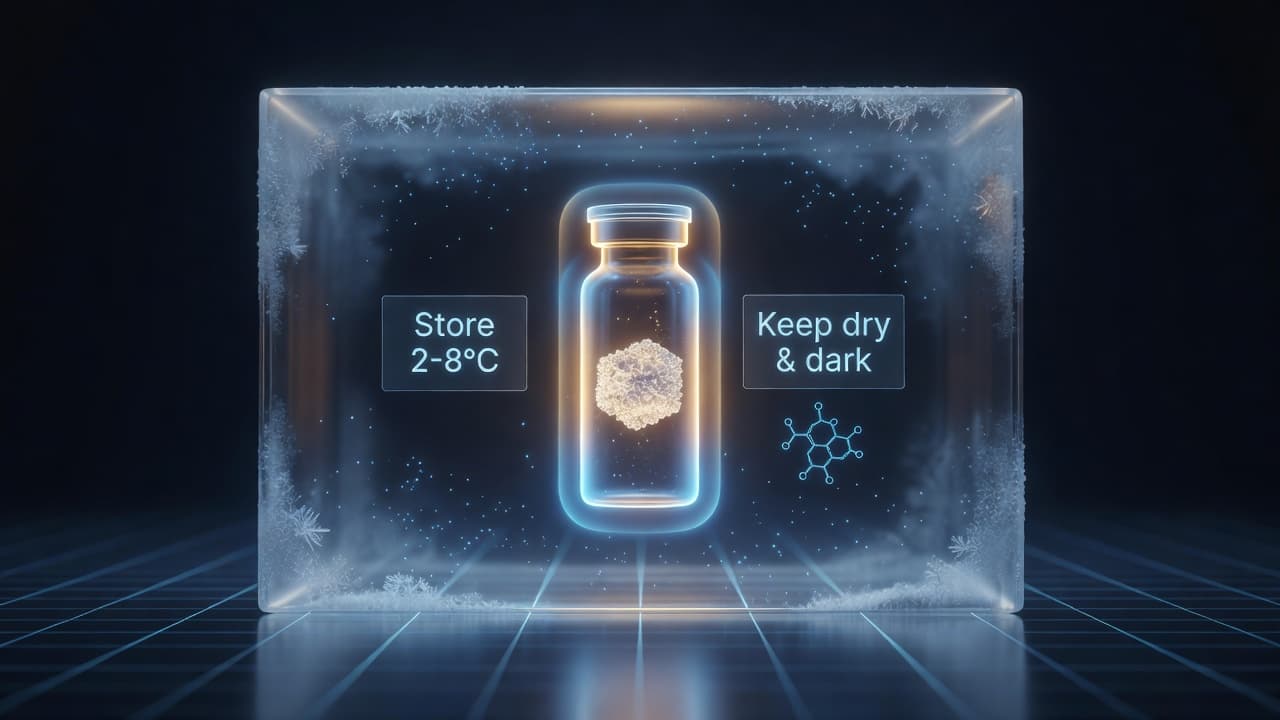
Storage Affects Sample Quality
A peptide left on the lab bench for an extended period is no longer stored under the same conditions as before. Heat, light, moisture, and microbial contamination can compromise chemical and physical stability. A clear, documented storage process is therefore worthwhile for reproducible results.
The basic rules are straightforward: store dry, protect from light, control temperature, and work aseptically during reconstitution. The specific formulation of each product always takes precedence.
Lyophilized Peptides: Generally the More Robust Form
Lyophilized peptides are generally more stable than reconstituted solutions. Low temperature, low humidity, and an intact primary packaging significantly reduce the risk of degradation processes.
Short-term storage
For material intended for near-term use, a cool, dry, light-protected storage location is appropriate. The specific temperature should be verified against the COA, datasheet, or manufacturer's information.
Medium-term storage
Many lyophilized peptides are stored refrigerated or frozen. Temperatures of 2-8 degrees Celsius or -20 degrees Celsius are frequently cited, depending on the product and intended storage duration.
Long-term storage
For sensitive materials or archival samples, deeper storage may be appropriate. Whether -80 degrees Celsius offers advantages depends on the peptide, formulation, and planned storage duration.
Allow to reach room temperature before opening
When removing a refrigerated or frozen vial from storage, allow it to reach room temperature before opening. This reduces condensation inside the vial and thereby minimizes moisture ingress.
Additional protection in practice
Keep stoppers and seals intact until use. Store vials protected from light wherever possible; amber glass or light-opaque outer packaging are suitable. A simple log with lot number, receipt date, storage location, and opening date facilitates traceability.
Reconstituted Peptides: Manufacturer Specifications Take Priority
After reconstitution, the risk of hydrolysis, oxidation, deamidation, aggregation, and microbial contamination increases. How quickly these processes become relevant depends on sequence, pH, excipients, concentration, container, and temperature profile.
Bacteriostatic water and sterile water are therefore not universal shelf-life specifications for reconstituted peptides. Pfizer's prescribing information for Bacteriostatic Water for Injection explicitly states that the choice of diluent, volume, and storage of the reconstituted drug must follow the manufacturer's instructions for the respective active substance. Furthermore, a reconstituted preparation should only be stored when the manufacturer explicitly provides for this.
Do not derive general timeframes from the diluent
Commonly cited figures such as "28 days in bacteriostatic water" or "48 hours in sterile water" cannot be transferred to peptides in general without further qualification. Only product-specific information from the label, COA, or manufacturer documentation is reliable.
Freezing only when explicitly cleared
Freezing reconstituted peptides is not a universal standard recommendation. Official prescribing information for some peptide and protein preparations explicitly states "do not freeze" after reconstitution. If a manufacturer does not explicitly authorize frozen storage, the solution should not be routinely frozen.
Reconstitute under aseptic conditions and document the peptide name, concentration, solvent, and reconstitution date directly on the vial. Refrigerated storage is often appropriate, but the same rule applies: product instructions take precedence over general rules of thumb. Unnecessary time at room temperature should be avoided.
Notes on Individual Peptides
Very specific shelf-life figures after reconstitution circulate for many research peptides. Without manufacturer documentation or reliable stability data, such time windows cannot be verified. For BPC-157, TB-500, GHK-Cu, or Retatrutide, fixed universal timeframes should therefore not be used unless explicitly stated in the COA or official product documentation.
Light-sensitive and oxidation-prone sequences
Peptides with sensitive residues such as tryptophan, tyrosine, methionine, or cysteine may react more strongly to light and oxidation. In such cases, light-protected storage, minimal air exposure, and the shortest possible handling time are particularly important.
Example from official prescribing information: Elamipretide
For the approved elamipretide product FORZINITY, the FDA label specifies storage at 2-8 degrees Celsius and "Do not freeze." After first opening, vials must be discarded within 8 days. This information is product-specific and should not be transferred to other peptides.
Typical Storage Errors
Leaving at room temperature too long
Even when brief handling times are often unavoidable in practice, vials should not remain outside their specified storage conditions longer than necessary. Depending on the formulation, degradation processes accelerate with rising temperature.
Multiple freeze-thaw cycles
Repeated freezing and thawing can promote aggregation and other physical changes. If a product may be frozen according to the manufacturer, small aliquots are usually preferable to repeatedly thawing the same complete vial.
Underestimating light and oxygen
Photochemical and oxidative damage is not always immediately visible. Particularly sensitive sequences should therefore routinely be handled protected from light and with minimal air exposure.
Microbial contamination is also a relevant risk. Improper multiple withdrawals, non-sterile accessories, or poorly disinfected stoppers can render a reconstituted solution unusable, even if it appears visually unremarkable. Aseptic technique and a clear discard rule are therefore important.
Receiving Shipments
Short transport times at ambient temperature may be acceptable for many lyophilized peptides, but general statements are unreliable here as well. Whether a shipping window is acceptable depends, among other things, on formulation, packaging, season, and actual temperature conditions during transport.
Inspect on arrival
Check vials immediately upon receipt for damage, moisture, and visible changes. The contents of lyophilized material should appear dry. If the product arrives notably warm, damaged, or with signs of condensation, manufacturer specifications and support should be consulted before using the material.
Sources and Context
- Pfizer Medical, "Bacteriostatic Water for Injection, USP": Reconstituted drugs must be used according to the manufacturer's instructions for the respective active substance and stored only when explicitly specified.
- FDA/AccessData, Herceptin Label: Example showing that reconstitution with different diluents can lead to different storage guidance and that reconstituted material should expressly not be frozen.
- FDA/AccessData, FORZINITY (Elamipretide) Label, 2025: Storage at 2-8 degrees Celsius, do not freeze, discard opened vials after 8 days.
- PubMed, "Solid-state chemical stability of proteins and peptides": Overview of temperature-, moisture-, and formulation-sensitive degradation pathways in solid form.
- PubMed, "The photodecomposition of tryptophan peptides": Example of photosensitivity in tryptophan-containing peptides.
- PMC, "Factors affecting the physical stability (aggregation) of peptide therapeutics": Overview of deamidation, oxidation, hydrolysis, and aggregation in peptide therapeutics.
USP-grade sterile water with 0.9% benzyl alcohol (near-neutral, pH 6.2 to 6.4) - the standard solvent for reconstituting lyophilized peptides. Essential accessory for any peptide research. Each vial is sealed and ready to use.
Hard zippered EVA case with 30 foam slots that keeps standard 1-3 ml peptide vials organized and protected for fridge storage or travel.
Frequently Asked Questions
The Short Version
Lyophilized peptides are generally easier to store than reconstituted solutions. For practical purposes, four points matter most: store dry, protected from light, under temperature control, and work aseptically. Once a peptide has been reconstituted, specific manufacturer documentation, the COA, and verified stability data should guide decisions - not general internet rules of thumb.
Research context for English-speaking buyers
Most of our English-speaking customers ship to the UK, Ireland, Malta or other English-as-second-language EU territories. The regulatory picture differs per country.
- Relevant authorities
- MHRA (UK, post-Brexit), HPRA (Ireland, EU-aligned), FDA Section 503A bulks list (US, restricted Cat 2 status of several peptides as of 2026)
- Customs and VAT
- EU shipments include 19% VAT; UK shipments after Brexit are now extra-EU and may attract UK VAT plus a handling fee at import
- Typical shipping window
- EU 2-4 working days, UK 4-7 working days, other international 7-14 working days, depending on customs
Research-grade peptides shipped from our EU warehouse are sold for laboratory use only and are not authorised for human or veterinary therapeutic application in any of the destination jurisdictions. US customers should be aware that the FDA Section 503A bulks list classification (and the April 2026 reclassification of twelve compounds) only governs compounding pharmacies, not direct-to-researcher imports for non-clinical work. UK buyers should declare the consignment on import and may be asked for a research justification by HMRC. We provide a CoA per batch identified by colour code rather than serial number; customs sometimes asks for this document when clearing the parcel.