GLP-1 Microdosing for Maintenance: The 0.05 mg Semaglutide Protocols Researchers Are Discussing
Microdose semaglutide for weight maintenance: 0.05 mg protocols, dosing intervals, reconstitution math. Research-only overview of the April 2026 trend.
Important Notice: This article is intended exclusively for scientific information and research purposes. All substances mentioned are not intended for human consumption. The content is not medical advice. No dosing recommendation is given. Always consult qualified professionals before using peptides.
First-ever triple-action weight management peptide targeting three receptors at once: GLP-1, GIP, and glucagon. Shown exceptional results in Phase 2 trials - up to 24% weight reduction. The most advanced metabolic peptide available.
A first-in-class dual GIP and GLP-1 receptor agonist, and one of the most extensively studied compounds in modern metabolic and weight-regulation research. Supplied as a lyophilised research peptide with a per-batch certificate of analysis, for laboratory and in-vitro use only.
Introduction: Why Microdosing Hit the Mainstream in April 2026
In April 2026 the term "GLP-1 microdosing" went from a niche research curiosity to mainstream coverage. Tufts Medicine published an explainer titled "Microdosing GLP-1s: Your Questions Answered" on its public health portal. Cleveland Clinic followed with a "Health Essentials" piece on the same topic. NewYork-Presbyterian and other major academic centres ran similar consumer-facing articles within the same fortnight. None of these institutions endorsed microdosing. All three flagged the same point: people who finished a course of semaglutide or tirzepatide are looking for a way to stay at their new weight without the cost, side effects and supply pressure of a full therapeutic dose, and they are doing it whether or not the literature has caught up.
The term "microdose" is borrowed loosely from psychedelic research and lacks an agreed clinical definition. In community discussions on r/Tirzepatide and r/Semaglutide it usually refers to weekly or biweekly doses one quarter to one tenth of the labeled maintenance dose. For semaglutide that means 0.05 mg to 0.25 mg, compared with the 1.7 mg or 2.4 mg licensed for chronic weight management. The interest is real, the data are sparse, and the practical questions are mostly about reconstitution math, dosing intervals and how to interpret an absent therapeutic signal. This article walks through the current evidence and the protocols being discussed, strictly as a research overview.
What Is GLP-1 Microdosing?
A microdose, in this context, is a dose of a GLP-1 receptor agonist that is well below the labeled therapeutic dose for either type 2 diabetes or chronic weight management. There is no consensus boundary. Tufts Medicine describes microdosing as "any dose below the FDA approved one." Cleveland Clinic notes that some users start at 0.05 mg semaglutide weekly, roughly one fifth of the standard 0.25 mg starter dose, while others stop ramping at 0.5 mg.
For orientation, the labeled regimens for semaglutide in obesity look like this:
- Dose
- 0.25 mg
- Frequency
- Weekly
- Dose
- 0.5 mg, 1.0 mg, 1.7 mg
- Frequency
- Weekly
- Dose
- 2.4 mg
- Frequency
- Weekly
Microdose protocols discussed in the community sit one to two log units below the maintenance dose:
- Dose
- 0.05 mg
- Frequency
- Every 7 to 14 days
- Dose
- 0.10 mg
- Frequency
- Every 7 to 10 days
- Dose
- 0.25 mg
- Frequency
- Every 7 to 14 days
These are not recommendations. They are the numbers most often quoted in user reports. None are taken from a published trial protocol.
For background on the molecule itself see Semaglutide: Science 2026 and the broader GLP-1 Agonists Compared.
Why People Are Doing It
The most cited motivation is post-loss maintenance. Phase 3 trials of semaglutide (STEP) and tirzepatide (SURMOUNT) consistently show weight regain within 12 months after discontinuation. The STEP 4 extension of semaglutide and the SURMOUNT-4 retreatment study both implied that ongoing exposure to a GLP-1 signal is what holds the weight off. People who have lost 15 to 25 percent of their body weight and do not want to regain it are looking for the smallest exposure that still produces a satiety signal.
Three other motivations come up repeatedly:
Side effect minimisation. Nausea, constipation and reflux are dose dependent. Users who tolerated 1.0 mg poorly often report that 0.10 to 0.25 mg is asymptomatic.
Cost and supply. A 5 mg semaglutide vial used at 0.10 mg per week lasts roughly a year. The same vial at 2.4 mg per week lasts two weeks. The economics of microdosing are a major part of the appeal, especially in 2026 when supply of branded semaglutide and tirzepatide remains tight.
Post cycle stability. Some users describe a "step down" from full therapeutic dosing during the last four to twelve weeks of a course, with the goal of arriving at a sustainable maintenance level rather than a hard stop.
For a comparison of the three leading molecules see Retatrutide vs. Tirzepatide vs. Semaglutide.
Typical Research Protocols Seen in Community Reports
The protocols below are summarised from public Reddit threads, forum posts and the explainers from Tufts Medicine, Cleveland Clinic and IvyRx. They are descriptive, not prescriptive. None come from a randomised trial.
Frequency: weekly, every 10 days, or every 14 days
Semaglutide has a half life of approximately 165 hours, roughly seven days. A weekly dose maintains a near steady state. Users running 0.05 to 0.10 mg weekly report a mild but consistent appetite signal. Some shift to every 10 or 14 days once they feel stable, on the rationale that they want intermittent reinforcement rather than continuous suppression. The pharmacokinetic case for biweekly dosing is weaker because plasma levels fall to roughly one quarter of peak by day 14.
Dose ramping in reverse
Users coming off a full therapeutic course often describe a stepwise reduction: from 2.4 mg to 1.7 mg, then 1.0 mg, then 0.5 mg, then 0.25 mg, then 0.10 mg, holding each step for two to four weeks. The aim is to identify the lowest dose at which appetite signal is preserved. This is sometimes called "finding your floor."
What Tufts and Cleveland Clinic actually say
Both institutions stop short of endorsing microdosing. Tufts Medicine notes that there is no clinical evidence that microdosing produces meaningful weight loss, that compounded versions sold for microdosing are not FDA reviewed, and that the practice is "not without risk." Cleveland Clinic frames the topic the same way: it is something patients are doing, the data do not yet exist, and any deviation from the label is between a patient and their physician. These articles are evidence of mainstream interest, not endorsements of a protocol.
What We Don't Know Yet
The honest answer is "almost everything." There are no completed randomised trials of a 0.05 mg or 0.10 mg semaglutide maintenance arm. The published Phase 3 programmes (STEP 1 to 8, SURMOUNT 1 to 5) studied the labeled doses against placebo, not microdoses against placebo or against full dosing. The closest analogue is the STEP 4 trial, which showed that continuing 2.4 mg sustained weight loss while switching to placebo led to regain. STEP 4 says nothing about whether 0.10 mg would have been enough.
Open questions include:
- The dose response curve of GLP-1 agonists below 0.25 mg is largely uncharacterised in humans.
- Whether intermittent dosing (every 14 days) preserves the central appetite effect or only the peripheral effects on gastric emptying is unknown.
- Long term safety at low chronic doses has not been studied separately. The Phase 3 safety database is at therapeutic doses.
- Compounded "microdose" products, often sold online in 2026, are not FDA reviewed and have shown variable potency in independent assays.
The conservative reading: microdose maintenance is a plausible hypothesis with no controlled evidence behind it.
Reconstitution and Storage for Microdose Research
The single most common practical question in community threads is how to draw 0.05 mg accurately from a 5 mg vial. The math is straightforward but the volumes are small and easy to get wrong.
Worked example with a 5 mg vial
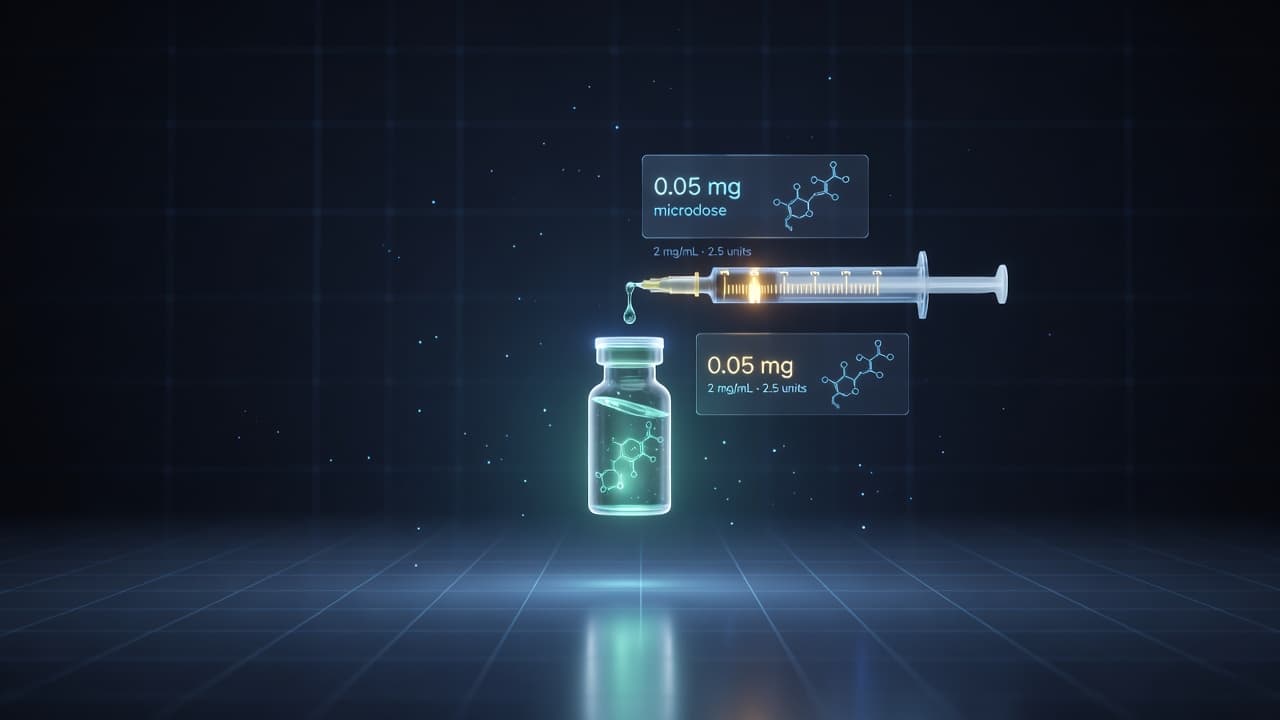
Reconstitute 5 mg of lyophilised semaglutide with 2.5 mL of bacteriostatic water. The vial now contains 5 mg / 2.5 mL = 2 mg/mL.
- Volume to draw
- 0.025 mL
- On a U-100 insulin syringe
- 2.5 units
- Volume to draw
- 0.050 mL
- On a U-100 insulin syringe
- 5 units
- Volume to draw
- 0.125 mL
- On a U-100 insulin syringe
- 12.5 units
- Volume to draw
- 0.250 mL
- On a U-100 insulin syringe
- 25 units
A U-100 insulin syringe has 100 units per millilitre. Each "unit" mark equals 0.01 mL.
If 2.5 units feels too small to read accurately, the alternative is to reconstitute with more bacteriostatic water. Reconstituting 5 mg with 5 mL gives 1 mg/mL, so a 0.05 mg dose becomes 0.05 mL or 5 units, which is easier to draw. The trade-off is a larger injected volume. For accurate microdose work the volume you can comfortably read on your syringe should drive the dilution, not the other way around.
For the underlying mechanics see BPC-157 Reconstitution Guide, which covers the same procedure in detail.
Storage of the reconstituted vial
Reconstituted semaglutide is generally stored refrigerated at 2 to 8 degrees Celsius. At microdose volumes a single vial may be in use for several months. Sterility, not chemical degradation, becomes the dominant concern. Bacteriostatic water (0.9 percent benzyl alcohol) is preferred over plain sterile water for that reason, and the rubber stopper should be wiped with isopropanol before each draw. See Peptide Storage Guide for shelf life data and temperature sensitivity.
Stack Considerations
A second pattern visible in 2026 community reports is the "microswitch": users alternating between a low dose of semaglutide and a low dose of tirzepatide on different weeks, on the theory that the GIP component of tirzepatide adds a different satiety axis. There is no published rationale for this. The pharmacokinetics of both molecules are similar enough that the practice is essentially intermittent dual agonism at low doses. For the mechanistic background see Tirzepatide: Science 2026.
A third stack discussed is microdose semaglutide alongside an oral appetite modulator or a non-incretin metabolic peptide. None of these combinations have been studied. The base rate for unexpected interactions in low-evidence stacks is high. Researchers planning combination protocols should treat them as exploratory.
Conclusion and Takeaways
Microdose GLP-1 maintenance is the loudest open question in metabolic peptide research in spring 2026. Mainstream coverage from Tufts Medicine, Cleveland Clinic and others marks it as a topic that the medical establishment can no longer ignore, but their explainers are not endorsements. The user-driven protocols centre on 0.05 mg to 0.25 mg semaglutide weekly or biweekly, derived empirically from the post-cycle experience of people who do not want to regain weight. The evidence base for these specific doses is essentially zero. The reconstitution math is the most reliable part of the discussion: a 5 mg vial reconstituted with 2.5 mL gives 2 mg/mL, and 0.05 mg is 2.5 units on a U-100 syringe.
Key points
- Microdose protocols use roughly 2 to 10 percent of the labeled maintenance dose
- Mainstream coverage in April 2026 reflects interest, not endorsement
- No randomised data exist for these dose ranges
- Reconstitution accuracy and sterility dominate the practical considerations
- Compounded microdose products are not FDA reviewed and vary in potency
For laboratory researchers, the gap between hypothesis and evidence here is large enough that any protocol design should explicitly state the absence of controlled data and prefer dose response work over fixed low-dose comparisons.
Further Reading
- Semaglutide: Science 2026
- Tirzepatide: Science 2026
- GLP-1 Agonists Compared
- Retatrutide vs. Tirzepatide vs. Semaglutide
- BPC-157 Reconstitution Guide
- Peptide Storage Guide
- GLP1R and GIPR Genetics: Why GLP-1 Works for Some and Not Others
- AI Reads 400,000 Reddit Posts: GLP-1 Side Effects Trials Missed
- Tirzepatide Cuts Post-PCI Mortality by 62% in T2D Patients (SCAI 2026)
Sources
-
Tufts Medicine. "Microdosing GLP-1s: Your Questions Answered." April 2026. https://www.tuftsmedicine.org/about-us/news/microdosing-glp-1s-your-questions-answered
-
Cleveland Clinic Health Essentials. "Microdosing GLP-1." April 2026. https://health.clevelandclinic.org/microdosing-glp-1
-
IvyRx. "GLP-1 Microdosing Schedule." 2026. https://www.ivyrx.com/blog/glp-1-microdosing-schedule
-
Rubino D, et al. "Effect of Continued Weekly Subcutaneous Semaglutide vs Placebo on Weight Loss Maintenance: STEP 4 Trial." JAMA. 2021;325(14):1414-1425.
-
Wilding JPH, et al. "Once-Weekly Semaglutide in Adults with Overweight or Obesity (STEP 1)." NEJM. 2021;384:989-1002.
-
Jastreboff AM, et al. "Tirzepatide Once Weekly for the Treatment of Obesity (SURMOUNT-1)." NEJM. 2022;387:205-216.
FAQ
Research context for English-speaking buyers
Most of our English-speaking customers ship to the UK, Ireland, Malta or other English-as-second-language EU territories. The regulatory picture differs per country.
- Relevant authorities
- MHRA (UK, post-Brexit), HPRA (Ireland, EU-aligned), FDA Section 503A bulks list (US, restricted Cat 2 status of several peptides as of 2026)
- Customs and VAT
- EU shipments include 19% VAT; UK shipments after Brexit are now extra-EU and may attract UK VAT plus a handling fee at import
- Typical shipping window
- EU 2-4 working days, UK 4-7 working days, other international 7-14 working days, depending on customs
Research-grade peptides shipped from our EU warehouse are sold for laboratory use only and are not authorised for human or veterinary therapeutic application in any of the destination jurisdictions. US customers should be aware that the FDA Section 503A bulks list classification (and the April 2026 reclassification of twelve compounds) only governs compounding pharmacies, not direct-to-researcher imports for non-clinical work. UK buyers should declare the consignment on import and may be asked for a research justification by HMRC. We provide a CoA per batch identified by colour code rather than serial number; customs sometimes asks for this document when clearing the parcel.