New Research: MOTS-c for the Liver, NMN for the Heart
Two preclinical studies from late February 2026 examine MOTS-c in a mouse model of acetaminophen-induced liver injury and NMN in a model of age-associated.
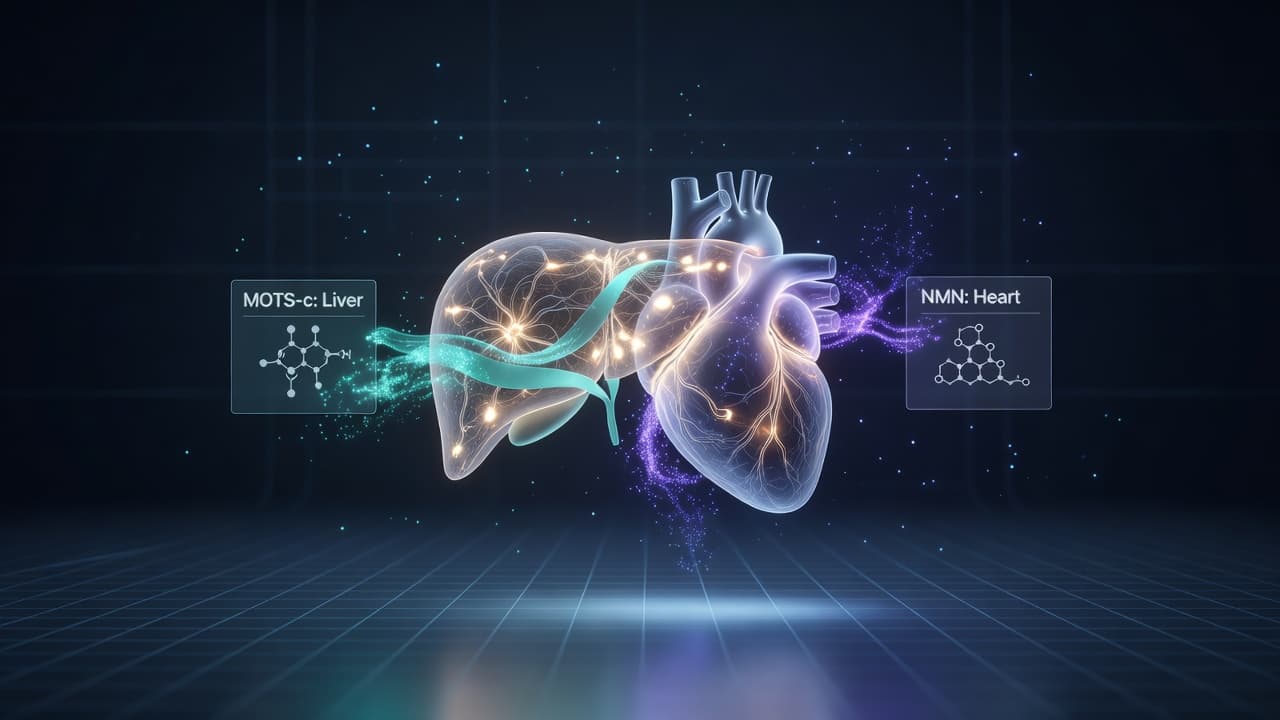
At the end of February 2026, two preclinical papers were published that illuminate different aspects of mitochondrial signaling pathways. One study examines MOTS-c in a mouse model of acetaminophen-induced liver injury. The other tests NMN (nicotinamide mononucleotide), an NAD+ precursor, in a model of age-associated cardiac damage under a high-fat diet.
Below are the key findings and how to interpret them.
Study 1: MOTS-c in Acetaminophen-Induced Liver Injury
Published in: Protein & Peptide Letters, 2026 Authors: Nan Li et al. PubMed: PMID 41764620
Acute acetaminophen overdose is a common cause of severe liver injury. In animal models, it leads to oxidative stress, inflammation, and cell death. The authors used an APAP model in C57BL/6 mice and tested whether MOTS-c could attenuate these injuries.
The paper reports several consistent signals:
- Lower endogenous MOTS-c levels in plasma and liver tissue during APAP-induced injury.
- More favorable liver markers after MOTS-c administration, including lower AST and ALT values and less histological damage.
- Less inflammation, measured by TNF-a, IL-1b, IL-6, COX-2, and macrophage infiltration among other markers.
- Less oxidative stress, including higher GSH levels and lower ROS signals.
- Involvement of the MAPK signaling pathway, as changes in ERK, JNK, and p38 were described.
The data thus support the interpretation that MOTS-c was associated with less liver injury in this mouse model. Whether and to what extent these observations translate to clinical situations in humans remains open.
Earlier work had already investigated MOTS-c in other liver contexts, such as NASH or hepatitis B-related models. This new study extends that literature to a model of acute drug-induced injury.
Study 2: NMN in Cardiac Damage in Aging Mice Under a High-Fat Diet
Published in: The Journal of Nutrition, 2026 Authors: Wen Xin et al. PubMed: PMID 41763569
The second paper deals not with NAD+ itself, but with NMN as an NAD+ precursor. A mouse model was studied in which older animals received a high-fat diet over an extended period. One group received NMN in drinking water at a dose of 400 mg/kg for seven months. The authors also conducted cell culture experiments with H9c2 cardiomyocytes and palmitic acid.
The focus was on structural cardiac changes and markers of senescence, inflammation, apoptosis, and mitophagy. Results reported include the following:
- Less cardiac fibrosis and a lower heart index compared to the untreated HFD group.
- Lower senescence markers, including P16, P21, b-galactosidase, and several SASP-associated factors.
- Reduced inflammation and apoptosis markers, including IL-1b, TNF-a, Bax/Bcl-2, and cleaved caspase-3.
- Changes in the Sirt3/PINK1/Parkin mitophagy axis as well as other autophagy and lysosome markers such as LC3, TFEB, and p62.
- Similar direction in cell culture, where NMN treatment was associated with less signs of damage.
These findings support a cardioprotective effect of NMN in this specific mouse model. The study shows marker changes and tissue findings, not a directly measured "slowed aging process" of the heart.
The long treatment duration also does not automatically make this work translational. It primarily provides hints about which signaling pathways may be affected in an animal model under metabolic stress.
Assessment
The two papers deal with different substances and different organ systems, but have a common thread: in both cases, mitochondrial stress responses and quality control are at the center of the analysis. In the case of MOTS-c, it concerns a mitochondrially derived peptide with effects on inflammation and stress signals. In the case of NMN, the role of an NAD+ precursor in connection with senescence and mitophagy markers is in the foreground.
Both studies are preclinical. They provide useful hypotheses for further research but do not replace human studies and do not constitute therapeutic claims.
For research on mitochondrial peptides, MOTS-c is available on peptidesdirect.io.
Frequently Asked Questions
This article is for informational and educational purposes only. The studies discussed are preclinical (animal and cell models) and do not constitute evidence of efficacy in humans. Nothing in this article should be interpreted as medical advice, a health claim, or a recommendation of a compound for the treatment, prevention, or cure of any disease. All products mentioned are sold exclusively for research purposes.
Research context for English-speaking buyers
Most of our English-speaking customers ship to the UK, Ireland, Malta or other English-as-second-language EU territories. The regulatory picture differs per country.
- Relevant authorities
- MHRA (UK, post-Brexit), HPRA (Ireland, EU-aligned), FDA Section 503A bulks list (US, restricted Cat 2 status of several peptides as of 2026)
- Customs and VAT
- EU shipments include 19% VAT; UK shipments after Brexit are now extra-EU and may attract UK VAT plus a handling fee at import
- Typical shipping window
- EU 2-4 working days, UK 4-7 working days, other international 7-14 working days, depending on customs
Research-grade peptides shipped from our EU warehouse are sold for laboratory use only and are not authorised for human or veterinary therapeutic application in any of the destination jurisdictions. US customers should be aware that the FDA Section 503A bulks list classification (and the April 2026 reclassification of twelve compounds) only governs compounding pharmacies, not direct-to-researcher imports for non-clinical work. UK buyers should declare the consignment on import and may be asked for a research justification by HMRC. We provide a CoA per batch identified by colour code rather than serial number; customs sometimes asks for this document when clearing the parcel.