Peptide Accessories: Bacteriostatic Water, Syringes & Needles
Everything for peptide research: Bacteriostatic Water for reconstitution, syringes, needles, and accessories. Guide to proper peptide reconstitution.
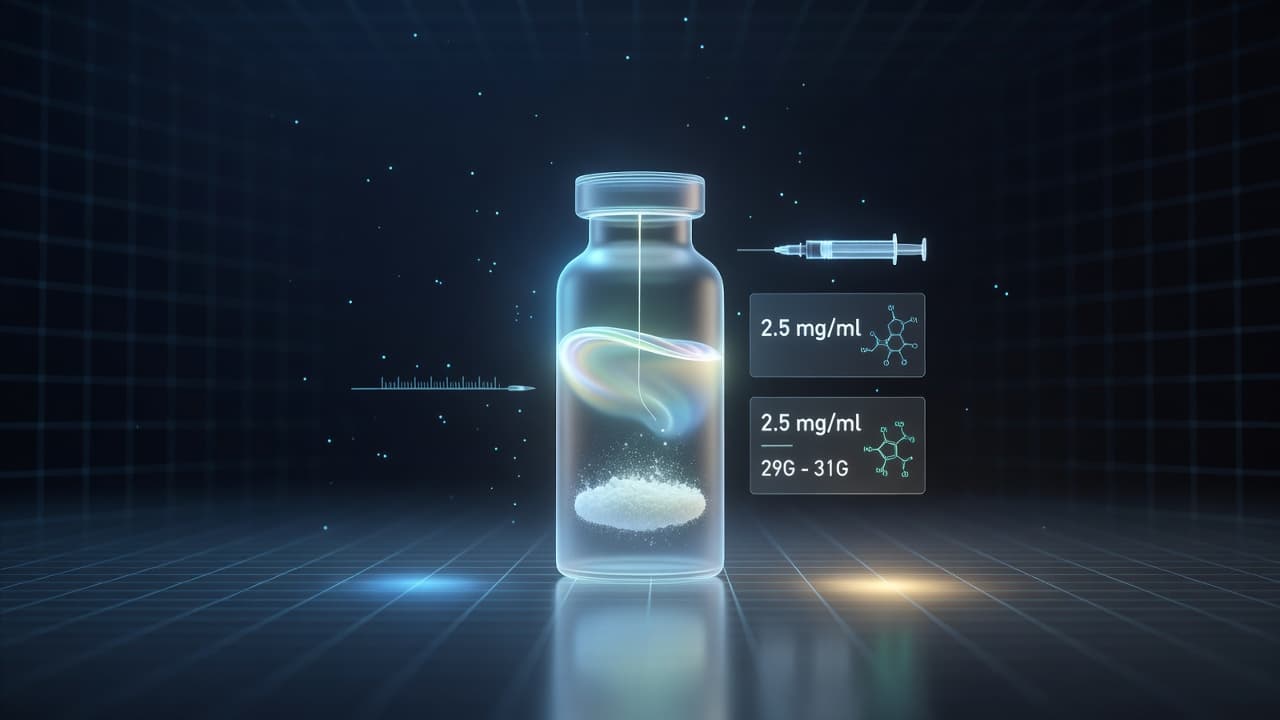
Peptide reconstitution depends on the right accessories: bacteriostatic water, syringes, needles, alcohol swabs, and clean storage conditions. This guide explains what each item does and where handling rules differ between bacteriostatic water, sterile water for injection, and saline.
Bacteriostatic Water for Multi-Dose Handling
USP-grade sterile water with 0.9% benzyl alcohol (near-neutral, pH 6.2 to 6.4) - the standard solvent for reconstituting lyophilized peptides. Essential accessory for any peptide research. Each vial is sealed and ready to use.
Bacteriostatic Water is sterile water with benzyl alcohol added as a preservative. Depending on the labeled product, the concentration may differ, for example 0.9% or 1.1%. The preservative suppresses microbial growth and is the key difference compared with preservative-free sterile water for injection (WFI). In practice, bacteriostatic water is used when repeated withdrawals from the same vial are needed and aseptic technique is maintained. Preservative-free sterile water is generally handled as a single-dose product, so any remainder is discarded after first entry.
Lyophilized, or freeze-dried, peptides must be dissolved before use. This process is called reconstitution, and bacteriostatic water is commonly used for multi-dose handling.
Comparison of Solvents
Bacteriostatic Water is sterile, contains benzyl alcohol as a preservative, and is intended for repeated withdrawals from a multi-dose vial when handled correctly. It is commonly used for peptide reconstitution, but the stability of the reconstituted peptide still depends on the specific substance and formulation.
Sterile Water (WFI) is also sterile but contains no preservative. It is generally treated as single-dose water for injection: after first use, any remainder is discarded. That does not mean the water becomes chemically unusable immediately, but it is not intended for repeated withdrawals.
NaCl 0.9% is sterile but has neither preservative nor multi-dose handling advantages. Some peptide formulations tolerate saline, while others are better reconstituted with sterile water. Compatibility should be checked for the specific peptide rather than assumed in general.
Recommendation
For projects that require repeated withdrawals from the same vial, Bacteriostatic Water is usually the practical choice. For single-use reconstitution, preservative-free sterile water may also be appropriate.
Reconstituting Peptides: Step by Step
Reconstitution is straightforward, but concentration errors and poor sterile technique can compromise the sample. A consistent process matters more than speed.
Preparation
Disinfect the work surface, wash hands or put on nitrile gloves, lay out all materials within reach. You need the peptide vial, BacWater, an insulin syringe, and alcohol swabs.
Disinfection
Wipe the rubber stoppers of both vials, peptide and BacWater, with an alcohol swab and let them dry for 30 seconds before puncturing.
Draw Up Water
Draw up the calculated amount of BacWater with the syringe. The required volume depends on the target concentration, the peptide amount in the vial, and the protocol being followed.
Reconstitution
Insert the needle through the stopper of the peptide vial and let the water run slowly down the inner wall. Do not spray directly onto the powder. Then gently swirl the vial instead of shaking it. Dissolution time varies by peptide and concentration.
Storage
Reconstituted peptides are often stored in the refrigerator (2-8 degrees Celsius), standing upright and protected from light. Actual stability depends on the peptide, concentration, and solvent, so do not assume a universal 28-day window.
Do Not Shake!
Avoid spraying the water directly onto the powder and avoid vigorous shaking. A slower flow down the inner wall plus gentle swirling is a common precaution to reduce foaming and rough handling during reconstitution.
Calculating Concentration
The formula is simple: Peptide amount (mg) divided by water volume (ml) equals the concentration (mg/ml).
An example: 5 mg BPC-157, dissolved in 2 ml BacWater, yields 2.5 mg/ml. In 0.1 ml of this solution, there are 250 micrograms.
Further common scenarios: 5 mg in 1 ml yields 5 mg/ml, meaning 500 micrograms per 0.1 ml. At 10 mg in 2 ml, you also get 5 mg/ml. With 40 mg in 2 ml, the concentration is 20 mg/ml, which equals 2 mg per 0.1 ml. At 50 mg in 2 ml, it is 25 mg/ml, meaning 2.5 mg per 0.1 ml.
Syringes and Needles
Two common setups are used for measuring peptide solutions.
Insulin syringes are widely used for small-volume dosing. Common sizes are 0.5 ml and 1 ml, usually with a permanently attached needle in the 29G to 31G range. On a 1 ml U-100 insulin syringe, 100 IU equals 1 ml, so each IU corresponds to 0.01 ml. Smaller syringe sizes use different total-unit scales, so always read the barrel marking before calculating volume.
Luer-lock syringes with separate needles offer more flexibility. A thicker 21G needle is often used to draw solution from the vial. For subcutaneous application, you then switch to a finer 27G to 30G needle. This setup adds steps but avoids using a dulled drawing needle for injection.
Needle Sizes at a Glance
18G (1.27 mm diameter) - only useful for drawing up viscous solutions, too thick for injections.
21G (0.81 mm) - a common drawing needle size. Solution can be drawn relatively quickly from the vial with this.
25G (0.51 mm) - suitable for intramuscular applications.
27G (0.41 mm) - commonly used for subcutaneous application.
29G (0.34 mm) - the typical insulin needle size, good for subcutaneous use.
30G (0.31 mm) - even finer and commonly used for subcutaneous dosing.
31G (0.26 mm) - one of the finer commonly used needle sizes. It may be more comfortable for subcutaneous use, but drawing up can take longer.
Storage and Hygiene
Proper Storage Is Essential
Proper storage determines the shelf life of peptides. Reconstituted peptides are commonly refrigerated at 2-8 degrees Celsius when the peptide documentation allows it. Opened Bacteriostatic Water is typically stored at controlled room temperature, 20-25 degrees Celsius, according to product labeling, and multi-dose vials are commonly discarded 28 days after first entry unless the manufacturer states otherwise. Lyophilized peptides that have not yet been reconstituted are commonly stored frozen for longer-term stability.
As a general rule, peptides should be stored protected from light, ideally in the original packaging or another light-blocking container.
Essential hygiene supplies include alcohol swabs with 70% isopropanol, nitrile gloves, and a sharps container for used needles.
What You Actually Need
If you are just starting with peptide research, the basic setup is Bacteriostatic Water, insulin syringes or another suitable syringe format, alcohol swabs, and disposable gloves.
More experienced users often add Luer-lock syringes with separate needles in different gauges, a sharps container, and a dosing table for reference.
Always Order Together
If a peptide requires reconstitution, order Bacteriostatic Water or another appropriate sterile solvent at the same time so the workflow is complete.
Frequently Asked Questions
Research context for English-speaking buyers
Most of our English-speaking customers ship to the UK, Ireland, Malta or other English-as-second-language EU territories. The regulatory picture differs per country.
- Relevant authorities
- MHRA (UK, post-Brexit), HPRA (Ireland, EU-aligned), FDA Section 503A bulks list (US, restricted Cat 2 status of several peptides as of 2026)
- Customs and VAT
- EU shipments include VAT, the rate depends on the destination country; UK shipments after Brexit are now extra-EU and may attract UK VAT plus a handling fee at import
- Typical shipping window
- EU 2-4 working days, UK 4-7 working days, other international 7-14 working days, depending on customs
Research-grade peptides shipped from our EU warehouse are sold for laboratory use only and are not authorised for human or veterinary therapeutic application in any of the destination jurisdictions. US customers should be aware that the FDA Section 503A bulks list classification (and the April 2026 reclassification of twelve compounds) only governs compounding pharmacies, not direct-to-researcher imports for non-clinical work. UK buyers should declare the consignment on import and may be asked for a research justification by HMRC. We provide a CoA per batch identified by colour code rather than serial number; customs sometimes asks for this document when clearing the parcel.