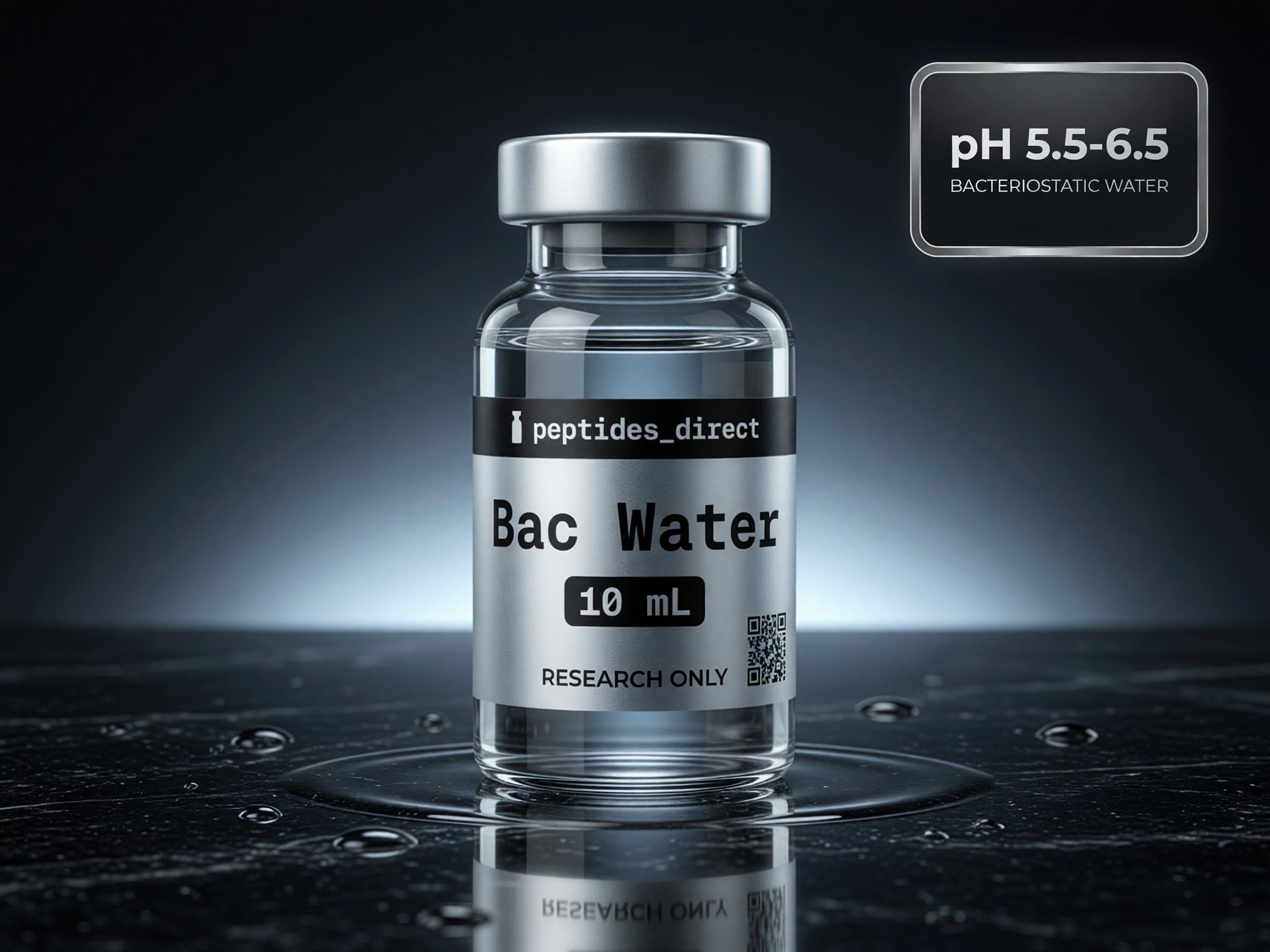
Bacteriostatic Water
USP-grade sterile water with 0.9% benzyl alcohol (near-neutral, pH 6.2 to 6.4) - the standard solvent for reconstituting lyophilized peptides. Essential accessory for any peptide research. Each vial is sealed and ready to use.
5.04 reviews€19.99
For Research Use Only
This product is sold strictly for in-vitro research and laboratory use. Not intended for human consumption or any in-vivo application.
Max. 3 per order
Payment Methods
0.9% benzyl alcohol
Sterile water plus 9 mg/mL benzyl alcohol, the USP-monograph concentration that suppresses microbial growth between withdrawals.
Multi-puncture vial, 28 days
The bacteriostatic preservative keeps the vial usable for up to 28 days after the first needle puncture under proper storage.
USP-grade sterility
Manufactured to USP Bacteriostatic Water for Injection specifications: sterile, non-pyrogenic, pH 4.5 to 7.0.
For lyophilized peptide reconstitution
The standard solvent in published peptide protocols. Dissolves freeze-dried research peptides cleanly without altering their structure.
Cold-chain shipped
Dispatched from EU stock with insulated packaging so the vial arrives intact and ready for laboratory use.
Research areas
What is bacteriostatic water
Bacteriostatic water is not a peptide. It is a solvent: sterile water with 0.9% benzyl alcohol added as a preservative. The benzyl alcohol does not kill bacteria outright, but it blocks them from multiplying, which is exactly what a multi-dose vial needs.
The key difference vs sterile water for injection: sterile water is single-use. Once the seal is broken, the vial must be discarded. Bacteriostatic water can be punctured repeatedly and reused for up to 28 days, because the preservative keeps the contents stable between withdrawals. That makes it the practical choice for laboratories working with lyophilized peptides, where each vial is reconstituted and then sampled in small fractions over several weeks.
How the preservative works
Benzyl alcohol is lipophilic. At 0.9% it embeds into bacterial cell membranes and disrupts membrane-bound proteins, halting cell division without killing existing organisms. This is why it is called bacteriostatic rather than bactericidal. The 0.9% concentration is the USP-monograph minimum that holds the 28-day window. Lower concentrations lose protection faster; higher concentrations risk cytotoxicity in cell-culture applications.
How to use
Used as a solvent for lyophilized peptide reconstitution in research workflows. The standard procedure is to draw the chosen volume into a syringe, inject it slowly down the side of the peptide vial, and let the powder dissolve without shaking. The reconstituted peptide is then stored according to its own protocol, while the bacteriostatic water vial can be returned to refrigeration for the next withdrawal.
Often studied alongside
Most lyophilized research peptides are reconstituted with bacteriostatic water as the default solvent in published protocols.
Healing-research peptide reconstituted with bacteriostatic water
Gastric pentadecapeptide (15 amino acids) known for exceptional tissue repair properties. Promotes wound healing, angiogenesis, and cytoprotection across tendons, muscles, gut, and nerves. Over 30 years of preclinical research.
Copper-peptide reconstituted with bacteriostatic water
Naturally occurring copper tripeptide complex for skin regeneration and anti-aging research. Stimulates collagen synthesis, accelerates wound healing, and modulates 4000+ genes. Plasma levels decline with age, making it a key target in longevity research.
Multi-peptide blend reconstituted with bacteriostatic water
4-in-1 anti-aging peptide blend: GHK-Cu 50mg + BPC-157 10mg + TB-500 10mg + KPV 10mg. Targets collagen synthesis, tissue regeneration, skin repair, and anti-inflammatory pathways.
Documentation
Material specification
Composition
Standard
Form
pH
Storage (sealed)
Storage (after first puncture)
CoA
Reference standards
No direct PubMed studies are required for bacteriostatic water itself. The relevant references are the USP monograph for Bacteriostatic Water for Injection and the FDA monograph for benzyl alcohol as a preservative. Both define the 0.9% concentration, the pH range of 4.5 to 7.0, and the 28-day post-puncture window used here.
Research use only
This material is sold strictly for in-vitro research and laboratory use. Not intended for human or animal consumption, medical, cosmetic, or household applications. Suitable only for professional laboratory environments.
Water quality matters
The pH and purity of the water directly affect whether a peptide dissolves cleanly or turns cloudy. This bacteriostatic water is USP grade and preserved with 0.9% benzyl alcohol for multiple draws. We have the pH confirmed by the manufacturer in the batch certificate and measure it ourselves again on every incoming delivery: we only sell what falls inside the USP range of 4.5 to 7.0. Store it at controlled room temperature of 20 to 25 degrees Celsius, dark and dry, do not freeze it and do not refrigerate it; only the finished reconstituted peptide belongs in the fridge. After opening, use it within the shelf life stated on the label and check that it looks clear before each use: do not use water that is cloudy, discolored, or has visible particles.
Reviews
AnonymousA coupon from our review program was granted for this review. 🇩🇪 · August 24, 2026
SvenA coupon from our review program was granted for this review. 🇩🇪 · August 23, 2026
Maria D.A coupon from our review program was granted for this review. 🇷🇴 · August 16, 2026
Top
AnonymousA coupon from our review program was granted for this review. 🇩🇪 · August 14, 2026
* Reviewer received a 5% thank-you coupon from our review program, independent of the rating.
Only customers who ordered the product from us can leave a review; we verify this automatically against the order number. Every review submitted is published, regardless of star rating. Rewarded reviews from our coupon program are individually labelled.