Why the Certificate of Analysis Matters, and What We Now Test Ourselves at Liquilabs
What a Certificate of Analysis really tells you, the difference between a manufacturer CoA and an independent test, and the full safety panel we now run at Liquilabs.
A research peptide is only as good as the evidence behind it. The single most important document for that is the Certificate of Analysis (CoA), the lab report for a specific batch. But not every CoA says the same thing, and most cover less than buyers assume. This article explains what a CoA actually proves, where its limits lie, the independent third-party tests some of our batches already carry beyond that, and what we have recently started commissioning ourselves on top: an independent test at Liquilabs in Czechia, verifiable online.
TL;DR: What this is about
Manufacturer CoA: typically proves identity and purity (HPLC) of the tested batch.
What HPLC purity is NOT: it measures organic impurities, not the actual peptide content, no heavy metals, no endotoxin, no microbiology.
Independent third-party layer: a number of our batches also carry a report from an independent third-party lab such as BT Labs, commissioned by our supplier or the wider research community, not by the manufacturer.
Our step: for selected products we go further and commission a full safety panel ourselves at Liquilabs (Czechia), including heavy metals (ICP-MS), endotoxin (LAL) and microbiology, verifiable online.
Status: the Liquilabs panel is rolling out batch by batch, starting with three products. Not every product has one yet.
What a Certificate of Analysis is
A CoA is the lab report for one specific production batch. In the peptide field it usually comes from an independent testing lab such as Janoshik Analytical and reports two key figures:
- Identity: Is the molecule actually the stated peptide? Confirmed by mass spectrometry and retention time.
- Purity: What share of the material is the target peptide versus organic byproducts? Measured by HPLC, given as a percentage.
The CoA is batch specific. A purity figure from one batch says nothing about another. That is why we publish the CoA with batch number and test date on every product page, and recently with a one-click verify link straight to the lab.
The catch: HPLC purity is not everything
A high HPLC purity sounds reassuring, but it only answers part of the question. Three common misunderstandings:
- Purity is not content. 99 percent purity means: of whatever is present in the vial as peptide, 99 percent is the target molecule. It does not tell you how many milligrams are actually in there. A separate assay (content) measures that.
- Purity is not safety. HPLC sees organic impurities. It does not see heavy metals, bacterial endotoxin or microbial contamination.
- A manufacturer CoA is not commissioned by us. It comes through the manufacturer's supply chain. We publish it transparently, but we did not commission it ourselves.
Important: purity is only one dimension
An HPLC purity of 99 percent is a good sign, but not the full picture. It reflects organic impurities, not the peptide content and not contaminants such as heavy metals or endotoxin. A complete picture needs several mutually independent tests.
Three layers of testing, full transparency
We deliberately rely on three clearly separated layers:
- Manufacturer third-party CoA (Janoshik): comes with every batch, covers identity and purity, verifiable online. This is the industry standard, and we keep it.
- Independent third-party lab tests: a number of batches also carry a report from an independent lab such as BT Labs, commissioned by our supplier or the wider research community, not by the manufacturer. We publish these unchanged, and they carry the full weight of an outside, disinterested lab.
- Our own commissioned test (Liquilabs): for selected batches we go a step further and become the client ourselves, sending the sample to a separate EU lab for a full safety panel. The results can be checked online on the lab's server.
Why this matters in the EU
The gray peptide market runs on claims without evidence. Our approach is the opposite: every batch carries a manufacturer CoA, a number of batches carry an additional independent third-party test, and for selected products we commission a full safety panel ourselves at Liquilabs, all verifiable online. You do not have to take our word for it, you can check it.
The independent third-party layer
A number of our batches carry a second report beyond the manufacturer's own Janoshik CoA: a test from an independent third-party lab such as BT Labs, commissioned by our supplier or by the wider peptide research community, not by the manufacturer and not by us. That report still stands as independent testing. No one in that batch's own supply chain paid the lab to look the other way, and the lab has no stake in what the result shows.
We list these reports on our Reports page under their own "Independent" badge, kept separate from the plain manufacturer tier and from the Liquilabs tests where we are the client. If you see this badge on a batch, read it for what it is: an outside lab's independent check, commissioned by someone other than us.
What Liquilabs tests for us
Liquilabs is an independent lab in Czechia. There we commission a full safety panel for selected batches, going well beyond identity and purity.
The panel in detail
Identity: UHPLC plus orthogonal LCMS confirmation.
Purity and content: UHPLC, in percent and in milligrams.
Microbiology: total viable count and yeasts/molds per USP <61> / Eur. Ph. 2.6.12.
Endotoxin: bacterial endotoxin (LAL) per USP <85>, given in EU/mg.
Heavy metals: arsenic, cadmium, mercury, lead and others by ICP-MS per USP <232> / Ph. Eur.
The first results are in and published on our Reports page. For the first three batches the safety panel was clean throughout: high purity, no microbial growth, endotoxin below 0.001 EU/mg and no detectable heavy metals.
Products we have already tested ourselves
The first independent Liquilabs reports are available for these products. Each report can be checked via the verify link on the product page and on the Reports page.
3-in-1 skin peptide blend: GHK-Cu 50mg + BPC-157 10mg + TB-500 10mg. Targets collagen synthesis, tissue regeneration, and skin repair for comprehensive dermatological research.
2-in-1 growth hormone blend: CJC-1295 no-DAC (Modified GRF 1-29, 5 mg) + Ipamorelin (5 mg) combined in one vial. The CJC-1295 component is the short-acting no-DAC variant (about 30 minute half-life), not the long-acting DAC form. Stimulates natural GH release through two different pathways for amplified, more physiological growth hormone pulses.
A first-in-class dual GIP and GLP-1 receptor agonist, and one of the most extensively studied compounds in modern metabolic and weight-regulation research. Supplied as a lyophilised research peptide with a per-batch certificate of analysis, for laboratory and in-vitro use only.
How to read and verify a CoA yourself
Match the batch
Check that the batch number or color code on the vial matches the CoA on the product page. The CoA only ever applies to exactly that batch.
Identity first
Look for the identity confirmation (mass spectrometry, retention time). Without confirmed identity, a purity figure is meaningless.
Purity in context
Read the HPLC purity as a measure of organic impurities, not as content and not as safety.
Verify online
Use the verify link to open the report directly on the lab's server. A result that cannot be checked externally remains a claim.
Look for the full panel
For maximum information value, look for microbiology, endotoxin and heavy metals, not just a purity figure.
A real example: a Liquilabs report in detail
So the five steps above are not just theory: here is a real, independently verifiable Liquilabs report in detail, batch LYO-0259 (Tirzepatide). This product is currently sold out in the shop, but the report works well as a teaching example because both the chromatogram and the mass spectrum are shown in full.
Purity: the area under the peak
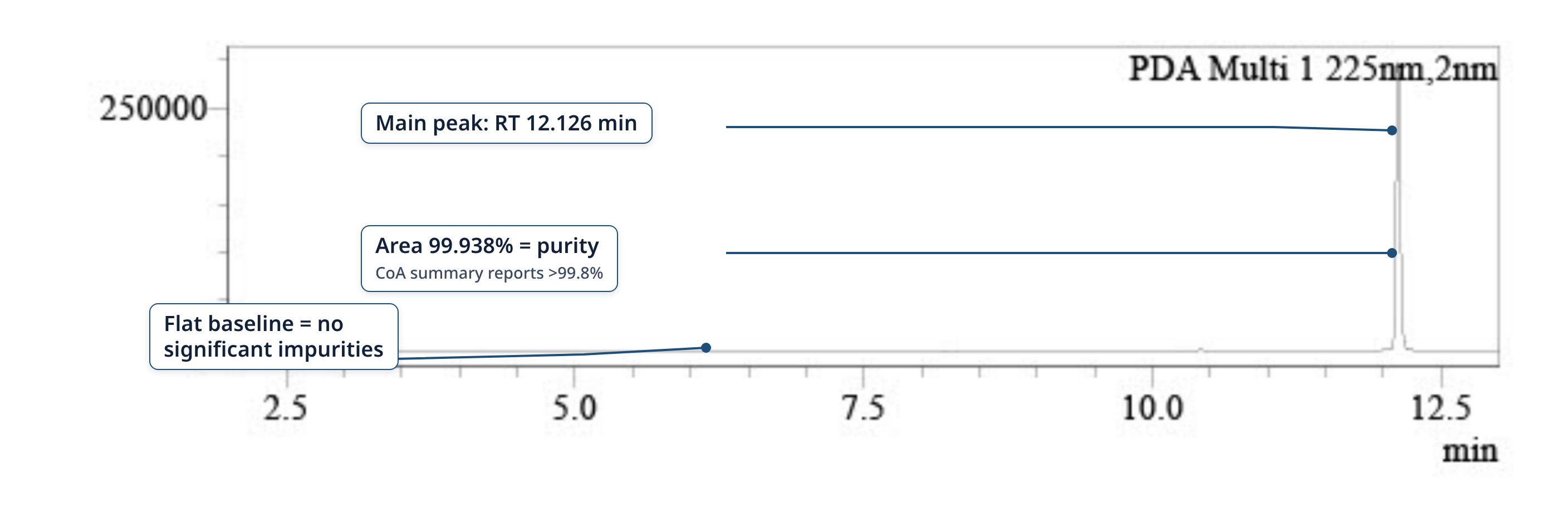
UHPLC-UV chromatogram (PDA Multi 1, 225 nm) from the Liquilabs report for batch LYO-0259. The main peak sits at retention time 12.126 minutes with an area of 99.938 percent, that is the measured purity. The CoA summary rounds this to ">99.8%". The flat baseline shows no notable impurities. Verify this report live
Worth noting when reading this: the area under the peak (Area%) is a purity measure relative to all peaks captured in the chromatogram, not a mass content in milligrams. How much peptide is actually in the vial is established by a separate content assay, not by the chromatogram.
Identity: the mass spectrum as a second, independent test
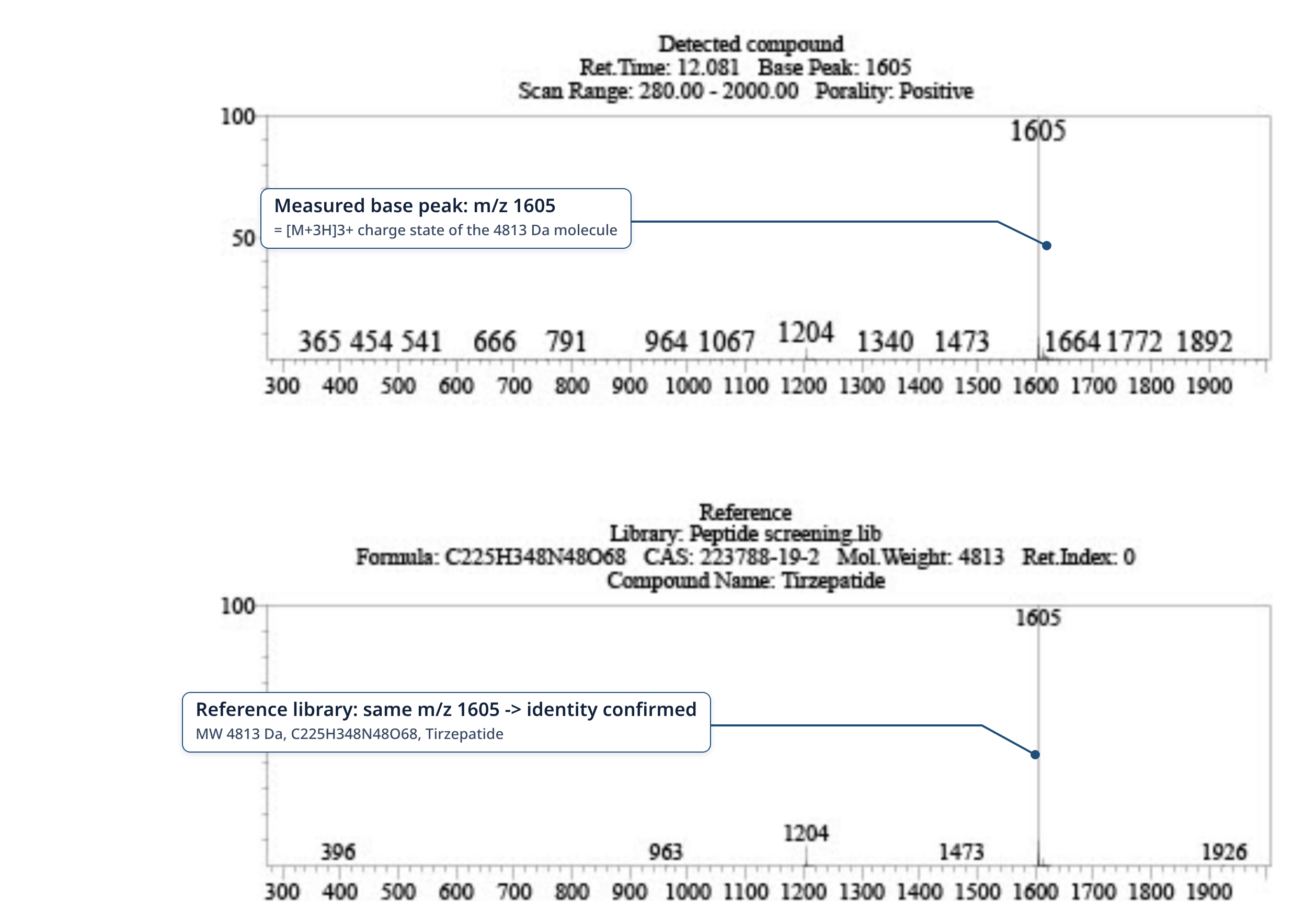
UHPLC-MS (TIC, positive mode) from the same report. On top, the measured compound with a base peak at m/z 1605, the triply protonated [M+3H]3+ ion of the 4813-dalton molecule. Below it, the reference spectrum from the library, also with a base peak at m/z 1605: identity confirmed. Molecular weight 4813 Da, formula C225H348N48O68. Verify this report live
Identity and purity are two independent measurements. A chromatogram alone does not prove identity, and a mass spectrum alone does not prove purity. A complete report needs both, ideally supplemented with content, microbiology, endotoxin and heavy metals, as described in the previous section.
Red flags when reading a CoA
Not every CoA delivers what it promises. These points should make you pause:
- Purity without a chromatogram is just a claim. A purity percentage without the underlying chromatogram cannot be verified.
- MS identity is not purity, and purity is not mass or IU content. These are three independent measurements that should be reported separately.
- Batch number and test date must be present. Without a batch number and date, a result cannot be tied to a specific vial.
- A verify link that actually resolves. A screenshot or a PDF with no source on the lab's own server is not verification.
- Area% is not mass content. The peak area in the chromatogram measures purity relative to other peaks, not a milligram amount.
- Be wary of +/-0.1 percent purity claims next to a 5 ppm MS tolerance. A purity figure quoted to one decimal place looks more precise than the underlying mass determination (typically accurate to only around 5 ppm) actually supports.
Limits, stated honestly
We are rolling out our own Liquilabs testing batch by batch. Not every product and not every batch has a Liquilabs panel yet, and the golden verify badge only appears for the batches Liquilabs has actually tested for us. Independent third-party tests from other labs, where they exist, carry their own separate badge. None of the labs involved (Janoshik, Liquilabs, and any third-party labs such as BT Labs) are ISO 17025 accredited. All products are intended exclusively for laboratory research, not for human or veterinary use.
Bottom line
A CoA is the foundation, but a single HPLC purity result is only a snapshot. Identity, content, microbiology, endotoxin and heavy metals together are what form the complete picture. That is exactly why we treat this as three layers: the manufacturer CoA on every batch, independent third-party tests already carried by a number of batches, and our own Liquilabs panels for selected products, rolled out further batch by batch, all verifiable online. You can find the current status and all reports on our Reports page.
For laboratory research only. Not for human or veterinary use. This article is not medical advice.
Research context for English-speaking buyers
Most of our English-speaking customers ship to the UK, Ireland, Malta or other English-as-second-language EU territories. The regulatory picture differs per country.
- Relevant authorities
- MHRA (UK, post-Brexit), HPRA (Ireland, EU-aligned), FDA Section 503A bulks list (US, restricted Cat 2 status of several peptides as of 2026)
- Customs and VAT
- EU shipments include 19% VAT; UK shipments after Brexit are now extra-EU and may attract UK VAT plus a handling fee at import
- Typical shipping window
- EU 2-4 working days, UK 4-7 working days, other international 7-14 working days, depending on customs
Research-grade peptides shipped from our EU warehouse are sold for laboratory use only and are not authorised for human or veterinary therapeutic application in any of the destination jurisdictions. US customers should be aware that the FDA Section 503A bulks list classification (and the April 2026 reclassification of twelve compounds) only governs compounding pharmacies, not direct-to-researcher imports for non-clinical work. UK buyers should declare the consignment on import and may be asked for a research justification by HMRC. We provide a CoA per batch identified by colour code rather than serial number; customs sometimes asks for this document when clearing the parcel.