Epitalon vs Thymalin: Telomere and Immune Peptide Research Compared
Epitalon and Thymalin compared: telomerase-related cell research vs thymic immune peptide research, with study context, limitations, and key differences.
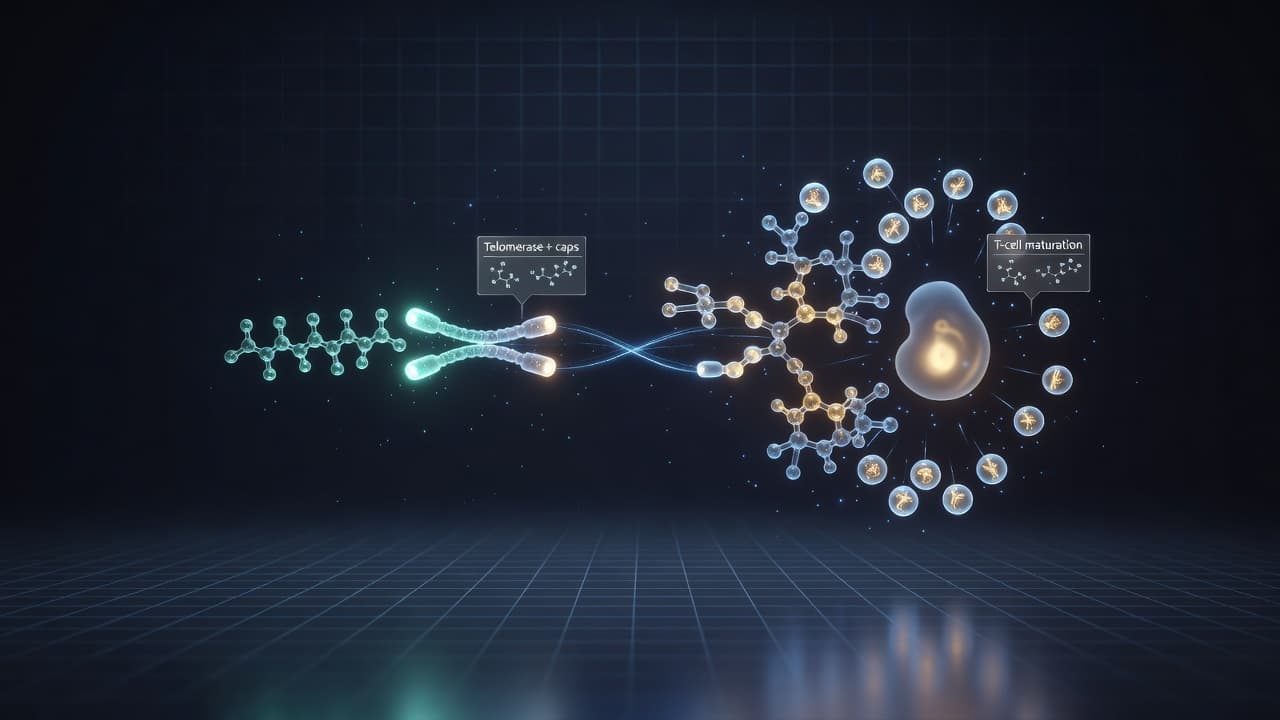
Epitalon and Thymalin share a common origin in the laboratory of Professor Vladimir Khavinson at the Saint Petersburg Institute of Bioregulation and Gerontology. Both emerged from Soviet and post-Soviet research into bioregulatory peptides, short amino acid chains proposed to influence tissue-specific cellular functions.
Despite that shared lineage, the two peptides are studied in different aging-related contexts. Epitalon is discussed mainly in relation to pineal signaling and telomerase-associated cell biology, while Thymalin is discussed mainly in relation to thymic function and immune aging.
Research Context
All information in this article reflects published preclinical and clinical research. These peptides are sold strictly as research compounds, not as therapeutic agents. Nothing here constitutes medical advice.
Epitalon (Epithalon / AEDG): The Telomerase Peptide
Structure and Origin
Epitalon is a synthetic tetrapeptide with the sequence Ala-Glu-Asp-Gly (AEDG). It was developed as a defined-sequence replacement for Epithalamin, a polypeptide extract derived from bovine pineal glands. The goal was to isolate a defined active fraction of the pineal extract and synthesize it for reproducibility and standardization.
Khavinson's group proposed AEDG as a leading bioactive sequence within the broader Epithalamin research program and used it as the basis for a more defined synthetic peptide. That does not establish with certainty that AEDG alone accounts for all effects previously attributed to the extract.
Mechanism: Telomerase and the Hayflick Limit
Every time a human cell divides, its telomeres, the protective caps at the ends of chromosomes, shorten slightly. Once telomeres reach a critical length, the cell enters senescence and stops dividing. This is the Hayflick limit, the built-in replicative ceiling that constrains normal somatic cells to roughly 40-60 divisions.
Telomerase is the enzyme that can rebuild telomere length, partially counteracting this shortening process. Most adult somatic cells express little to no telomerase, which is why telomere shortening is considered a primary hallmark of aging.
Epitalon's central claim in the research literature is its ability to activate telomerase in somatic cells that would otherwise lack meaningful telomerase expression.
Key Studies
In a 2003 study indexed on PubMed as Bulletin of Experimental Biology and Medicine, Khavinson and colleagues reported that Epitalon increased telomerase activity in human fetal fibroblast cultures. In that experimental system, treated cells also showed longer telomeres and continued dividing beyond the point where untreated controls had entered senescence (PMID 12937682).
Separate work on human retinal pigment epithelium (RPE) cells reported a stimulatory effect on proliferation after Epitalon exposure, but the evidence in that paper is more limited than a broad claim of telomerase-driven lifespan extension in RPE cells (PMID 12937684). This line of research is relevant to retinal aging questions, but it remains preclinical.
Khavinson 2003 - Telomerase Activation
Khavinson V. et al. reported telomerase activation, telomere elongation, and prolonged replicative lifespan in human fibroblast cultures treated with the AEDG peptide. The PubMed-listed citation is Bull Exp Biol Med. 2003 (PMID 12937682).
Recent Mechanistic Insights (2025)
A 2025 study reported that Epitalon was associated with telomere-length changes through both telomerase-related effects and changes in Alternative Lengthening of Telomeres (ALT) markers. That finding was strongest in cancer cell lines, while normal cells showed only a small ALT increase, so the paper should be read as an early mechanistic signal rather than proof of broad efficacy in low-telomerase normal tissues (PMID 40908429, PMC).
A 2025 review summarized the main Epitalon literature around telomerase-related signaling, melatonin regulation, antioxidant effects, and possible antitumor activity. As with the primary literature, most of that evidence remains preclinical and should be interpreted accordingly (PMC review 2025).
Melatonin and Circadian Rhythm
Beyond telomere biology, Epitalon has also been studied for effects on melatonin synthesis. As a synthetic analog derived from pineal peptide research, that focus is biologically plausible because the pineal gland is the primary source of melatonin.
Animal studies have reported restoration of evening melatonin peaks in aged rodents and primates after Epitalon exposure. Melatonin is involved not only in sleep timing but also in antioxidant signaling, immune modulation, and circadian regulation. Age-related declines in melatonin are therefore studied as one possible contributor to broader aging-related changes.
Tetrapeptide (Ala-Glu-Asp-Gly) that activates telomerase, the enzyme responsible for maintaining telomere length. One of the most studied peptides in longevity research, developed by Prof. Khavinson at the St. Petersburg Institute of Bioregulation.
Thymalin: The Immune Bioregulator
Structure and Origin
Thymalin is a peptide complex originally extracted from the thymus glands of calves. Unlike Epitalon's defined four-amino-acid sequence, Thymalin is a polypeptide preparation, a standardized extract containing multiple peptide fractions. It was one of the earlier bioregulatory peptides developed by Khavinson's group and was studied in Russian clinical settings beginning in the late Soviet period.
The thymus is a central organ in immune aging. Located behind the sternum, it is where T-cells mature and become immunocompetent. The thymus begins involuting relatively early in life, and by older age functional thymic tissue is substantially reduced. This process, thymic involution, is an important contributor to immune aging (immunosenescence).
Mechanism: T-Cell Maturation and Immune Restoration
Thymalin's researched mechanism centers on restoring thymic function and supporting T-cell differentiation. In aged organisms, the decline in naive T-cell production leaves the immune system increasingly reliant on memory T-cells from past exposures, reducing the ability to respond to novel pathogens.
Research on Thymalin has shown effects on:
- T-cell subset ratios, including age-associated shifts in CD4/CD8 balance
- Naive T-cell output, as a marker of capacity to respond to unfamiliar pathogens
- Cytokine profiles, including inflammatory signaling patterns associated with immunosenescence
- Natural killer (NK) cell activity, as part of innate immune surveillance
Key Studies: The Elderly Trials
The main human data relevant to Thymalin comes from small long-term studies by Khavinson's research group in elderly populations. In reports spanning 6 to 12 years, participants received periodic peptide courses, often involving Thymalin plus Epithalamin rather than Thymalin alone. Those papers described:
- Improvements in selected immune function biomarkers
- Lower reported incidence of acute respiratory infections
- Lower reported cardiovascular event rates
- Lower all-cause mortality in some combined-treatment follow-up analyses compared with untreated controls
These reports are notable for their follow-up duration, but they also need careful framing. They come largely from the same regional research network, involve relatively small cohorts by modern standards, and have limited external replication. The mortality findings are especially tied to combination protocols and should not be presented as proof of an isolated Thymalin effect (PMID 14523363, PMID 12577695).
Long-Term Mortality Data
In a 12-year follow-up report, Khavinson's group described lower mortality in elderly patients receiving Thymalin together with Epithalamin than in controls. These findings are frequently cited, but they are better treated as limited long-term evidence from a narrow study network than as definitive proof, especially because independent replication is sparse (PMID 14523363, PMID 12577695).
Thymic Peptides and Immune Aging in the Post-COVID Era
The COVID-19 pandemic brought renewed attention to immune aging research. Higher mortality rates in older populations reflected multiple factors, including immunosenescence, comorbidity burden, and age-related changes in inflammatory and vascular biology.
Aged individuals' poor responses to both the virus and vaccination highlighted the consequences of thymic involution: fewer naive T-cells, impaired antibody class-switching, and dysregulated inflammatory responses. While Thymalin was not studied specifically for COVID-19, the pandemic underscored why thymic peptide research is considered increasingly relevant to public health and longevity science.
Thymus-derived immune peptide developed by Prof. Khavinson. Restores T-cell function and thymic activity that naturally decline with age. Over 40 years of clinical use in Russia for immune support and anti-aging research.
Epitalon vs Thymalin: Direct Comparison
- Epitalon (AEDG)
- Synthetic tetrapeptide
- Thymalin
- Polypeptide thymic extract
- Epitalon (AEDG)
- Ala-Glu-Asp-Gly
- Thymalin
- Complex peptide mixture
- Epitalon (AEDG)
- Pineal gland
- Thymalin
- Thymus
- Epitalon (AEDG)
- Telomerase activation, melatonin regulation
- Thymalin
- T-cell maturation, immune modulation
- Epitalon (AEDG)
- Telomere shortening (cellular aging)
- Thymalin
- Immunosenescence (immune aging)
- Epitalon (AEDG)
- Telomere length, telomerase activity, melatonin levels
- Thymalin
- CD4/CD8 ratio, naive T-cells, NK cell activity
- Epitalon (AEDG)
- Preclinical + limited human data
- Thymalin
- Older Russian clinical literature and small follow-up studies
- Epitalon (AEDG)
- Primarily cell culture and animal models
- Thymalin
- Small human studies, often from one regional research network
The central distinction in the literature is that Epitalon is studied mainly in relation to telomere and pineal signaling, while Thymalin is studied mainly in relation to thymic and immune regulation. They are discussed within different aging-related pathways, although both evidence bases remain incomplete.
Complementary Mechanisms: Why Researchers Study Both
Aging is not a single process. It is the convergence of multiple deteriorating systems. Telomere erosion and immune decline are two of the recognized hallmarks of aging, and they interact: immune cells themselves are subject to telomere shortening, and immunosenescent cells contribute to the chronic low-grade inflammation ("inflammaging") that accelerates systemic aging.
This is why Khavinson's long-term studies often combined Thymalin with Epithalamin (Epitalon's precursor). The working hypothesis was that addressing both cellular replicative biology and immune competence might produce broader effects than either peptide alone, but that combined approach has not been validated in large independent trials.
Two Pillars of Aging
Think of Epitalon and Thymalin as targeting two distinct but interconnected areas of aging research. Epitalon is studied in relation to telomere-associated cell biology. Thymalin is studied in relation to immune aging and thymic function. Neither alone covers the full spectrum of biological aging.
The Broader Longevity Research Context
Epitalon and Thymalin represent the bioregulatory peptide approach to aging, but they exist within a broader ecosystem of longevity-focused compounds under active investigation:
- SS-31 (Elamipretide), which is studied for mitochondrial dysfunction by stabilizing cardiolipin in the inner mitochondrial membrane
- MOTS-c, a mitochondrial-derived peptide studied for effects on metabolic homeostasis and exercise-mimetic pathways
- NAD+ precursors (NMN, NR), which are studied in the context of age-related declines in nicotinamide adenine dinucleotide and cellular energy metabolism
Telomere research remains an active area in aging biology, and recent reviews continue to discuss telomere length as one biomarker among several used to study biological aging. Experimental telomerase manipulation in animal models is often cited in this context, but those results do not directly establish clinical efficacy for peptide interventions in humans.
Each of these targets a different aging mechanism. A common view in longevity research is that multi-target approaches may ultimately be needed to influence biological aging in a meaningful way, because no single hallmark acts independently.
Frequently Asked Questions
Selected References
- Khavinson VKh et al. Epitalon activates telomerase and extends replicative lifespan in human fibroblasts (PMID 12937682).
- Khavinson VKh et al. Epitalon and proliferative activity in human retinal pigment epithelium cells (PMID 12937684).
- Khavinson VKh et al. Pineal peptide research context and related mechanistic literature (PMID 15455129).
- Al-Dulaimi et al. 2025 mechanistic study on Epitalon, telomeres, and ALT markers (PMID 40908429).
- Araj et al. 2025 review of Epitalon biology and research status (PMC review 2025).
- Khavinson VKh et al. Long-term Thymalin and Epithalamin follow-up data in elderly cohorts (PMID 14523363, PMID 12577695).
- Khavinson VKh et al. Epithalamine in accelerated aging syndrome models (PMID 17426848).
This article is provided for educational and research purposes only. Epitalon and Thymalin are research peptides, not approved medications. The studies cited reflect published findings and do not constitute medical claims. Always consult relevant regulations and qualified professionals before designing any research protocol.
Research context for English-speaking buyers
Most of our English-speaking customers ship to the UK, Ireland, Malta or other English-as-second-language EU territories. The regulatory picture differs per country.
- Relevant authorities
- MHRA (UK, post-Brexit), HPRA (Ireland, EU-aligned), FDA Section 503A bulks list (US, restricted Cat 2 status of several peptides as of 2026)
- Customs and VAT
- EU shipments include 19% VAT; UK shipments after Brexit are now extra-EU and may attract UK VAT plus a handling fee at import
- Typical shipping window
- EU 2-4 working days, UK 4-7 working days, other international 7-14 working days, depending on customs
Research-grade peptides shipped from our EU warehouse are sold for laboratory use only and are not authorised for human or veterinary therapeutic application in any of the destination jurisdictions. US customers should be aware that the FDA Section 503A bulks list classification (and the April 2026 reclassification of twelve compounds) only governs compounding pharmacies, not direct-to-researcher imports for non-clinical work. UK buyers should declare the consignment on import and may be asked for a research justification by HMRC. We provide a CoA per batch identified by colour code rather than serial number; customs sometimes asks for this document when clearing the parcel.