Bacteriostatic, Acetic Acid, or Sterile Water: Which One for Your Peptide?
Bacteriostatic, acetic acid, or sterile water: an honest decision guide with a table and a 10-second rule for the right reconstitution.
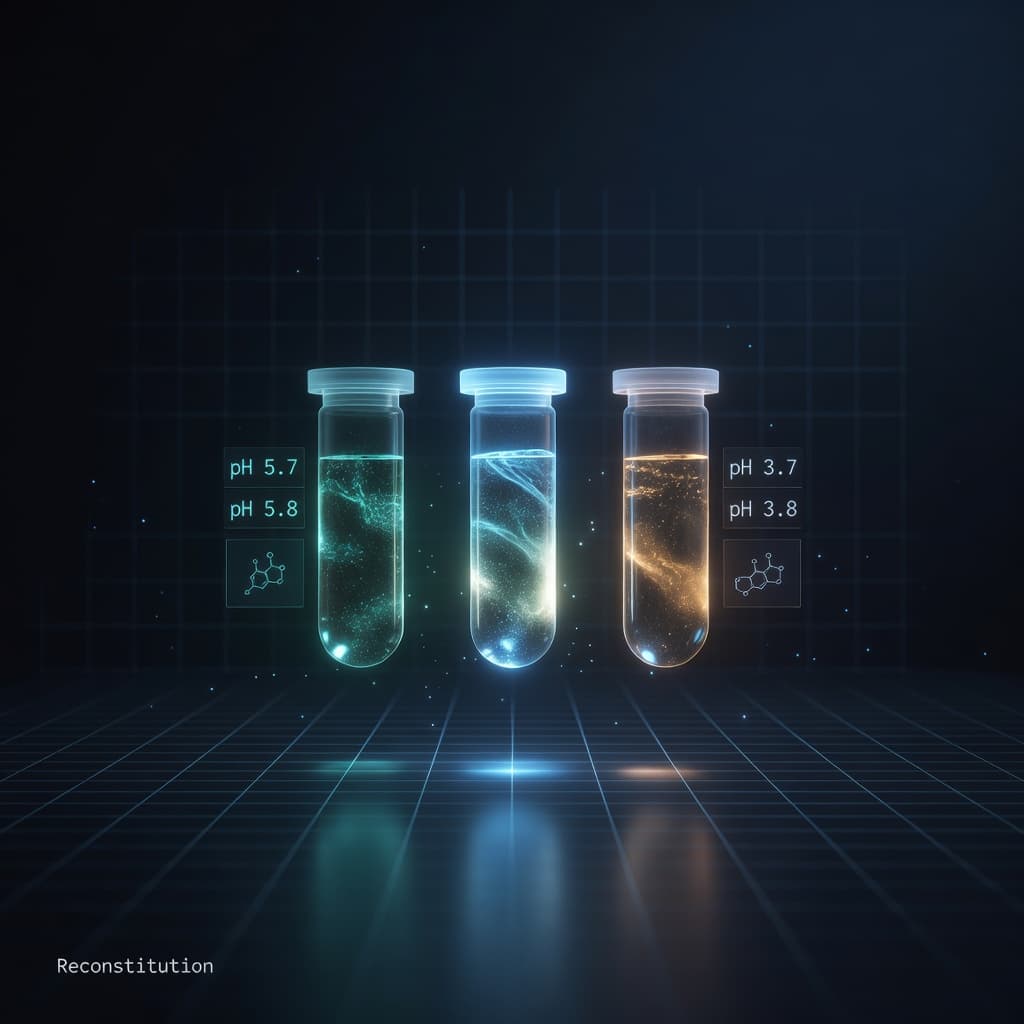
Three waters sit on the shelf, but only one is actually what the vast majority of researchers need. This guide sorts bacteriostatic water, acetic acid water, and sterile water cleanly by pH, shelf life, and use case, with a decision table, a 10-second rule, and the two-step method for the peptides that genuinely need to be reconstituted acidic.
TL;DR: Almost always bacteriostatic water
For the vast majority of researchers, the answer is bacteriostatic water. It is the multi-draw standard for BPC-157, TB-500, CJC-1295, Ipamorelin, Sermorelin, Retatrutide, Semax, Selank, and almost everything else in the catalog. Acetic acid water solves exactly one problem: stubbornly cloudy peptides like IGF-1 LR3 or Cagrilintide, always using the two-step method, never with copper peptides. Sterile water is preservative-free for cell culture and single-day preparations, but without the 28-day shelf life of the bacteriostatic version. If you're unsure, bacteriostatic water is almost never the wrong choice.
For research purposes only
This article categorizes research peptides and their reconstitution. It is not medical advice, not a recommendation for human use, and does not replace consulting a physician.
The decision table
- pH
- ~5.7 (near-neutral, USP range 5.0-7.0)
- Multi-draw?
- Yes, up to 28 days
- Best for
- The standard: BPC-157, TB-500, CJC-1295, Ipamorelin, Sermorelin, Retatrutide, Semax, Selank, and most other peptides
- Not suitable for
- Cell culture and in vitro work (benzyl alcohol is cytotoxic)
- pH
- ~3.8 (acidic, roughly 0.6% acetic acid)
- Multi-draw?
- Only as part of the two-step method, then topped up with BAC water
- Best for
- Peptides that remain cloudy or won't dissolve in neutral water: IGF-1 LR3, Cagrilintide
- Not suitable for
- Copper peptides (GHK-Cu, GLOW, KLOW) and as a default choice for anything else; also neutral-pH peptides that dissolve fine in bacteriostatic water (Retatrutide, Tirzepatide, CJC-1295, CJC-1295/Ipamorelin), do not acidify these
- pH
- ~5.5 (near-neutral, preservative-free)
- Multi-draw?
- No, single use, discard same day
- Best for
- Cell culture and in vitro assays, benzyl-alcohol-sensitive peptides, single-session vials
- Not suitable for
- Any multi-draw use spanning several days or weeks
Bacteriostatic water: the standard
Bacteriostatic water is sterile water with 0.9% benzyl alcohol as a preservative, at a near-neutral pH of roughly 5.7 (USP allows 5.0 to 7.0). That benzyl alcohol is exactly why the same vial can be pierced repeatedly over up to 28 days without the solution becoming a contamination risk. And that's how most peptide research actually runs: reconstitute once, draw small doses over days or weeks.
Use it when: a peptide will be drawn from more than once. That covers the large majority of what's actually purchased: BPC-157, TB-500, CJC-1295, Ipamorelin, Sermorelin, Retatrutide, Semax, Selank, and almost everything else in a typical research protocol.
Avoid it when: cell culture or in vitro work is planned. Benzyl alcohol is cytotoxic at the concentrations found in bacteriostatic water and will skew assay results. That's what sterile water is for.
If you only buy one bottle, this should be it. Our reconstitution calculator works out how much water you need for your target concentration.
Acetic acid water: a specialty tool, not an upgrade
Acetic acid water is a dilute (~0.6%) acidic solution with a pH of roughly 3.8. It exists for exactly one purpose: a small number of peptides simply won't dissolve cleanly in neutral water and stay cloudy or grainy no matter how long you swirl. Two documented cases: IGF-1 LR3, where manufacturer data sheets list dilute acetic acid as a suitable solvent, and Cagrilintide, which belongs to the amylin class and is formulated for acidic conditions. For more on the causes and the difference between harmless and concerning cloudiness, see our guide Why Does My Peptide Turn Cloudy?.
The two-step method
Don't reconstitute the whole vial in acetic acid water. Instead, first dissolve the peptide powder in a small amount, about 0.1 to 0.2 ml, of acetic acid water, then top up to the target volume with bacteriostatic water. The result is a solution that's only mildly acidic overall, not a fully acidic vial, while still giving the peptide the acidic environment it needed to go into solution in the first place.
- Step 1: Reconstitute the peptide powder with 0.1 to 0.2 ml of acetic acid water, swirl gently until clear.
- Step 2: Top up to the desired target volume with bacteriostatic water.
The copper peptide exception
Never acidify copper peptides. GHK-Cu and blends containing it, such as GLOW and KLOW, should not be reconstituted with acetic acid water. The copper peptide complex follows different chemistry than IGF-1 LR3 or Cagrilintide, and acidifying it works against the formulation rather than for it.
Avoid it when: the peptide dissolves without issue in bacteriostatic water. If the solution goes clear with gentle swirling in BAC water, there's no reason to reach for acetic acid water. It isn't a "better" solvent, it's the answer to a specific solubility problem that most peptides simply don't have. This also covers peptides that go into solution cleanly at neutral pH, such as Retatrutide, Tirzepatide, CJC-1295 and CJC-1295/Ipamorelin: they belong in bacteriostatic water, and acidifying them is both unnecessary and a needless risk to a sensitive peptide.
Sterile water: single use, no preservative
Sterile water for injection (USP) is preservative-free: no benzyl alcohol, near-neutral pH of roughly 5.5. Because nothing in it controls microbial growth after opening, it doesn't have the 28-day window bacteriostatic water offers. Once reconstituted, use it the same day and discard the rest.
Use it when:
- cell culture or in vitro assay work is planned, where benzyl alcohol would be cytotoxic and skew results.
- the peptide is one of the few known to be benzyl-alcohol-sensitive.
- a vial is drawn up in a single session and no shelf life beyond that day is needed.
- an immediately used working solution is needed where multi-draw stability doesn't matter.
Avoid it when: a vial will be drawn from over several days. That's a job for bacteriostatic water. Using sterile water for a multi-week protocol just means discarding a perfectly good peptide because the water couldn't keep it stable that long.
All three at a glance
USP-grade sterile water with 0.9% benzyl alcohol (near-neutral, pH 6.2 to 6.4) - the standard solvent for reconstituting lyophilized peptides. Essential accessory for any peptide research. Each vial is sealed and ready to use.
Dilute 0.6% acetic-acid diluent at around pH 3.8, for reconstituting research peptides that stay cloudy in plain bacteriostatic water, such as IGF-1 LR3 and Cagrilintide. Two-step protocol. Each vial is sealed and ready to use.
A first-in-class dual GIP and GLP-1 receptor agonist, and one of the most extensively studied compounds in modern metabolic and weight-regulation research. Supplied as a lyophilised research peptide with a per-batch certificate of analysis, for laboratory and in-vitro use only.
All three water types have certificates of analysis on our Lab Reports page; measured purity values for additional batches are in our purity database.
Choose in 10 seconds
- Cell culture or in vitro work? -> Sterile water. Stop here.
- Not cell culture. Is it IGF-1 LR3 or Cagrilintide (or another peptide that stays cloudy in neutral water)? -> Acetic acid water, two-step method, except with copper peptides.
- Everything else, which is almost everyone here -> Bacteriostatic water.
The honest bottom line
Most researchers only need bacteriostatic water. It's the multi-draw standard, works for almost everything in the catalog, and there's no benefit to buying the other two "just in case." Acetic acid water and sterile water solve two specific, narrowly defined problems: solubility for a few particular peptides, and preservative-free single use or in vitro needs. If neither applies to you, there's no reason to buy them.
Frequently asked questions
The substances and solvents described here are intended for research purposes. This article is for informational purposes only, is not medical advice, and is not to be understood as a recommendation for human use.
Research context for English-speaking buyers
Most of our English-speaking customers ship to the UK, Ireland, Malta or other English-as-second-language EU territories. The regulatory picture differs per country.
- Relevant authorities
- MHRA (UK, post-Brexit), HPRA (Ireland, EU-aligned), FDA Section 503A bulks list (US, restricted Cat 2 status of several peptides as of 2026)
- Customs and VAT
- EU shipments include 19% VAT; UK shipments after Brexit are now extra-EU and may attract UK VAT plus a handling fee at import
- Typical shipping window
- EU 2-4 working days, UK 4-7 working days, other international 7-14 working days, depending on customs
Research-grade peptides shipped from our EU warehouse are sold for laboratory use only and are not authorised for human or veterinary therapeutic application in any of the destination jurisdictions. US customers should be aware that the FDA Section 503A bulks list classification (and the April 2026 reclassification of twelve compounds) only governs compounding pharmacies, not direct-to-researcher imports for non-clinical work. UK buyers should declare the consignment on import and may be asked for a research justification by HMRC. We provide a CoA per batch identified by colour code rather than serial number; customs sometimes asks for this document when clearing the parcel.