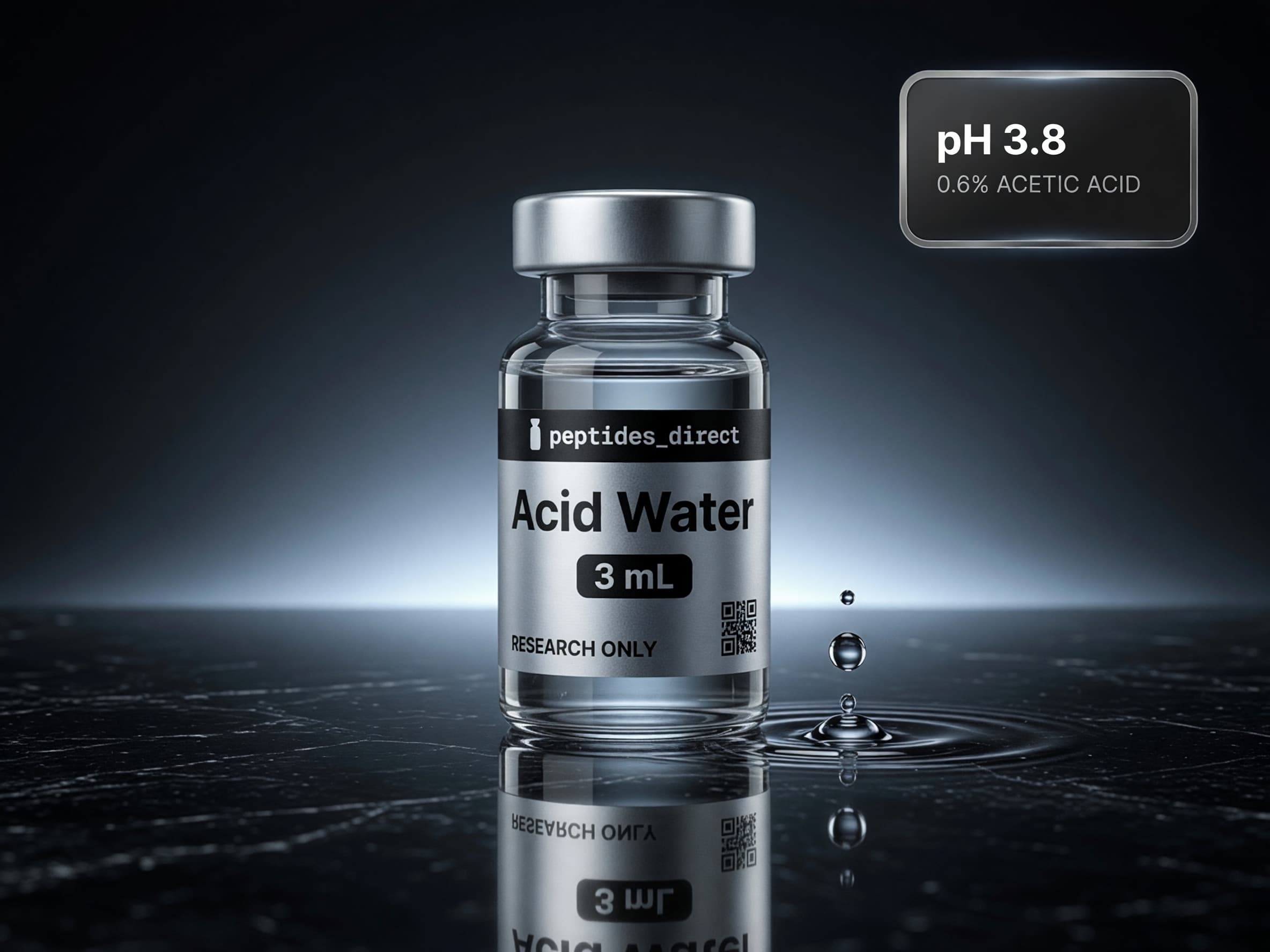
Acetic Acid Water
Dilute 0.6% acetic-acid diluent at around pH 3.8, for reconstituting research peptides that stay cloudy in plain bacteriostatic water, such as IGF-1 LR3 and Cagrilintide. Two-step protocol. Each vial is sealed and ready to use.
€4.99
For Research Use Only
This product is sold strictly for in-vitro research and laboratory use. Not intended for human consumption or any in-vivo application.
Max. 5 per order
Payment Methods
0.6% acetic acid
Sterile water with about 0.6% acetic acid, the dilute-acid diluent used to dissolve peptides that do not clear in plain bacteriostatic water.
Around pH 3.8
A mildly acidic pH (about 3.8) that protonates basic peptide residues and pushes them away from their isoelectric point, improving solubility.
For hard-to-dissolve peptides
The go-to solvent when a peptide such as IGF-1 LR3 or Cagrilintide stays hazy in bacteriostatic water. Most peptides do not need it.
Two-step reconstitution
Dissolve the powder in a small amount of acetic-acid water first, then top up to the target volume with bacteriostatic water.
Cold-chain shipped
Dispatched from EU stock in insulated packaging so the vial arrives intact and ready for laboratory use.
Research areas
What is acetic acid water
Acetic acid water is not a peptide. It is a reconstitution solvent: sterile water with about 0.6% acetic acid, giving a mildly acidic pH around 3.8. It exists for one job: dissolving the minority of research peptides that will not go fully clear in standard bacteriostatic water.
Most lyophilized peptides reconstitute cleanly in near-neutral bacteriostatic water (about pH 5.7). A few are poorly soluble at that pH and turn hazy or gel. For those, a small amount of dilute acetic acid protonates their basic side chains, moves the molecule away from its isoelectric point, and lets it dissolve properly.
Which peptides need it
Acetic acid water is a specialist solvent, not a default. It is the documented choice for a short list:
- IGF-1 LR3, where manufacturer datasheets specify reconstitution in dilute acetic acid before topping up.
- Cagrilintide, an amylin-class peptide whose approved analogues are formulated at acidic pH to stay in solution.
Long-chain or hydrophobic peptides that stay cloudy in bacteriostatic water can also benefit. Everything else, including BPC-157, TB-500, CJC-1295 and the copper peptides, should use ordinary bacteriostatic water. Do not acidify copper peptides such as GHK-Cu.
How to use
The standard method is a two-step reconstitution. Draw a small volume of acetic acid water (typically 0.1 to 0.2 mL) and inject it slowly down the side of the peptide vial. Let the powder dissolve without shaking. Once it is clear, top up to your target volume with bacteriostatic water. This keeps the finished solution only mildly acidic while still getting the peptide into solution.
Often studied alongside
Used as the acidic diluent for the specific peptides that do not dissolve in bacteriostatic water alone.
Reconstituted in dilute acetic acid per manufacturer protocol
Long R3 variant of Insulin-like Growth Factor 1, modified for reduced IGFBP binding and ~20-30 hour half-life. Researched for cell proliferation, hypertrophy, and metabolic signaling. ≥99% purity.
Amylin-class peptide formulated at acidic pH
Long-acting amylin analog studied for once-weekly satiety and appetite control. Phase 3 REDEFINE trials complete, NDA filed with FDA December 2025. A mechanism distinct from GLP-1 agonists.
The standard near-neutral solvent for most peptides
USP-grade sterile water with 0.9% benzyl alcohol (near-neutral, pH 6.2 to 6.4) - the standard solvent for reconstituting lyophilized peptides. Essential accessory for any peptide research. Each vial is sealed and ready to use.
Documentation
Material specification
Composition
Form
pH
Use
Storage (sealed)
Storage (after first puncture)
CoA
Reference standards
There is no per-peptide official pH specification for research peptides. The relevant, sourced anchors are the manufacturer datasheet for LR3 IGF-1 (reconstitution in 100 mM acetic acid) and the acidic formulation of approved amylin analogues. The general principle is charge-opposite-solvent: basic, low-solubility peptides dissolve better in a small amount of dilute acid.
Research use only
This material is sold strictly for in-vitro research and laboratory use. Not intended for human or animal consumption, medical, cosmetic, or household applications. Suitable only for professional laboratory environments.
Reviews
No reviews yet. Write the first one!
Only customers who ordered the product from us can leave a review; we verify this automatically against the order number. Every review submitted is published, regardless of star rating. Rewarded reviews from our coupon program are individually labelled.