BPC-157: Two 2026 Reviews on Tendons, Muscles, and Arrhythmias
An overview of two 2026 review papers on BPC-157 in musculoskeletal injury models and arrhythmia research, with attention to the mainly preclinical evidence.
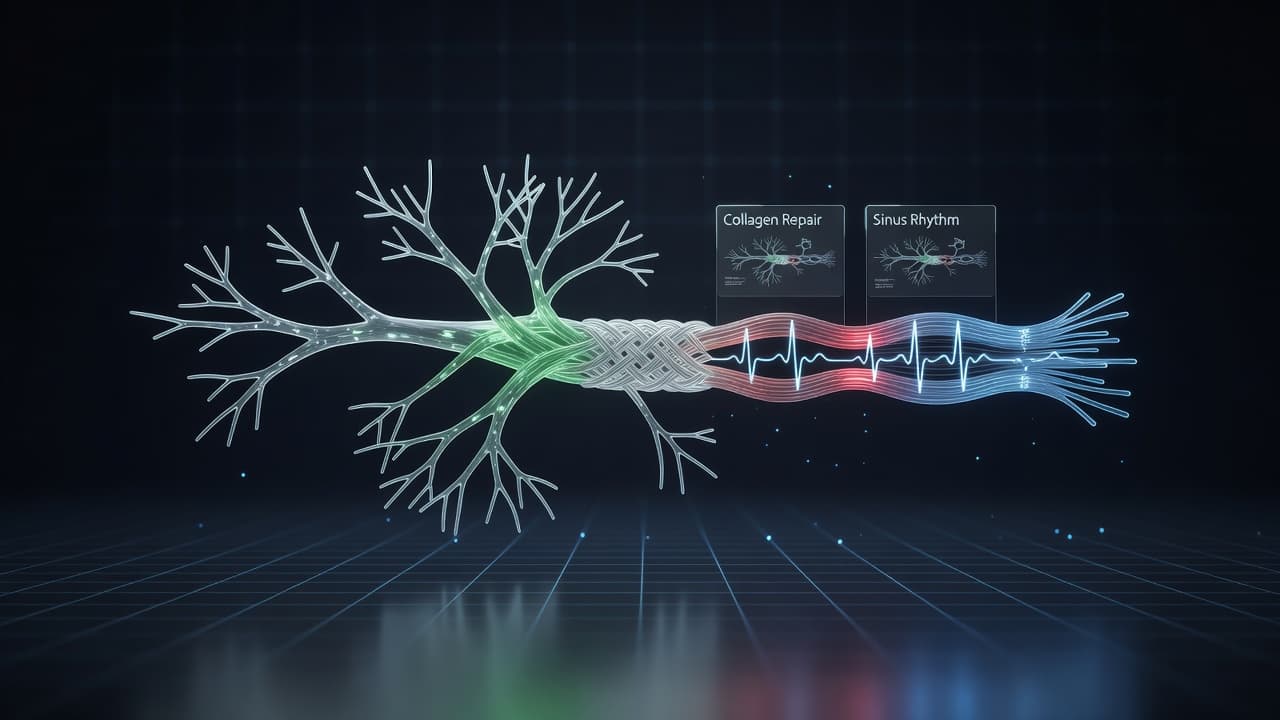
In early 2026, two review papers in Pharmaceuticals summarized published research on BPC-157 in two different areas: tendon, ligament, and muscle healing and cardiac arrhythmias. The arrhythmia review was published on January 29, 2026, and the musculoskeletal review on February 12, 2026. Both papers discuss possible mechanisms and preclinical findings, but they do not represent new original trials.
Taken together, they show where current BPC-157 research is concentrated and where the evidence is still limited, especially in humans.
What Is BPC-157?
BPC-157 is a synthetic pentadecapeptide (15 amino acids) based on a sequence originally described from human gastric juice. In the literature, it is usually grouped with stable gastric peptides because experimental work has described stability in gastric conditions.
Most of the published BPC-157 literature is preclinical. Authors have reported findings in areas such as:
- wound and tissue repair in animal models
- cytoprotective effects in gastrointestinal and other experimental settings
- inflammatory signaling and angiogenesis
These signals are the reason BPC-157 continues to appear in review articles, but they do not by themselves establish clinical efficacy.
2026 Review: Tendon, Ligament, and Muscle Injuries
Matek, Japjec, and colleagues published a review focused on BPC-157 in musculoskeletal healing contexts (Matek et al., 2026). The paper discusses tendon, ligament, muscle, tendon-to-bone, and muscle-to-tendon injury models and places BPC-157 alongside broader repair pathways and growth factor signaling.
What the Review Covers
The review summarizes preclinical reports describing:
- faster healing of tendon and ligament injuries in animal models
- changes in biomechanical properties during repair
- findings at tendon-bone and muscle-tendon junctions
- potential links to signaling pathways involved in angiogenesis and tissue remodeling
It also discusses how BPC-157 has been studied in relation to growth factors such as VEGF, EGF, TGF-beta, and FGF. That section summarizes proposed mechanisms, but it remains a mechanistic review rather than proof of clinical benefit.
What It Does Not Show
The musculoskeletal paper is a review of existing literature, not a new controlled clinical study. That distinction matters because current orthopedic evidence for BPC-157 remains heavily weighted toward laboratory and animal research.
2026 Review: BPC-157 and Arrhythmia Research
The second 2026 paper, by Sikiric, Barisic, Udovicic, and colleagues, reviews BPC-157 in the context of cardiac arrhythmias (Sikiric et al., 2026). It compares BPC-157 with established antiarrhythmic drug classes and presents it as a cytoprotective candidate discussed in experimental arrhythmia models.
Main Points From the Paper
The review highlights preclinical reports in which BPC-157 was associated with:
- restoration of sinus rhythm in some induced arrhythmia models
- effects on gap junction stability and cellular signaling
- reduced oxidative stress markers in experimental settings
- broader tissue-protective hypotheses that could be relevant to cardiac injury
This is still an early research area. The paper argues for further investigation, but it does not establish BPC-157 as a validated clinical antiarrhythmic therapy.
Safety and Evidence Limits
Safety is the area where BPC-157 claims often run ahead of the evidence. The available literature includes limited human data, while most published findings come from preclinical work. A 2025 orthopedic systematic review noted that the evidence base is dominated by animal studies and that robust clinical safety data are lacking (Vasireddi et al., 2025).
That means cautious wording is more accurate than absolute statements. Based on the cited reviews and the broader musculoskeletal review literature, a fair summary is:
- preclinical toxicology reports have not established a clear clinical safety profile
- limited human exposure data exist, but they are not enough to rule out adverse effects or interactions
- large randomized human trials are still missing
Practical Reading of the 2026 Papers
These two 2026 reviews are useful if you want an overview of how BPC-157 is being discussed in the literature. They suggest that researchers remain interested in BPC-157 across connective tissue repair and cardiac rhythm models, and they outline several proposed mechanisms.
At the same time, the papers should be read as review-level summaries of a mostly preclinical field. They are better understood as a snapshot of ongoing experimental interest than as confirmation of established medical use.
Outlook
The next steps for this research area are clearer human evidence, reproducible mechanistic work, and more rigorous safety reporting:
- Better human data, including controlled clinical trials
- Clearer mechanistic work that can be reproduced across groups
- More rigorous safety reporting, including drug interaction and dosing data
Gastric pentadecapeptide (15 amino acids) known for exceptional tissue repair properties. Promotes wound healing, angiogenesis, and cytoprotection across tendons, muscles, gut, and nerves. Over 30 years of preclinical research.
The Wolverine Stack: BPC-157 + TB-500 in equal parts in one vial (50/50: 10mg = 5mg each, 20mg = 10mg each). The most researched healing peptide duo for tissue repair, tendon recovery, and systemic regeneration. Batch-specific Janoshik COA.
4-in-1 anti-aging peptide blend: GHK-Cu 50mg + BPC-157 10mg + TB-500 10mg + KPV 10mg. Targets collagen synthesis, tissue regeneration, skin repair, and anti-inflammatory pathways.
3-in-1 skin peptide blend: GHK-Cu 50mg + BPC-157 10mg + TB-500 10mg. Targets collagen synthesis, tissue regeneration, and skin repair for comprehensive dermatological research.
References
-
Matek D, Japjec M, et al. "Tendon, Ligament, and Muscle Injury, Osteotendinous, Myotendinous, and Muscle-to-Bone Junction Therapy Perspectives with Growth Factors and Stable Gastric Pentadecapeptide BPC 157 - A Review." Pharmaceuticals (Basel). 2026;19(2):309. doi:10.3390/ph19020309. PubMed
-
Sikiric P, Barisic I, et al. "Conventional Antiarrhythmics Class I-IV, Late INa Inhibitors, IKs Enhancers, RyR2 Stabilizers, Gap Junction Modulators, Atrial-Selective Antiarrhythmics, and Stable Gastric Pentadecapeptide BPC 157 as Useful Cytoprotective Therapy in Arrhythmias." Pharmaceuticals (Basel). 2026;19(2):235. doi:10.3390/ph19020235. PubMed
-
Vasireddi N, et al. "Emerging Use of BPC-157 in Orthopaedic Sports Medicine: A Systematic Review." HSS J. 2025 Jul 31:15563316251355551. doi:10.1177/15563316251355551. PubMed
Frequently Asked Questions
This article is for informational and educational purposes only. All mentioned peptides are intended exclusively for laboratory research and not for human consumption. For Research Purposes Only.
Research context for English-speaking buyers
Most of our English-speaking customers ship to the UK, Ireland, Malta or other English-as-second-language EU territories. The regulatory picture differs per country.
- Relevant authorities
- MHRA (UK, post-Brexit), HPRA (Ireland, EU-aligned), FDA Section 503A bulks list (US, restricted Cat 2 status of several peptides as of 2026)
- Customs and VAT
- EU shipments include 19% VAT; UK shipments after Brexit are now extra-EU and may attract UK VAT plus a handling fee at import
- Typical shipping window
- EU 2-4 working days, UK 4-7 working days, other international 7-14 working days, depending on customs
Research-grade peptides shipped from our EU warehouse are sold for laboratory use only and are not authorised for human or veterinary therapeutic application in any of the destination jurisdictions. US customers should be aware that the FDA Section 503A bulks list classification (and the April 2026 reclassification of twelve compounds) only governs compounding pharmacies, not direct-to-researcher imports for non-clinical work. UK buyers should declare the consignment on import and may be asked for a research justification by HMRC. We provide a CoA per batch identified by colour code rather than serial number; customs sometimes asks for this document when clearing the parcel.