GLP-1 and Alcohol: What the Research Shows About Reduced Drinking
GLP-1 research on alcohol use: RCTs on semaglutide, exenatide, and retatrutide, mechanism, EHR cohort data, and limitations, at a glance.
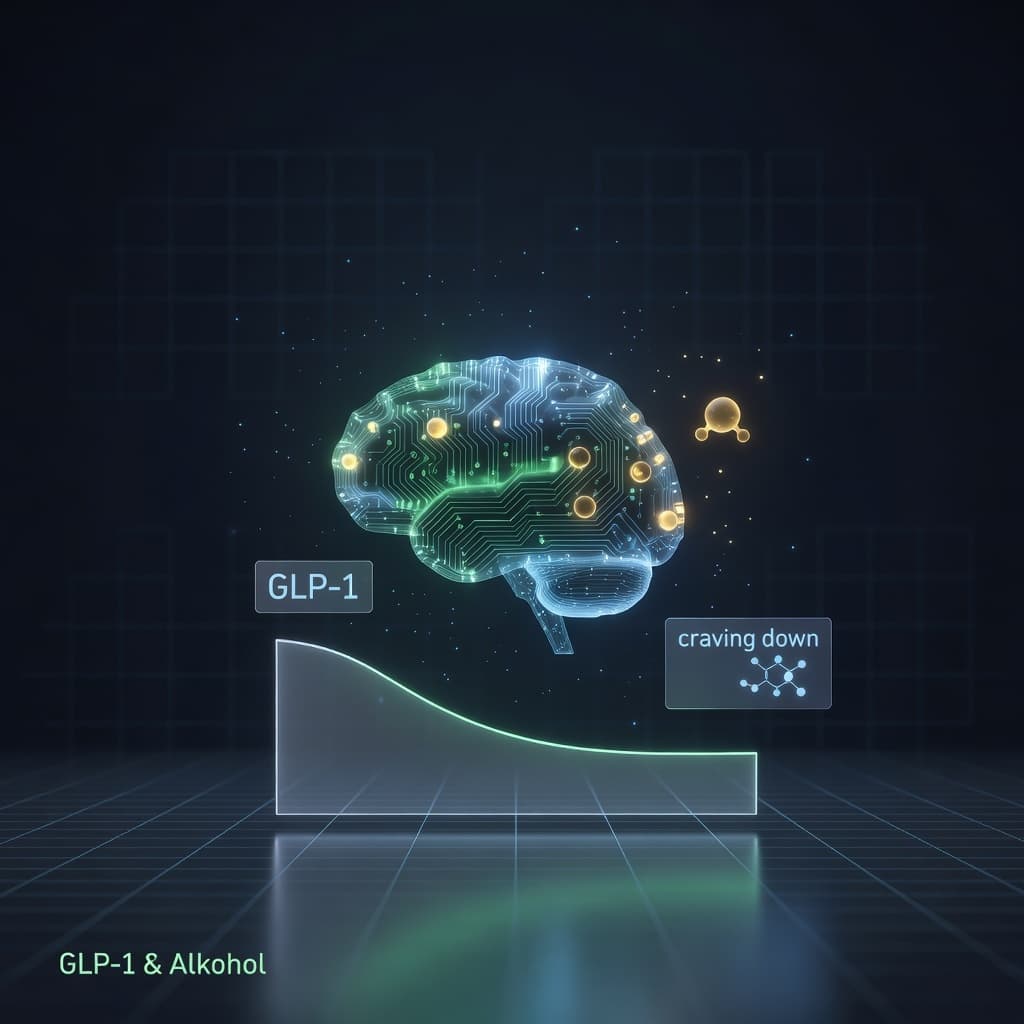
GLP-1 receptor agonists were developed for diabetes and later for weight loss. Over the past few years, however, observations have accumulated that patients on these compounds also want to drink less alcohol. That observation has now spawned its own research line, running from preclinical dopamine studies through a large real-world cohort to two dedicated randomized controlled trials (RCTs) specifically on alcohol use disorder (AUD). This article summarizes what has been published, with PMIDs and study details, without dosing recommendations and without any therapeutic claim.
TL;DR: What the evidence shows
Two dedicated RCTs positive: In two randomized trials (2025 and 2026), semaglutide reduced craving, drinking amount, and heavy-drinking days versus placebo. Older exenatide RCT mixed: The primary endpoint was missed in 2022, but the trial showed altered reward reactivity in the brain (fMRI). Real-world signal: A cohort of more than 80,000 patients found roughly a 50 percent lower AUD risk under semaglutide, which is an association, not proof of causation. Mechanism: GLP-1 receptors in the mesolimbic reward system preclinically blunt the dopamine release that alcohol normally triggers. Not approved: No GLP-1 compound is approved anywhere for AUD. All human data are investigational. Next generation: Retatrutide shows animal-model effects on the subjective effects of alcohol similar to semaglutide and tirzepatide.
The two dedicated RCTs on alcohol use disorder
Two controlled trials have tested semaglutide specifically in people with AUD, not as a side finding in a diabetes or obesity trial.
The first dedicated semaglutide RCT (2025). A double-blind phase 2 trial in 48 non-treatment-seeking adults with AUD, run over nine weeks, compared semaglutide with placebo. In a laboratory drinking session, semaglutide reduced the amount of alcohol consumed (beta = -0.48; 95% CI -0.85 to -0.11; P = 0.01) and peak breath alcohol concentration (beta = -0.46; 95% CI -0.87 to -0.06; P = 0.03). Weekly craving fell (beta = -0.39; 95% CI -0.73 to -0.06; P = 0.01). Effects on drinks per drinking day and heavy-drinking days were significant and large during the 0.5 mg dose weeks (Cohen's d greater than 0.80). A secondary finding: among the 13 smokers in the trial, cigarettes per day fell (P = 0.005).
The larger 2026 trial with comorbid obesity. A 26-week double-blind RCT in 108 treatment-seeking patients with moderate to severe AUD and obesity tested semaglutide 2.4 mg per week added to cognitive behavioral therapy (CBT). Heavy-drinking days fell from baseline by -41.1 percentage points (95% CI -48.7 to -33.5) versus -26.4 percentage points (95% CI -34.1 to -18.6) under placebo. The estimated treatment difference was -13.7 percentage points (95% CI -22.0 to -5.4; P = 0.0015).
Methodology: study details at a glance
Hendershot et al., JAMA Psychiatry 2025 (PMID 39937469): phase 2, double-blind, n=48, 9 weeks, non-treatment-seeking, primary endpoint laboratory drinking session. Klausen et al., Lancet 2026 (PMID 42070571): double-blind, n=108, 26 weeks, treatment-seeking with obesity, semaglutide 2.4 mg/week plus CBT, primary endpoint heavy-drinking days.
What the older exenatide trial showed, and what it did not
Before the semaglutide data, there was already a controlled trial with the GLP-1 compound exenatide. A 26-week double-blind RCT in treatment-seeking AUD patients (exenatide 2 mg/week plus CBT) missed its primary endpoint: overall, heavy-drinking days did not fall significantly more than under placebo.
There was, however, an interesting secondary finding. Exenatide reduced fMRI reactivity to alcohol cues in the ventral striatum and septum, two core regions of the reward system, and lowered dopamine transporter availability. A prespecified exploratory subgroup with obesity (BMI greater than 30) showed reduced heavy drinking and reduced total alcohol intake.
Important: a mixed result, not a clean win
The primary clinical endpoint of the exenatide trial was negative. The positive finding was at the level of brain imaging, and it was not in a prespecified main group but only in an exploratory subgroup. That is a hypothesis-generating finding, not a confirmatory one.
Real-world data and the mechanism in the reward system
A large cohort study of more than 80,000 patients. A retrospective analysis of electronic health record data (TriNetX) compared semaglutide with other anti-obesity medications without GLP-1 activity. In patients with obesity, the hazard ratio for a new AUD diagnosis was 0.50 (95% CI 0.39-0.63) and for AUD relapse was 0.44 (95% CI 0.38-0.52) over 12 months. The pattern replicated in a type 2 diabetes cohort (new-onset HR 0.56, 95% CI 0.43-0.74; relapse HR 0.61, 95% CI 0.50-0.75). Important caveat: this is an association from observational data, not proof of causation.
The preclinical mechanism. In rats, acute and repeated semaglutide reduced alcohol consumption and prevented relapse-like drinking after an abstinence period. In mice, semaglutide blunted alcohol-induced hyperlocomotion and the alcohol-triggered dopamine rise in the nucleus accumbens. These findings fit a broader preclinical picture: GLP-1 receptor signaling in the mesolimbic dopamine system (ventral tegmental area and nucleus accumbens) blunts alcohol reward, alcohol consumption, conditioned preference, and stress-induced relapse in animal models, and the effects appear to be mediated centrally in the brain, not only peripherally.
An additional pharmacokinetic factor. A preliminary study in people with obesity on a GLP-1 receptor agonist found that breath alcohol concentration after a standardized dose rose more slowly and that participants felt less intoxicated, even though the total amount of alcohol consumed ultimately stayed the same. Delayed gastric emptying slows alcohol absorption, a plausible additional mechanism alongside the central reward effect.
Where retatrutide and cagrilintide fit into this picture
The studies cited so far were conducted with the approved drugs semaglutide, tirzepatide, and exenatide, which are branded medications, not research peptides. The next generation of molecules on the same reward-signaling axis is already under preclinical investigation.
In an operant drug-discrimination model in male and female rats, semaglutide, tirzepatide, AND retatrutide each blunted the interoceptive (subjectively perceived) effects of alcohol. With repeated semaglutide dosing, the effect persisted for 15 days and reversed three days after discontinuation.
Retatrutide (a GLP-1/GIP/glucagon tri-agonist) is thus a molecule being studied on exactly this reward-signaling axis, not only on metabolic endpoints. We carry retatrutide and cagrilintide as research peptides for laboratory purposes, not as drugs and not for treating any condition.
First-ever triple-action weight management peptide targeting three receptors at once: GLP-1, GIP, and glucagon. Shown exceptional results in Phase 2 trials - up to 24% weight reduction. The most advanced metabolic peptide available.
A first-in-class dual GIP and GLP-1 receptor agonist, and one of the most extensively studied compounds in modern metabolic and weight-regulation research. Supplied as a lyophilised research peptide with a per-batch certificate of analysis, for laboratory and in-vitro use only.
Long-acting amylin analog studied for once-weekly satiety and appetite control. Phase 3 REDEFINE trials complete, NDA filed with FDA December 2025. A mechanism distinct from GLP-1 agonists.
Limitations: what these data do not show
Important: five limitations of the current evidence
1. No approved indication. No GLP-1 compound is approved anywhere for alcohol use disorder. Any human use in this context is investigational or off-label. 2. Small, early trials. The two positive dedicated RCTs enrolled only 48 and 108 participants at single centers, with short duration (9 and 26 weeks). The older exenatide RCT missed its primary endpoint overall. 3. Cohort data show association, not causation. The 80,000-plus-patient EHR signal cannot prove that semaglutide caused the lower AUD rates. Residual confounding is possible. 4. The mechanism comes largely from animal data. The dopamine and reward findings, as well as the retatrutide data, come from rodent models. Translation to humans is not guaranteed. 5. Not risk-free and not a self-treatment tool. GLP-1 receptor agonists have real gastrointestinal side effects, and drinking alcohol with delayed gastric emptying carries its own caution points. Nothing in this article recommends combining alcohol with these compounds.
Frequently asked questions
Further reading
More on the evidence around GLP-1 compounds: GLP-1 trials. Background on dosing questions in research: Dosing overview.
For research purposes only. This article summarizes published studies on approved branded drugs (semaglutide, tirzepatide, exenatide) as well as preclinical data on research compounds. Alcohol use disorder is not an approved indication for GLP-1 compounds. We sell retatrutide and cagrilintide exclusively as research peptides for laboratory purposes, not as drugs, not for self-treatment, and not with any therapeutic claim.
Research context for English-speaking buyers
Most of our English-speaking customers ship to the UK, Ireland, Malta or other English-as-second-language EU territories. The regulatory picture differs per country.
- Relevant authorities
- MHRA (UK, post-Brexit), HPRA (Ireland, EU-aligned), FDA Section 503A bulks list (US, restricted Cat 2 status of several peptides as of 2026)
- Customs and VAT
- EU shipments include 19% VAT; UK shipments after Brexit are now extra-EU and may attract UK VAT plus a handling fee at import
- Typical shipping window
- EU 2-4 working days, UK 4-7 working days, other international 7-14 working days, depending on customs
Research-grade peptides shipped from our EU warehouse are sold for laboratory use only and are not authorised for human or veterinary therapeutic application in any of the destination jurisdictions. US customers should be aware that the FDA Section 503A bulks list classification (and the April 2026 reclassification of twelve compounds) only governs compounding pharmacies, not direct-to-researcher imports for non-clinical work. UK buyers should declare the consignment on import and may be asked for a research justification by HMRC. We provide a CoA per batch identified by colour code rather than serial number; customs sometimes asks for this document when clearing the parcel.