How Are Used Syringes and Needles Disposed of in the EU?
What EU waste law says about used syringes and needles, which waste code applies, and how six EU countries handle sharps from private households.
Research use only. This page is legal and scientific background on EU waste law for used syringes and needles, with community-report context. Every compound sold here is supplied strictly for in-vitro research. Nothing on this page is a protocol, a recommendation, or medical advice.
Storage of unopened research vials is not a waste-law question; the listed storage box is not a sharps container.
Transparent storage box with 10 individual compartments for 1-3 ml peptide vials. Stackable, fridge-friendly, travel-safe. Ideal for organising bacteriostatic water, GLP-1, BPC-157, and similar vials.
Unused accessories are covered at peptide research accessories.
TL;DR: waste law, six country routes, the gaps
Research question: How are used syringes and needles disposed of in EU countries? What the published data say: Directive 2008/98/EC defines waste as any object the holder discards or is required to discard (Art. 3(1)) and requires separate collection of hazardous household fractions by 1 January 2025 (Art. 20(1)). Decision 2000/532/EC lists sharps in chapter 18 (18 01 01, 18 01 03*). Search results and verification limits: two PubMed eutils searches on 17 September 2026 (“household sharps disposal European Union regulation”, “sharps disposal Germany households needles municipal waste”) returned count=0. Italy was not verified, and Ireland, Denmark, Austria, Belgium, Portugal, Finland, Greece and the rest were not checked. What research communities report: in the Reddit corpus we track, 52 question posts in 12 months and 1 of 956 posts in the 13 to 17 September 2026 window matched the sharps-disposal search expression documented in the data sheet. These are reports of what people ask, not evidence of frequency.
What does EU waste law say about a used syringe?
A used syringe is waste once the holder discards it or is required to discard it (Directive 2008/98/EC, Art. 3(1)). The same directive requires “separate collection for hazardous waste fractions produced by households” by 1 January 2025 (Art. 20(1)), prohibits “abandonment, dumping or uncontrolled management of waste, including littering” (Art. 36(1)) and requires management “without endangering human health, without harming the environment” (Art. 13).
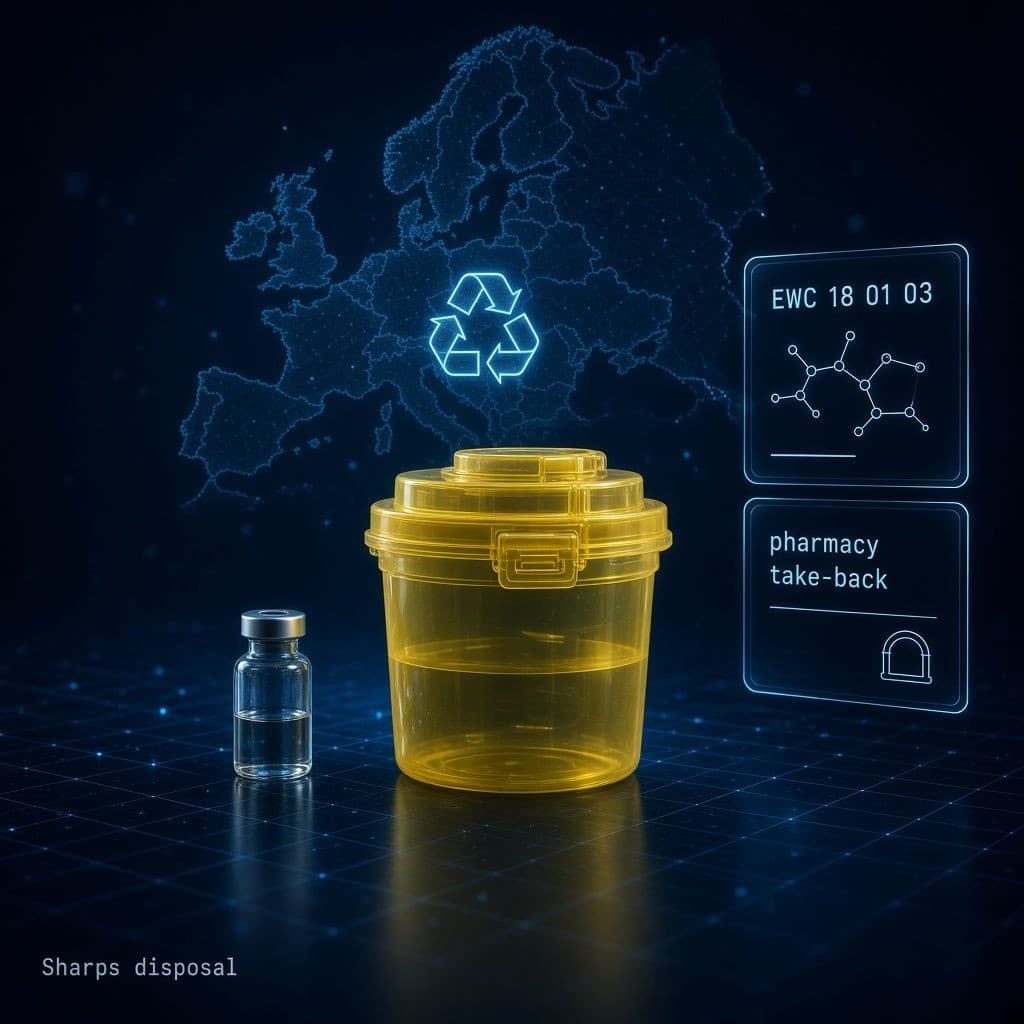
Chapter 18 of the List of Wastes is headed “WASTES FROM HUMAN OR ANIMAL HEALTH CARE AND/OR RELATED RESEARCH” (Decision 2000/532/EC). Code 18 01 01 is “sharps (except 18 01 03)”; the starred 18 01 03* covers “wastes whose collection and disposal is subject to special requirements in order to prevent infection.” “Sharps” occurs only in chapter 18; the municipal chapter has no sharps entry.
Does the sharps injury directive apply to a private holder?
No. Directive 2010/32/EU “applies to all workers in the hospital and healthcare sector, and all who are under the managerial authority ... of the employers” (Clause 2). Inside that employment scope, Clause 6 records that “the practice of recapping shall be banned with immediate effect” and calls for “clearly marked and technically safe containers for the handling of disposable sharps.” Those are employer duties in healthcare settings, not a private-household statute.
Which country routes are verified?
Six jurisdictions were verified on 17 September 2026, which is not an EU-wide household rule. France and Germany follow below, each with its limit.
- Documented household route
- Needles as small chemical waste (KCA), pharmacy as second route, packing duty
- Scope limit
- Municipal KCA stream
- Source
- Milieu Centraal
- Documented household route
- Piercing objects to the pharmacy in the dedicated container, empty syringes without needle on the municipal route
- Scope limit
- County folder, five municipalities
- Source
- 1177.se (Blekinge)
- Documented household route
- Piercing objects encapsulated in a rigid, leak-tight plastic container for the punto limpio (LER 180103)
- Scope limit
- Catalan special-waste route
- Source
- Agència de Residus
- Documented household route
- Municipalities must accept household needles and syringes at the collection point
- Scope limit
- Waste from medicinal products in injection form
- Source
- Dz.U. 2025 poz. 733
France’s free scheme is not open to every holder: DASTRI quotes CSP L4211-2-1 as obliging pharmacies “tenues de collecter sans frais les déchets d’activités de soins à risque infectieux perforants,” and its patients page limits that scheme to “patients qui s’administrent par leurs propres moyens un traitement médical” (arrêtés 2011, 2016, 2017, 2022; décret 2010-1263 for the free boxes).
Bavaria’s LfU note (Stand 6/2020) describes “ein vom Hersteller vorgesehener Kanülenschutz für die Restmüllentsorgung,” yet records two districts where “Behälter mit Kanülen nicht in die Restmülltonne gegeben werden”: a Land-level view, so the municipal rules decide. LAGA Mitteilung 18 (Stand 2021-06-23) collects AS 18 01 01 “in bruch- und durchstichsicheren Einwegbehältnissen ... fest verschlossen” and cites DIN EN ISO 23907 as its reference; that ISO text was not obtained (iso.org HTTP 403, 17 September 2026).
Source summaries
The rows above summarise statutes and agency pages; they are not a disposal protocol.
Why does a loose needle in the bin matter?
Improper sharps disposal outside healthcare is documented as an occupational hazard in case reports (Liss 1990, PMID 2282600). In a Greek cross-sectional study of 208 municipal waste collectors, anti-HBc prevalence was 23% and reported needle sticks were associated with it (RR 2.64, 95% CI 1.01 to 6.96; Rachiotis 2012, PMID 22544469). WHO puts the risk after a stick from an infected source at “30%, 1.8%, and 0.3% respectively of becoming infected with HBV, HCV and HIV.” These are occupational figures, not a purpose for any compound sold here.
The US label of Mounjaro, an approved prescription medicine, describes a household container “made of a heavy-duty plastic ... with a tight-fitting, puncture-resistant lid, without sharps being able to come out” (DailyMed). PeptidesDirect does not sell Mounjaro. That is a prescription-label description, not an EU waste rule or guidance for anything listed here.
What is not settled, and where do local rules decide?
Beyond Art. 3, 13, 20 and 36 of the waste directive, the last mile is municipal. A mail-back is a transport question this page does not describe: Directive 2008/68/EC applies “Annexes A and B to the ADR,” and unece.org returned HTTP 403 for the ADR 2025 and 2023 volumes on 17 September 2026, so no UN number or packing instruction is quoted.
Italy was not verified: normattiva.it and gazzettaufficiale.it returned preamble and notes only on 17 September 2026. The Member States listed in the summary above were not checked.
Sources
- European Parliament and Council. Directive 2008/98/EC on waste, consolidated 18 February 2024. CELEX 02008L0098-20240218. https://eur-lex.europa.eu/legal-content/EN/TXT/HTML/?uri=CELEX:02008L0098-20240218
- European Commission. Commission Decision 2000/532/EC establishing a list of wastes, consolidated 1 June 2015. CELEX 02000D0532-20150601. https://eur-lex.europa.eu/legal-content/EN/TXT/HTML/?uri=CELEX:02000D0532-20150601
- Council of the European Union. Directive 2010/32/EU implementing the Framework Agreement on prevention from sharp injuries in the hospital and healthcare sector. CELEX 32010L0032. https://eur-lex.europa.eu/legal-content/EN/TXT/HTML/?uri=CELEX:32010L0032
- European Parliament and Council. Directive 2008/68/EC on the inland transport of dangerous goods. CELEX 32008L0068. https://eur-lex.europa.eu/legal-content/EN/TXT/HTML/?uri=CELEX:32008L0068
- DASTRI. Ce que dit la loi. CSP L4211-2-1; décret 2010-1263. https://dastri.fr/ce-que-dit-la-loi/
- DASTRI. Les patients en auto-traitement. https://dastri.fr/les-patients-en-auto-traitement/
- Bayerisches Landesamt für Umwelt (LfU). Medizinische Abfälle. Stand 6/2020. https://abfallratgeber.bayern.de/.../medizinische_abfaelle.pdf
- Bund/Länder-Arbeitsgemeinschaft Abfall (LAGA). Mitteilung 18, Stand 2021-06-23. https://laga-online.de/documents/laga-m-18_stand_2021-06-23_1626849905.pdf
- Milieu Centraal. Afvalscheidingswijzer: injectienaald. https://afvalscheidingswijzer.nl/alle-afvalproducten/medisch-afval/injectienaald
- 1177.se / Landstinget Blekinge. Så tar du hand om dina använda sprutor och kanyler.
- Agència de Residus de Catalunya. Agulles (residus municipals especials). https://residus.gencat.cat/.../residus_municipals_especials/agulles/index.html
- Poland. Ustawa o utrzymaniu czystości i porządku w gminach, Dz.U. 2025 poz. 733, art. 3 ust. 2 pkt 6. https://api.sejm.gov.pl/eli/acts/DU/2025/733/text.pdf
- Rachiotis. 2012. Cross-sectional study of 208 municipal waste collectors, Greece (HBV prevalence, needle-stick association). PMID 22544469. https://pubmed.ncbi.nlm.nih.gov/22544469/
- World Health Organization. Health-care waste fact sheet. https://www.who.int/news-room/fact-sheets/detail/health-care-waste
- DailyMed. MOUNJARO label. Container description quoted in data sheet C107, finding P4.
- Liss GM. 1990. Improper office disposal of needles and other sharps: an occupational hazard outside of health care institutions. PMID 2282600. https://pubmed.ncbi.nlm.nih.gov/2282600/
Research use only. Compounds listed here are supplied for laboratory research, not for human or animal administration, and not as medicines. Nothing in this article is a dosing, injection, or medical instruction.
Research context for English-speaking buyers
Most of our English-speaking customers ship to the UK, Ireland, Malta or other English-as-second-language EU territories. The regulatory picture differs per country.
- Relevant authorities
- MHRA (UK, post-Brexit), HPRA (Ireland, EU-aligned), FDA Section 503A bulks list (US, restricted Cat 2 status of several peptides as of 2026)
- Customs and VAT
- EU shipments include VAT, the rate depends on the destination country; UK shipments after Brexit are now extra-EU and may attract UK VAT plus a handling fee at import
- Typical shipping window
- EU 2-4 working days, UK 4-7 working days, other international 7-14 working days, depending on customs
Research-grade peptides shipped from our EU warehouse are sold for laboratory use only and are not authorised for human or veterinary therapeutic application in any of the destination jurisdictions. US customers should be aware that the FDA Section 503A bulks list classification (and the April 2026 reclassification of twelve compounds) only governs compounding pharmacies, not direct-to-researcher imports for non-clinical work. UK buyers should declare the consignment on import and may be asked for a research justification by HMRC. We provide a CoA per batch identified by colour code rather than serial number; customs sometimes asks for this document when clearing the parcel.