Peptide Reconstitution and Storage: Bacteriostatic Water, Solvents, and Lab Supplies
Guide to peptide reconstitution and peptide storage: bacteriostatic water, sterile handling, solvent choice, storage temperatures, and essential lab supplies.
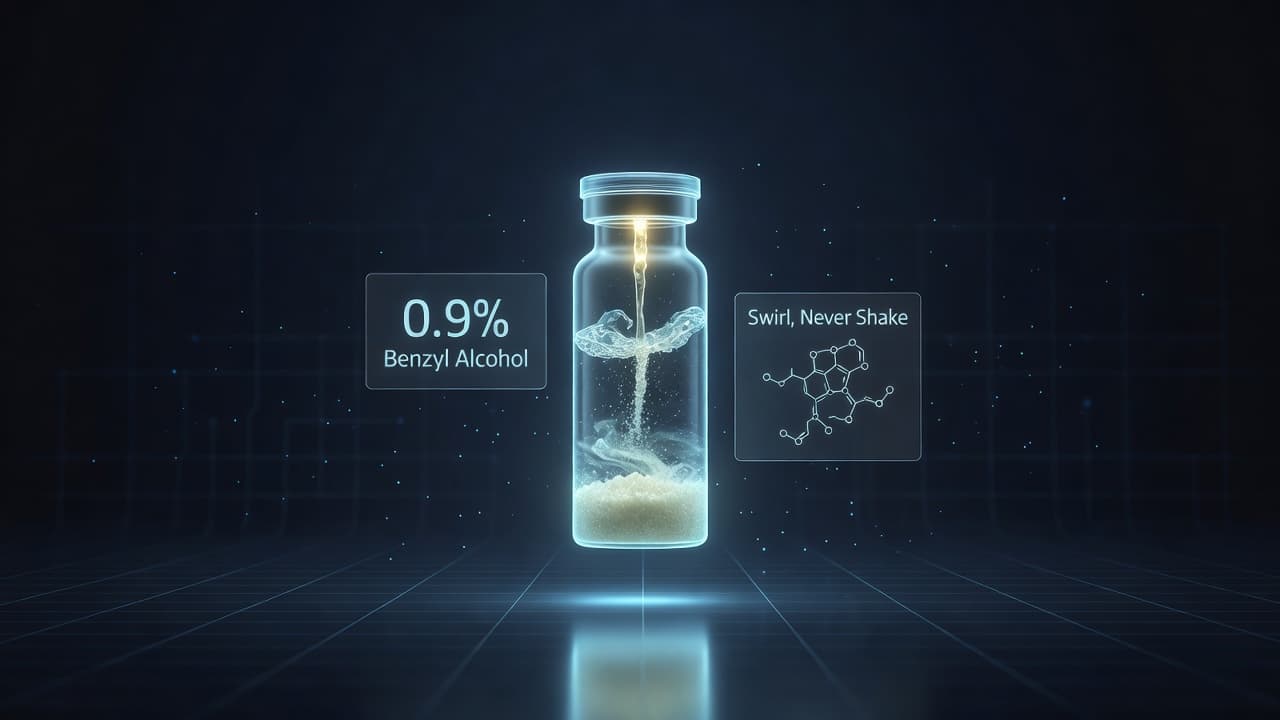
Careful peptide reconstitution and storage are part of basic lab handling. Even when the peptide itself is high quality, unsuitable solvent choice, poor sterile technique, or avoidable temperature stress can reduce sample quality and compromise downstream work.
Bacteriostatic Water for Peptide Reconstitution
What Exactly Is Bacteriostatic Water?
Bacteriostatic Water (Bacteriostatic Water for Injection, BWFI) is sterile water that contains benzyl alcohol as a preservative. Depending on the product, official labeling may list 0.9% or 1.1% benzyl alcohol. The preservative helps limit microbial growth after first puncture, which is the main practical difference from plain sterile water.
Why Not Just Sterile Water?
At first glance, sterile water seems sufficient. The practical difference appears after the first withdrawal. Sterile water is sterile when opened, but contamination risk changes once a container is punctured or opened. Whether it is appropriate for repeated use depends on the specific container, labeling, and handling conditions. Single-use sterile water products should not be treated like preserved multi-dose vials.
Bacteriostatic water, by contrast, is designed for multi-dose handling because the preservative reduces contamination risk after opening. In clinical handling guidance, opened multi-dose vials are commonly dated for up to 28 days unless the manufacturer states otherwise. That makes bacteriostatic water a practical choice when the same vial will be used repeatedly over a short period.
Our Bacteriostatic Water
USP-grade sterile water with 0.9% benzyl alcohol (near-neutral, pH 6.2 to 6.4) - the standard solvent for reconstituting lyophilized peptides. Essential accessory for any peptide research. Each vial is sealed and ready to use.
The bacteriostatic water from PeptidesDirect is produced from sterile water in USP quality, contains benzyl alcohol as a preservative, and is sterile-filtered and filled under controlled conditions. It is offered for research use.
Reconstituting Peptides Properly
Lyophilized peptides are supplied as freeze-dried powder. Before use, they must be dissolved in a suitable solvent. The process is straightforward, but solvent choice, sterile handling, and gentle mixing all matter if you want reproducible preparation conditions.
What You Need
You need bacteriostatic water as a solvent, an appropriate sterile syringe and needle or other validated transfer tool for the required volume, alcohol swabs for disinfecting the rubber stoppers, and the peptide vial with the lyophilized powder.
The Procedure
Equilibrate and Prepare
Bring the peptide vial and bacteriostatic water to room temperature. Wash hands, put on gloves, disinfect the work surface.
Disinfect Rubber Stoppers
Clean the rubber stoppers of both vials with alcohol swabs and let dry for approximately 30 seconds.
Draw Up Water
Draw up the required volume of bacteriostatic water into the syringe. Select the volume based on the peptide amount, target concentration, and the transfer accuracy your workflow requires.
Slowly Introduce Water
Insert the needle through the rubber stopper of the peptide vial and let the water run slowly down the glass wall. Avoid forcing the stream directly onto the powder, especially with more delicate formulations.
Swirl Gently
Gently swirl the vial with circular motions instead of vigorous shaking. Many peptides tolerate light handling well, but aggressive agitation can increase foaming or physical stress in some formulations. Wait until the solution is completely clear if the peptide is expected to dissolve fully.
Store Cool
Place the fully reconstituted peptide in the refrigerator at 2-8 degrees Celsius, protected from light. Use the solution promptly and follow product- or sequence-specific stability guidance where available.
Never Shake
Avoid directing a fast stream of solvent straight onto the powder and avoid vigorous shaking. Let the liquid run down the glass wall and mix with a gentle swirl instead.
A more detailed reconstitution guide can be found using BPC-157 as an example: BPC-157 Reconstitution Guide. The basic principles apply to all peptides.
Storing Peptides Properly
Peptides are sensitive molecules. Exposure to heat, light, moisture, or oxygen can reduce stability, so storage conditions matter as much as clean reconstitution.
Observe Storage Temperatures
Lyophilized powder: Store sealed, dry, and protected from light. For longer-term storage, many handling guides prefer -80 degrees Celsius when available. -20 degrees Celsius is often used for medium-term storage, but actual stability depends on sequence, purity, residual moisture, packaging, and handling.
Reconstituted solution: Store at 2-8 degrees Celsius and use within the shortest practical timeframe. Stability after reconstitution varies widely by peptide and solvent system, so a fixed shelf-life should not be assumed without sequence-specific data. Room temperature exposure should be limited to active handling.
Common Mistakes
Repeated freezing and thawing is one of the most common avoidable problems. Depending on the peptide, freeze-thaw cycles can accelerate degradation or promote aggregation. Direct light exposure should also be minimized because some compounds are light-sensitive. Clean the stopper with an alcohol swab before each withdrawal to reduce contamination risk, and keep heat exposure as short as possible.
More on storage: Peptide Storage Guide
Category-Specific Handling Notes
The same core rules apply across most peptide products: choose a suitable solvent, use clean technique, minimize avoidable agitation, and control temperature and light exposure. Beyond that, handling recommendations become increasingly product-specific.
For healing peptides such as BPC-157, TB-500, or GHK-Cu, the main consideration is not the category label itself but the individual sequence, formulation, and storage history.
Longevity peptides such as Epitalon, SS-31, or MOTS-c should likewise be handled according to product-specific data rather than assumptions based on category alone.
Cognitive peptides such as Semax, Selank, or PE-22-28 are usually prepared using standard sterile handling principles, but sequence-level stability still matters.
Hormonal peptides such as Ipamorelin or CJC-1295 are often discussed alongside larger peptide hormones and proteins. In practice, larger biomolecules may have different stability profiles, so it is worth checking dedicated handling guidance for each product.
GLP-1 agonists such as Retatrutide should also be handled with standard sterile technique, but reconstitution and storage decisions still need to follow sequence- and formulation-specific stability data where available.
Always Order Together
If your workflow requires reconstitution, order bacteriostatic water and basic sterile consumables at the same time so the material can be handled correctly on arrival.
Frequently Asked Questions
Order from PeptidesDirect
Bacteriostatic Water costs EUR 15.00 and can be ordered directly together with peptides in a single order.
We ship within the EU in 2-3 business days, without customs. Payment is accepted via crypto (BTC, USDT) or credit card.
Related Products
USP-grade sterile water with 0.9% benzyl alcohol (near-neutral, pH 6.2 to 6.4) - the standard solvent for reconstituting lyophilized peptides. Essential accessory for any peptide research. Each vial is sealed and ready to use.
Research context for English-speaking buyers
Most of our English-speaking customers ship to the UK, Ireland, Malta or other English-as-second-language EU territories. The regulatory picture differs per country.
- Relevant authorities
- MHRA (UK, post-Brexit), HPRA (Ireland, EU-aligned), FDA Section 503A bulks list (US, restricted Cat 2 status of several peptides as of 2026)
- Customs and VAT
- EU shipments include VAT, the rate depends on the destination country; UK shipments after Brexit are now extra-EU and may attract UK VAT plus a handling fee at import
- Typical shipping window
- EU 2-4 working days, UK 4-7 working days, other international 7-14 working days, depending on customs
Research-grade peptides shipped from our EU warehouse are sold for laboratory use only and are not authorised for human or veterinary therapeutic application in any of the destination jurisdictions. US customers should be aware that the FDA Section 503A bulks list classification (and the April 2026 reclassification of twelve compounds) only governs compounding pharmacies, not direct-to-researcher imports for non-clinical work. UK buyers should declare the consignment on import and may be asked for a research justification by HMRC. We provide a CoA per batch identified by colour code rather than serial number; customs sometimes asks for this document when clearing the parcel.