Research in plain language
Tirzepatide
What it is
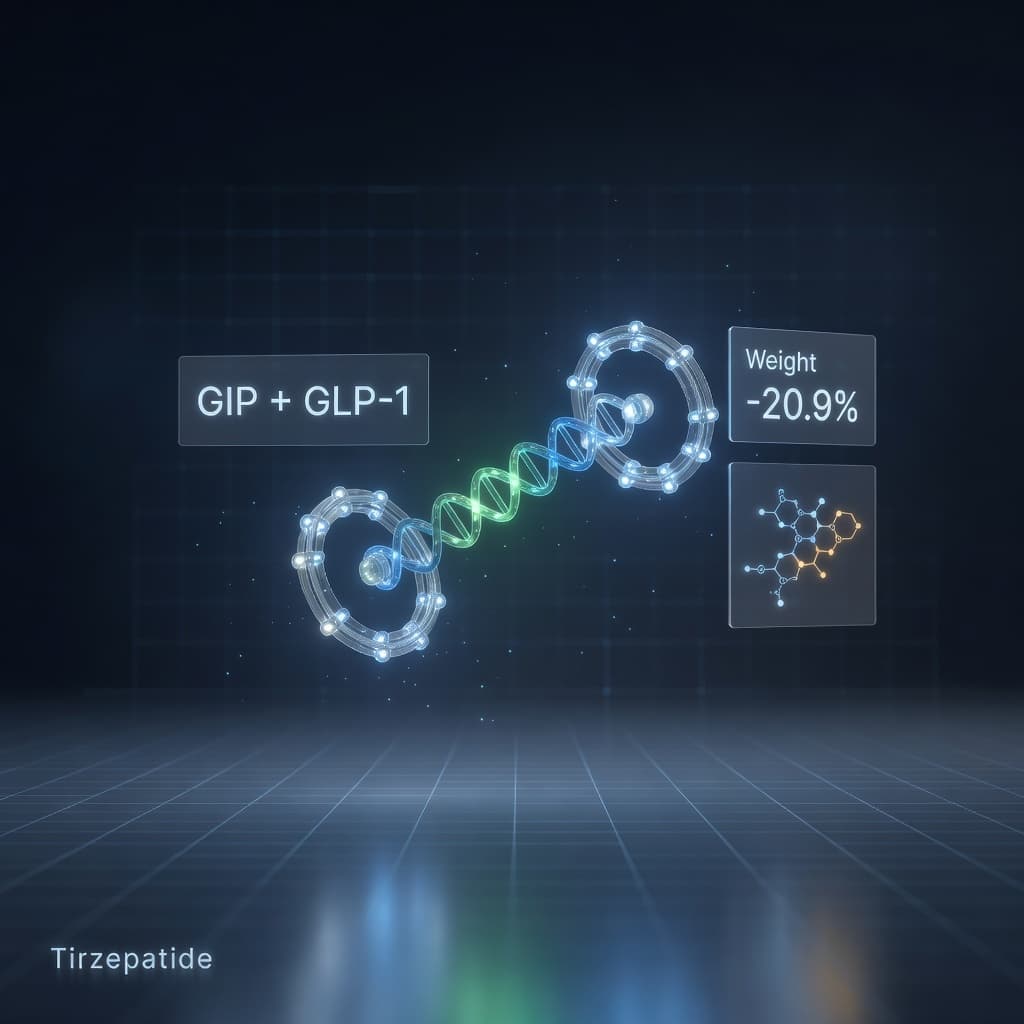
Tirzepatide (code LY3298176) is a synthetic 39-amino-acid peptide developed by Eli Lilly and the first single molecule to combine agonism of the GIP and GLP-1 incretin receptors. In research it is studied as an injectable agent for body-weight reduction and blood-glucose control, and more recently for liver disease (MASH) and obstructive sleep apnea. A C20 fatty-diacid chain gives it a half-life of about five days, so trials use once-weekly dosing. PeptidesDirect does not sell tirzepatide. This page is a study reference only.
Dosing Reference from Studies
5 mg once weekly (human) to 15 mg once weekly (human)
Dose in studies
No established human protocol
How studies used it
- Model
- Human, adults with obesity (BMI 30 or higher, or 27 or higher with a weight-related complication) without diabetes
- Studied for
- Weight management (obesity), SURMOUNT-1 dose-ranging versus placebo
- Dose
- 5, 10 or 15 mg per week subcutaneous. Mean baseline weight was 104.8 kg, so 15 mg is about 0.14 mg/kg per week; the trial used fixed (not weight-based) doses.
- Dosing
- Once weekly, with a 20-week stepwise dose-escalation period
- Route
- subcutaneous
- Duration
- 72 weeks
Effects measured: Mean weight change at week 72 was -15.0% (5 mg), -19.5% (10 mg) and -20.9% (15 mg) versus -3.1% with placebo. A reduction of 20% or more was reached by 50% (10 mg) and 57% (15 mg) of participants versus 3% on placebo, and all prespecified cardiometabolic markers improved.
Side effects: Most common were gastrointestinal (nausea, diarrhoea, constipation), mostly mild to moderate and concentrated during dose escalation. Adverse events led to discontinuation in 4.3%, 7.1% and 6.2% on tirzepatide versus 2.6% on placebo.
- Model
- Human, adults with type 2 diabetes on metformin
- Studied for
- Glycaemic control, head-to-head versus semaglutide 1 mg (SURPASS-2)
- Dose
- Tirzepatide 5, 10 or 15 mg per week versus semaglutide 1 mg per week. Mean baseline HbA1c was 8.28% and mean weight 93.7 kg.
- Dosing
- Once weekly, open-label
- Route
- subcutaneous
- Duration
- 40 weeks
Effects measured: HbA1c fell by 2.01, 2.24 and 2.30 percentage points on tirzepatide 5/10/15 mg versus 1.86 on semaglutide; tirzepatide was non-inferior and superior at all doses. Weight loss exceeded semaglutide by 1.9, 3.6 and 5.5 kg respectively.
Side effects: Predominantly gastrointestinal (nausea, diarrhoea, vomiting), mostly mild to moderate, similar in pattern to semaglutide.
- Model
- Human, adults with biopsy-confirmed MASH and stage F2-F3 (moderate to severe) liver fibrosis
- Studied for
- Metabolic dysfunction-associated steatohepatitis (MASH), SYNERGY-NASH phase 2
- Dose
- 5, 10 or 15 mg per week subcutaneous versus placebo (190 participants randomised).
- Dosing
- Once weekly
- Route
- subcutaneous
- Duration
- 52 weeks
Effects measured: Resolution of MASH without worsening of fibrosis reached 44% (5 mg), 56% (10 mg) and 62% (15 mg) versus 10% with placebo. Improvement of at least one fibrosis stage without worsening MASH was more frequent on tirzepatide than placebo.
Side effects: Mostly gastrointestinal and mild to moderate, consistent with the incretin class.
- Model
- Human, adults with moderate-to-severe obstructive sleep apnea and obesity
- Studied for
- Obstructive sleep apnea (OSA), SURMOUNT-OSA two phase-3 trials (with and without positive-airway-pressure therapy)
- Dose
- Maximum tolerated dose 10 or 15 mg per week subcutaneous versus placebo. Mean baseline apnea-hypopnea index was 51.5 (no PAP) and 49.5 (on PAP) events per hour, BMI about 39.
- Dosing
- Once weekly
- Route
- subcutaneous
- Duration
- 52 weeks
Effects measured: In the no-PAP trial the apnea-hypopnea index fell by 25.3 events per hour on tirzepatide versus 5.3 on placebo. Body weight, hypoxic burden, high-sensitivity CRP and systolic blood pressure also improved.
Side effects: Predominantly gastrointestinal and mild to moderate.
How solid the evidence is
Honest summary: all four studies cited here are human randomized controlled trials, and most are large peer-reviewed phase 3 trials (SURMOUNT-1 in obesity and SURPASS-2 in type 2 diabetes, both in the New England Journal of Medicine, and SURMOUNT-OSA in obstructive sleep apnea), with SYNERGY-NASH a peer-reviewed phase 2 liver trial. This is a stronger, later-stage evidence base than most research peptides. All were sponsored by Eli Lilly and largely authored by Lilly employees and Lilly-funded investigators, so a sponsorship bias should be assumed. The weekly 5, 10 and 15 mg doses are the fixed, trial-defined doses used in these studies, not a recommended regimen; tirzepatide is an EMA-approved, prescription-only medicine that PeptidesDirect does not sell, and no human dosing protocol is given here. All effects listed are study findings in defined patient populations, not promises of benefit; gastrointestinal side effects (nausea, diarrhoea, constipation) were consistently the most common and were dose-related, concentrated during the dose-escalation phase. The numbers are taken from the published abstracts (weight change, HbA1c, apnea-hypopnea index, MASH-resolution rates and baseline values as reported); where a per-kg dose is shown it is derived from the trial's mean baseline weight and is approximate.
Sources
- Jastreboff AM, et al. Tirzepatide Once Weekly for the Treatment of Obesity (SURMOUNT-1). N Engl J Med. 2022;387(3):205-216.(PMID 35658024)
- Frias JP, et al. Tirzepatide versus Semaglutide Once Weekly in Patients with Type 2 Diabetes (SURPASS-2). N Engl J Med. 2021;385(6):503-515.(PMID 34170647)
- Loomba R, et al. Tirzepatide for Metabolic Dysfunction-Associated Steatohepatitis with Liver Fibrosis (SYNERGY-NASH). N Engl J Med. 2024;391(4):299-310.(PMID 38856224)
- Malhotra A, et al. Tirzepatide for the Treatment of Obstructive Sleep Apnea and Obesity (SURMOUNT-OSA). N Engl J Med. 2024;391(13):1193-1205.(PMID 38912654)
Frequently asked questions
What is Tirzepatide?
Tirzepatide (code LY3298176) is a synthetic 39-amino-acid peptide developed by Eli Lilly and the first single molecule to combine agonism of the GIP and GLP-1 incretin receptors. In research it is studied as an injectable agent for body-weight reduction and blood-glucose control, and more recently for liver disease (MASH) and obstructive sleep apnea. A C20 fatty-diacid chain gives it a half-life of about five days, so trials use once-weekly dosing. PeptidesDirect does not sell tirzepatide. This page is a study reference only.
Study data, research use only. No established human dosing protocol.