Research in plain language
NAD+
What it is
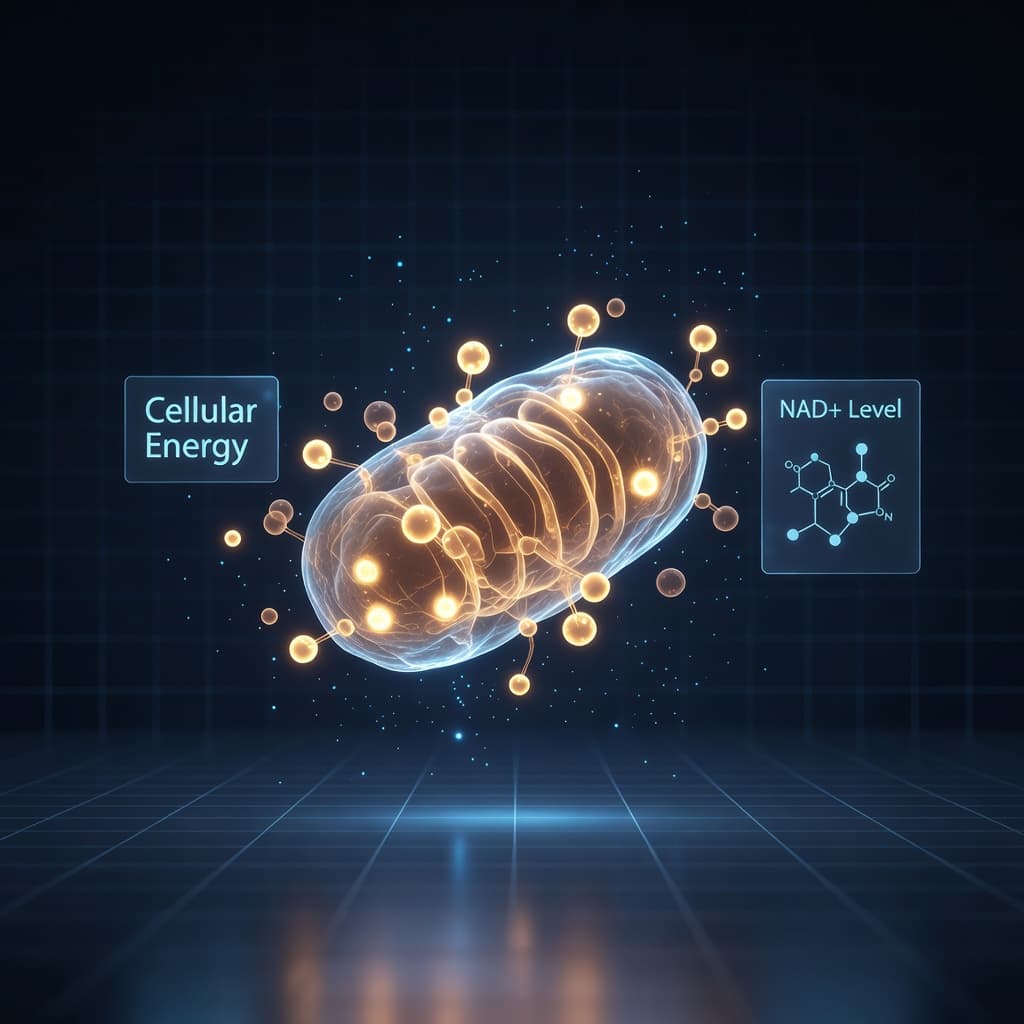
NAD+ (nicotinamide adenine dinucleotide) is the central coenzyme that cells use to move electrons in energy metabolism and to fuel enzymes such as sirtuins and PARPs. When given by injection or IV drip it is marketed for "anti-aging", energy and recovery, but the direct human evidence for injected NAD+ itself is thin: most of the rigorous human data are for the oral precursors NR and NMN, which the body converts into NAD+, not for the intact molecule given by vein.
Dosing Reference from Studies
5 mg/kg (rat, IV) to 750 mg total per infusion (human, IV)
Dose in studies
Discussed in research communities 50-100 mg (SC, 2-3x/week)
Reference from peptide forums and community discussions. Not a recommendation, not based on studies, and not an established human protocol.
No established human protocol
How studies used it
- Model
- Human, healthy men aged 30 to 55 (n=8 test, n=3 saline control), BMI under 30
- Studied for
- Pharmacokinetics: whether IV NAD+ actually raises the blood and urine NAD+ metabolome
- Dose
- 750 mg total NAD+ infused (about 2 mg/min, equal to 3 micromol/min). Absolute dose only: individual body weight was NOT reported, just mean BMI ~27.5, so a per-kg figure cannot be derived
- Dosing
- Single continuous infusion at a constant rate
- Route
- intravenous
- Duration
- Single 6 hour infusion
Effects measured: Surprisingly, no change in plasma NAD+ or its metabolites (nicotinamide, methylnicotinamide, ADPR, NMN) was seen during the first 2 hours. Plasma NAD+ rose significantly (about 398%) only at the 6 hour timepoint, with comparable rises (~393 to 409%) in metabolites. Urinary NAD+ excretion rose ~538% and methylnicotinamide ~403% by 6 hours, with little urinary nicotinamide. Interpretation: most infused NAD+ does not appear intact in blood quickly, suggesting extensive extracellular breakdown or rapid uptake.
Side effects: No adverse events were observed during the 6 hour infusion. Minor, clinically insignificant liver-enzyme shifts (GGT, LD, AST fell; bilirubin rose slightly).
Sources: Grant R et al., Front Aging Neurosci. 2019 (PMID 31572171)
- Model
- Rat (adult male Wistar, 250 to 280 g), myocardial ischemia/reperfusion model
- Studied for
- Heart protection against ischemia/reperfusion injury
- Dose
- 5, 10 and 20 mg/kg (already per kg body weight)
- Dosing
- Single dose given right before ischemia was induced
- Route
- intravenous
- Duration
- Single dose; 60 min ischemia then 6 or 24 h reperfusion
Effects measured: Dose-dependent reduction of infarct size, with roughly 85% reduction at 20 mg/kg. Lower cardiac troponin I at 6 h, fewer TUNEL-positive (apoptotic) cells, less cleaved caspase-3 and Bax, higher Bcl-XL, and preserved SOD activity/SOD-2 protein.
Side effects: No adverse events or toxicity reported in this study.
Sources: Zhang Y et al., Am J Transl Res. 2016 (PMID 27648125)
- Model
- Human, real-world IV-clinic clients (retrospective chart review; n=6 NAD+, n=8 NR)
- Studied for
- Tolerability and safety of IV NAD+ compared with IV nicotinamide riboside
- Dose
- 500 mg per infusion. Absolute dose only: body weight was NOT reported in this retrospective record review, so a per-kg figure cannot be derived
- Dosing
- Once daily on 4 consecutive days (loading-dose protocol)
- Route
- intravenous
- Duration
- 4 days of infusions, 30 day follow-up
Effects measured: All 6 NAD+ recipients reported moderate to severe symptoms (abdominal cramping, diarrhea, nausea, vomiting, raised heart rate, throat pain, chest pressure); NAD+ infusions had to run slower (mean 97 min vs 37 min for NR, ~60% longer, p<0.05). No clinically significant changes in liver enzymes (ALT, AST normal; alkaline phosphatase fell slightly but stayed in range) or in inflammation (hsCRP unchanged). NAD+ group showed a significant fall in HDL-cholesterol; NR group a significant fall in HbA1c.
Side effects: NAD+: all 6 had moderate-to-severe GI and cardiovascular-type symptoms requiring slower infusion. These were the main tolerability finding of the study.
- Model
- Human, newly diagnosed, treatment-naive Parkinson's disease patients (n=30). PRECURSOR study (oral NR), not injected NAD+
- Studied for
- Whether an oral NAD+ precursor reaches the brain and changes Parkinson metabolism
- Dose
- 1,000 mg/day NR. Absolute dose only: body weight was NOT reported, so a per-kg figure cannot be derived
- Dosing
- Once daily, oral
- Route
- oral
- Duration
- 30 days
Effects measured: Significant but variable rise in cerebral NAD levels (measured by 31P magnetic resonance spectroscopy) plus higher NAD-related metabolites in cerebrospinal fluid. Responders with raised brain NAD showed altered cerebral metabolism on FDG-PET and mild clinical improvement on the MDS-UPDRS. Upregulation of mitochondrial, lysosomal and proteasomal gene programs in blood/muscle and lower inflammatory cytokines.
Side effects: NR treatment was well tolerated; no significant adverse events attributed to NR in this trial. Included here as a labelled PRECURSOR (oral NR), to contrast with the thin direct injected-NAD+ data.
Sources: Brakedal B et al. (NADPARK), Cell Metab. 2022 (PMID 35235774)
- Model
- Human, healthy adults aged 22 to 64 (n=30; 15 NMN, 15 placebo). PRECURSOR study (oral NMN), not injected NAD+
- Studied for
- Safety of an oral NAD+ precursor and whether it raises blood NAD+
- Dose
- 250 mg/day NMN. Absolute dose only: body weight was NOT reported, so a per-kg figure cannot be derived
- Dosing
- 125 mg tablet twice daily, oral
- Route
- oral
- Duration
- 12 weeks
Effects measured: Whole-blood NAD+ rose significantly versus placebo at 4, 8 and 12 weeks (largest rise by week 4; p<0.001), with elevated NAMN; NMN itself unchanged in blood. No abnormalities in physiologic or laboratory tests.
Side effects: Minimal and similar to placebo. One NMN participant had mild abdominal pain that resolved within 30 minutes; one placebo participant withdrew with GI symptoms. No serious adverse events. Included as a labelled PRECURSOR (oral NMN).
How solid the evidence is
Honest read: direct evidence for INJECTED or IV NAD+ in humans is genuinely thin and weak. Only two small human studies on the intact molecule exist here. Grant 2019 (PMID 31572171) is a single-group pharmacokinetic pilot in just 8 dosed healthy men, with only 3 saline controls, no clinical endpoints, and its main finding is actually deflating: infused NAD+ does not raise blood NAD+ for the first 2 hours, hinting that much of it is broken down before reaching cells. Reyna 2026 (PMID 41704678) is a tiny retrospective chart review (6 NAD+, 8 NR) with no placebo, a fixed 4-day loading protocol, and an explicit conflict of interest (some authors were employed by the commercial infusion provider); it is a tolerability signal, not an efficacy study, and its main result is that IV NAD+ caused moderate-to-severe GI and cardiovascular-type symptoms in all 6 recipients and had to be infused slowly. The efficacy data for injected NAD+ are animal-only: Zhang 2016 (PMID 27648125) is a single rat ischemia/reperfusion study (surrogate infarct-size endpoints, no long-term outcomes) and does not translate to human dosing. There are no large, randomized, placebo-controlled human trials showing that injected/IV NAD+ produces a clinical benefit, and no established per-kg human dosing protocol; clinic "drip" doses (250 to 1000 mg) are empirical, not validated. The stronger human evidence is for ORAL PRECURSORS, clearly labelled as such: NR raised cerebral NAD and was well tolerated in Parkinson's (NADPARK, PMID 35235774, n=30, phase I, results variable and only mild clinical change), and oral NMN safely raised blood NAD+ in healthy adults (Okabe 2022, PMID 35479740). Raising NAD+ levels is the established effect; a functional clinical longevity benefit is NOT established in RCTs: a nicotinamide riboside long-COVID RCT (PMID 41357333) missed its primary cognitive endpoint despite a 2.6 to 3.1x rise in blood NAD+, and an NMN/NR meta-analysis (PMID 40275690) found no muscle-function or frailty benefit in adults over 60. Crucially, precursor data should NOT be read as proof that injecting NAD+ itself works. Note also no per-kg dose could be computed for any human study: none reported individual body weights (Grant gave only mean BMI), so human doses above are absolute, with that limitation stated.
Sources
- Grant R et al., Front Aging Neurosci. 2019 (PMID 31572171)(PMID 31572171)
- Zhang Y et al., Am J Transl Res. 2016 (PMID 27648125)(PMID 27648125)
- Reyna K et al., Front Aging. 2026 (PMID 41704678)(PMID 41704678)
- Brakedal B et al. (NADPARK), Cell Metab. 2022 (PMID 35235774)(PMID 35235774)
- Okabe K et al., Front Nutr. 2022 (PMID 35479740)(PMID 35479740)
- Wood J et al., nicotinamide riboside RCT in long COVID MISSED its primary cognitive endpoint despite a 2.6-3.1x rise in blood NAD+, 2026 (PMID 41357333)(PMID 41357333)
- Meta-analysis of NMN/NR supplementation: NO improvement in muscle function or frailty in adults over 60, 2025 (PMID 40275690)(PMID 40275690)
- IV NAD+ vs IV NR tolerability: every IV NAD+ participant had moderate-to-severe acute infusion symptoms vs mild for NR, Front Aging 2026 (PMC12907335)
Frequently asked questions
What is NAD+?
NAD+ (nicotinamide adenine dinucleotide) is the central coenzyme that cells use to move electrons in energy metabolism and to fuel enzymes such as sirtuins and PARPs. When given by injection or IV drip it is marketed for "anti-aging", energy and recovery, but the direct human evidence for injected NAD+ itself is thin: most of the rigorous human data are for the oral precursors NR and NMN, which the body converts into NAD+, not for the intact molecule given by vein.
Is NAD+ legal to buy in the EU?
NAD+ is sold strictly for laboratory research use. In the European Union it can be purchased as a research chemical, and it is not approved or intended for human or veterinary use. You are responsible for compliant handling in your country.
Where can I buy NAD+ in Europe?
You can buy NAD+ from PeptidesDirect, an EU-based shop that dispatches fast, tracked DHL parcels from within Europe. Every batch comes with a third-party Janoshik certificate of analysis (HPLC purity and mass-spectrometry identity), and selected batches also carry our own independent Liquilabs lab testing, all verifiable online before you buy.
Study data, research use only. No established human dosing protocol.