Research in plain language
Tesamorelin
What it is
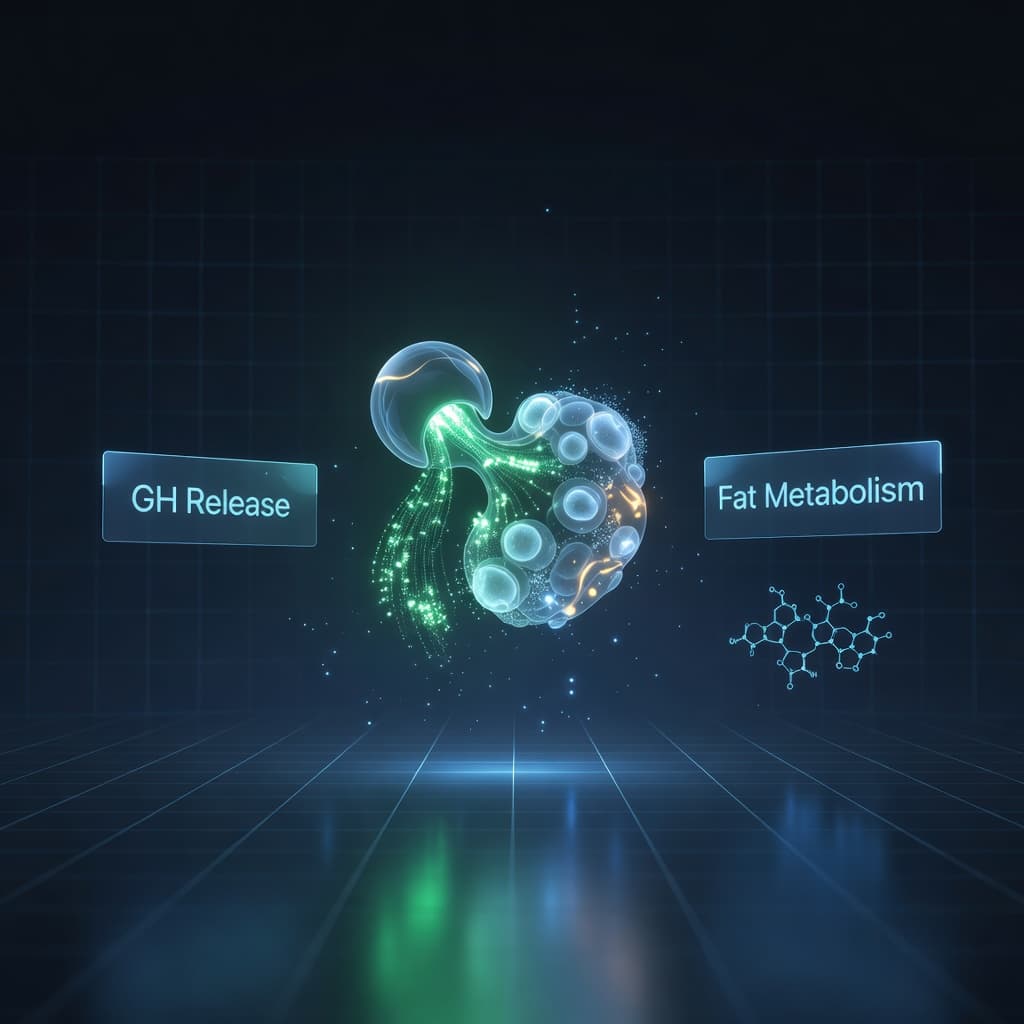
Tesamorelin (trade name Egrifta, formerly TH9507) is a synthetic analogue of growth-hormone-releasing hormone (GHRH). It stimulates the pituitary to release the body's own growth hormone in a pulsatile pattern, which raises IGF-1 and, in the studied populations, reduces visceral (deep abdominal) fat and liver fat. It is the only GHRH analogue with completed phase III human trials, all in HIV-associated fat accumulation.
Dosing Reference from Studies
2 mg/day (human, fixed, ~0.02 mg/kg/day) to 600 ug/kg (0.6 mg/kg, animal)
Dose in studies
Discussed in research communities 1-2 mg/day (SC)
Reference from peptide forums and community discussions. Not a recommendation, not based on studies, and not an established human protocol.
Established human dose available
How studies used it
- Model
- Human, 412 HIV patients on antiretroviral therapy with abdominal fat accumulation (86% male)
- Studied for
- HIV-associated lipodystrophy / excess visceral abdominal fat
- Dose
- 2 mg/day, about 0.02 mg/kg/day. Basis: the trial reported BMI, not body weight; for this 86%-male HIV cohort with documented median BMI in the high-20s the mean weight is roughly 85 kg, so 2 mg / ~85 kg is about 0.024 mg/kg/day. Raw mean weight in kg was not reported.
- Dosing
- once daily
- Route
- subcutaneous
- Duration
- 26 weeks
Effects measured: Visceral adipose tissue (VAT) fell 15.2% with tesamorelin versus a 5.0% rise with placebo (P<0.001). IGF-1 rose 81.0% versus a 5.0% fall on placebo (P<0.001). Triglycerides dropped 50 mg/dL versus a 9 mg/dL rise on placebo (P<0.001). Total-cholesterol-to-HDL ratio fell 0.31 versus a 0.21 rise on placebo.
Side effects: Overall adverse-event frequency did not differ significantly between groups, and no significant differences were seen in glucose or insulin measures. More tesamorelin-treated patients withdrew because of an adverse event than placebo patients (specific events not itemized in the report).
Sources: Falutz et al., N Engl J Med, 2007 (NEJM phase III, 26-week)
- Model
- Human, 404 HIV adults on antiretroviral therapy with central fat accumulation
- Studied for
- HIV-associated lipodystrophy / excess visceral abdominal fat (with 6-month safety extension)
- Dose
- 2 mg/day, about 0.02 mg/kg/day. Basis: trial reported BMI, not weight; ~85 kg cohort estimate gives 2 mg / ~85 kg = ~0.024 mg/kg/day. Mean weight in kg was not reported.
- Dosing
- once daily
- Route
- subcutaneous
- Duration
- 12 months (6-month efficacy phase plus 6-month extension)
Effects measured: At 6 months VAT fell 10.9% (about 21 cm2) versus 0.6% (about 1 cm2) on placebo (P<0.0001). In patients who stayed on drug for 12 months VAT fell about 18% (P<0.001). Trunk fat, waist circumference, and waist-to-hip ratio all improved; IGF-1 rose (P<0.001). Patients switched from tesamorelin to placebo rapidly re-accumulated VAT, showing the effect is not durable after stopping.
Side effects: Described as well tolerated. No significant change in glucose parameters during the efficacy phase. The abstract did not itemize injection-site or joint events.
Sources: Falutz et al., J Acquir Immune Defic Syndr, 2010 (12-month with safety extension)
- Model
- Human, 806 HIV patients on antiretroviral therapy with excess abdominal fat (543 tesamorelin, 263 placebo)
- Studied for
- HIV-associated lipodystrophy / excess visceral abdominal fat
- Dose
- 2 mg/day, about 0.02 mg/kg/day. Basis: trial reported BMI, not weight; ~85 kg cohort estimate gives 2 mg / ~85 kg = ~0.024 mg/kg/day. Mean weight in kg was not reported.
- Dosing
- once daily
- Route
- subcutaneous
- Duration
- 26-week primary phase plus 26-week safety extension (52 weeks total)
Effects measured: At week 26 VAT fell 24 cm2 with tesamorelin versus a 2 cm2 rise on placebo (treatment effect -15.4%). IGF-1 rose 108 ng/mL versus -7 ng/mL on placebo (P<0.001). Triglycerides fell 37 mg/dL versus a 6 mg/dL rise on placebo. By week 52 VAT had fallen about 35 cm2 (-17.5%) in continued-treatment patients.
Side effects: Generally well tolerated with no clinically meaningful differences in glucose parameters at weeks 26 and 52. Injection-site and joint events were not detailed numerically in this report.
Sources: Falutz et al., J Clin Endocrinol Metab, 2010 (second phase III, 806 patients)
- Model
- Human, 50 antiretroviral-treated HIV men and women with abdominal fat accumulation (48 completed); median BMI 28.1 (tesamorelin) and 30.1 (placebo) kg/m2
- Studied for
- Visceral fat plus liver (hepatic) fat in HIV
- Dose
- 2 mg/day, about 0.02 mg/kg/day. Basis: median BMI was 28-30 kg/m2; weight in kg was not tabulated. Using a representative ~85 kg for this cohort, 2 mg / ~85 kg = ~0.024 mg/kg/day. Raw weight was not reported.
- Dosing
- once daily
- Route
- subcutaneous
- Duration
- 6 months
Effects measured: VAT fell 34 cm2 with tesamorelin versus an 8 cm2 rise on placebo (net treatment effect -42 cm2, P=0.005). Liver fat (lipid-to-water percentage) fell a median 2.0% versus a 0.9% rise on placebo (net -2.9%, P=0.003). Fasting glucose rose transiently at 2 weeks but normalized by 6 months.
Side effects: No significant between-group difference overall. Injection-site bruising 36% vs 50% placebo; erythema 14% vs 9%; stinging 11% vs 0%. Arthralgia 14% vs 18% placebo; myalgia 11% vs 0%; paresthesia 21% vs 5% placebo; hyperglycemia 7% vs 9% placebo.
Sources: Stanley et al., JAMA, 2014 (liver-fat mechanistic RCT)
- Model
- Human, 61 HIV patients with non-alcoholic fatty liver disease (hepatic fat fraction >=5%); 30 tesamorelin, 30 placebo; baseline BMI 30.1 (tesamorelin) and 32.9 (placebo) kg/m2
- Studied for
- HIV-associated non-alcoholic fatty liver disease (NAFLD) / liver fat and fibrosis
- Dose
- 2 mg/day, about 0.02 mg/kg/day. Basis: baseline BMI ~30-33 kg/m2; weight in kg was not reported. Using a representative ~90 kg for this higher-BMI cohort, 2 mg / ~90 kg = ~0.022 mg/kg/day. Raw weight was not reported.
- Dosing
- once daily
- Route
- subcutaneous
- Duration
- 12-month blinded phase (plus 6-month open-label)
Effects measured: Hepatic fat fraction fell 4.1% absolute (95% CI -7.6 to -0.7, P=0.018), a 37% relative drop from baseline (P=0.016). 35% of tesamorelin patients reached hepatic fat fraction below 5% versus 4% on placebo (P=0.0069). Fibrosis progression occurred in 10.5% on tesamorelin versus 37.5% on placebo (P=0.04).
Side effects: More localized injection-site complaints on tesamorelin (e.g. erythema 3 vs 0, stinging 4 vs 1, other site complaints 10 vs 1; bruising 11 vs 11), none judged serious. Hyperglycemia 12 vs 11; glucose and HbA1c changes were comparable between groups.
- Model
- Animal / preclinical: pigs, rats and dogs (non-clinical pharmacology and toxicology)
- Studied for
- Pharmacology and safety profiling of the GHRH analogue TH9507 (tesamorelin); GH/IGF-1 stimulation
- Dose
- Up to 600 microg/kg (0.6 mg/kg), given directly per kg body weight
- Dosing
- single and repeated daily injections (subchronic toxicity studies)
- Route
- intravenous and subcutaneous
- Duration
- up to 4 months in subchronic toxicity studies
Effects measured: Plasma growth hormone and IGF-1 rose markedly in pigs, rats and dogs. A significant but not dose-related increase in body-weight gain occurred alongside the biomarker response. Elimination half-life in dogs ranged from about 21 to 45 minutes.
Side effects: At sustained supraphysiological GH/IGF-1 exposure, dogs showed reversible adverse findings: liver and kidney changes, anaemia, clinical-chemistry shifts and organ-weight effects. These were attributed to the exaggerated pharmacology (high GH/IGF-1), not direct toxicity.
Sources: Ferdinandi et al., Basic Clin Pharmacol Toxicol, 2007 (preclinical, 600 ug/kg)
How solid the evidence is
Strong for one narrow use, weak for everything else. The human evidence base is unusually solid for a peptide: multiple randomized, double-blind, placebo-controlled trials (Falutz NEJM 2007 with 412 patients, Falutz JCEM 2010 with 806 patients, plus mechanistic RCTs from Stanley) and an established, regulator-approved human dosing protocol of 2 mg subcutaneous once daily (FDA Egrifta, 2010). That is a real human protocol, unlike most research peptides. The important caveat is that every one of these trials was in HIV patients with antiretroviral-associated fat accumulation; there is NO trial evidence in healthy adults, in general obesity, or for bodybuilding/anti-aging use, so any use outside HIV-associated fat is unstudied and off-label. The phase III trials (Falutz 2007/2010) were funded by the manufacturer (Theratechnics/EMD Serono), a clear sponsorship interest; the Stanley JAMA 2014 and Lancet HIV 2019 trials were largely NIH-funded and more independent. A dosing-conversion caveat: none of these papers reported participants' body weight in kilograms, only BMI (median roughly 28-33 kg/m2), so the per-kg figures here (~0.02 mg/kg/day) are estimates derived from a representative ~85-90 kg weight for these predominantly male cohorts and should be read as approximate, not as a figure the papers themselves printed. Consistent measured signals across trials: visceral fat down ~15-18%, liver fat down ~37%, IGF-1 up substantially, triglycerides down. Recurrent adverse events: injection-site reactions, arthralgia/myalgia, paresthesia, and transient or borderline glucose elevations (IGF-1 rises and glucose drift are predictable consequences of raising GH). Benefits reverse after stopping. The preclinical Ferdinandi 2007 work is animal-only and showed reversible liver/kidney/anaemia findings in dogs at sustained high GH/IGF-1 exposure. None of this is a therapeutic promise; it is a summary of what the studies measured.
Sources
- Falutz et al., N Engl J Med, 2007 (NEJM phase III, 26-week)(PMID 18057338)
- Falutz et al., J Acquir Immune Defic Syndr, 2010 (12-month with safety extension)(PMID 20101189)
- Falutz et al., J Clin Endocrinol Metab, 2010 (second phase III, 806 patients)(PMID 20554713)
- Stanley et al., JAMA, 2014 (liver-fat mechanistic RCT)(PMID 25038357)
- Stanley et al., Lancet HIV, 2019 (NAFLD RCT)(PMID 31611038)
- Ferdinandi et al., Basic Clin Pharmacol Toxicol, 2007 (preclinical, 600 ug/kg)(PMID 17214611)
- Dhillon, BioDrugs, 2011 - review of tesamorelin in HIV-associated lipodystrophy (pooled two 26-week trials, week-52 maintenance, VAT re-accumulation on discontinuation; serious AEs <4% included injection-site reactions, arthralgia, headache, peripheral edema)(PMID 22050344)
- Badran et al., Obes Res Clin Pract, 2026 - meta-analysis of 5 RCTs: VAT -27.71 cm2, trunk fat -1.18 kg, hepatic fat -4.28%, waist -1.61 cm, lean body mass +1.42 kg; AEs arthralgia, myalgia, paresthesia, injection-site erythema, no serious safety signal(PMID 41545261)
Frequently asked questions
What is Tesamorelin?
Tesamorelin (trade name Egrifta, formerly TH9507) is a synthetic analogue of growth-hormone-releasing hormone (GHRH). It stimulates the pituitary to release the body's own growth hormone in a pulsatile pattern, which raises IGF-1 and, in the studied populations, reduces visceral (deep abdominal) fat and liver fat. It is the only GHRH analogue with completed phase III human trials, all in HIV-associated fat accumulation.
Is Tesamorelin legal to buy in the EU?
Tesamorelin is sold strictly for laboratory research use. In the European Union it can be purchased as a research chemical, and it is not approved or intended for human or veterinary use. You are responsible for compliant handling in your country.
Where can I buy Tesamorelin in Europe?
You can buy Tesamorelin from PeptidesDirect, an EU-based shop that dispatches fast, tracked DHL parcels from within Europe. Every batch comes with a third-party Janoshik certificate of analysis (HPLC purity and mass-spectrometry identity), and selected batches also carry our own independent Liquilabs lab testing, all verifiable online before you buy.
Study data, research use only. No established human dosing protocol.