Does BPC-157 work near the injury or systemically?
What animal studies report when local and systemic BPC-157 routes were run in the same model, which routes were tested, and what human data are missing.
Research use only. This page is scientific background and community-report context. Every compound sold here is supplied strictly for in-vitro research. Nothing on this page is a protocol, a recommendation, or medical advice.
TL;DR: local versus systemic BPC-157 routes
Research question: Do animal studies compare local and systemic BPC-157 routes in one model? What the published data say: two rat papers each ran a local arm plus systemic arms in one model, and both state the outcome for treated animals as a group versus control, without ranking routes (Gjurasin 2010, PMID 19903499; Cerovecki 2010, PMID 20225319). What the documented searches found: no controlled human comparison of a local site versus a systemic dose. A PubMed search on 2026-09-17 for BPC-157 AND humans[MeSH Terms] returned 53 records; the human route reports are uncontrolled (PMID 40131143, PMID 34324435). ClinicalTrials.gov listed 4 BPC-157 studies and 0 with results. What research communities report: in the Reddit corpus we track, 52 question posts in 12 months (of 87,002) matched a local-versus-systemic route pattern, and 1 post in the 13 to 17 September 2026 window (of 956) matched. Those counts are reports of questions asked, not evidence of an effect.
Did any animal study compare a local and a systemic route in one model?
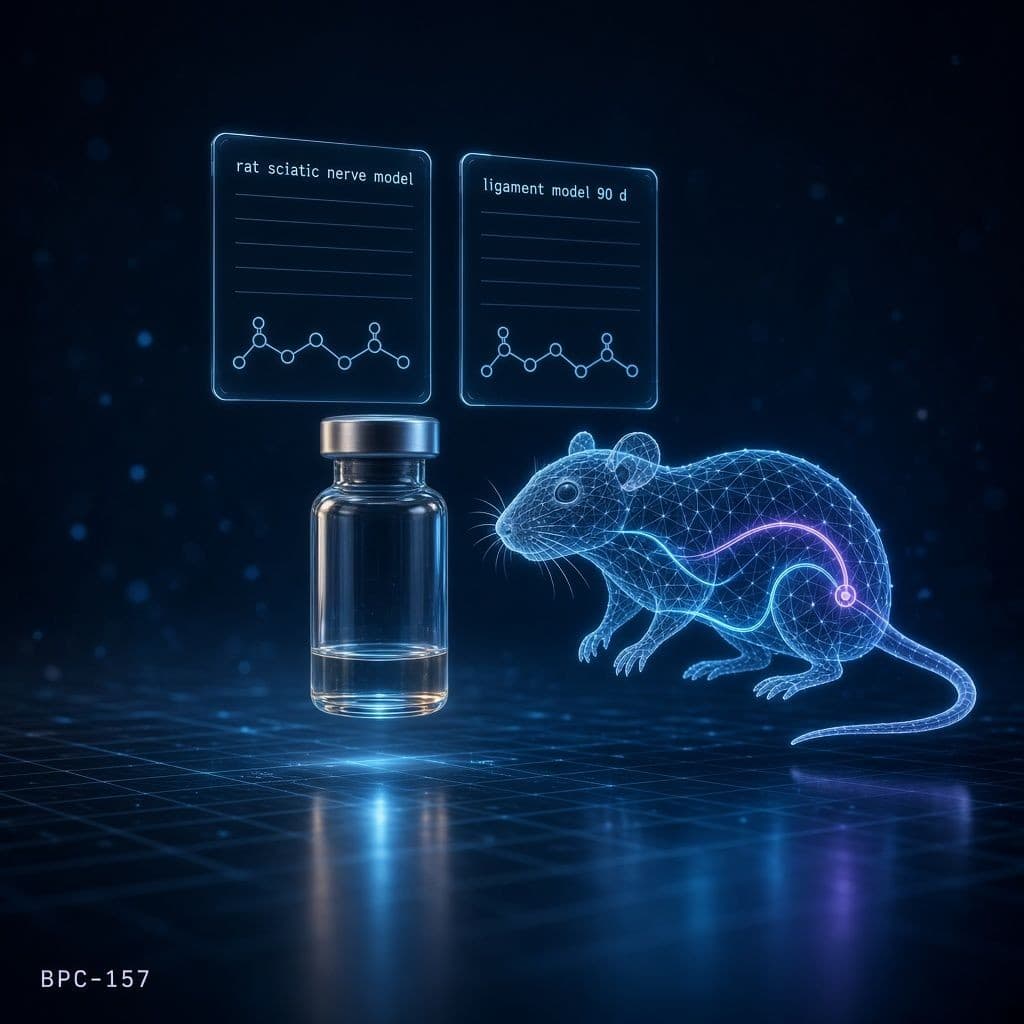
Two rat papers ran a local arm alongside systemic arms in one model, and both reported treated-arm results collectively without ranking routes: Gjurasin 2010 in a sciatic nerve transection model (PMID 19903499) and Cerovecki 2010 in a ligament transection model (PMID 20225319). A PubMed esearch on 2026-09-17 returned 0 records for "BPC 157 local versus systemic administration" as a titled topic, and 11 records for "BPC 157 AND (local OR topical) AND systemic", none of them a human route comparison. Mateescu 2026, section 5.4, cites "the theoretical advantage of achieving high local tissue concentrations at the site of injury while minimizing systemic exposure" and does not treat that advantage as demonstrated (PMID 42198317).
Which routes were used in the rat nerve and ligament models?
These are the study arms of the cited trials, not an application protocol for research vials.
- Local arm
- At the anastomosis; one configuration directly into nerve tubing after resection of a 7 mm nerve segment
- Systemic arms
- Intraperitoneal and intragastric, 10 microg/kg and 10 ng/kg
- Comparator
- Control (treated arms as a group)
- Duration
- 1 or 2 months
- Source
- PMID 19903499
- Local arm
- Thin cream, 1.0 microg per g
- Systemic arms
- Intraperitoneal 10 microg/kg or 10 ng/kg once daily; drinking water 0.16 microg/mL
- Comparator
- Control (all three arms as a group)
- Duration
- Up to 90 days
- Source
- PMID 20225319
In Gjurasin 2010 the arms started shortly after injury, and one local configuration placed the peptide directly into non-anastomozed nerve tubing after a 7 mm nerve segment was resected (PMID 19903499). In Cerovecki 2010 the intraperitoneal arm began 30 min after surgery, the drinking water ran at 12 mL per day per rat until sacrifice, and the peptide was always given alone, without a carrier (PMID 20225319). The local cream and the systemic solutions are not the same preparation.
The remaining cited models used these route sets. In a mouse burn model, Mikus 2001 applied BPC-157 intraperitoneally at 10 microg/kg or 10 ng/kg, or topically at the burn as a thin cream (50 microg in 50 g base), once daily from immediately after burning until 24 h before sacrifice, days 1 to 21 (PMID 11718984). Krivic 2006 used only an intraperitoneal route, remote from the lesion (PMID 16583442). Japjec 2021 used intraperitoneal and drinking-water arms only, with no local arm at the myotendinous junction (PMID 34829776).
What did those reports say about the treated animals?
Gjurasin 2010 states a collective result versus control, with no ranking between routes: "BPC 157-rats exhibited faster axonal regeneration" (PMID 19903499). Cerovecki 2010 states a group result for all three arms versus control up to 90 days, without declaring one route superior: "Commonly, BPC 157 microg-ng-rats exhibited consistent functional, biomechanical, macroscopic and histological healing improvements." (PMID 20225319). In a mouse burn model, Mikus 2001 reported that gastric lesions remote from the burn were "consistently attenuated only by BPC 157 treatments: either given i.p. (at either dose), or given locally (at either concentration)" (PMID 11718984). That gastric readout is not a general rule for other lesions. The cited rat reports describe treated-arm results collectively and do not establish route superiority (PMID 19903499; PMID 20225319).
What do animal pharmacokinetic data show about where the peptide goes?
In the formal animal pharmacokinetic study, rats received single intravenous and single intramuscular doses at 20, 100 and 500 microg/kg, dogs at 6, 30 and 150 microg/kg (He 2022, PMID 36588717). After a single intravenous dose in rats, the average elimination half-life (t1/2) was 15.2 min; after single intramuscular doses, absolute bioavailability was 18.82%, 14.49% and 19.35% in rats and 45.27%, 47.64% and 50.56% in dogs; after one intramuscular dose of tritium-labelled BPC-157 at 100 microg/kg, total radioactivity concentration was detected in all sampled rat tissues from 3 min through 24 h (PMID 36588717). Tissue radioactivity is not a ranking of local versus systemic lesion readouts, and it is not a human finding.
What is missing in the human record?
A PubMed esearch on 2026-09-17 for "BPC-157 AND humans[MeSH Terms]" returned 53 records. No retrieved record is a controlled human comparison of a local application site with a systemic dose; the human route reports are uncontrolled. Lee 2025 enrolled two people and infused BPC-157 in normal saline over one hour on each of two consecutive days; the primary abstract reports safety endpoints only (PMID 40131143). Lee 2021 reviewed 17 intra-articular charts, reached 16 people, 12 on BPC-157 alone, with recall after 6 to 12 months, and used no specific tools to measure function, quality of life or stiffness (PMID 34324435). ClinicalTrials.gov on 2026-09-17 listed 4 BPC-157 studies and 0 with posted results (NCT07803250, NCT07437547, NCT07752381, NCT02637284). The study descriptions here are not an application protocol for research vials.
Products mentioned
BPC-157 is a synthetic 15-amino-acid gastric pentadecapeptide, studied in rodent and cell-culture models for angiogenesis, cell migration and nitric-oxide pathway activity. Lyophilized powder, specified purity at or above 98% (HPLC), batch CoA.
A pre-mixed vial of BPC-157 and full-length thymosin beta-4 (TB-500) at a fixed 1:1 composition, 10 mg = 5 mg each, 20 mg = 10 mg each. Purity reported per component on a batch-specific Janoshik CoA.
Sources
- Gjurasin 2010, Regul Pept 160(1-3):33-41, PMID 19903499.
- Cerovecki 2010, J Orthop Res 28(9):1155-61, PMID 20225319.
- Mikus 2001, Burns 27(8):817-27, PMID 11718984.
- Krivic 2006, J Orthop Res 24(5):982-9, PMID 16583442.
- Japjec 2021, Biomedicines 9(11):1547, PMID 34829776.
- He 2022, Front Pharmacol, PMID 36588717.
- Lee 2025, Altern Ther Health Med 31(5):20-24, PMID 40131143.
- Lee 2021, Altern Ther Health Med 27(4):8-13, PMID 34324435.
- Mateescu 2026, Pharmaceutics, section 5.4, PMID 42198317.
- ClinicalTrials.gov, 2026-09-17, query BPC-157: NCT07803250, NCT07437547, NCT07752381, NCT02637284 (4 studies, 0 with results).
- PubMed esearch, 2026-09-17: "BPC 157 local versus systemic administration" (0 records); "BPC 157 AND (local OR topical) AND systemic" (11 records); "BPC-157 AND humans[MeSH Terms]" (53 records).
- Reddit corpus we track: 87,002 question posts in 12 months; 956 posts in the 13 to 17 September 2026 window.
Research use only. BPC-157 is supplied for laboratory research, not for human or animal administration, and not as a medicine. Nothing in this article is a dosing, injection, or medical instruction.
Research context for English-speaking buyers
Most of our English-speaking customers ship to the UK, Ireland, Malta or other English-as-second-language EU territories. The regulatory picture differs per country.
- Relevant authorities
- MHRA (UK, post-Brexit), HPRA (Ireland, EU-aligned), FDA Section 503A bulks list (US, restricted Cat 2 status of several peptides as of 2026)
- Customs and VAT
- EU shipments include VAT, the rate depends on the destination country; UK shipments after Brexit are now extra-EU and may attract UK VAT plus a handling fee at import
- Typical shipping window
- EU 2-4 working days, UK 4-7 working days, other international 7-14 working days, depending on customs
Research-grade peptides shipped from our EU warehouse are sold for laboratory use only and are not authorised for human or veterinary therapeutic application in any of the destination jurisdictions. US customers should be aware that the FDA Section 503A bulks list classification (and the April 2026 reclassification of twelve compounds) only governs compounding pharmacies, not direct-to-researcher imports for non-clinical work. UK buyers should declare the consignment on import and may be asked for a research justification by HMRC. We provide a CoA per batch identified by colour code rather than serial number; customs sometimes asks for this document when clearing the parcel.