Do Copper Peptides Actually Work? GHK vs GHK-Cu vs AHK-Cu in the Research
Copper peptides compared: GHK vs GHK-Cu vs AHK-Cu, copper-bound vs copper-free, and what the skin and wound research actually supports.
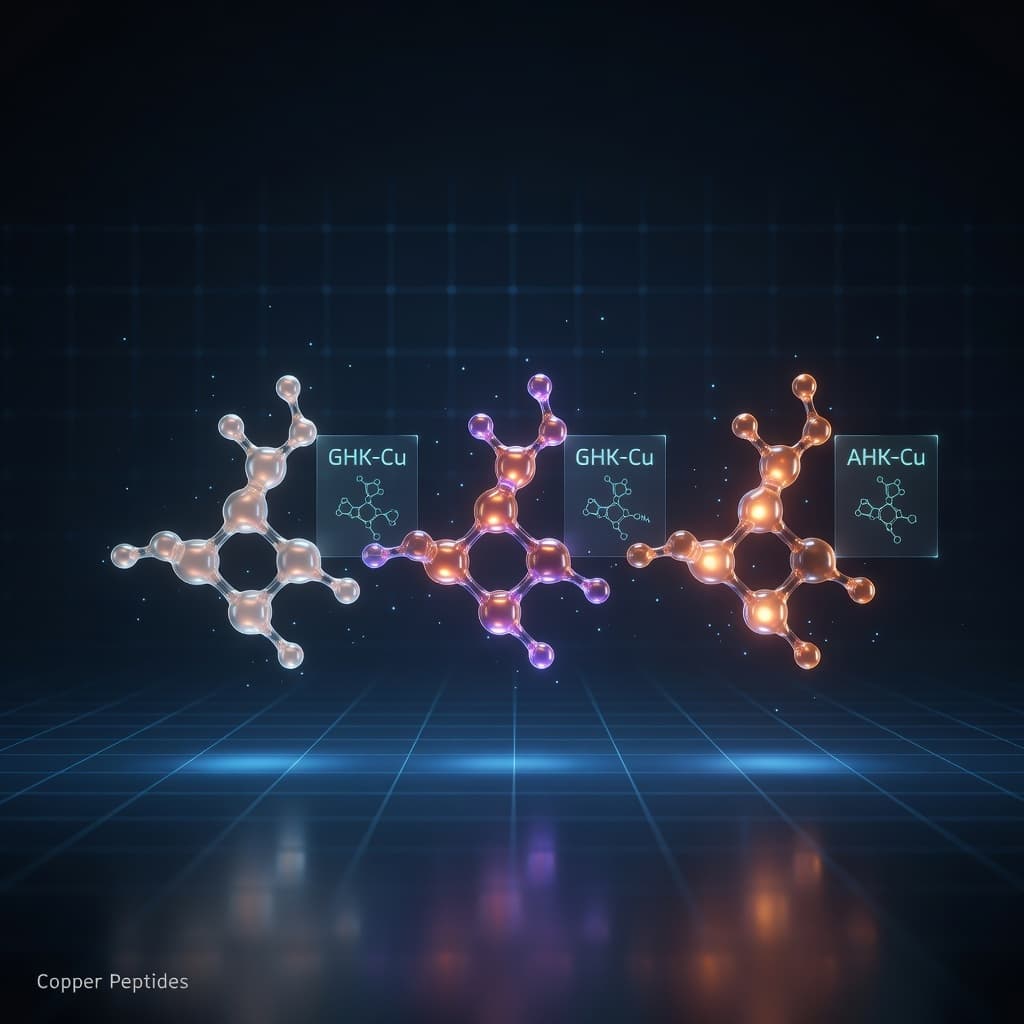
TL;DR: three different tripeptides, not one product with three names
GHK is a copper-free tripeptide (glycine-histidine-lysine) that occurs naturally in human plasma. GHK-Cu is the same tripeptide non-covalently bound to one copper(II) ion, the form sold as a research compound and used cosmetically as Copper Tripeptide-1. AHK-Cu swaps the glycine for alanine and has its own, much smaller evidence base, centered on a single dedicated hair-follicle study. Copper-free GHK is not inert. Several independent studies show it retains activity on its own (keratinocyte stemness markers, fibroblast signaling, direct metal chelation), so "GHK vs GHK-Cu" is not simply inactive-versus-active. The hair data belongs to AHK-Cu, not GHK-Cu. Conflating the two is one of the most common errors in vendor and blog content on this topic. No drug approval exists for any of the three. GHK-Cu's real regulatory footprint is as a cosmetic ingredient in the EU under Regulation (EC) 1223/2009; a widely repeated FDA-approval claim actually traces back to a 510(k) device clearance for an unrelated copper-saline wound dressing. A 2024/2025 review flags the elephant in the room: despite decades of cosmetic marketing, there is a surprising absence of controlled human clinical studies on GHK-Cu, alongside unresolved questions about how well it actually penetrates skin.
Copper peptides are one of the oldest names in peptide research, and also one of the most confused. Type "GHK-Cu" into a search bar and you will find hair-growth claims, wrinkle-cream claims, wound-healing claims, and a number attached to genes that gets repeated so often it reads as settled fact. Very little of that popular narrative distinguishes between three chemically distinct molecules: GHK, GHK-Cu, and AHK-Cu. This article works through what separates them, what the actual published research supports for each, and where marketing language has drifted from the data.
Three molecules, not one name
GHK (glycyl-L-histidyl-L-lysine) is a naturally occurring human tripeptide, first isolated by Loren Pickart in 1973 from an observation that a fraction of young human plasma made cultured aged liver tissue behave more like younger tissue. The Gly-His-Lys sequence itself was identified around 1977. GHK has since been detected circulating in human plasma, saliva and urine, in its copper-free form.
GHK-Cu is GHK non-covalently chelating a single Cu2+ ion. The chemistry is specific: the free amino group of the N-terminal glycine, the backbone amide nitrogen, and the histidine imidazole nitrogen together form a high-affinity, roughly square-planar copper complex (an ATCUN-type binding motif). That tight binding is the proposed reason GHK-Cu can carry copper around without triggering the free-radical (Fenton) chemistry that loose Cu2+ ions are prone to. Cosmetically, GHK-Cu is registered under the INCI name Copper Tripeptide-1 and is commonly formulated at roughly 0.05 to 1 percent in leave-on products, a figure sourced from formulator and vendor practice rather than a regulatory mandate.
AHK-Cu (alanyl-L-histidyl-L-lysine-Cu2+) looks almost identical on paper: swap the N-terminal glycine of GHK-Cu for alanine, keep the bound copper ion. But its evidence base is separate and far smaller. A targeted search of the literature for the exact term AHK-Cu returns essentially one dedicated primary paper, a 2007 in-vitro and ex-vivo hair-biology study (PMID 17703734). There is no comparable AHK-Cu body of work on skin remodeling, wound healing, or gene expression: that literature belongs to GHK-Cu.
The distinction matters for a simple reason: a lot of secondary content treats GHK, GHK-Cu and AHK-Cu as interchangeable spellings of the same ingredient. They are not. Only one, GHK-Cu, is stocked here as a standalone research compound.
Naturally occurring copper tripeptide complex for skin regeneration and anti-aging research. Stimulates collagen synthesis, accelerates wound healing, and modulates 4000+ genes. Plasma levels decline with age, making it a key target in longevity research.
What the GHK-Cu research actually shows
The foundational GHK-Cu literature comes largely from Loren Pickart's own group. A 2008 review (PMID 18644225) synthesizes decades of cell-culture and animal work: GHK-Cu chemoattracts macrophages, mast cells and capillary endothelial cells to sites of injury, stimulates synthesis of collagen, elastin, glycosaminoglycans and growth factors, promotes fibroblast and keratinocyte proliferation, and supports nerve outgrowth and angiogenesis. A follow-up 2015 paper (PMID 26236730) extends this into a broader transcriptional picture, reporting that GHK modulates expression across a very large number of human genes based on bioinformatic gene-signature matching, and frames this as GHK resetting cellular activity toward a healthier pattern.
Read the gene-expression claim as a hypothesis, not a proven outcome
The oft-repeated line that GHK resets thousands of genes and reverses aging traces back to Pickart's own bioinformatic signature-matching analysis in his own papers, where Pickart is also the original discoverer of the peptide. It is not an independently replicated, causally validated human outcome trial. Treat it as hypothesis-generating research, useful for directing further study, not as demonstrated clinical fact.
Two mechanistic threads outside the Pickart group are worth separating out because they change how "GHK vs GHK-Cu" should be understood. First, copper-free GHK is independently bioactive. A 2012 study (PMID 23019153) found that GHK without any bound copper increased keratinocyte proliferation and basal-cell stemness markers in a skin model, with effects the authors describe as similar to the copper-bound form. A 2014 study (PMID 25745767) found that both GHK and GHK-Cu similarly reduced IGF-2-driven TGF-beta1 secretion in cultured human dermal fibroblasts, a pathway relevant to anti-fibrotic and anti-scarring rationale. Second, a 2024 paper (PMID 38599632) shows copper-free GHK itself chelates and buffers free Cu2+ and Zn2+ ions, preventing metal-induced protein aggregation and cell death in a central-nervous-system in-vitro model, and proposes (without human data) relevance to neurodegenerative disease research.
Put together: GHK is not simply an inert delivery vehicle that only "does something" once copper is attached. Both forms show activity, sometimes on the same assay, which is a more nuanced picture than most vendor copy presents.
Animal-model data adds further mechanistic support without closing the human-evidence gap. A rabbit study (PMID 17083573) found a topical tripeptide-copper complex improved open-wound healing parameters compared to controls. A mouse study (PMID 27517151) found GHK-Cu reduced inflammatory markers (TNF-alpha, IL-6), oxidative stress and lung tissue damage in a model of acute lung injury, alongside reduced NF-kB and p38 MAPK signaling in macrophages in vitro. Both are legitimate preclinical findings and both are rodent or rabbit studies, not human data.
AHK-Cu and hair: a separate, much thinner evidence track
The hair-growth claim attached to copper peptides deserves its own section because it is frequently mis-cited. The dedicated dataset is a 2007 paper (PMID 17703734) testing AHK-Cu, not GHK-Cu, on human tissue in vitro and ex vivo. At concentrations between 10^-12 and 10^-9 M, picomolar to nanomolar, AHK-Cu stimulated elongation of cultured human hair follicles and proliferation of dermal papilla cells, and reduced dermal papilla cell apoptosis (a higher Bcl-2/Bax ratio and lower cleaved caspase-3 and PARP, markers of reduced programmed cell death).
That is a real, specific, and reasonably clean in-vitro and ex-vivo signal. What it is not: a GHK-Cu study, or a human clinical trial. A search of the literature for the exact term AHK-Cu returns this paper as essentially the entirety of the dedicated dataset, meaning there is no independent replication and no in-vivo human hair-growth trial behind it.
We do not stock AHK-Cu as a separate product. If you are researching the hair-follicle mechanism specifically, that evidence sits with AHK-Cu, not with the GHK-Cu compound listed here, and the two should not be treated as interchangeable simply because both are copper-bound tripeptides.
Where the evidence is thinner than the marketing
The honest caveat for this entire compound family comes from a 2024/2025 review (PMID 39963574) focused specifically on topical GHK as an anti-wrinkle peptide. Its central finding is blunt: despite widespread cosmetic-market use of GHK-Cu and derivatives like palmitoyl-GHK, there is a surprising absence of controlled clinical studies. The same review flags that GHK's intrinsic skin permeability is poor, it is hydrophilic with a low partition coefficient, and formulation stability is an unresolved problem, meaning published data on how much of a topically applied dose actually reaches viable skin layers remains insufficient.
Watch for fabricated citations in copper-peptide content
This topic attracts an unusual volume of invented-looking references: specific percentages attached to author names and years that do not resolve to real papers on PubMed or Europe PMC, and in at least one case a citation formatted to look like a PMID that was actually a DOI for an unrelated document. Separately, a real, verifiable paper (Watson et al. 2009, British Journal of Dermatology) is sometimes wrongly attributed to GHK-Cu in AI-generated summaries: it studies a different, unnamed cosmetic anti-aging product's effect on fibrillin-1, not GHK-Cu. If a claim cannot be traced to a PMID you can independently pull up, treat it as unverified.
There is currently one registered human trial of topical GHK-Cu gel for acute skin wound healing (NCT07437586), still recruiting with no results posted as of this writing. Until that or a comparable trial reports, the human efficacy picture for GHK-Cu remains built on cell culture, animal models, and a small number of older, sponsor-linked or non-independently-verified human reports rather than a large, peer-reviewed, placebo-controlled dataset.
Regulatory status, safety, and sourcing for research use
None of GHK, GHK-Cu, or AHK-Cu is an FDA-approved or EMA-approved drug. No completed large human randomized controlled trial establishing a drug-level efficacy claim for any of the three was located. GHK-Cu's genuine regulatory footprint is as a cosmetic ingredient: in the EU it falls under Cosmetics Regulation (EC) 1223/2009 as a safety-assessed ingredient, not a medicine. A claim that circulates periodically, that GHK-Cu is FDA approved, appears to trace back to a real but unrelated event: a Pickart-linked copper-saline wound dressing received FDA 510(k) clearance as a Class II medical device (K964468). That is device clearance for a dressing product, not drug approval of the peptide itself, and the two should not be conflated.
On safety, topical GHK-Cu and copper-free GHK at typical cosmetic-use levels are generally described as well tolerated in the literature reviewed here, but dedicated, independent, long-duration human toxicology and pharmacokinetic studies are limited. Most of the safety inference comes from short cosmetic tolerability observations plus general copper biology rather than purpose-built trials. Mechanistically, free unchelated Cu2+ is redox-active and can drive oxidative damage, and copper overload is toxic in conditions like Wilson's disease; GHK's high copper-binding affinity is proposed to blunt this reactivity when copper is complexed, but that is a chemistry-based rationale, not a substitute for dedicated safety data. No human dosing or safety data for injectable or oral GHK-Cu or AHK-Cu were found in this review; the only parenteral-route data located is the rodent lung-injury model (PMID 27517151), so any claim extrapolating cosmetic topical safety to injectable research use is not supported by the literature.
For sourcing, the same rules apply to copper peptides as to any research compound: verify identity and purity rather than trusting a listing on its own. Every GHK-Cu batch sold here ships with a Janoshik certificate of analysis, viewable on the product page and on the site's public Lab Reports page; purity methodology is explained further at /purity. Reconstitute with bacteriostatic water using standard sterile technique, store lyophilized powder at minus 20 Celsius, and keep reconstituted solution refrigerated and used within a few weeks, standard practice for a small, chelation-sensitive tripeptide rather than a compound-specific quirk.
For readers researching the tripeptide class more broadly rather than copper chemistry specifically, GHK-Cu is one of the components in our GLOW blend, and KPV represents a structurally different but equally short bioactive tripeptide, derived from the C-terminal end of alpha-MSH, studied for anti-inflammatory rather than copper-dependent tissue-remodeling activity. Worth knowing as a separate mechanism if you are mapping short-tripeptide research generally, not a substitute for the copper-chemistry evidence discussed above.
Naturally occurring copper tripeptide complex for skin regeneration and anti-aging research. Stimulates collagen synthesis, accelerates wound healing, and modulates 4000+ genes. Plasma levels decline with age, making it a key target in longevity research.
3-in-1 skin peptide blend: GHK-Cu 50mg + BPC-157 10mg + TB-500 10mg. Targets collagen synthesis, tissue regeneration, and skin repair for comprehensive dermatological research.
Anti-inflammatory tripeptide derived from alpha-MSH (positions 11-13). Inhibits NF-kB signaling, supports gut barrier integrity, and shows antimicrobial activity. A targeted approach to inflammation research without broad immunosuppression.
Tissue repair, wound healing, and recovery peptides
By research goal
Copper-chelation and tissue-remodeling mechanism research
Multi-peptide skin-regeneration blend that includes GHK-Cu
Anti-inflammatory tripeptide research, different mechanism class
Frequently Asked Questions
This article is for informational and research purposes only. GHK, GHK-Cu, AHK-Cu, and all products referenced are sold exclusively as research material for in-vitro and preclinical laboratory use, not for human consumption or therapeutic use.
Research context for English-speaking buyers
Most of our English-speaking customers ship to the UK, Ireland, Malta or other English-as-second-language EU territories. The regulatory picture differs per country.
- Relevant authorities
- MHRA (UK, post-Brexit), HPRA (Ireland, EU-aligned), FDA Section 503A bulks list (US, restricted Cat 2 status of several peptides as of 2026)
- Customs and VAT
- EU shipments include 19% VAT; UK shipments after Brexit are now extra-EU and may attract UK VAT plus a handling fee at import
- Typical shipping window
- EU 2-4 working days, UK 4-7 working days, other international 7-14 working days, depending on customs
Research-grade peptides shipped from our EU warehouse are sold for laboratory use only and are not authorised for human or veterinary therapeutic application in any of the destination jurisdictions. US customers should be aware that the FDA Section 503A bulks list classification (and the April 2026 reclassification of twelve compounds) only governs compounding pharmacies, not direct-to-researcher imports for non-clinical work. UK buyers should declare the consignment on import and may be asked for a research justification by HMRC. We provide a CoA per batch identified by colour code rather than serial number; customs sometimes asks for this document when clearing the parcel.