Does NAD+ Fuel Cancer? What the Research Says About NAD+ and Tumor Risk
Does NAD+ fuel cancer? An honest research look at NAD+ metabolism, NAMPT in tumors and what preclinical and human data actually show.
TL;DR: What the evidence actually shows
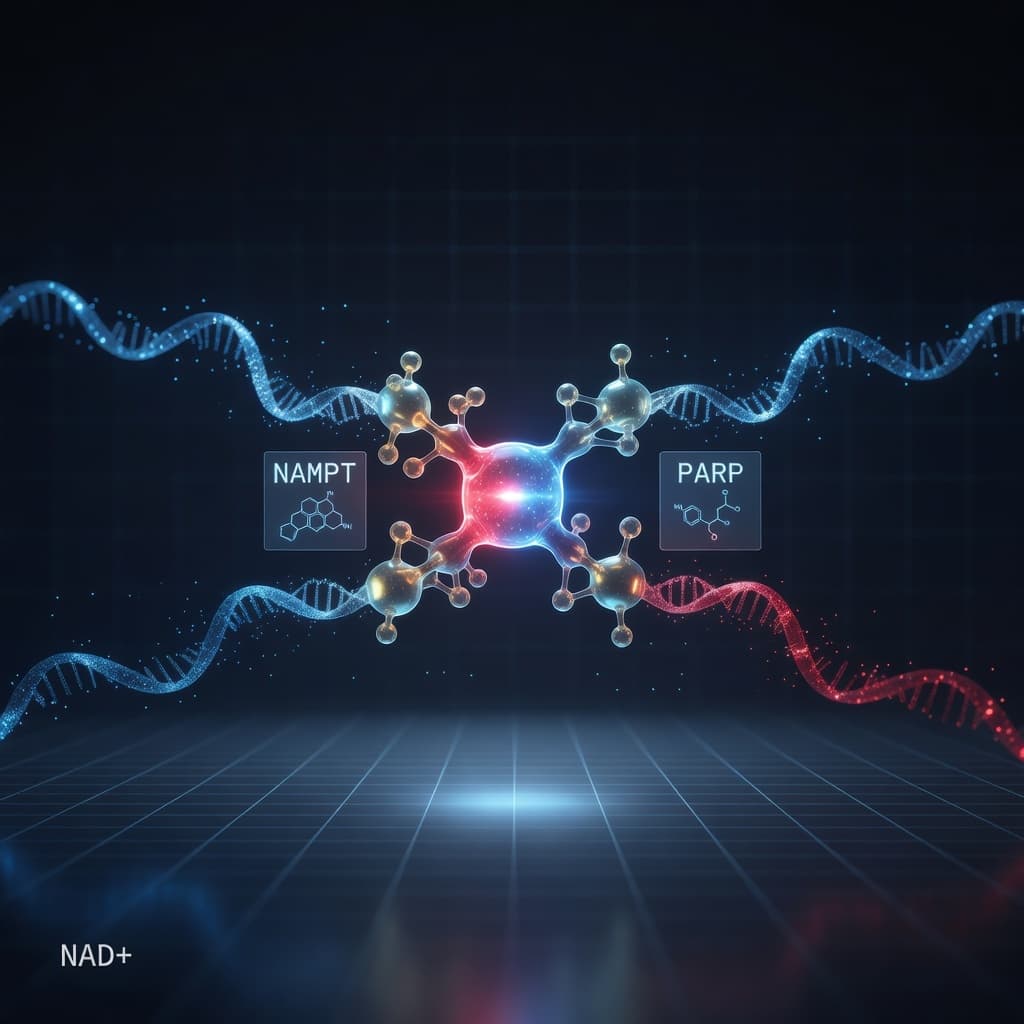
NAD+ metabolism is genuinely double-edged: it powers DNA repair (PARP1) and stress-response enzymes (sirtuins), but the same NAD+ pool also fuels the Warburg shift and survival pathways inside cells that are already cancerous. NAMPT, the enzyme that recycles NAD+, is recurrently overexpressed in prostate, colon, glioma, breast and gastric tumors, which is exactly why cancer drug developers tried to block it. No human study has shown that oral NAD+ precursors (NMN, NR) cause cancer, but no study has run long enough to properly test that question either. One 2023 mouse study found NR accelerated metastasis in an existing aggressive breast tumor model, a different 2024 mouse study found NMN reduced colon tumor formation, the preclinical picture is genuinely mixed. This is not medical advice: none of the research below establishes cancer safety or risk for humans, and it does not apply to anyone with active or recent cancer without their oncologist's input.
NAD+ (nicotinamide adenine dinucleotide) sits at the center of two research literatures that rarely talk to each other. In longevity and metabolic-health circles, it is framed as the molecule that keeps mitochondria and DNA-repair machinery running as cells age. In oncology, the exact same molecule is the reason a whole class of experimental cancer drugs, NAMPT inhibitors, was built specifically to deplete it from tumor cells. Both framings are backed by real, peer-reviewed evidence. This article tries to hold both at once, honestly, without collapsing into either "NAD+ is safe" or "NAD+ causes cancer," because neither claim is supported by the current data.
The double-edged biology: why NAD+ cuts both ways
NAD+ is not a drug with a single mechanism. It is a coenzyme required by several NAD+-dependent enzyme families, and two of those, PARP1/PARP2 and the sirtuins (SIRT1-7), explain most of the tension in this topic.
The protective side: DNA repair and genome stability
When a cell's DNA is damaged, PARP1 and PARP2 (poly-ADP-ribose polymerases) rapidly consume the local NAD+ pool to drive base-excision and single-strand-break repair. PARP1 is described in the literature as the single largest NAD+-consuming activity in the nucleus during a DNA-damage response, and this NAD+ consumption is part of a broader metabolic-shift response tied to the cell's repair process (Murata et al., 2019, PMID 31390283).
Alongside PARPs, the sirtuin family (SIRT1-7) are NAD+-dependent deacetylases that regulate DNA repair, mitochondrial function and stress responses. Some sirtuins, such as SIRT4, actively restrain genotoxic metabolic reprogramming and help preserve genomic integrity after damage (Jeong and Haigis, 2015, PMID 26420294). This is the mechanistic basis for the claim that "NAD+ supports genome stability," and it is a real, well-documented effect.
The tumor-promoting side: NAMPT and the Warburg shift
The same NAD+-dependent machinery gets co-opted once a cell has already become malignant. NAMPT (nicotinamide phosphoribosyltransferase) is the rate-limiting enzyme of the NAD+ salvage pathway, converting nicotinamide back into the NAD+ precursor NMN. NAMPT is recurrently overexpressed in prostate, colon, glioma, breast and gastric cancers (Yaku et al., 2018, PMID 30631755).
Elevated NAD+ from NAMPT overexpression does two things for a cancer cell. First, it fuels the Warburg shift, aerobic glycolysis needs NAD+ as a cofactor for enzymes like GAPDH and LDH. Second, it funds the same PARP- and SIRT1-driven survival and repair programs described above, letting cancer cells tolerate genotoxic and oxidative stress and sustain cancer-stem-cell-like properties (Lucena-Cacace et al., 2018, PMID 29203587). In glioma specifically, one study reported that elevated NAMPT expression drives cancer-stem-cell characteristics and that a NAMPT-derived gene signature was associated with tumor grade and outcome (Lucena-Cacace et al., 2017, PMID 29245920). In prostate cancer, a separate study reported that NAMPT overexpression contributes to tumor cell survival and stress-response tolerance (Wang et al., 2011, PMID 20956937).
One molecule, two enzyme families, opposite framings
A 2012 Nature Reviews Cancer paper frames this precisely: NAD+-dependent signaling, transcription, DNA repair, cell cycle, apoptosis, undergoes "crucial reprogramming" in cancer cells, making NAD+ metabolism a targetable, double-edged determinant of tumor biology (Chiarugi et al., 2012, PMID 23018234). A 2023 review goes further, describing explicit dual roles: malignant cells raise NAMPT to fuel glycolysis (tumor-promoting), while the same NAD+ pool supports the genome-stability functions of PARP and sirtuins described above (protective) (Yong et al., 2023, PMID 38116009).
Why oncology already tried to weaponize this: the NAMPT-inhibitor story
This dependency is exactly why NAMPT became a drug target. If tumors are unusually reliant on NAD+ for glycolysis and DNA-repair capacity, then depleting NAD+ selectively should starve them. Several NAMPT inhibitors were developed on that logic: FK866 (also called APO866 or daporinad), GMX1777/GMX1778, and CHS828.
Preclinically, this worked well. FK866 selectively killed leukemia, ALL, mantle cell lymphoma, CLL and T-cell lymphoma cells at low concentrations while sparing normal hematopoietic progenitors (Nahimana et al., 2009, PMID 19196867).
In human trials, the story changed. The first-in-human Phase I trial of FK866 enrolled 24 solid-tumor patients across six dose levels (0.018 to 0.144 mg/m2/h via 96-hour continuous IV infusion). The recommended Phase II dose was 0.126 mg/m2/h, but the trial hit dose-limiting thrombocytopenia in three patients at the highest levels. Four patients had stable disease for three or more months. Zero patients had an objective tumor response (Holen et al., 2008, PMID 17924057).
CHS828 told a similar story: a Phase I trial in seven patients (20-80 mg oral, once weekly for three weeks per four-week cycle), combined with a pooled overview of the published literature, found that across 104 total patients treated with NAD-depleting drugs of this class, toxicity was dominated by gastrointestinal symptoms and thrombocytopenia, and zero objective tumor remissions were recorded (von Heideman et al., 2010, PMID 19789873).
A failed drug class is not proof the biology is wrong
It is tempting to read "NAMPT inhibitors failed in trials" as evidence that NAD+ dependency in cancer was overstated. That is not the right conclusion. These drugs failed on toxicity and therapeutic window, hitting dose-limiting side effects before reaching a dose that showed efficacy, not because the underlying rationale (tumors that over-rely on NAD+ can be starved of it) was disproven. Combination approaches and more selective NAMPT inhibitors remain in active preclinical research. This is a pharmacology problem, not a biology refutation.
The consumer-facing question: do NAD+ precursors raise cancer risk in healthy people?
Everything above describes NAD+ metabolism inside cells that are already cancerous, or inside an experimental drug-development context. That is a different question from what most people actually want to know: if a healthy person raises their NAD+ levels with an oral precursor like NMN or NR, does that increase their risk of developing cancer? Here the evidence is much thinner, and the honest answer is that we do not know, because it has not been adequately studied.
What the human trials actually measured
Every controlled human trial of NMN or NR that has produced usable safety data is short, ranging from a single dose up to about twelve weeks, and was conducted in healthy, overweight, or prediabetic adults, not in cancer-risk or cancer-surveillance populations. None of them tracked cancer incidence as an endpoint.
- A single-dose trial of NMN (100, 250, and 500 mg) in 10 healthy Japanese men found the compound well tolerated at the studied single doses, with no significant deleterious effects reported (Irie et al., 2020, PMID 31685720).
- An 8-week randomized, placebo-controlled trial of NR (as nicotinamide riboside chloride) at 100, 300 and 1,000 mg/day in healthy overweight adults found a dose-dependent rise in whole-blood NAD+ of 22%, 51% and 142% respectively, with no excess adverse events versus placebo (Conze et al., 2019, PMID 31278280).
- A 10-week randomized trial of NMN at 250 mg/day in prediabetic postmenopausal women improved muscle insulin sensitivity versus placebo, with no reported safety signal (Yoshino et al., 2021, PMID 33888596).
Absence of a cancer signal in 8-12 weeks is not evidence of long-term safety
Cancer typically has a multi-year latency between an initiating event and a clinically detectable tumor. A trial that runs for 8 to 12 weeks, in healthy or metabolically mild populations, and that never measured cancer incidence, cannot answer the cancer-risk question either way. "No adverse events in the study period" answers a short-term tolerability question. It does not answer a long-term cancer-risk question, and should not be cited as though it does.
What the preclinical (animal) data show: genuinely mixed
Because human long-term data does not exist, the preclinical literature is where most of the concerning and reassuring signals both live, and it does not point in one consistent direction.
One concerning finding comes from a 2023 study tracking nicotinamide riboside uptake in mice. In an immunodeficient-mouse xenograft model of aggressive triple-negative breast cancer, the tumor subpopulation with the highest NR uptake also showed the fastest metastatic spread, and NR supplementation was associated with increased cancer prevalence and brain metastasis compared to controls (Maric et al., 2023, PMID 36371959). This is the study behind most "popular supplement linked to cancer" headlines.
Read the model carefully, though. This was a metastasis-acceleration study in mice that already carried an aggressive, pre-existing tumor with high NAD+ demand. It is not a carcinogenesis-initiation study showing NR creates cancer in healthy tissue. Those are different questions, and the study only answers the first one, in mice, with an already-established malignancy.
On the other side, a 2024 study in a colitis-associated colorectal-cancer mouse model found that NMN protected the tumor-suppressor protein STAT1 from oxidative-stress-induced degradation and reduced tumor formation, a preventive rather than promoting signal in a different cancer model (Li et al., 2024, PMID 39575303).
Reading two opposite mouse studies honestly
Neither the Maric (2023) nor the Li (2024) result cancels the other out, and neither should be treated as the final word. They used different cancer models (breast-cancer metastasis versus colitis-driven colorectal tumorigenesis), different precursors (NR versus NMN), and different NAD+-demand contexts. The honest summary is that NAD+-precursor effects on tumor behavior appear to be highly model- and context-dependent in animals, which is exactly why extrapolating either result directly to healthy human supplement users is not sound.
Common misconceptions, corrected
Two overreaches, both wrong
"NAD+ causes cancer" overstates the evidence: what is established is that many already-formed tumors upregulate NAD+ salvage metabolism via NAMPT to fuel their own growth, a different claim from "raising NAD+ in a healthy person causes cancer to form," which has no direct human evidence either way.
"NAD+ is purely protective, more is always better" also overstates the evidence, and ignores a decades-deep oncology drug-development literature (the NAMPT inhibitors above) built specifically on the fact that many tumors are NAD+-dependent.
A few more distinctions matter for reading this literature accurately:
- "NAD+ fuels existing cancer cells" is not the same claim as "NAD+ precursor supplements give healthy people cancer." The first is mechanistically well documented in tumor biology. The second has not been shown in any human study, and applies to a different population (people who already have cancer versus healthy supplement users).
- Injectable or IV NAD+ is not the same evidence base as oral precursors (NMN, NR). The two routes have different pharmacokinetics and different (and much thinner) safety literatures. Our own NAD+ research entry keeps this distinction explicit: direct human evidence for injected or IV NAD+ is genuinely thin, while the stronger human safety and pharmacokinetic data exist for oral NMN and NR specifically. This cancer-risk article stays consistent with that distinction and does not merge the two routes.
- A failed NAMPT-inhibitor drug program does not mean the NAD+-cancer dependency was wrong. As covered above, these trials failed on toxicity and therapeutic window, not on a lack of biological rationale.
A contrasting data point: not every longevity peptide shows this pattern
It is worth being precise that "cancer-adjacent uncertainty" is not a blanket description of every compound in this research category. Epitalon, a synthetic four-amino-acid peptide (AEDG) studied in aging research, has a different and narrower preclinical signal. In a chemically induced (DMH) rat colon-cancer model, continuous Epitalon treatment was associated with a lower mean tumor count than in saline controls (PMID 12049808). In an aging SHR mouse cohort, Epitalon-treated animals showed a markedly lower leukemia incidence, with no change in total spontaneous tumor incidence (PMID 14501183).
This is preclinical-only evidence from a single Russian research group and should not be read as an anti-cancer claim for a human product. It is included here strictly as an honest contrast point: some peptides studied in longevity research show reduced tumor signals in specific animal models, while other longevity-relevant compounds that are not peptides, like the NAD+ precursors above, show a genuinely mixed and context-dependent picture. Neither should be flattened into a single "longevity compounds are protective" or "longevity compounds are risky" narrative.
Where the EU research-material model helps
None of this changes what a research buyer actually needs: batch-level identity and purity documentation, not marketing claims about disease outcomes. Certificate-of-analysis and purity-methodology detail for the peptides discussed here are published at /coa and /purity. That does not resolve the cancer-risk science discussed in this article, no certificate of analysis can, but it does let researchers review the reported identity and purity testing methodology alongside the primary literature themselves.
Essential cellular coenzyme that declines with age. Powers energy metabolism in every cell, activates sirtuins (longevity genes), and supports DNA repair. A cornerstone molecule in aging and longevity research.
Tetrapeptide (Ala-Glu-Asp-Gly) that activates telomerase, the enzyme responsible for maintaining telomere length. One of the most studied peptides in longevity research, developed by Prof. Khavinson at the St. Petersburg Institute of Bioregulation.
Mitochondrial-derived signaling peptide (16 amino acids) that mimics the effects of exercise at the cellular level. Activates AMPK, improves glucose uptake, and enhances fat metabolism - a key tool in metabolic and longevity research.
Mitochondrial function, NAD+ metabolism, telomere maintenance
Practical framing for researchers
None of the compounds discussed in this article are approved cancer drugs, approved NAD+-raising therapeutics, or approved to treat, prevent, or diagnose any disease. NAMPT inhibitors (FK866, GMX1777/GMX1778, CHS828) reached Phase I/II oncology trials and were discontinued after dose-limiting toxicity without objective tumor responses; none are approved anywhere. NMN and NR are sold as research chemicals or dietary supplements, not drugs, and no disease claims, cancer-related or otherwise, are permitted on them under any current regulatory status.
Who this caution is actually aimed at
The oncology literature's caution around NAD+-precursor protocols is most relevant to people with an active cancer diagnosis, a recent cancer history, or a strong hereditary cancer risk, populations where raising systemic NAD+ could theoretically interact with an existing or undiagnosed NAD+-dependent tumor, mirroring what endogenous NAMPT overexpression already does inside cancer cells. This is a mechanistic and theoretical concern grounded in real biology, not a proven clinical outcome. It is not a general warning against research use by healthy researchers, and it is not established science in either direction for the general population.
Mitochondrial and NAD+ metabolism research
Aging-related peptide research
Mitochondrial and NAD+-metabolism-adjacent research
Frequently asked questions
This article is for research and educational purposes only. It is not medical advice, not a cancer-prevention or cancer-treatment claim, and none of the compounds discussed are approved to diagnose, treat, cure or prevent any disease. Anyone with an active or recent cancer history, or undergoing cancer treatment, should not use NAD+, its precursors, or any peptide discussed here without first discussing it with their oncologist.
Research context for English-speaking buyers
Most of our English-speaking customers ship to the UK, Ireland, Malta or other English-as-second-language EU territories. The regulatory picture differs per country.
- Relevant authorities
- MHRA (UK, post-Brexit), HPRA (Ireland, EU-aligned), FDA Section 503A bulks list (US, restricted Cat 2 status of several peptides as of 2026)
- Customs and VAT
- EU shipments include 19% VAT; UK shipments after Brexit are now extra-EU and may attract UK VAT plus a handling fee at import
- Typical shipping window
- EU 2-4 working days, UK 4-7 working days, other international 7-14 working days, depending on customs
Research-grade peptides shipped from our EU warehouse are sold for laboratory use only and are not authorised for human or veterinary therapeutic application in any of the destination jurisdictions. US customers should be aware that the FDA Section 503A bulks list classification (and the April 2026 reclassification of twelve compounds) only governs compounding pharmacies, not direct-to-researcher imports for non-clinical work. UK buyers should declare the consignment on import and may be asked for a research justification by HMRC. We provide a CoA per batch identified by colour code rather than serial number; customs sometimes asks for this document when clearing the parcel.