GHRP-6, GHRP-2, Hexarelin vs Ipamorelin: Why Only One Remained
The pharmacology and evidence behind GHRP-6, GHRP-2 and Hexarelin, why none reached the market, and how Ipamorelin differs mechanistically.
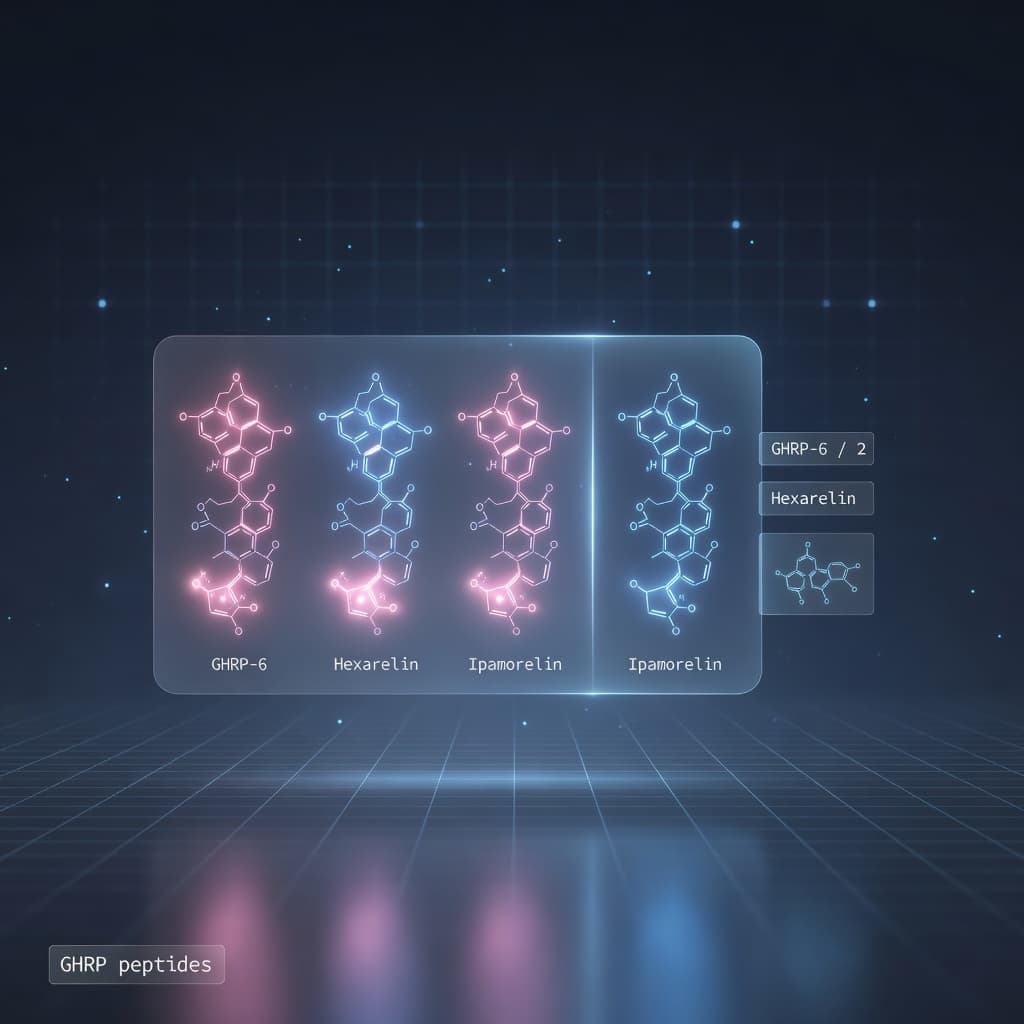
TL;DR: GHRP-6, GHRP-2, Hexarelin vs Ipamorelin
- GHRP-6, GHRP-2, Hexarelin and Ipamorelin all activate the ghrelin receptor GHS-R1a to stimulate pulsatile GH release, but the four peptides differ sharply in potency, side-effect load and clinical history (PMID 9186261).
- Hexarelin is the strongest acute GH releaser of the group, but repeated dosing partially desensitises its effect, an effect that reverses after a washout period (PMID 10990150).
- GHRP-6 and GHRP-2 both drive hunger through the same ghrelin-mimetic pathway that stimulates GH, with GHRP-2 raising ad-libitum food intake by 35.9 percent in a controlled human study (PMID 15699539).
- Ipamorelin matched GHRP-6 for GH potency in its original 1998 characterization but did not raise cortisol or ACTH, and did not disturb LH, FSH, prolactin or TSH, even at 200-fold the effective GH dose (PMID 9849822).
- None of GHRP-6, GHRP-2 or Hexarelin ever reached drug approval. We do not sell them. Ipamorelin is the research peptide we carry from this family, for laboratory research only.
Growth hormone releasing peptides, or GHRPs, are a family of synthetic compounds developed from the late 1970s onward to probe an alternative route into the growth hormone axis. Rather than mimicking growth hormone releasing hormone (GHRH), they mimic ghrelin, the stomach-derived hormone that was only formally identified in 1999, several years after the first GHRPs were already in clinical study. GHRP-6, GHRP-2 and Hexarelin are the three oldest and most-studied members of this family. Ipamorelin, characterized in 1998, is the youngest and pharmacologically the most distinct. This article covers what the published research actually shows about each of these four compounds, why the three older ones never became approved drugs, and how Ipamorelin, the one peptide from this family available at PeptidesDirect for laboratory research, differs mechanistically.
We do not stock GHRP-6, GHRP-2 or Hexarelin. From this family we carry Ipamorelin, plus the GHRH side of the axis. The cards below are not offered as substitutes for the three compounds discussed here, they are simply what we can actually supply for laboratory research:
Highly selective growth hormone releaser that triggers natural GH pulses without raising cortisol or prolactin. Clean GH stimulation with minimal side effects - the most targeted growth hormone peptide available.
CJC-1295 without DAC (Mod GRF 1-29) is a short-acting GHRH(1-29) analog for GH/IGF-1 research. Research-grade lyophilized powder, specified purity >=99% (HPLC). Laboratory use only.
2-in-1 growth hormone blend: CJC-1295 no-DAC (Modified GRF 1-29, 5 mg) + Ipamorelin (5 mg) combined in one vial. The CJC-1295 component is the short-acting no-DAC variant (about 30 minute half-life), not the long-acting DAC form. Stimulates natural GH release through two different pathways for amplified, more physiological growth hormone pulses.
Growth hormone secretagogues and gonadotropins
What Are GHRPs? A Shared Mechanism, Four Different Molecules
GHRP-6, GHRP-2, Hexarelin and Ipamorelin are all small synthetic peptides that act as agonists at the growth hormone secretagogue receptor, GHS-R1a, the same receptor that endogenous ghrelin activates. A 1997 review covering GHRP-1, GHRP-2, GHRP-6 and Hexarelin as a class found that their GH-releasing effect is dose-dependent across intravenous, subcutaneous, intranasal and oral routes of administration, that it undergoes partial desensitization with continuous use, that it raises circulating IGF-1, and that it acts synergistically with GHRH while being blunted by glucose, fatty acids and glucocorticoids (PMID 9186261). The same review noted that the magnitude of the GH response declines with age once puberty has passed, a pattern shared with the endogenous GH axis itself.
Mechanistically, this puts GHRPs in a different category from GHRH analogues such as Sermorelin, Tesamorelin or CJC-1295, which act on the separate GHRH receptor. GHRPs instead exploit the ghrelin pathway, which is also involved in appetite regulation, a fact that turns out to matter a great deal for two of the three older compounds discussed below.
GHRP-6: The Hunger Peptide
GHRP-6 is the oldest of the three legacy GHRPs and carries the strongest reputation for stimulating appetite, a reputation borne out by the underlying pharmacology rather than folklore. Because GHRP-6 activates the same GHS-R1a receptor that mediates ghrelin's role as the body's primary hunger-signalling hormone, an appetite effect is not an incidental side effect but a predictable consequence of the mechanism itself.
A 2002 study in rats found that central administration of GHRP-6, like ghrelin itself, significantly stimulated food intake and transiently lowered core body temperature, an effect mediated through Y1 neuropeptide Y receptor signalling and activation of orexin neurons in the lateral hypothalamus (PMID 11751604). This gives GHRP-6's hunger effect a defined neuroendocrine circuit rather than leaving it as an unexplained observation, and it is the same circuit implicated in ghrelin's normal physiological role in meal initiation.
GHRP-2: More Potent GH Release, Same Appetite Baggage
GHRP-2 is generally regarded as a more potent GH secretagogue than GHRP-6, but the 1997 class review found that the orexigenic, or appetite-stimulating, effect is a feature of the ghrelin-mimetic mechanism shared across the group, not something unique to GHRP-6 (PMID 9186261). A 2005 controlled study in seven lean, healthy men confirmed this directly: subcutaneous GHRP-2 infusion increased ad-libitum buffet food intake by 35.9 plus or minus 10.9 percent compared to saline (136.0 versus 101.3 kJ per kg body weight), with every single subject in the study eating more and reporting increased hunger (PMID 15699539).
GHRP-2's clearest clinical evidence base lies in pediatric growth hormone deficiency and short stature, where it has been studied for its effect on height velocity, rather than in adult body composition or muscle-building contexts (PMID 8950613). That distinction matters: the strongest published human data for GHRP-2 comes from a diagnostic and pediatric-endocrinology setting, not from athletic or lean-mass research in adults.
Hexarelin: The Strongest Acute Releaser, and the Fastest to Fade
Hexarelin is the most potent acute GH releaser of the three legacy GHRPs. An intravenous dose-response study found a half-maximal effective dose (ED50) of roughly 0.5 to 0.64 mcg/kg, with near-maximal GH release (a Cmax around 55 ng/ml) already reached at 2 mcg/kg (PMID 7957536). That acute potency, however, comes with a durability problem that distinguishes Hexarelin most clearly from Ipamorelin in any protocol involving sustained use.
Hexarelin desensitization: real, partial, reversible
A 16-week trial gave twice-daily subcutaneous Hexarelin to 12 healthy elderly subjects and tracked the GH response over time. The GH-response area under the curve fell from 19.1 to 10.5 microg/l per hour by week 16, a roughly 45 percent decline, consistent with partial tachyphylaxis (reduced responsiveness with repeated dosing). Critically, the response recovered fully to baseline after a 4-week washout period, showing that the desensitization is a temporary, reversible pharmacological adaptation rather than a permanent loss of receptor function (PMID 10990150).
Because of both its potency and its distinct receptor-binding profile, Hexarelin was studied clinically mainly in a cardioprotection context rather than a muscle or body-composition one, an application that reflects effects observed at the level of cardiac tissue and receptor subtypes rather than any established human muscle-mass outcome. This is a meaningfully different research angle from the muscle-focused narrative that circulates informally around Hexarelin, and it is worth separating the two clearly.
The GH Axis and Muscle: Where the Real Evidence Bridge Sits
The reason GHRPs come up at all in discussions of lean mass is straightforward: GH and its downstream mediator IGF-1 are established regulators of protein synthesis and body composition, and any compound that reliably raises GH pulses will, through that same axis, have some relationship to lean mass. The best-quality human body-composition evidence in this broader secretagogue drug class comes not from a GHRP peptide itself, but from a 2-year randomized trial of an oral non-peptide ghrelin-receptor agonist, MK-677, in 65 adults aged 60 to 81. Over 12 months, fat-free mass increased by 1.1 kg versus a 0.5 kg decline on placebo (P less than 0.001), alongside GH and IGF-1 levels raised into the young-adult reference range (PMID 18981485).
MK-677 is a small-molecule ghrelin mimetic, not a peptide, and is not something PeptidesDirect sells or discusses as a product. It is cited here purely to illustrate the mechanism that the entire GH-secretagogue class, GHRPs included, shares: GH-axis stimulation is mechanistically linked to age-related lean-mass maintenance. That mechanistic link is also the natural bridge to a separate, forthcoming discussion of GLP-1 receptor agonists and lean-mass loss, since both drug classes intersect the same GH-IGF-1-muscle axis from opposite directions.
What the Community Reports
What the community reports (anecdotal, not clinical evidence)
Discussion on forums such as MESO-Rx, ProfessionalMuscle, MuscleChemistry and AnabolicMinds consistently centers on a handful of recurring themes. None of this is clinical evidence and should be read as self-reported, non-verified community sentiment only.
Hunger is the most-repeated complaint about the older peptides. Posters describe GHRP-2 causing sudden, blood-sugar-crash-level hunger, especially for carbohydrates, and GHRP-6 as having the strongest hunger effect of the class. Multiple threads describe this as the main reason people switch to Ipamorelin, which posters consistently describe as having little to no appetite effect.
Water retention and bloat come up repeatedly with GHRP-2. One forum poster reported gaining several pounds of water weight within days of starting a GHRP-2 and Mod-GRF combination and attributed it to the GHRP-2. Another reported an 11-pound one-day jump along with bloating, brain fog and hypoglycemia-like symptoms at a 200 mcg dose. The community explanation offered, unverified, is a fluid shift tied to elevated GH and IGF-1, said to be worse early on and dose-dependent.
Cortisol and prolactin concerns recur around GHRP-6 and especially Hexarelin. Some posters cite an older study, referenced secondhand, concluding that chronic Hexarelin dosing did not meaningfully raise prolactin or cortisol; others remain cautious and add cabergoline as a precaution. Ipamorelin is repeatedly held up in these same threads as the cleaner alternative specifically because posters describe it as not touching cortisol or prolactin.
Tolerance, or GHRP-6 "stopping working," is a lighter, more anecdotal thread, generally framed as a reason to cycle off for several weeks or switch to Ipamorelin.
Muscle claims in these communities are modest and hedged, not dramatic. Typical framing suggests expecting a few pounds of fat loss and modest muscle gain over three to six months, not a fast transformation. Hexarelin occasionally attracts stronger muscle claims, but posters in the same threads pushed back, arguing any real-world change is likely just the GH and IGF-1 elevation itself rather than anything unique to Hexarelin's chemistry.
A cardioprotective benefit for Hexarelin is mentioned periodically but flagged as fringe even by experienced posters in the threads that raised it, who called it speculative and far from anything clinically meaningful in humans.
Two paraphrased, non-identifying examples of this sentiment: one poster summed up the appeal of switching to Ipamorelin as wanting "the GH-stimulating potency of the older peptides without the constant hunger and prolactin and cortisol baggage that comes with them." Another long-time poster pushed back on hype around secretagogue-specific benefits, arguing that most of what people credit to a specific peptide is really "elevated GH and IGF-1 doing the work," regardless of which GHRP is used to get there.
Why We Do Not Sell GHRP-6, GHRP-2 or Hexarelin
Legacy research compounds, not approved products
GHRP-6, GHRP-2 and Hexarelin are legacy synthetic ghrelin-receptor agonists first studied clinically in the 1980s and 1990s, mainly for pediatric growth hormone deficiency and, in Hexarelin's case, cardioprotection research. None of the three ever received drug approval for any indication, and none carry an established, verified safety and efficacy profile for general human use. PeptidesDirect does not sell GHRP-6, GHRP-2 or Hexarelin, and nothing in this article should be read as dosing guidance, an availability signal or an efficacy claim for muscle building. These compounds also carry a documented hormonal side-effect profile, including cortisol, prolactin and appetite effects, that the field has since moved past with more selective research compounds.
The Research Peptides We Carry
Ipamorelin is the GHRP-family research peptide we carry, sold strictly for laboratory research use.
Highly selective growth hormone releaser that triggers natural GH pulses without raising cortisol or prolactin. Clean GH stimulation with minimal side effects - the most targeted growth hormone peptide available.
Growth hormone secretagogues and gonadotropins
Growth hormone axis
Highly selective growth hormone releaser that triggers natural GH pulses without raising cortisol or prolactin. Clean GH stimulation with minimal side effects - the most targeted growth hormone peptide available.
2-in-1 growth hormone blend: CJC-1295 no-DAC (Modified GRF 1-29, 5 mg) + Ipamorelin (5 mg) combined in one vial. The CJC-1295 component is the short-acting no-DAC variant (about 30 minute half-life), not the long-acting DAC form. Stimulates natural GH release through two different pathways for amplified, more physiological growth hormone pulses.
GHRH(1-29) analog for physiological growth hormone stimulation research
How Ipamorelin Differs Mechanistically
The 1998 study that first characterized Ipamorelin found that it matched GHRP-6's potency for GH release across rat pituitary cells, anesthetized rats and conscious swine. Unlike other GHS-R1a agonists tested, including GHRP-6, it did not raise ACTH or cortisol above levels seen with GHRH stimulation alone, even at doses 200-fold higher than the GH-effective dose, and it did not affect FSH, LH, prolactin or TSH (PMID 9849822). This selectivity profile is the reason the literature describes Ipamorelin as the first GHRP-receptor agonist with a GH-release selectivity comparable to GHRH itself, in contrast to GHRP-6, GHRP-2 and Hexarelin, which all engage broader hormonal signalling alongside their GH effect.
This is a laboratory research finding about receptor selectivity, not a human-use or bodybuilding recommendation. Ipamorelin, like the rest of our catalog, is intended exclusively for laboratory research applications.
Questions about GHRP-6, GHRP-2 or Hexarelin availability
If you have questions about the research status, availability or legal framing of GHRP-6, GHRP-2 or Hexarelin, our team can point you to published literature and explain why these are not carried in our catalog. Reach out at support@peptidesdirect.io.
FAQ
This article is for informational and educational purposes only. All mentioned peptides are intended exclusively for laboratory research and not for human consumption. We do not sell the drug this article is about. For Research Purposes Only.
Research context for English-speaking buyers
Most of our English-speaking customers ship to the UK, Ireland, Malta or other English-as-second-language EU territories. The regulatory picture differs per country.
- Relevant authorities
- MHRA (UK, post-Brexit), HPRA (Ireland, EU-aligned), FDA Section 503A bulks list (US, restricted Cat 2 status of several peptides as of 2026)
- Customs and VAT
- EU shipments include 19% VAT; UK shipments after Brexit are now extra-EU and may attract UK VAT plus a handling fee at import
- Typical shipping window
- EU 2-4 working days, UK 4-7 working days, other international 7-14 working days, depending on customs
Research-grade peptides shipped from our EU warehouse are sold for laboratory use only and are not authorised for human or veterinary therapeutic application in any of the destination jurisdictions. US customers should be aware that the FDA Section 503A bulks list classification (and the April 2026 reclassification of twelve compounds) only governs compounding pharmacies, not direct-to-researcher imports for non-clinical work. UK buyers should declare the consignment on import and may be asked for a research justification by HMRC. We provide a CoA per batch identified by colour code rather than serial number; customs sometimes asks for this document when clearing the parcel.