HCG (Human Chorionic Gonadotropin): Mechanism and Evidence
How hCG (Pregnyl, Ovitrelle) works, what the trial data actually shows for fertility, hypogonadism and muscle, and why it is prescription-only.
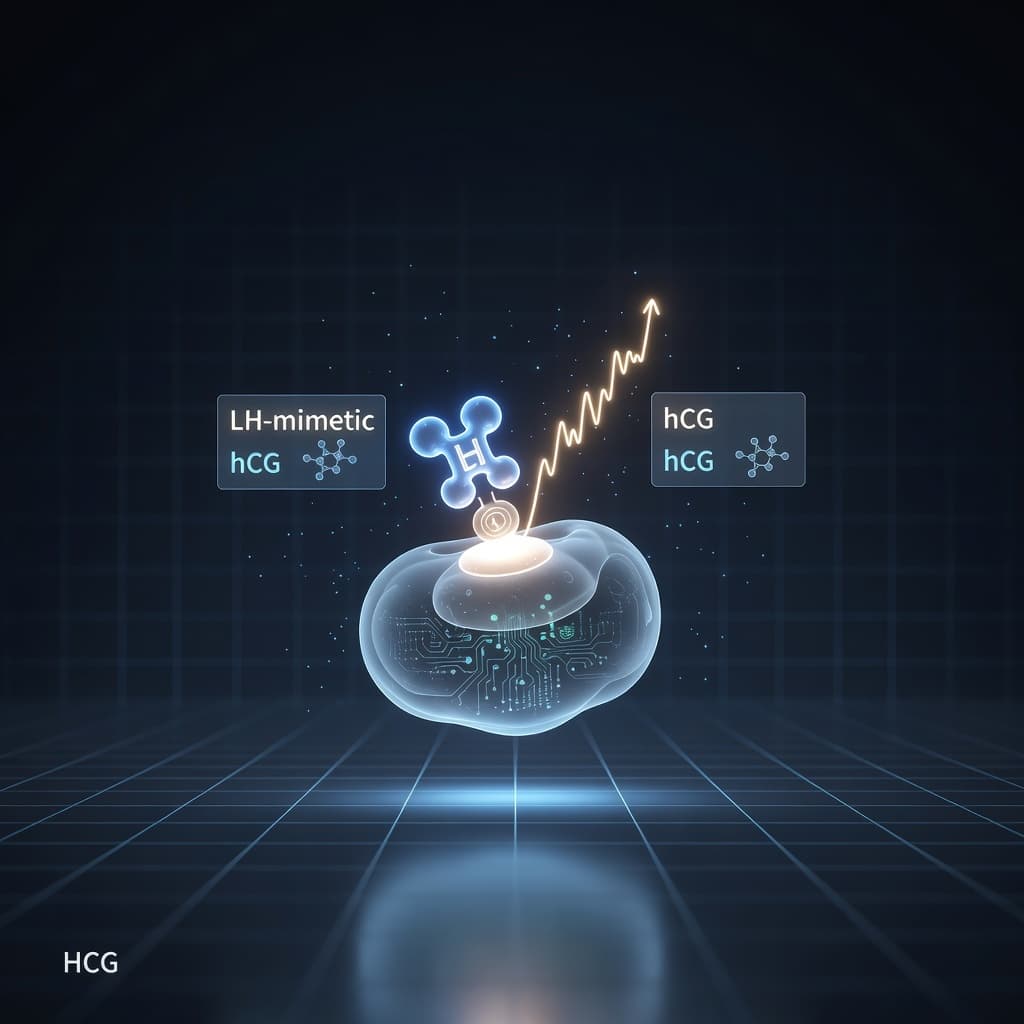
Human chorionic gonadotropin, better known under the brand names Pregnyl, Ovitrelle and Novarel, is one of the oldest hormone therapies still in routine clinical use. It is also one of the most misunderstood, thanks partly to a decades-old weight-loss fad that has nothing to do with its real, approved medical function. This article explains what hCG actually is, how it works at the receptor level, what the controlled trial data show for fertility preservation, hypogonadism and muscle, and why it sits entirely outside the growth-hormone-axis research peptides this site covers.
TL;DR: What the evidence actually shows
hCG is a placental hormone that mimics luteinizing hormone (LH), binding the LHCGR receptor on testicular Leydig cells and triggering testosterone synthesis (PMID 28056997). In men on testosterone replacement therapy, low-dose hCG co-therapy preserves spermatogenesis and prevents testicular atrophy (PMID 23260550, PMID 33345656). As monotherapy in borderline-hypogonadal men, hCG raised testosterone by roughly 50 percent over a median 8 months with no reported adverse events (PMID 31408289). The only controlled muscle data (a 2002 RCT in older men) found hCG raised lean mass by about 2 kg but produced no gain in strength, gait or balance (PMID 12107212). The "hCG diet" for weight loss is scientifically debunked back to the original 1976 double-blind trial (PMID 792477); hCG has no mechanistic link to the GH/IGF-1 axis at all.
What is hCG?
Human chorionic gonadotropin is a glycoprotein hormone naturally produced by the placenta during pregnancy, where it signals the corpus luteum to keep producing progesterone. Structurally it belongs to the same hormone family as luteinizing hormone (LH), sharing an alpha subunit with LH, follicle-stimulating hormone (FSH) and thyroid-stimulating hormone, and a hormone-specific beta subunit that gives it its distinct receptor binding and its much longer circulating half-life than LH.
Pharmaceutically, hCG is manufactured either by extraction and purification from the urine of pregnant women or, in newer products, recombinantly. It has been an approved prescription medicine for decades and is marketed under names including Pregnyl, Ovitrelle and Novarel. Clinically it is used almost exclusively in two settings: female fertility treatment, where it triggers ovulation and supports IVF protocols, and male hypogonadism and infertility, where it substitutes for the body's own LH signal. This article focuses on the male-hypogonadism use case, since that is the context in which hCG regularly comes up in conversations about muscle, body composition and the GH axis. Female fertility applications are outside its scope.
Mechanism: hCG as a long-acting LH mimetic
The reason hCG works in men at all is receptor overlap. Both LH and hCG bind the same receptor, LHCGR, expressed on Leydig cells in the testes. A 2017 mechanistic study comparing the two hormones side by side in Leydig cells found that hCG is roughly ten times more potent than LH at recruiting the cAMP second messenger, and that both hormones engage the same cAMP/PKA/ERK1/2 signalling cascade, ultimately producing equal final testosterone output (PMID 28056997). In practical terms, hCG is not a distinct pathway or a novel hormone action. It is a longer-acting, more potent stand-in for the body's own LH signal, stimulating the same Leydig cells to synthesize testosterone through the same downstream machinery.
This matters clinically because the testes need a continuous LH-type signal to keep producing testosterone locally (intratesticular testosterone) and to keep sperm-producing tissue active. When a man starts exogenous testosterone replacement therapy (TRT), the pituitary senses adequate circulating testosterone and shuts down its own LH and FSH output through negative feedback. Without any LH-type signal reaching the testes, intratesticular testosterone collapses, spermatogenesis stalls and the testes can shrink. hCG is used specifically to keep that local signal alive while external testosterone is being administered.
The clinical evidence: fertility preservation and hypogonadism monotherapy
The best-established use of hCG is as a co-therapy alongside TRT to preserve fertility. In a study following 26 hypogonadal men on TRT combined with low-dose intramuscular hCG for a mean of about 6.2 months, no patient became azoospermic (zero sperm count), and partners in 9 of the couples achieved pregnancy during the study period (PMID 23260550). A 2021 review of the broader literature reached the same conclusion at a mechanistic level: hCG's LH-like action drives testosterone and sperm production without the fertility-suppressing effect seen with testosterone replacement alone, because it keeps the local testicular signal intact even while circulating testosterone from TRT suppresses the pituitary (PMID 33345656).
hCG has also been studied as a standalone therapy, not just an add-on to TRT. In a retrospective study of 20 men with hypogonadal symptoms but total testosterone still above 300 ng/dL, hCG monotherapy raised mean testosterone by 49.9 percent, from 362 to 519.8 ng/dL, over a median follow-up of 8 months. Roughly half the patients reported symptom improvement, and no adverse events were recorded (PMID 31408289). This positions hCG monotherapy as a plausible option specifically for men who want to raise endogenous testosterone without shutting down natural production and fertility, an outcome that exogenous testosterone cannot offer.
Reading these numbers carefully
The monotherapy study (PMID 31408289) was retrospective and uncontrolled, with only 20 patients and no placebo arm, so the reported 49.9 percent rise cannot be fully separated from regression to the mean or other confounders. The fertility-preservation data (PMID 23260550) is a small observational cohort, not a randomized trial. Both are informative but should not be read as definitive proof of effect size.
The "hCG diet" myth: what the trials actually found
hCG's popular reputation as a weight-loss aid traces back to a protocol developed in the 1950s combining hCG injections with an extremely low-calorie diet (around 500 kcal per day), often called the Simeons protocol. The claim was that hCG itself mobilized stored fat and suppressed hunger. This claim has been tested directly and repeatedly, and it does not hold up.
The landmark study is a 1976 double-blind, placebo-controlled crossover trial of 202 patients, in which each participant received both hCG and placebo injections at different points in the trial while on the same restricted diet. The result: no statistically significant difference between hCG and placebo on weight loss, skin-fold thickness or dropout rate at any phase of the study (PMID 792477). Subsequent placebo-controlled trials reached the same conclusion. Whatever weight loss occurs on the "hCG diet" is attributable entirely to the severe calorie restriction, not to the hormone. US regulators eventually caught up with the science: the FDA and FTC issued joint warning letters in December 2011 declaring hCG weight-loss products "unproven and illegal," a designation that still applies to over-the-counter and homeopathic hCG products marketed for weight loss today.
Muscle and the GH axis: what the 2002 trial actually shows
Because hCG raises testosterone, and testosterone is loosely associated with muscle in the popular imagination, hCG sometimes gets discussed as a muscle-building agent. The controlled evidence tells a more precise, and more limited, story.
The only randomized, placebo-controlled trial examining hCG's effect on muscle and physical function was conducted in 40 men aged 60 to 85 with partial age-related androgen deficiency. Over 3 months, recombinant hCG raised testosterone and estradiol by roughly 150 percent, increased lean body mass by approximately 2 kg and reduced fat mass by roughly 1 kg. But the same trial found no improvement in muscle strength, physical function, gait speed or balance, and testis volume actually decreased by about 5 mL over the study period (PMID 12107212). In other words, hCG produced a measurable hormonal and body-composition shift without any corresponding functional muscle benefit.
This distinction matters for anyone specifically interested in the growth-hormone/IGF-1 axis and tissue repair, because hCG has zero mechanistic overlap with that system. It works exclusively through the LH receptor on gonadal tissue, not through the GHRH receptor or the ghrelin receptor that drive endogenous growth hormone release. It does not raise GH, does not raise IGF-1, and does not engage the signalling pathways associated with muscle-protein synthesis and connective-tissue repair the way GH-secretagogue peptides do. The 2002 trial's finding, lean mass up but strength and function flat, is a useful illustration of that gap: raising sex hormones changes body composition numbers, but it is not the same lever as stimulating the GH/IGF-1 axis directly.
What the community reports
What the community reports (anecdotal, not clinical evidence)
The following points summarize general sentiment from TRT and bodybuilding-adjacent online forums (MESO-Rx/thinksteroids, ExcelMale, general web discussion). None of this is clinical evidence, verified data or medical advice, and it is presented here only as a picture of how the community talks about the hormone.
Dosing chatter is highly self-directed. Forum members report weekly hCG protocols ranging from 0 IU (skipped entirely) to 1,000-1,250 IU per week, with 250-500 IU two to three times weekly cited most often as an informal "maintenance" range, alongside a commonly quoted clinical figure of 250-350 IU every other day.
Preserving testicular size is the most frequently cited perceived benefit, with users describing noticeable changes starting around 2-6 weeks into use. Subjective claims about libido and mood are also common, though posters themselves often flag these as possibly placebo.
Estrogen-related concerns (bloating, water retention, gynecomastia risk) come up often, particularly at higher doses above roughly 5,000 IU, sometimes prompting use of an aromatase inhibitor or discontinuation.
Using hCG alone as a substitute for injectable testosterone is viewed skeptically by experienced forum members. One documented case described a poster using 150-300 IU per day of hCG plus oral compounds instead of injectable testosterone, whose bloodwork came back showing very low serum testosterone (20 ng/dL) despite subjective strength gains, a case cited by other posters as a cautionary example.
The "hCG diet" for fat loss is widely dismissed within these same communities as debunked, with posters distinguishing it clearly from hCG's use in TRT contexts and noting the regulatory findings against it.
Overall sentiment runs mixed-to-positive for fertility/testicular-maintenance use within TRT protocols, and skeptical-to-dismissive toward claims of standalone muscle-building or fat-loss benefit.
Why we do not sell hCG
hCG is a prescription-only medicine, not a research peptide
hCG (Pregnyl, Ovitrelle, Novarel) is an approved prescription drug regulated as a medicine in the EU, the UK and the US. It is used under a physician's prescription and supervision for fertility treatment and male hypogonadism management, and it is not sold, listed or shipped by peptidesdirect.io in any form. This article is educational context only, written to explain the hormone's real mechanism and evidence base, and to point readers researching the broader GH/muscle axis toward the research peptides we actually carry.
hCG also falls outside our catalog for a structural reason beyond its legal status: it works through the LH receptor on gonadal tissue, an entirely different system from the GHRH-receptor and ghrelin-receptor pathways that our GH-secretagogue research peptides target. Someone researching GH-axis-driven tissue effects, IGF-1 signalling or lean-mass mechanisms is, mechanistically speaking, looking at a different hormonal system than the one hCG operates on.
The research peptides we carry instead
For research into the GHRH-receptor and ghrelin-receptor pathways that drive endogenous growth hormone and IGF-1 signalling, the following peptides are available for laboratory research use:
GHRH(1-29) analog for physiological growth hormone stimulation research
CJC-1295 without DAC (Mod GRF 1-29) is a short-acting GHRH(1-29) analog for GH/IGF-1 research. Research-grade lyophilized powder, specified purity >=99% (HPLC). Laboratory use only.
Highly selective growth hormone releaser that triggers natural GH pulses without raising cortisol or prolactin. Clean GH stimulation with minimal side effects - the most targeted growth hormone peptide available.
Growth hormone secretagogues and gonadotropins
Growth hormone axis
GHRH(1-29) analog for physiological growth hormone stimulation research
CJC-1295 without DAC (Mod GRF 1-29) is a short-acting GHRH(1-29) analog for GH/IGF-1 research. Research-grade lyophilized powder, specified purity >=99% (HPLC). Laboratory use only.
Highly selective growth hormone releaser that triggers natural GH pulses without raising cortisol or prolactin. Clean GH stimulation with minimal side effects - the most targeted growth hormone peptide available.
Sermorelin is GHRH(1-29), the shortest active fragment of natural growth-hormone-releasing hormone, and activates the GHRH receptor to produce a pulsatile, physiological GH release. CJC-1295 (the No-DAC form carried here) is a DPP-IV-resistant GHRH(1-29) analogue with the same receptor target but a metabolically hardened structure, often paired with ipamorelin for synergistic GHRH/ghrelin-receptor signalling. Ipamorelin itself is a selective ghrelin-receptor agonist (a GHRP) that stimulates GH release with minimal effect on cortisol or prolactin. None of these three engages the LH receptor or the gonadal axis at all, they are mechanistically unrelated to hCG, and none is positioned here as a substitute for it. They are relevant only because they are the actual GH-axis tools available for laboratory research into the pathways hCG does not touch. Readers following the GLP-1-and-muscle-loss research thread on this site will recognize these same GHRH/ghrelin pathways as the mechanistic bridge between GH-axis signalling and lean-tissue research.
Questions about hCG availability
peptidesdirect.io does not sell, source or ship hCG (Pregnyl, Ovitrelle, Novarel or any equivalent) under any circumstances, and cannot advise on obtaining it. For questions about hCG availability or purchase, please consult a licensed physician or pharmacy. For questions about the GH-secretagogue research peptides covered in this article, contact support@peptidesdirect.io.
This article is for informational and educational purposes only. All mentioned peptides are intended exclusively for laboratory research and not for human consumption. We do not sell the drug this article is about. For Research Purposes Only.
Research context for English-speaking buyers
Most of our English-speaking customers ship to the UK, Ireland, Malta or other English-as-second-language EU territories. The regulatory picture differs per country.
- Relevant authorities
- MHRA (UK, post-Brexit), HPRA (Ireland, EU-aligned), FDA Section 503A bulks list (US, restricted Cat 2 status of several peptides as of 2026)
- Customs and VAT
- EU shipments include 19% VAT; UK shipments after Brexit are now extra-EU and may attract UK VAT plus a handling fee at import
- Typical shipping window
- EU 2-4 working days, UK 4-7 working days, other international 7-14 working days, depending on customs
Research-grade peptides shipped from our EU warehouse are sold for laboratory use only and are not authorised for human or veterinary therapeutic application in any of the destination jurisdictions. US customers should be aware that the FDA Section 503A bulks list classification (and the April 2026 reclassification of twelve compounds) only governs compounding pharmacies, not direct-to-researcher imports for non-clinical work. UK buyers should declare the consignment on import and may be asked for a research justification by HMRC. We provide a CoA per batch identified by colour code rather than serial number; customs sometimes asks for this document when clearing the parcel.