Mod GRF 1-29 Explained: Mechanism, Evidence and GH/Muscle Link
Mod GRF 1-29 (GRF(1-29) without DAC) explained: GHRH mechanism, real PMIDs, the DAC caveat, and why it is exactly what we sell as CJC-1295 (No DAC).
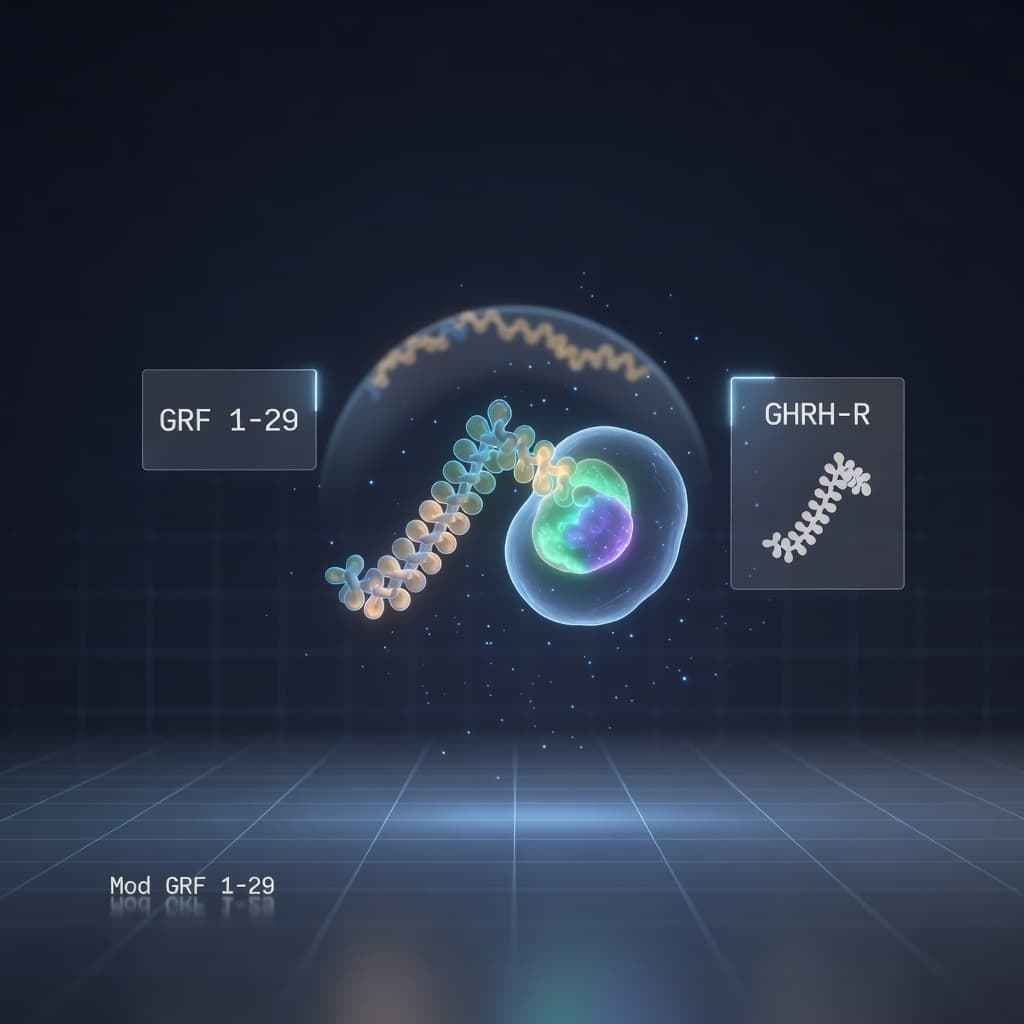
TL;DR: What the data actually says about Mod GRF 1-29
What it is: A truncated, tetrasubstituted 29-amino-acid analog of human GHRH, engineered for protease resistance. Same backbone family as sermorelin and the DAC-conjugated form of CJC-1295, but without the albumin-binding DAC modification itself. Our product: Mod GRF 1-29, "CJC-1295 without DAC," and CJC-1295 (No DAC) name the same molecule, and it is exactly what peptidesdirect.io sells as CJC-1295 (No DAC). Mechanism: GHRH-receptor agonism on pituitary somatotrophs, amplifying pulsatile GH release while leaving the natural feedback loop intact (unlike exogenous GH). Evidence gap: No PubMed-indexed human trial names this exact tetrasubstituted, non-DAC molecule. Nearly all real human GH/IGF-1 data in this peptide family comes from either native GRF(1-29)/sermorelin studies or a separate, DAC-conjugated CJC-1295 program. Half-life: Roughly 30 minutes (PMID 2546126), the same short kinetics as native GHRH(1-29), which is exactly what DAC-conjugation was built to fix. Bottom line: Mod GRF 1-29 is the molecule we sell as CJC-1295 (No DAC), verified by the third-party Janoshik CoA. This article explains the pharmacology honestly, including the fact that the pivotal human trial data most marketing cites for "CJC-1295" was generated with a separate, DAC-conjugated form we do not carry.
Mod GRF 1-29 shows up constantly in online peptide discussion, almost always as a companion to a ghrelin mimetic like ipamorelin or GHRP-2. It is frequently described as "the same thing as CJC-1295," and for the product we sell under that name, CJC-1295 (No DAC), that description is correct: Mod GRF 1-29 is the molecule. Where the confusion creeps in is the evidence, because a second, separate molecule also answers to the name "CJC-1295," the DAC-conjugated, long-acting form that carries the pivotal human trial data. This article lays out the structure, the mechanism, and the honest evidence picture for the molecule we actually sell, explains why the GHRH-axis mechanism matters for muscle and lean-mass research more broadly, and shows exactly where it sits in our GHRH-class catalog.
What Is Mod GRF 1-29? Structure, Naming, and How It Relates to CJC-1295 and Sermorelin
Human growth hormone releasing hormone (hGHRH) is a 44-amino-acid hypothalamic peptide. Its first 29 residues, GHRH(1-29), retain the full receptor-binding activity of the native hormone. Mod GRF 1-29 is a modified version of that same 29-residue fragment: four amino-acid substitutions (hence "tetrasubstituted") are introduced at positions known to be vulnerable to enzymatic cleavage, most notably protecting against degradation by DPP-4 and trypsin-like proteases. The goal of these substitutions is chemical stability, not a change in the underlying pharmacology.
This is the source of a genuine naming mess, one worth untangling rather than glossing over. "Mod GRF 1-29," "CJC-1295 without DAC," and "CJC-1295 (No DAC)" are three names for the exact same molecule, the tetrasubstituted 29-residue GHRH analog described above, without the DAC modification. That is the product sold here as CJC-1295 (No DAC). The confusion comes from a second, separate molecule that also gets called "CJC-1295": the same substituted backbone, but with a DAC (Drug Affinity Complex, a maleimide-based albumin-binding group) attached. DAC is not a cosmetic add-on. The foundational comparison between the two forms was done directly by the researchers who first developed the compound (PMID 15817669): unconjugated hGRF(1-29) analog and DAC-conjugated CJC-1295 were tested side by side in rats. DAC-conjugation increased GH area-under-curve four-fold over two hours and kept the peptide detectable in plasma beyond 72 hours. The unconjugated backbone, the molecule sold here, cleared far faster and produced a correspondingly shorter GH pulse.
So within this small peptide family there are effectively three related molecules: native GHRH(1-29)/sermorelin (no modifications, no DAC), Mod GRF 1-29, also sold as CJC-1295 (No DAC) (four stabilizing substitutions, no DAC), and the DAC-conjugated form of CJC-1295 (the same substituted backbone, plus DAC conjugation for extended half-life, not carried here). Only the DAC-conjugated form carries the pivotal human trial data referenced in the rest of this article, which is precisely the distinction this article is built to make clear.
This is what peptidesdirect.io sells as CJC-1295 (No DAC): the second molecule in that list, not the third. The rest of this article treats that identity as settled and focuses on what actually follows from it.
CJC-1295 without DAC (Mod GRF 1-29) is a short-acting GHRH(1-29) analog for GH/IGF-1 research. Research-grade lyophilized powder, specified purity >=99% (HPLC). Laboratory use only.
Mechanism of Action: GHRH Receptor Agonism and Pulsatile GH Release
Mechanistically, Mod GRF 1-29 works the same way native GHRH and its analogs do. It binds the GHRH receptor (GHRHR) on anterior-pituitary somatotroph cells, activating a Gs-protein-coupled cAMP/PKA signaling cascade that triggers GH synthesis and release. This is a fundamentally different mode of action from injecting GH directly. Exogenous GH bypasses the pituitary and creates a sustained, non-physiological elevation. A GHRH-receptor agonist instead amplifies the body's own pulsatile GH secretion while leaving the upstream feedback loop, somatostatin tone and IGF-1 negative feedback on the pituitary, intact.
The tradeoff for that more physiological signaling pattern is speed of clearance. The 1989 human dosing study of native and analogue GRF(1-29) peptides (PMID 2546126) gave healthy male volunteers 3 mcg/kg subcutaneously and found comparable peak GH responses and short pharmacokinetic profiles between native GHRH(1-29) and an early agonist analogue, establishing the short-acting, pulsatile release pattern typical of this entire unconjugated peptide class. Mod GRF 1-29's protease-resistant substitutions extend its stability against enzymatic degradation in solution and in circulation, but they do not add an albumin-binding domain, so its functional half-life remains in the same short range as native GHRH(1-29), on the order of 30 minutes. That is precisely the limitation the DAC-conjugated form of CJC-1295 was engineered to solve.
The Evidence, Honestly: What Human and Animal Data Actually Exist
This is the part most vendor copy glosses over, so it is worth stating plainly: no PubMed-indexed human clinical trial was located that specifically names and tests the tetrasubstituted, non-DAC molecule sold here as CJC-1295 (No DAC), also known online as "Mod GRF 1-29." Virtually all of the real human dosing, safety and efficacy data in this peptide family comes from either native GRF(1-29)/sermorelin studies, or the pivotal DAC-conjugated CJC-1295 program, a different molecule from the one in this product.
What the DAC-conjugated CJC-1295 evidence base actually covers
PMID 15817669 (2005): Rat model. Directly compared unconjugated hGRF(1-29) analog to DAC-conjugated CJC-1295. DAC-conjugation increased GH AUC four-fold over two hours and extended plasma detectability beyond 72 hours versus the short-acting parent peptide. This is the paper that identifies DAC-conjugated CJC-1295 as a distinct long-acting molecule, separate from the unconjugated backbone sold here. PMID 16822960 (2006): GHRH-knockout mouse model. Daily 2 mcg DAC-conjugated CJC-1295 normalized body weight, length, and lean/fat body composition versus untreated controls; less-frequent dosing gave only partial normalization. Demonstrates GHRH-receptor agonism drives normal growth and body composition, but only with sufficiently frequent dosing. PMID 19386527 (2009): Eleven healthy men, single DAC-conjugated CJC-1295 injection. Serum protein biomarkers linked to GH/IGF-1 axis activation were shifted one full week after a single dose, confirming sustained downstream endocrine signaling in humans, again on the DAC-conjugated molecule. Design caveat: none of these three studies used the non-DAC, tetrasubstituted molecule sold here as CJC-1295 (No DAC). They establish that DAC conjugation, not the peptide backbone itself, is the feature responsible for the sustained effect being measured.
The one human study that does involve the unconjugated short-acting analog class (PMID 2546126, 1989) predates the CJC-1295/Mod GRF naming entirely and used a 3 mcg/kg single-dose protocol in healthy men, showing the expected short, pulsatile GH response, not a sustained multi-day effect. That is consistent with the mechanistic story: without DAC, the peptide should behave like a short-acting GHRH secretagogue, not like the DAC-conjugated form, which is a separate, longer-acting molecule not carried here.
Reading the evidence honestly
Marketing that cites CJC-1295 human trial data (PMID 16822960, PMID 19386527) as if it applies directly to Mod GRF 1-29, or to our CJC-1295 (No DAC), is overstating the case. Those trials used the DAC-conjugated molecule specifically because DAC changes the pharmacokinetics that the trials were measuring. The short half-life of the product actually sold here means its real human effect profile is closer to the 1989 native-GRF(1-29) data (PMID 2546126) than to the DAC-conjugated CJC-1295 program.
GH/IGF-1 and Muscle: Why the GHRH Axis Matters for Lean Mass and Sarcopenia Research
The reason GHRH-receptor agonists attract sustained research interest at all, beyond this specific naming confusion, is the well-established link between the GH/IGF-1 axis and skeletal muscle. A 2008 review in the sarcopenia literature (PMID 18762207) lays out the mechanism: age-related decline in GH/IGF-1 signaling is mechanistically tied to sarcopenia, the loss of muscle mass, strength and protein synthesis capacity that accompanies aging. That review is careful to note the clinical evidence for GH/IGF-1-axis modulation reliably improving strength or function in humans is not uniform, but the mechanistic rationale for studying GHRH agonism as a muscle-preservation strategy is solid.
The clearest human proof-of-concept for a GHRH-class analog affecting muscle comes not from CJC-1295 or Mod GRF 1-29, but from tesamorelin, the only FDA-approved GHRH-class drug, a full-length GHRH(1-44) analog (Egrifta, indicated narrowly for HIV-associated lipodystrophy). A secondary analysis of two randomized controlled trials (PMID 31237318, 193 responders versus 148 placebo) found that tesamorelin significantly increased skeletal muscle area and density in adults with HIV. That result illustrates the muscle-relevant potential of GHRH-receptor agonism as a drug class, entirely separate from any specific claim about Mod GRF 1-29.
Modified GHRH analog for lipodystrophy and metabolic liver research
Put together, the mechanistic chain is genuine: GHRH-receptor agonism raises GH and downstream IGF-1, and GH/IGF-1 signaling is tied to muscle protein synthesis and lean mass maintenance, with tesamorelin providing the strongest human RCT-level confirmation of a muscle-composition effect within this drug class. What is not established is that Mod GRF 1-29 specifically, at any home-use dosing pattern, reproduces that effect, since its short half-life and complete absence of dedicated human trials leave that link entirely untested for this particular molecule.
What the Community Reports
Anecdotal forum reports, not clinical evidence
The following is drawn from bodybuilding and TRT-forum discussion (ExcelMale, MESO-Rx/thinksteroids, TMuscle, UK-Muscle, ProfessionalMuscle, and one AnabolicMinds thread title/summary). Reddit and YouTube comment threads could not be retrieved for this article. None of this is controlled data, and it should be read strictly as self-reported forum chatter, not as evidence of safety or efficacy.
A recurring "recipe" appears across multiple independent threads: roughly 100 mcg Mod GRF 1-29 combined with 100 mcg of a ghrelin mimetic (ipamorelin or GHRP-2), dosed two to four times daily, described by posters as a "saturation dose." Cycling patterns vary, some describe 8 to 12 weeks on with 4 to 6 weeks off, others use shorter on/off-day patterns, both framed by posters as guarding against receptor desensitization.
Sleep is the effect people report noticing first, often within one to three weeks, usually credited to the bedtime dose. It is the single most consistently repeated "win" across the threads reviewed. Body-composition claims, by contrast, are framed on a much slower timeline: posters describe fat loss becoming noticeable around six months, with joint comfort and recovery improvements described around nine months, plus vaguer "leaner" or "more energy" comments within the first few weeks. These reports are rarely isolated from concurrent training, diet, or other compounds; one poster crediting muscle gain to the protocol also mentioned concurrent testosterone and nandrolone use.
A near-ritualized side effect recurs across threads: a warm facial flush roughly 20 to 30 minutes post-injection, followed by a sudden appetite spike large enough that some posters plan a meal around it. Some treat the flush itself as informal proof the product is active. Night sweats are also a recurring complaint, specifically discouraging some users from bedtime dosing, with a few switching to pharmaceutical-grade HGH for sleep instead. More concerning is a recurring, smaller safety thread describing injection-site welts and hives, occasionally with facial or lip swelling, in one case severe enough to require an emergency-room visit. Forum consensus theory blames a methylparaben preservative allergy or under-diluted peptide, with more bacteriostatic water and antihistamines offered as the informal workaround. This is discussed casually by posters, but it is a legitimate hypersensitivity reaction and should be flagged as such rather than dismissed as a minor nuisance.
Several posters also raise cost and stacking skepticism, noting Mod GRF 1-29 alone is pricier and effectively "needs" a ghrelin-mimetic partner to feel worthwhile, which creates ongoing ambiguity in the threads about whether reported effects trace to the GRF component or the partner peptide. One AnabolicMinds thread title cites a single self-reported IGF-1 lab jump from 227 ng/mL to 406 ng/mL on the combined protocol. This is an uncontrolled n=1 self-test with no stated assay or lab quality-control context, and should be read only as an example of the kind of self-quantification some community members attempt, not as representative evidence. Notably, legality or sourcing concerns barely surfaced as a community anxiety theme in the threads themselves; that language appears almost exclusively on vendor websites, while forum conversation stayed overwhelmingly practical, focused on dosing, timing and side effects.
This Is Our CJC-1295 (No DAC)
Mod GRF 1-29 is what we sell as CJC-1295 (No DAC)
Mod GRF 1-29, "CJC-1295 without DAC," and CJC-1295 (No DAC) are three names for one molecule, and it is exactly what ships when CJC-1295 (No DAC) is ordered from peptidesdirect.io. The third-party Janoshik CoA proves it directly: 10 mg nominal fill, 99.31% purity, 11.10 mg measured content, and the lab's own test label is Cjc_no_dac. See the full report.
That is not a regulatory technicality, it is the same honesty applied to the evidence throughout this article. The pharmacology and the third-party testing both trace to the specific molecule in the vial, not to the separate, longer-lived molecule that happens to share a family name.
The same molecule is also available premixed with ipamorelin, the ghrelin-mimetic pairing most often discussed alongside Mod GRF 1-29 in the community reports above.
2-in-1 growth hormone blend: CJC-1295 no-DAC (Modified GRF 1-29, 5 mg) + Ipamorelin (5 mg) combined in one vial. The CJC-1295 component is the short-acting no-DAC variant (about 30 minute half-life), not the long-acting DAC form. Stimulates natural GH release through two different pathways for amplified, more physiological growth hormone pulses.
For the practical side of sourcing and combining the two, see the CJC-1295 and ipamorelin buying guide. For how GHRH-class peptides like this one compare mechanistically to ghrelin mimetics such as ipamorelin and GHRP-2, see GHRH vs GHRP.
The GHRH-Class Research Peptides We Carry
Within the GHRH-analog family, peptidesdirect.io carries two research peptides with distinct, traceable evidence profiles.
GHRH(1-29) analog for physiological growth hormone stimulation research
CJC-1295 without DAC (Mod GRF 1-29) is a short-acting GHRH(1-29) analog for GH/IGF-1 research. Research-grade lyophilized powder, specified purity >=99% (HPLC). Laboratory use only.
Growth hormone secretagogues and gonadotropins
Growth hormone axis
GHRH(1-29) analog for physiological growth hormone stimulation research
CJC-1295 without DAC (Mod GRF 1-29) is a short-acting GHRH(1-29) analog for GH/IGF-1 research. Research-grade lyophilized powder, specified purity >=99% (HPLC). Laboratory use only.
2-in-1 growth hormone blend: CJC-1295 no-DAC (Modified GRF 1-29, 5 mg) + Ipamorelin (5 mg) combined in one vial. The CJC-1295 component is the short-acting no-DAC variant (about 30 minute half-life), not the long-acting DAC form. Stimulates natural GH release through two different pathways for amplified, more physiological growth hormone pulses.
Sermorelin is unmodified GHRH(1-29): no stabilizing substitutions, no DAC, the shortest half-life and the cleanest mechanistic baseline of the entire class. It historically held FDA approval as GEREF before its 2008 market withdrawal, a decision the manufacturer attributed to commercial rather than safety reasons. CJC-1295 (No DAC), as sold and researched here, is the tetrasubstituted, non-DAC form described throughout this article, also sold elsewhere as Mod GRF 1-29 or "CJC-1295 without DAC." The pivotal human GH/IGF-1 axis studies referenced above (PMID 19386527, PMID 16822960) were run on a separate, DAC-conjugated form of CJC-1295, mechanistically characterized against the unconjugated form in the same foundational paper (PMID 15817669). That DAC-conjugated form is not carried here.
Put simply, there are three points on this continuum, not two: native GHRH(1-29) (sermorelin, the shortest half-life, FDA history, no pivotal trial of its own), CJC-1295 (No DAC) (the molecule this entire article is about, chemically stabilized but still short-acting), and the DAC-conjugated form of CJC-1295 (not sold here, a multi-day half-life, the molecule behind PMID 19386527 and PMID 16822960). Knowing which point on that continuum a given piece of marketing or research is actually describing is the whole point of this article. For a full side-by-side comparison of where sermorelin and CJC-1295 (No DAC) fit for research purposes, see Sermorelin vs CJC-1295 vs Ipamorelin.
Questions about CJC-1295 (No DAC) / Mod GRF 1-29
peptidesdirect.io carries CJC-1295 (No DAC), the molecule sold elsewhere as Mod GRF 1-29 or CJC-1295 without DAC, verified by the third-party CoA above. We do not carry the separate DAC-conjugated form of CJC-1295. For questions about our GHRH-class catalog or laboratory research use of these products, contact support@peptidesdirect.io.
This article is for informational and educational purposes only. All mentioned peptides are intended exclusively for laboratory research and not for human consumption. For Research Purposes Only.
Research context for English-speaking buyers
Most of our English-speaking customers ship to the UK, Ireland, Malta or other English-as-second-language EU territories. The regulatory picture differs per country.
- Relevant authorities
- MHRA (UK, post-Brexit), HPRA (Ireland, EU-aligned), FDA Section 503A bulks list (US, restricted Cat 2 status of several peptides as of 2026)
- Customs and VAT
- EU shipments include 19% VAT; UK shipments after Brexit are now extra-EU and may attract UK VAT plus a handling fee at import
- Typical shipping window
- EU 2-4 working days, UK 4-7 working days, other international 7-14 working days, depending on customs
Research-grade peptides shipped from our EU warehouse are sold for laboratory use only and are not authorised for human or veterinary therapeutic application in any of the destination jurisdictions. US customers should be aware that the FDA Section 503A bulks list classification (and the April 2026 reclassification of twelve compounds) only governs compounding pharmacies, not direct-to-researcher imports for non-clinical work. UK buyers should declare the consignment on import and may be asked for a research justification by HMRC. We provide a CoA per batch identified by colour code rather than serial number; customs sometimes asks for this document when clearing the parcel.