Retatrutide Dosing and Titration in Clinical Research
Evidence-based overview of retatrutide dosing and titration in published clinical research, with pharmacokinetic context and comparisons to semaglutide.
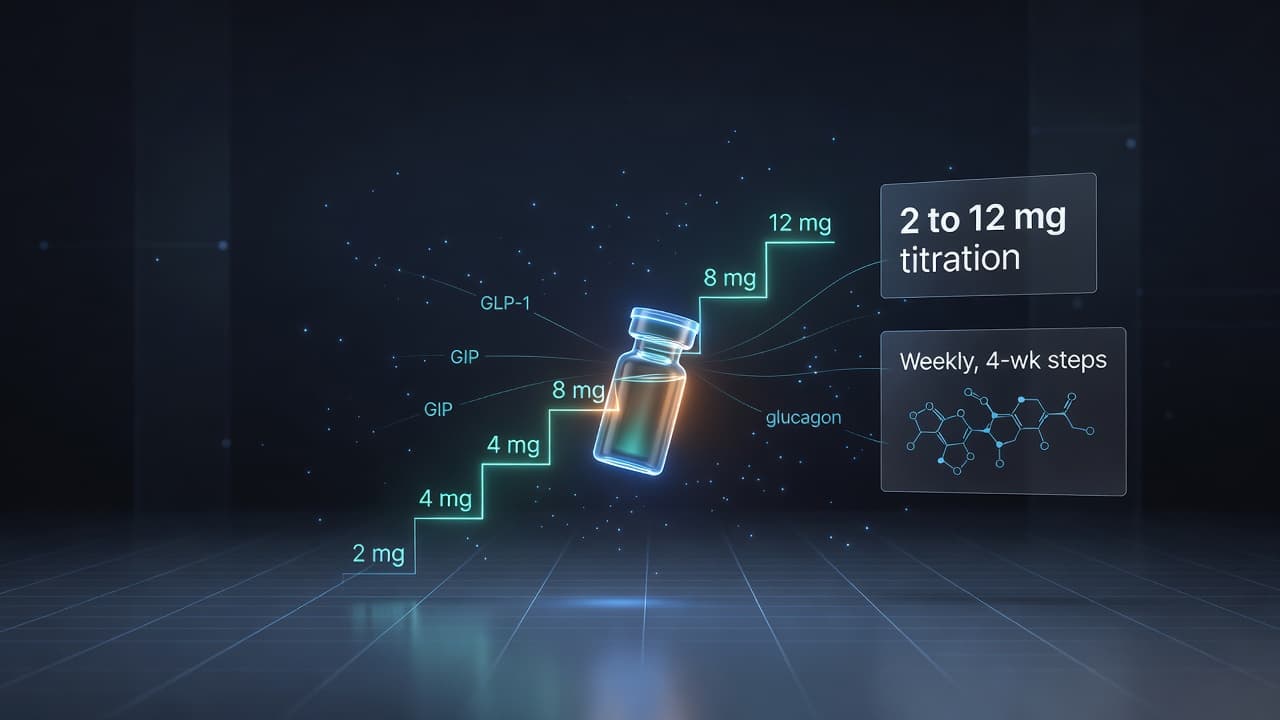
First-ever triple-action weight management peptide targeting three receptors at once: GLP-1, GIP, and glucagon. Shown exceptional results in Phase 2 trials - up to 24% weight reduction. The most advanced metabolic peptide available.
A first-in-class dual GIP and GLP-1 receptor agonist, and one of the most extensively studied compounds in modern metabolic and weight-regulation research. Supplied as a lyophilised research peptide with a per-batch certificate of analysis, for laboratory and in-vitro use only.
Retatrutide (LY-3437943) is an investigational once-weekly triple-hormone receptor agonist that activates GLP-1, GIP, and glucagon receptors. Published clinical data describe a structured dose-escalation approach used during treatment initiation. This article summarizes dosing and pharmacokinetic points from published retatrutide studies and compares them with the labeled escalation schedules for semaglutide and tirzepatide.
Published Lilly study reports describe investigational clinical-trial use of retatrutide. They do not establish a general reconstitution or storage protocol for third-party lyophilized retail products.
Pharmacokinetics of Retatrutide
Published Phase 1 and Phase 2 studies support once-weekly subcutaneous dosing. Specific pharmacokinetic estimates such as half-life and dose proportionality come from the early multiple-ascending-dose study rather than from the obesity Phase 2 paper.
- Value
- Approximately 6 days
- Source
- Urva et al., Lancet 2022
- Value
- Subcutaneous injection
- Source
- Urva et al., Lancet 2022; Jastreboff et al., NEJM 2023; Lilly FAQ
- Value
- Once weekly in published Phase 1b and Phase 2 trials
- Source
- Urva et al., Lancet 2022; Jastreboff et al., NEJM 2023; Lilly FAQ
- Value
- Dose-proportional pharmacokinetics in the Phase 1b study
- Source
- Urva et al., Lancet 2022
The approximately 6-day half-life is consistent with a weekly schedule. The obesity Phase 2 trial then applied 4-week intervals between escalation steps, but that trial should be cited for the schedule itself rather than as the primary source of the pharmacokinetic estimates above.
Titration Schedule from Published Clinical Trials
The randomized Phase 2 obesity trial (Jastreboff AM et al., N Engl J Med 2023, PMID 37366315, registered as NCT04881760) reported several dose groups. In the 12 mg arm, participants followed a stepwise escalation schedule:
Starting dose: 2 mg once weekly
Escalation: higher doses introduced at 4-week intervals
Target dose: 12 mg once weekly
This schedule was used in a clinical trial setting. In the Phase 2 report, gastrointestinal adverse events were dose-related and were partially mitigated by a lower starting dose.
Dosing Table: Week-by-Week Overview
The table below reflects the escalation pattern reported for the 12 mg regimen in the Phase 2 trial (NCT04881760). The trial registration describes that arm verbatim as: "Participants received 2 mg LY3437943 starting dose followed by 4 mg LY3437943, 8 mg LY3437943 and then 12 mg LY3437943 administered as SC injection QW." Escalation ran every 4 weeks for up to 12 weeks.
- Dose (s.c., once weekly)
- 2 mg
- Phase
- Starting dose
- Notes
- Treatment initiation
- Dose (s.c., once weekly)
- 2 mg
- Phase
- Starting dose
- Notes
- Dose (s.c., once weekly)
- 2 mg
- Phase
- Starting dose
- Notes
- Dose (s.c., once weekly)
- 2 mg
- Phase
- Starting dose
- Notes
- End of first 4-week interval
- Dose (s.c., once weekly)
- 4 mg
- Phase
- Escalation 1
- Notes
- First dose increase
- Dose (s.c., once weekly)
- 4 mg
- Phase
- Escalation 1
- Notes
- Dose (s.c., once weekly)
- 4 mg
- Phase
- Escalation 1
- Notes
- Dose (s.c., once weekly)
- 4 mg
- Phase
- Escalation 1
- Notes
- End of second 4-week interval
- Dose (s.c., once weekly)
- 8 mg
- Phase
- Escalation 2
- Notes
- Second dose increase
- Dose (s.c., once weekly)
- 8 mg
- Phase
- Escalation 2
- Notes
- Dose (s.c., once weekly)
- 8 mg
- Phase
- Escalation 2
- Notes
- Dose (s.c., once weekly)
- 8 mg
- Phase
- Escalation 2
- Notes
- End of third 4-week interval
- Dose (s.c., once weekly)
- 12 mg
- Phase
- Maintenance dose
- Notes
- Assigned target dose
Total titration duration to 12 mg: 12 weeks.
The same trial also studied lower target doses. The published evidence therefore supports more than one retatrutide dosing pathway, depending on the study arm.
Starting Dose and Tolerability
The published retatrutide studies, like the approved semaglutide and tirzepatide labels, use gradual escalation rather than immediate full-dose exposure. Tolerability is the stated rationale. Be precise about what the data shows here: the Phase 2 publication reports that gastrointestinal events were dose-related and "were partially mitigated with a lower starting dose". The trial did not compare escalation speeds against each other, so the independent effect of how fast you escalate was never tested.
Gastrointestinal Tolerability
In the Phase 2 trial, the most commonly reported adverse events were gastrointestinal, including:
- nausea
- diarrhea
- vomiting
- constipation
In the published Phase 2 abstract, these events were described as dose-related, mostly mild to moderate, and partially mitigated with a lower starting dose. This article does not repeat exact event percentages because those figures depend on the analysis population, dose arm, and time window used in the source publication.
Mechanistic Context
Retatrutide engages three metabolic signalling pathways, one more than tirzepatide and two more than semaglutide. That is a mechanistic difference, and it does not by itself establish anything about tolerability. What is documented is simply the design: the Phase 2 trial used gradual up-titration rather than immediate exposure to the highest dose.
The 4 mg Glucagon Threshold: What the Dose-Response and Appetite Data Show
Research forums repeat two claims about one number: that retatrutide's glucagon receptor arm only switches on near 4 mg weekly, leaving lower doses to the GLP-1 and GIP arms, and that appetite suppression fades above it. The published record establishes neither.
In vitro the molecule "shows balanced GCGR and GLP-1R activity but more GIPR activity" (Coskun T et al., Cell Metab 2022, PMID 35985340). That is relative potency, not an on/off point. The same paper's body weight finding, "augmented by the addition of GCGR-mediated increases in energy expenditure to GIPR- and GLP-1R-driven calorie intake reduction", is from obese mice. As of 2026-09-04, no completed study has reported a milligram dose at which glucagon receptor activity begins for this investigational compound (PubMed searches: 'retatrutide AND (threshold OR receptor occupancy)' and '(retatrutide OR LY3437943) AND threshold[tiab]', both returning only PMID 42649514; ClinicalTrials.gov search: 'retatrutide AND glucagon AND threshold', no studies).
The 4 mg figure fits the dose grid better than the biology. The phase 2 type 2 diabetes trial randomized maintenance doses of 0.5 mg, 4 mg, 8 mg and 12 mg (Rosenstock J et al., Lancet 2023, PMID 37385280, NCT04867785), so nothing sits between 0.5 mg and 4 mg. In that population body weight decreased dose dependently at 36 weeks by 3.19% at 0.5 mg, 7.92% and 10.37% in the two 4 mg arms, 16.81% and 16.34% in the two 8 mg arms and 16.94% at 12 mg, against 3.00% on placebo. Only at 4 mg and greater were those decreases significantly greater than placebo. Its body composition substudy reported percent reduction from baseline in total fat mass at week 36 of 4.9% at 0.5 mg, 15.2% at 4 mg pooled, 26.1% at 8 mg pooled and 23.2% at 12 mg, against 4.5% on placebo (Coskun T et al., Lancet Diabetes Endocrinol 2025, PMID 40609566).
Below 4 mg the readouts are not blank. The liver-fat substudy of the phase 2 obesity trial (NCT04881760) reported a mean relative change in liver fat at 24 weeks of -42.9% at 1 mg against +0.3% on placebo, all doses P<0.001 versus placebo (Sanyal AJ et al., Nat Med 2024, PMID 38858523). That paper related those reductions to body weight, abdominal fat and metabolic measures, not to a named receptor.
The appetite half fares no better. In the phase 2 obesity trial, perceived hunger and disinhibition scores fell significantly more than placebo in every retatrutide dose group at weeks 24 and 48, p < 0.01 for all comparisons, and the decreases "generally appeared dose-dependent, particularly for disinhibition" (Kanu C et al., Diabetes Obes Metab 2025, PMID 40735804). Pre-specified exploratory analyses in 275 adults with type 2 diabetes reported greater improvements versus placebo in Eating Inventory Perceived Hunger and Disinhibition at 8 mg and 12 mg, weeks 24 and 36 (Kanu C et al., Diabetes Obes Metab 2025, PMID 40916752). Both are group means, not individual trajectories.
As of 2026-09-04, no completed study has reported human data separating the calorie-intake component from the energy-expenditure component (PubMed search: 'retatrutide AND ("energy expenditure" OR "indirect calorimetry" OR "resting metabolic rate")', 8 records; ClinicalTrials.gov search: 'retatrutide AND energy expenditure', 1 study). That study, NCT06313528, is a phase 1 trial with 85 participants, completed 26 August 2025, calorie intake primary and 24-hour energy expenditure secondary, no results posted.
Retatrutide remains investigational. In the phase 2 obesity trial participants were randomized to a fixed target dose rather than titrating to effect (NCT04881760), so staying low because appetite suppression already feels complete was never an arm. Whether to escalate or stay low is an individual decision the published evidence does not answer.
Appetite Around the Escalation Steps: What Was Measured and When
Community reports describe what the escalation table cannot: hunger or food noise louder after a step up, separate from the onset and end-of-week reports covered in our time course article. In our current Reddit corpus of 5761 question posts, 59 r/Retatrutide posts carry both a hunger or food-noise term and a dose-increase or titration term.
The trials measured something narrower. In the Phase 2 obesity trial, participants "completed the 51-item Eating Inventory at baseline, Weeks 24 and 48", so both on-treatment readings came after escalation had finished; perceived hunger and disinhibition scores fell more than placebo in all retatrutide dose groups at both visits (p < 0.01 for all comparisons); the authors note that "the lag in treatment effect for the 12 mg group may have resulted from the long dose titration" (PMID 40735804). In the Phase 2 type 2 diabetes study, Appetite Visual Analog Scale scores in 275 adults came after 24 and 36 weeks; retatrutide at 4 mg or higher produced greater reductions from baseline in overall appetite, hunger and prospective food consumption than placebo at Week 24 (all p <0.05), a pre-specified exploratory analysis (PMID 40916752). Both are group means at fixed visits, not within-person step comparisons.
As of 2026-09-04, no completed study has reported appetite or hunger ratings measured before and after an individual retatrutide dose-escalation step (PubMed search: retatrutide AND (appetite OR hunger) AND ("dose escalation" OR titration), 0 records; ClinicalTrials.gov search: retatrutide, 33 registered studies, outcomes screened for appetite, hunger, eating and food-intake terms). NCT06313528 lists an appetite endpoint in a Phase 1 calorie-intake and energy-expenditure trial in 85 participants under calorie restriction, completed 26 August 2025, with no results posted.
Three documented findings sit beside this without confirming it:
- Energy deficit: in 50 overweight or obese patients on a 10-week very-low-energy diet, no drug, mean weight loss was 13.5 kg (SE 0.5), subjective appetite rose at 10 weeks (P<0.001), and hunger differed from baseline at 62 weeks (PMID 22029981); our weight regain article covers this counter-regulation.
- Glucagon-receptor arm: in obese mice, weight loss "was augmented by the addition of GCGR-mediated increases in energy expenditure to GIPR- and GLP-1R-driven calorie intake reduction" (PMID 35985340), preclinical, not a human measure of a step up.
- Training load: a systematic review of 103 studies in healthy adults found no consistent evidence that exercise affects energy or macronutrient intake (PMID 24454704).
Whether to hold a step or keep escalating is a dosing decision, not answerable here: for this investigational compound the escalation sequence was assigned by arm in the registration (NCT04881760), and the PubMed search above returns no report using appetite ratings as an escalation input.
Comparison of Dosing Schedules: Semaglutide, Tirzepatide, Retatrutide
The comparison below places approved product labels alongside an investigational clinical-trial regimen:
- semaglutide and tirzepatide rows summarize current FDA-labeled escalation schedules for approved products
- retatrutide summarizes the published clinical-trial schedule for an investigational drug
- Semaglutide (Wegovy injection)
- FDA-approved product
- Tirzepatide (Zepbound)
- FDA-approved product
- Retatrutide
- Investigational drug
- Semaglutide (Wegovy injection)
- GLP-1
- Tirzepatide (Zepbound)
- GLP-1 + GIP
- Retatrutide
- GLP-1 + GIP + glucagon
- Semaglutide (Wegovy injection)
- 0.25 mg
- Tirzepatide (Zepbound)
- 2.5 mg
- Retatrutide
- 2 mg
- Semaglutide (Wegovy injection)
- 2.4 mg
- Tirzepatide (Zepbound)
- 15 mg
- Retatrutide
- 12 mg in one Phase 2 arm
- Semaglutide (Wegovy injection)
- 0.25 -> 0.5 -> 1.0 -> 1.7 -> 2.4 mg
- Tirzepatide (Zepbound)
- 2.5 -> 5 -> 7.5 -> 10 -> 12.5 -> 15 mg
- Retatrutide
- 2 -> 4 -> 8 -> 12 mg
- Semaglutide (Wegovy injection)
- 4 weeks
- Tirzepatide (Zepbound)
- At least 4 weeks
- Retatrutide
- 4 weeks in the published Phase 2 schedule
- Semaglutide (Wegovy injection)
- Once weekly
- Tirzepatide (Zepbound)
- Once weekly
- Retatrutide
- Once weekly
This table should not be read as a head-to-head efficacy ranking. It is a schedule comparison only. Retatrutide also remains investigational. Lilly's public FAQ states that retatrutide is not available for public use and is being studied in Phase 3 clinical trials.
Formulation and Reconstitution: What the Published Trial Data Do Not Show
The available retatrutide clinical publications do not provide a generalizable protocol for reconstituting retail lyophilized vials with bacteriostatic water. That distinction matters because:
- Lilly describes retatrutide as an investigational drug available through its clinical development program, not as an approved commercial product
- the published trial reports summarize dosing and outcomes, but do not establish a standard compounding or handling method for third-party products
- product-specific concentration, excipients, sterility controls, and storage instructions can differ across suppliers
For that reason, a research article grounded in published trial evidence should not present a bacteriostatic-water reconstitution table as though it were part of Lilly's clinical protocol.
Storage and Handling Caveat
The same limitation applies to storage claims. The published clinical-trial sources cited here do not provide a general storage standard for commercially sold reconstituted retatrutide vials. Any handling or storage instructions should come from product-specific manufacturer documentation and laboratory SOPs, not from inference based on Lilly trial publications.
Scope of the Published Evidence
The published retatrutide sources cited here support three narrow points relevant to dosing:
- published clinical studies used once-weekly subcutaneous administration
- the Phase 2 obesity trial used stepwise escalation to the assigned target dose
- the clinical publications do not provide a general protocol for third-party vial reconstitution, storage, or supply planning
Broader operational details should come from study-specific documents, manufacturer materials, and institutional procedures rather than from inference based on the published trial papers alone.
Conclusion
The published retatrutide evidence supports a once-weekly, stepwise escalation approach in clinical research, with the 12 mg Phase 2 regimen moving from 2 mg to 4 mg to 8 mg to 12 mg at 4-week intervals. The available sources also support cautious language: retatrutide remains investigational, and published Lilly trial reports do not provide a standard reconstitution or storage protocol for third-party commercial vials.
For schedule comparisons across the incretin field, approved product labels and investigational trial regimens should be cited separately and interpreted on their own terms.
-> Research Product: Retatrutide
This article is intended solely for informational purposes in scientific research. It does not provide medical advice and does not describe an approved prescribing protocol.
Frequently Asked Questions
References
- Urva S, et al. LY3437943, a novel triple GIP, GLP-1, and glucagon receptor agonist in people with type 2 diabetes: a phase 1b, multicentre, double-blind, placebo-controlled, randomised, multiple-ascending dose trial. Lancet. 2022;400(10366):1869-1881. PMID 36354040.
- Jastreboff AM, et al. Triple-Hormone-Receptor Agonist Retatrutide for Obesity - A Phase 2 Trial. N Engl J Med. 2023;389(6):514-526. PMID 37366315. ClinicalTrials.gov NCT04881760.
- Eli Lilly and Company. What to know about retatrutide.
- U.S. FDA. Wegovy prescribing information.
- U.S. FDA. Zepbound prescribing information.
- Coskun T, et al. LY3437943, a novel triple glucagon, GIP, and GLP-1 receptor agonist for glycemic control and weight loss: From discovery to clinical proof of concept. Cell Metab. 2022;34(9):1234-1247.e9. PMID 35985340.
- Rosenstock J, et al. Retatrutide, a GIP, GLP-1 and glucagon receptor agonist, for people with type 2 diabetes: a randomised, double-blind, placebo and active-controlled, parallel-group, phase 2 trial conducted in the USA. Lancet. 2023;402(10401):529-544. PMID 37385280.
- Coskun T, et al. Effects of retatrutide on body composition in people with type 2 diabetes: a substudy of a phase 2, double-blind, parallel-group, placebo-controlled, randomised trial. Lancet Diabetes Endocrinol. 2025;13(8):674-684. PMID 40609566.
- Kanu C, et al. Association between patient-reported eating behaviours and weight change: Secondary analyses of a randomized, double-blind trial comparing retatrutide and placebo in people with obesity or overweight. Diabetes Obes Metab. 2025;27(10):6088-6091. PMID 40735804.
- Kanu C, et al. Appetite, eating attitudes, and eating behaviours during treatment with retatrutide in adults with type 2 diabetes: Results of a phase 2 study. Diabetes Obes Metab. 2025;27(12):6988-6998. PMID 40916752.
- ClinicalTrials.gov. NCT06313528: A Randomized, Double-Blind, Phase 1 Study to Investigate the Effect of LY3437943 Versus Placebo on Calorie Intake and Energy Expenditure in Participants With Obesity Under Calorie Restriction.
Disclaimer: FOR RESEARCH USE ONLY. All products from PeptidesDirect are intended exclusively for in-vitro research and laboratory use. Not for human consumption. Not for in-vivo applications. By purchasing, you confirm that the products are not intended for ingestion or any other application in humans.
Research context for English-speaking buyers
Most of our English-speaking customers ship to the UK, Ireland, Malta or other English-as-second-language EU territories. The regulatory picture differs per country.
- Relevant authorities
- MHRA (UK, post-Brexit), HPRA (Ireland, EU-aligned), FDA Section 503A bulks list (US, restricted Cat 2 status of several peptides as of 2026)
- Customs and VAT
- EU shipments include VAT, the rate depends on the destination country; UK shipments after Brexit are now extra-EU and may attract UK VAT plus a handling fee at import
- Typical shipping window
- EU 2-4 working days, UK 4-7 working days, other international 7-14 working days, depending on customs
Research-grade peptides shipped from our EU warehouse are sold for laboratory use only and are not authorised for human or veterinary therapeutic application in any of the destination jurisdictions. US customers should be aware that the FDA Section 503A bulks list classification (and the April 2026 reclassification of twelve compounds) only governs compounding pharmacies, not direct-to-researcher imports for non-clinical work. UK buyers should declare the consignment on import and may be asked for a research justification by HMRC. We provide a CoA per batch identified by colour code rather than serial number; customs sometimes asks for this document when clearing the parcel.