TRT and Muscle: The Science of Testosterone Therapy
How testosterone builds muscle, what the trial data actually show, and why a research-peptide shop cannot and does not sell TRT.
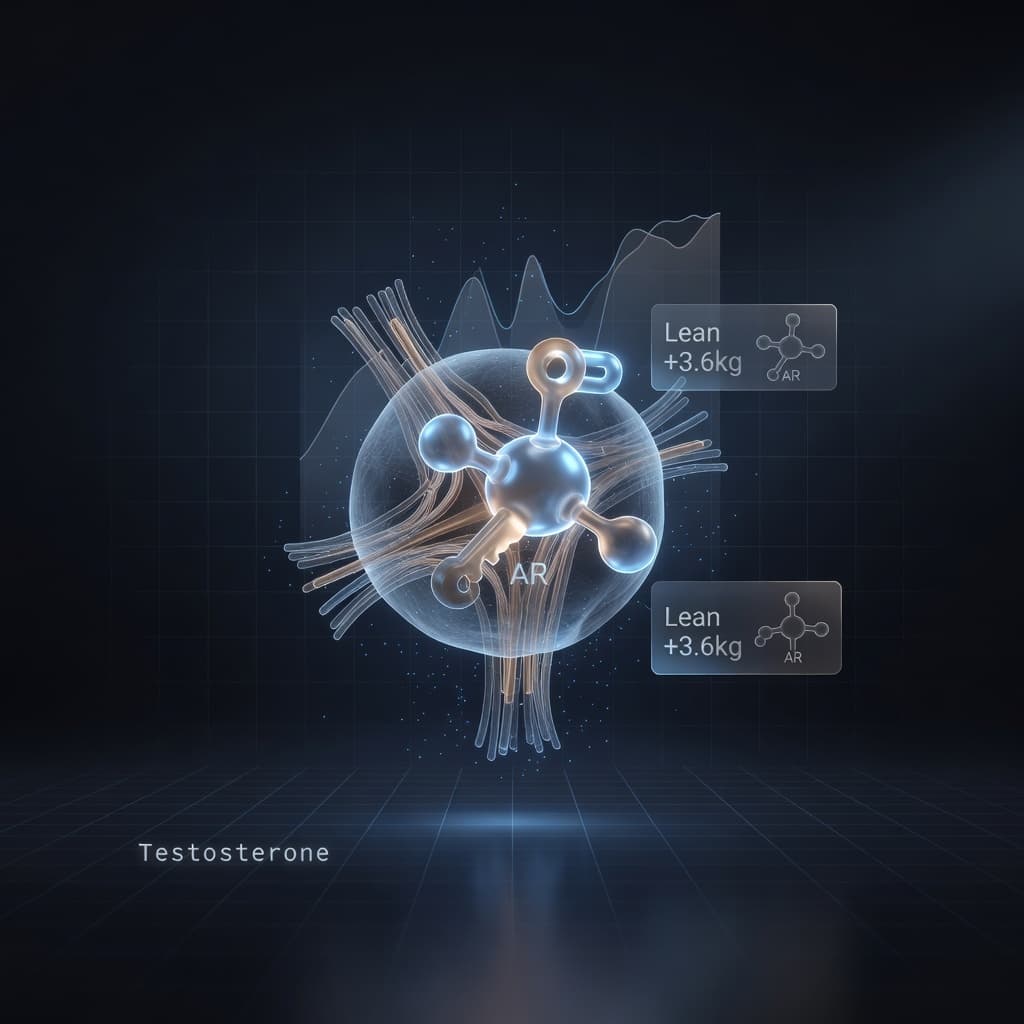
TL;DR: What TRT does to muscle, and why we do not sell it
What it is: Testosterone Replacement Therapy (TRT) is a prescription hormone treatment for men with clinically diagnosed hypogonadism, delivered as injections, gels, or pellets under physician supervision.
What it does to muscle: Testosterone acts directly on muscle tissue through the androgen receptor, and the dose-response relationship is one of the cleanest in endocrinology: fat-free mass rose from +3.4kg to +7.9kg across a 125mg to 600mg weekly dose range in a 20-week trial (PMID 11701431).
The honest limits: Gains are dose-dependent and largest at supraphysiologic doses used for research, not standard replacement dosing. In older men, the largest functional trial found no improvement in vitality or walking distance despite normalized testosterone (PMID 26886521), and cardiovascular safety data are mixed (PMID 20592293, PMID 37326322).
Why we do not sell it: Testosterone is prescription-only across the EU and a controlled substance under Germany's Betaeubungsmittelgesetz (BtMG). peptidesdirect.io does not sell testosterone, anabolic-androgenic steroids, or any prescription hormone, in any form.
What we carry instead: Sermorelin, CJC-1295, and ipamorelin, GHRH/GHRP-class research peptides that work upstream through the pituitary GH/IGF-1 axis, a mechanistically distinct pathway from exogenous hormone replacement.
Testosterone Replacement Therapy sits at the center of a genuine clinical need, well-documented age-related decline, and a much louder cultural conversation about muscle, vitality, and male aging. This article separates the two. It walks through what testosterone actually does to skeletal muscle at the receptor level, what the controlled trials show about dose, age, and safety, and what online communities say about living with TRT day to day. It then explains, without hedging, why a research-peptide catalog based in the EU does not and cannot sell testosterone, and where the GH-axis peptides we do carry, sermorelin, CJC-1295, and ipamorelin, fit into the same broader conversation about muscle and healthy aging, without ever being framed as a substitute for hormone therapy.
What is testosterone / TRT?
Testosterone is the principal androgen hormone in men, produced mainly in the testes under signaling from the hypothalamic-pituitary-gonadal axis. Levels typically peak in early adulthood and decline gradually with age, a decline of roughly 1 to 2% per year after age 30 to 40 that compounds over decades. When testosterone falls below a clinically defined threshold and is accompanied by symptoms, low libido, fatigue, loss of muscle mass, mood changes, the condition is diagnosed as hypogonadism, and TRT is the standard medical treatment.
TRT is prescribed and monitored by a physician, most often an endocrinologist or urologist, following blood work that confirms a genuine deficiency rather than symptoms alone. Delivery forms in clinical use include intramuscular or subcutaneous injections of testosterone esters such as cypionate or enanthate, transdermal gels, and subcutaneous pellets. Dosing, monitoring intervals, and duration are all set by the prescribing physician based on the patient's bloodwork and clinical picture, not a fixed protocol a patient chooses independently.
Mechanism: how testosterone builds muscle, and how that differs from the GH axis
Testosterone's anabolic effect on skeletal muscle runs through a direct receptor pathway. The hormone binds the androgen receptor inside muscle cells, including in myonuclei and in satellite cells, the muscle stem cells responsible for repair and growth. Receptor binding directly upregulates muscle protein synthesis. Separately, testosterone increases expression of follistatin, a protein that suppresses myostatin, one of the body's principal negative regulators of muscle growth. Suppressing a brake on growth, on top of directly driving protein synthesis, is part of why testosterone's anabolic effect is so consistently reproducible in trials.
This is mechanistically distinct from how the GH/IGF-1 axis works. Growth hormone secretagogues act upstream, at the pituitary gland, stimulating the body's own release of growth hormone, which then drives IGF-1 production in the liver and peripheral tissues. Testosterone acts directly at the muscle cell via the androgen receptor. Both pathways can support lean tissue, but they are not the same lever, and a compound that stimulates one does not substitute for, or replicate, the other.
The clinical evidence: testosterone's dose-response on muscle
Few relationships in endocrinology are as cleanly documented as testosterone's dose-dependent effect on lean mass.
The foundational trial (PMID 8637535, Bhasin et al., New England Journal of Medicine, 1996) randomized 43 normal men to supraphysiologic testosterone enanthate (600mg weekly) or placebo, with and without strength training, over 10 weeks. Testosterone alone increased fat-free mass and muscle fiber size versus placebo, with no strength training required to produce the effect. Testosterone combined with strength training produced the largest gains across fat-free mass, muscle fiber cross-sectional area, and bench press and squat strength. The trial established, for the first time under controlled conditions, that supraphysiologic testosterone is directly anabolic to skeletal muscle independent of exercise.
A follow-up dose-response trial (PMID 11701431, Bhasin et al., American Journal of Physiology, 2001) went further, suppressing endogenous testosterone in 61 eugonadal men with a GnRH agonist, then administering 25, 50, 125, 300, or 600mg of testosterone enanthate weekly for 20 weeks. Fat-free mass rose in a dose-dependent, near-linear pattern: +3.4kg at 125mg, +5.2kg at 300mg, +7.9kg at 600mg per week, strongly correlated with log testosterone dose (r=0.73, p=0.0001). This trial is the basis for essentially all modern understanding of testosterone dosing, and it showed that muscle and strength effects are far more dose-sensitive than mood or cognitive measures in the same study.
Trial design note: suppress-then-replace
The 2001 dose-response trial's design, chemically suppressing each participant's own testosterone production before administering a fixed weekly dose, is what allows the dose-response curve to be attributed cleanly to the administered testosterone rather than to variation in each man's baseline hormone output. It is a standard and well-regarded method for isolating a dose-response relationship, but it also means the doses studied, up to 600mg weekly, are far above what a hypogonadal man would receive under standard TRT, which is typically dosed to restore, not exceed, normal physiological levels.
In older, sarcopenic men, the population where muscle preservation is most clinically relevant, the effect is real but considerably smaller. A pooled meta-analysis found TRT produced an average lean mass gain of 3.59kg and fat mass reduction of 1.78kg (PMID 25637335), roughly half the magnitude seen in young men on the higher end of the supraphysiologic dose range studied above.
The honest limits: functional gains and cardiovascular safety
Strength and body composition are not the only outcomes that matter, and the evidence on functional benefit and cardiovascular risk is more mixed than the muscle data alone would suggest.
The T Trials, the largest modern randomized trial of TRT in older men with low testosterone (n=790, PMID 26886521), found no improvement in vitality or overall walking distance despite raising testosterone to mid-normal-for-young-men levels. Measurable strength gains do not automatically translate into the subjective sense of wellbeing or the functional mobility outcomes that matter most for many older patients.
Cardiovascular safety is the area requiring the most care. The TOM trial (PMID 20592293, Basaria et al., New England Journal of Medicine, 2010) enrolled 209 men aged 65 and older with mobility limitations, randomized to testosterone gel or placebo for six months, and was stopped early after 23 cardiovascular adverse events occurred on testosterone versus 5 on placebo, despite genuine strength gains on measures like leg press, chest press, and stair-climbing speed. That early-stopped trial is why cardiovascular monitoring became a standard part of TRT protocols, especially for older or comorbid patients.
Cardiovascular monitoring is not optional, and the data remain mixed
The most recent and by far the largest safety trial, TRAVERSE (PMID 37326322, Lincoff et al., New England Journal of Medicine, 2023), followed 5,246 hypogonadal men aged 45 to 80 with existing or elevated cardiovascular risk for roughly 22 months of treatment and 33 months of follow-up. Testosterone gel was noninferior to placebo for major adverse cardiac events (7.0% versus 7.3%, hazard ratio 0.96), a reassuring headline result. But the same trial found higher rates of atrial fibrillation, acute kidney injury, and pulmonary embolism on testosterone. TRAVERSE refines the safety picture in a large, cardiac-risk population, it does not erase the need for ongoing physician monitoring, which remains a hard requirement of any legitimate TRT protocol.
Muscle preservation with age: sarcopenia and the parallel GH-axis decline
Age-related muscle loss, sarcopenia, is driven by more than one hormonal system declining together. Testosterone's roughly 1 to 2% annual decline after age 30 to 40 runs in parallel with a well-documented decline in growth hormone and IGF-1 output across the same decades. Both pathways converge on the same downstream outcome, less lean tissue and slower muscle repair, but they operate through different mechanisms, the androgen receptor for testosterone, the pituitary GH/IGF-1 axis for growth hormone. That parallel, but mechanistically separate, decline is a large part of why research interest in growth hormone secretagogues exists independently of the hormone replacement literature, as a different lever on the same broad problem of age-related muscle loss.
What the community reports (anecdotal, not clinical evidence)
Beyond the clinical trials, TRT is heavily discussed across dedicated forums, MESO-Rx/thinksteroids.com, ExcelMale, and r/testosterone-adjacent content, as well as TRT-journey YouTube videos. Everything below is self-reported forum and community chatter, not clinical evidence, and Reddit and YouTube largely could not be scraped directly, so themes reflect what search engines surfaced and what forum pages were directly readable. Treat this as what people say, not what is true.
Energy and mood first, body composition later. The most-repeated narrative across TRT-journey content is that subjective improvements, energy, mood, motivation, libido, show up first, with visible body composition changes described as arriving later once levels stabilize.
Dosing chatter is granular and highly individualized. Forum threads on MESO-Rx and ExcelMale are dominated by detailed dose talk, commonly 100 to 200mg weekly of testosterone cypionate or enanthate, split across injection frequencies to smooth out peak-to-trough swings. Users frequently cite their own SHBG levels as the reason one protocol works for them and not for someone else, and threads show constant self-adjustment, one poster described cutting from 150mg to 90mg weekly specifically to manage estrogen.
Estrogen management is a dominant anxiety theme. A large share of dosing discussion is not about testosterone at all but about controlling estradiol with aromatase inhibitors like anastrozole. Community sentiment consistently holds that a crashed estrogen level feels worse than an elevated one, described in terms of mood swings, joint pain, and libido loss, and that aromatase-inhibitor dosing has a narrow margin that is easy to overshoot. One poster described a small adjustment to their aromatase-inhibitor dose making them feel like themselves again, and remarked on how unsettling it was that hormone levels alone could shift mood and personality so completely. Another participant in the same thread cautioned that a crashed estrogen level is worse to live with than an elevated one, citing disrupted sleep, low libido, and poor gym performance as the cost of overcorrecting.
Three side effects recur most often. Acne, especially in the first three to six months, accelerated hair loss in genetically predisposed men, and elevated hematocrit or polycythemia requiring monitoring, and occasionally phlebotomy, are the side effects that come up again and again across forum and clinical-adjacent discussion.
Muscle claims exist but are contested within the community itself. Some users report noticeable fat loss and muscle fullness, and forum posters point to data suggesting doses of roughly 125mg weekly and above correlate with fat-free mass gains. But experienced forum voices consistently push back that standard TRT replacement dosing alone is not a muscle-building protocol, gains still require training, diet, and sleep, and dramatic gains are usually attributed to people running doses beyond standard TRT range, described in the community as blasting.
Sourcing and legality split into two camps. Legitimate telehealth-clinic TRT is criticized in community chatter for cost, reports of over $1,000 per month, and sometimes opaque prescribing practices. Gray-market or underground-lab sourcing is motivated by cost, with some reports around $200 for a supply that would cost far more through a clinic, but is repeatedly flagged, including in cautionary posts, for unreliable actual potency and no medical monitoring. Claims that underground-lab vials tested at 25 to 400% of labeled dose are a recurring talking point in cautionary sourcing content, but this research could not independently verify it against a primary lab dataset, so it is flagged here as an unverified community claim, not a confirmed finding.
Overall sentiment is polarized but pragmatic-positive among people already on therapy. Those actively on TRT and posting in dedicated communities skew toward describing it as worthwhile once dialed in, while broader outside commentary, including skeptical physicians, frames the surge in TRT and manosphere popularity with suspicion, questioning whether all users are properly diagnosed hypogonadal patients or lifestyle and performance seekers.
Why we do not sell testosterone
Testosterone is prescription-only and a controlled substance, we do not sell it, in any form
Testosterone is a prescription-only medicine across the European Union. In Germany specifically, it is regulated as a controlled substance under the Betaeubungsmittelgesetz (BtMG), and manufacturing, selling, or possessing it without a valid prescription is illegal. It cannot legally be imported for personal use, including from abroad. peptidesdirect.io does not sell testosterone, any anabolic-androgenic steroid, or any hormone requiring a prescription, and nothing in this article is dosing or purchasing guidance, or an implication that testosterone can be obtained here in any form. Anyone considering TRT should speak with a licensed physician or endocrinologist, who can order the appropriate bloodwork and determine whether treatment is clinically warranted.
The research peptides we carry
Our own catalog does not include testosterone or any hormone replacement product. What we carry, for laboratory research purposes only, are three GHRH/GHRP-class peptides that act on the pituitary GH/IGF-1 axis rather than the androgen receptor pathway described above:
GHRH(1-29) analog for physiological growth hormone stimulation research
CJC-1295 without DAC (Mod GRF 1-29) is a short-acting GHRH(1-29) analog for GH/IGF-1 research. Research-grade lyophilized powder, specified purity >=99% (HPLC). Laboratory use only.
Highly selective growth hormone releaser that triggers natural GH pulses without raising cortisol or prolactin. Clean GH stimulation with minimal side effects - the most targeted growth hormone peptide available.
Growth hormone secretagogues and gonadotropins
Lean-mass research
GHRH(1-29) analog for physiological growth hormone stimulation research
CJC-1295 without DAC (Mod GRF 1-29) is a short-acting GHRH(1-29) analog for GH/IGF-1 research. Research-grade lyophilized powder, specified purity >=99% (HPLC). Laboratory use only.
Highly selective growth hormone releaser that triggers natural GH pulses without raising cortisol or prolactin. Clean GH stimulation with minimal side effects - the most targeted growth hormone peptide available.
How the mechanisms actually compare
Sermorelin and CJC-1295 are both GHRH (growth hormone-releasing hormone) analogs, they signal the pituitary to release its own growth hormone. Ipamorelin is a GHRP (growth hormone-releasing peptide), a ghrelin-mimetic that stimulates GH release through a separate pituitary receptor, often studied alongside a GHRH analog for a combined signal. None of the three raises testosterone, none acts on the androgen receptor, and none suppresses myostatin through the follistatin pathway described earlier in this article. They belong to the growth hormone secretagogue class, a mechanistically distinct pathway from exogenous testosterone, and they are not framed here, or anywhere in our catalog, as an alternative or substitute for TRT. They exist in our catalog strictly as research compounds studied for their effect on the body's own GH/IGF-1 output, not as a hormone-replacement product.
Questions about testosterone or TRT availability
Testosterone and TRT are not products we list or sell. If you have questions about availability, regulatory status, or where TRT can legally be obtained, email support@peptidesdirect.io and we will answer honestly, including telling you clearly when the honest answer is that we cannot help and you should consult a licensed physician.
Frequently Asked Questions
This article is for informational and educational purposes only. All mentioned peptides are intended exclusively for laboratory research and not for human consumption. We do not sell the drug this article is about. For Research Purposes Only.
Research context for English-speaking buyers
Most of our English-speaking customers ship to the UK, Ireland, Malta or other English-as-second-language EU territories. The regulatory picture differs per country.
- Relevant authorities
- MHRA (UK, post-Brexit), HPRA (Ireland, EU-aligned), FDA Section 503A bulks list (US, restricted Cat 2 status of several peptides as of 2026)
- Customs and VAT
- EU shipments include 19% VAT; UK shipments after Brexit are now extra-EU and may attract UK VAT plus a handling fee at import
- Typical shipping window
- EU 2-4 working days, UK 4-7 working days, other international 7-14 working days, depending on customs
Research-grade peptides shipped from our EU warehouse are sold for laboratory use only and are not authorised for human or veterinary therapeutic application in any of the destination jurisdictions. US customers should be aware that the FDA Section 503A bulks list classification (and the April 2026 reclassification of twelve compounds) only governs compounding pharmacies, not direct-to-researcher imports for non-clinical work. UK buyers should declare the consignment on import and may be asked for a research justification by HMRC. We provide a CoA per batch identified by colour code rather than serial number; customs sometimes asks for this document when clearing the parcel.