AOD-9604 vs HGH Fragment 176-191: One Amino Acid Apart, What the Research Shows
AOD-9604 vs HGH Fragment 176-191: the shared growth-hormone C-terminal sequence, the added N-terminal tyrosine, and what research shows for each.
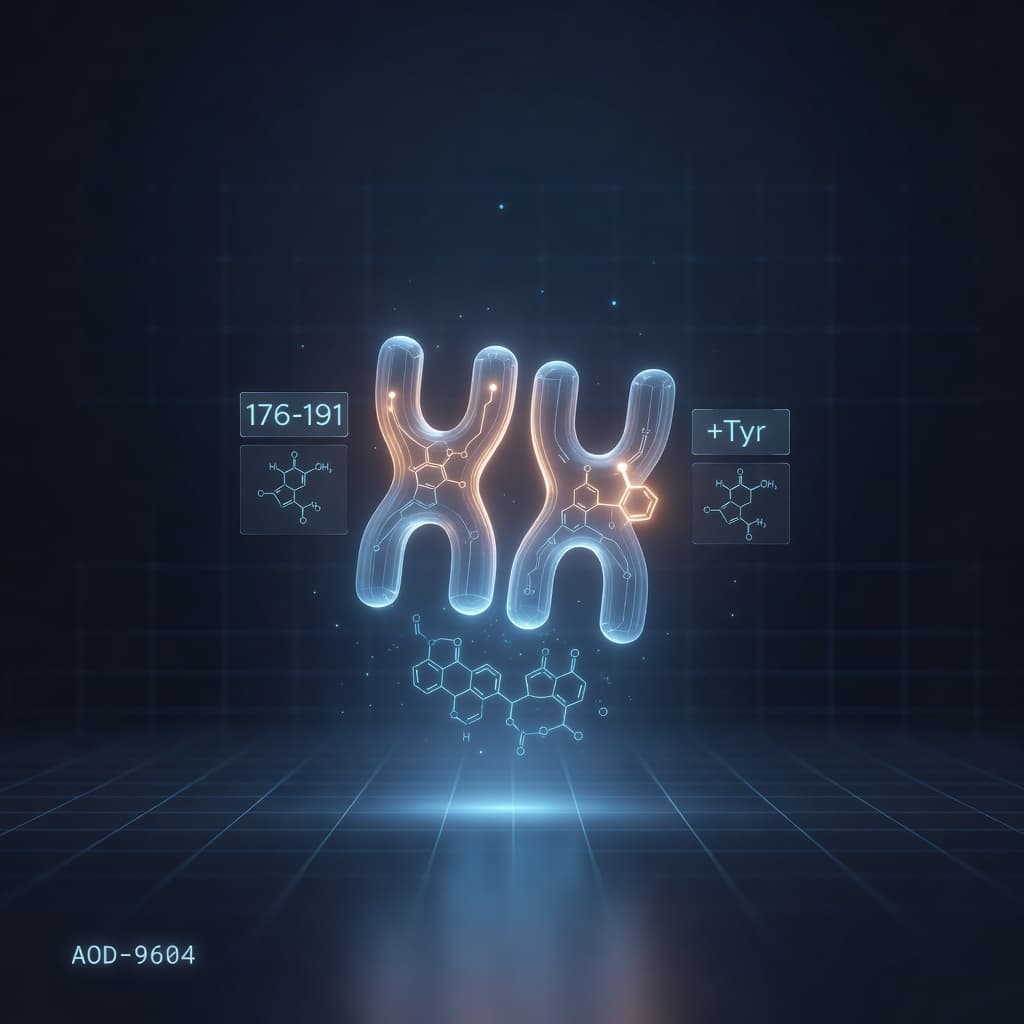
TL;DR: one amino acid apart, very different evidence base
Shared origin: both peptides come from the C-terminal end of human growth hormone (hGH), a region commonly described in the literature as carrying lipolytic activity separate from GH's growth-promoting effects.
The one-residue difference: HGH Fragment 176-191 keeps the native phenylalanine at position 1 (FLRIVQCRSVEGSCGF). AOD-9604 swaps that phenylalanine for a tyrosine (YLRIVQCRSVEGSCGF), everything from position 2 onward is identical.
Only one of them reached humans: AOD-9604 went through roughly six company-sponsored trials and about 900 subjects. The pivotal 24-week trial did not beat placebo on weight loss, and the program was shelved around 2007. Fragment 176-191 never had a comparable human program at all.
Mechanism is rodent-only: the proposed beta-3-adrenergic lipolytic pathway comes entirely from mouse studies. No published human tissue or receptor data confirm it for either peptide.
Neither is approved: no FDA or EMA approval, for any indication, in humans or animals. Both are sold strictly as research material.
Search "AOD-9604" or "HGH Fragment 176-191" and you will find the two names used almost interchangeably across research-chemical forums and vendor listings. That is a mistake worth correcting, because the two peptides are not identical, and the evidence behind them is not equally strong. This article works through the actual sequence difference, why it was introduced, what each peptide has and has not been shown to do, and where the two names get conflated in ways that overstate what either one has demonstrated.
The shared origin: a 16-residue piece of hGH
Full-length human growth hormone is a 191-amino-acid, roughly 22 kDa protein. The literature on hGH structure-function commonly describes its biological activities as mapped to different regions of the molecule, with the C-terminal domain, roughly residues 176-191, described as a region with lipolytic (fat-mobilizing) activity that appears separable from the receptor-binding region responsible for GH's growth-promoting, IGF-1-generating effects.
That separation is the whole premise behind both peptides discussed here. If a short C-terminal fragment carries the lipolytic signal without the growth-hormone-receptor engagement, in principle you get a tool that studies fat metabolism without touching the IGF-1 axis. Whether that premise holds up cleanly in practice is exactly what the rest of this article works through.
HGH Fragment 176-191 is the native sequence exactly as it occurs in intact hGH: a 16-residue peptide, Phe-Leu-Arg-Ile-Val-Gln-Cys-Arg-Ser-Val-Glu-Gly-Ser-Cys-Gly-Phe (FLRIVQCRSVEGSCGF), with an intramolecular disulfide bridge between the two cysteines. CAS 66004-57-7, molecular formula approximately C78H123N23O22S2, molecular weight approximately 1799 g/mol.
AOD-9604 (Anti-Obesity Drug 9604) is built on the same 16-residue backbone but with the native N-terminal phenylalanine replaced by a non-native tyrosine: Tyr-Leu-Arg-Ile-Val-Gln-Cys-Arg-Ser-Val-Glu-Gly-Ser-Cys-Gly-Phe (YLRIVQCRSVEGSCGF). Everything from position 2 to 16 is the unmodified native hGH 177-191 sequence, which is why the compound is sometimes written as Tyr-hGH(177-191). Same disulfide bridge, same 16 residues, CAS 221231-10-3, molecular formula approximately C78H123N23O23S2, approximately 1815 g/mol, about 16 Da heavier than the native fragment because of the extra hydroxyl group the tyrosine carries.
Why the tyrosine, specifically
The substitution is consistently explained across secondary and industry sources by two practical reasons: the added tyrosine gave researchers a convenient site for radioiodination (125-I labeling), which was used in the original receptor-binding and pharmacokinetic tracer work, and it was associated with improved synthesis and metabolic stability compared with the native fragment. No primary, peer-reviewed paper stating this exact rationale was located for this article, so treat it as the commonly given explanation for the design choice rather than a directly sourced fact.
The proposed mechanism, and where it stops being confirmed
The mechanistic case described below rests on a small set of rodent studies of AOD-9604, almost all from the same research group (Ng, Heffernan, and colleagues, working in Australia). HGH Fragment 176-191 has no comparable dedicated study program of its own; any mechanistic narrative attached to it is borrowed from these AOD-9604 findings.
Receptor-binding assays showed that AOD9604 does not compete for the growth hormone receptor, unlike full-length hGH (PMID 11673763). That non-competition finding is the basis for describing the fragment as not directly engaging the GH receptor itself, though it does not by itself establish full independence from downstream IGF-1 signaling.
In chronic (14-day) dosing studies in obese mice, AOD9604 raised beta-3-adrenergic receptor (beta3-AR) mRNA in adipose tissue and reduced weight gain and fat mass. When the same experiment was repeated in beta3-AR knockout mice, the chronic weight-loss and lipolysis effect disappeared entirely, which is the direct evidence tying the sustained fat-loss effect to that specific receptor pathway (PMID 11713213). The downstream signaling steps between that receptor and the resulting fat breakdown have not been demonstrated directly for this peptide in a cited primary paper.
One nuance from the same knockout study is worth keeping: an acute increase in energy expenditure and fat oxidation still occurred even in the beta3-AR knockout mice, suggesting the full picture may include an acute, receptor-independent component alongside the chronic, beta3-AR-dependent one. Neither component has been shown in human tissue or in living human subjects. Every mechanistic finding described above comes from obese Zucker rats, diet-obese or ob/ob mice, and beta3-AR knockout mice.
A glucose-neutral profile is not automatic for this hGH region
A frequently repeated claim is that AOD9604 and the fragment "don't affect blood sugar." That is specific to AOD9604 in the Ng and Heffernan work, not a guaranteed property of the hGH 176-191 region as a class. An earlier 1978 study found that several other synthetic hGH C-terminal fragments from the same general region (spanning 172-191 through 180-191) caused transient hyperglycemia and reduced insulin sensitivity in rats (PMID 645904). The glucose-sparing result reported for AOD9604 is a later, sequence-specific finding, not evidence that every fragment drawn from this part of hGH behaves the same way.
The rodent efficacy data behind AOD-9604
The foundational efficacy study dosed obese Zucker rats orally with AOD9604 at 0.5 mg/kg/day for 19 days. Treated animals gained 15.8 plus or minus 0.6 g versus 35.6 plus or minus 0.8 g in controls, a reduction in weight gain of more than 50 percent, and euglycemic clamp testing found no adverse effect on insulin sensitivity (PMID 11146367).
A second study using subcutaneous osmotic-pump delivery over 14 days in obese mice found increased fat oxidation and plasma glycerol and reduced weight gain, again without the hyperglycemia or reduced insulin secretion seen when full-length hGH was used instead (PMID 11673763).
Outside the weight-loss literature, one small rabbit study tested intra-articular AOD9604 (0.25 mg per knee, weekly) in a collagenase-induced osteoarthritis model and found improved cartilage-damage scores versus saline (n=32) (PMID 26275694). This is unrelated to fat metabolism and should not be read as supporting evidence for the weight-loss claim; it is included here only because it occasionally surfaces in AOD-9604 discussions.
All of the weight-loss efficacy evidence above comes from rodent studies (the rabbit osteoarthritis study above tests an unrelated endpoint, as noted). HGH Fragment 176-191, the unmodified native peptide, was never run through a dedicated human efficacy program of its own; whatever narrative exists for it online is borrowed from AOD-9604's data, under a different name.
What happened when AOD-9604 reached human trials
AOD-9604 was developed commercially by Metabolic Pharmaceuticals (Australia), building on the original Ng laboratory work, and it went further in clinical development than HGH Fragment 176-191 ever did: roughly six randomized, placebo-controlled human trials, about 900 subjects total, run in Australia and the UK between roughly 2001 and 2007. The compound had reached Phase IIa human trials by February 2002 (PMID 15134286).
An earlier 12-week trial (roughly 300 subjects) produced a smaller, promotionally cited signal, on the order of 2.6 to 2.8 kg of weight loss in the best-performing dose group versus roughly 0.8 kg on placebo. That signal did not hold up. The pivotal trial, a 24-week, randomized, double-blind, placebo-controlled Phase 2b study in roughly 500 obese adults, found no clinically meaningful weight loss versus placebo across the dose range tested. Development of AOD-9604 for obesity was discontinued around 2007.
No peer-reviewed publication of the human efficacy results exists
The human weight-loss data described above come from company and press communications, not from a peer-reviewed, PubMed-indexed paper. The closest published human report is safety-only: Stier H, Vos E, Kenley D, "Safety and Tolerability of the Hexadecapeptide AOD9604 in Humans," Journal of Endocrinology and Metabolism, 2013, a non-PubMed-indexed journal with sponsor-affiliated authors. It reports AOD-9604 as well tolerated across roughly 900 subjects, with no treatment-related serious adverse events, no anti-drug antibodies, and no IGF-1 elevation, but it does not report weight-loss efficacy. Treat all human weight-loss figures for AOD-9604 as company-sourced, not independently verified.
AOD-9604 has not disappeared from regulatory conversations entirely. It appeared as one of several peptides reviewed under the FDA Pharmacy Compounding Advisory Committee's (PCAC) 503A bulk drug substances framework: initially placed on the interim Category 2 list (substances flagged as presenting significant safety risk pending review), it was later removed from Category 2 in September 2024 after the nominator withdrew the nomination. FDA's January 2025 final interim guidance eliminated Categories 2 and 3 from the framework altogether. None of this is drug approval, and it does not establish safety or efficacy for any use. It is worth reading alongside our separate coverage of the FDA PCAC review and what it means for EU buyers, which walks through that same compounding-policy process in more detail.
Separately, AOD-9604 is a monitored substance under anti-doping rules: an in vitro human serum and urine assay study established a stable metabolite marker and a urine detection limit of 50 pg/mL (PMID 25208511). That is evidence of regulatory relevance in sport, not of efficacy.
Modified hGH fragment (177-191) studied for fat metabolism and lipolysis research. Interacts with beta-3 adrenergic receptors without growth-promoting effects.
Five things people consistently get wrong about these two peptides
"AOD-9604 and HGH Fragment 176-191 are the same product under two names." They are not. They differ at position 1, native phenylalanine versus a substituted tyrosine, and only one of them, AOD-9604, was ever a clinically tested compound with a company-run trial program behind it.
"AOD-9604 was proven to burn fat and lead to weight loss in humans." The pivotal human trial did not show a benefit over placebo, and the program was discontinued. Nothing in the human record supports an efficacy claim.
"The beta-3-adrenergic mechanism is established science." It is an established finding in mice, specifically demonstrated by the beta3-AR knockout experiment (PMID 11713213). There is no published human receptor or tissue confirmation for either peptide.
"It doesn't affect blood sugar, full stop." AOD9604 specifically avoided hyperglycemia and insulin problems in the rodent efficacy studies, but earlier work on other fragments from the same hGH region found the opposite (PMID 645904), and there is no large peer-reviewed human glucose-safety dataset for AOD9604. The claim is animal-model-specific.
"HGH Fragment 176-191 has its own evidence base because AOD-9604 does." The unmodified fragment never had a dedicated human efficacy program. Any human-relevant narrative attached to "the GH fragment" online is really AOD-9604's trial history, transplanted onto a different peptide.
Why this matters for research buyers
None of the ambiguity above is a sourcing problem, it is a literature problem, and it predates any particular vendor. What a research buyer can control is knowing exactly which sequence a listing actually refers to, the native Phe176 fragment or the tyrosine-substituted AOD-9604, since the two names get used interchangeably across research-chemical forums and vendor listings even though only one of them carries any human trial history.
Where AOD-9604 sits next to today's metabolic research compounds
AOD-9604's clinical story is roughly two decades old, its trial failure occurred around 2007, well before the current generation of GLP-1/GIP/glucagon-class obesity compounds existed. For context, two peptides in active, much larger human trial programs today:
Retatrutide, a triple GIP/GLP-1/glucagon receptor agonist, produced a mean weight change of -24.2 percent at the highest dose tested versus -2.1 percent on placebo in a 48-week Phase 2 trial, with 83 percent of that highest-dose group losing at least 15 percent of body weight versus 2 percent on placebo (Jastreboff et al., NEJM 2023, PMID 37366315). Topline Phase 3 data (not yet peer-reviewed) reported in May 2026 showed -28.3 percent at 80 weeks.
Cagrilintide, a long-acting amylin analog, is most studied in combination with semaglutide as CagriSema. In the REDEFINE 1 Phase 3 trial, CagriSema produced -20.4 percent body weight versus -3.0 percent placebo at week 68 (Garvey et al., NEJM 2025, PMID 40544433). Novo Nordisk filed a US FDA application for CagriSema in December 2025; it remains unapproved.
Neither of these is approved either. The point of the comparison is scale of evidence, not a claim that any of these compounds is interchangeable with the others: they act through entirely different, and in AOD-9604's case still largely unconfirmed-in-humans, receptor systems. For a closer mechanistic comparison, see AOD-9604 vs Retatrutide: two mechanisms, one research goal of fat loss, and for a three-way view including cagrilintide, Retatrutide vs Cagrilintide vs AOD-9604.
First-ever triple-action weight management peptide targeting three receptors at once: GLP-1, GIP, and glucagon. Shown exceptional results in Phase 2 trials - up to 24% weight reduction. The most advanced metabolic peptide available.
Long-acting amylin analog studied for once-weekly satiety and appetite control. Phase 3 REDEFINE trials complete, NDA filed with FDA December 2025. A mechanism distinct from GLP-1 agonists.
GIP/GLP-1/Glucagon agonists and metabolic pathways
Frequently Asked Questions
Adipocyte-targeted lipolysis research (rodent-model evidence)
Incretin-axis / systemic weight research
Broader metabolic weight-loss research
This article is for informational and research purposes only. AOD-9604, HGH Fragment 176-191, Retatrutide, and Cagrilintide are not approved drugs and are sold exclusively as research material for laboratory use, not for human consumption.
Research context for English-speaking buyers
Most of our English-speaking customers ship to the UK, Ireland, Malta or other English-as-second-language EU territories. The regulatory picture differs per country.
- Relevant authorities
- MHRA (UK, post-Brexit), HPRA (Ireland, EU-aligned), FDA Section 503A bulks list (US, restricted Cat 2 status of several peptides as of 2026)
- Customs and VAT
- EU shipments include 19% VAT; UK shipments after Brexit are now extra-EU and may attract UK VAT plus a handling fee at import
- Typical shipping window
- EU 2-4 working days, UK 4-7 working days, other international 7-14 working days, depending on customs
Research-grade peptides shipped from our EU warehouse are sold for laboratory use only and are not authorised for human or veterinary therapeutic application in any of the destination jurisdictions. US customers should be aware that the FDA Section 503A bulks list classification (and the April 2026 reclassification of twelve compounds) only governs compounding pharmacies, not direct-to-researcher imports for non-clinical work. UK buyers should declare the consignment on import and may be asked for a research justification by HMRC. We provide a CoA per batch identified by colour code rather than serial number; customs sometimes asks for this document when clearing the parcel.