BPC-157 and Gut Integrity: What the Preclinical Research Shows
BPC-157 and gut integrity research: intestinal healing, the gut-brain axis and mucosal protection in preclinical models, in a research-use context.
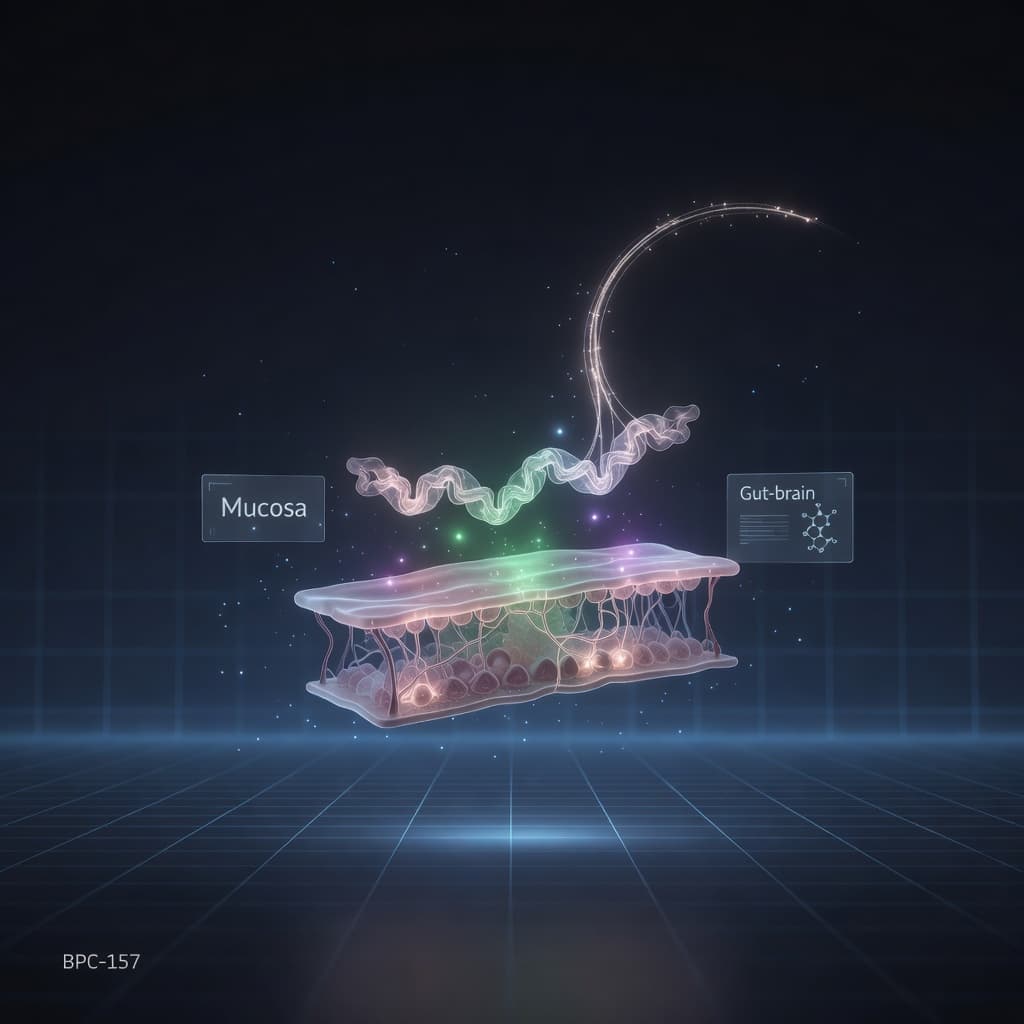
BPC-157 is best known in the research-peptide world for tendon and connective-tissue work, but a large, separate strand of the literature is entirely about the gut. Colitis models, surgical anastomosis, fistula healing, short-bowel syndrome: the intestinal data set is arguably the oldest part of the BPC-157 story, dating back to 1995. This article walks through what that literature actually shows, how it compares mechanistically to the tripeptide KPV, and where the evidence stops and speculation begins.
TL;DR: BPC-157 and Gut Integrity Research
Rat models show BPC-157 reduces TNBS-induced colonic damage and accelerates healing of surgical anastomoses, colocutaneous and colovesical fistulas, and short-bowel-syndrome lesions. The proposed mechanism combines VEGFR2-driven angiogenesis and modulation of the nitric oxide system, though the angiogenesis data come from non-gut tissue and are inferred, not directly measured, in the intestine. A "gut-brain axis" effect is a theoretical framework from one research group, not an independently confirmed pathway. KPV, a three-amino-acid fragment of Alpha-MSH, has a narrower but more precisely mapped gut mechanism via PepT1 and NF-kB, with the caveat that plain oral KPV is a weak performer without a delivery system. No completed human gastrointestinal trial exists for either peptide as of 2026. All gut-integrity claims below are preclinical, rat or mouse, in-vitro research findings.
The Mechanism: Angiogenesis, Nitric Oxide, and a Stable Gastric Peptide
BPC-157 (Body Protection Compound-157) is a synthetic pentadecapeptide, 15 amino acids long, with the sequence Gly-Glu-Pro-Pro-Pro-Gly-Lys-Pro-Ala-Asp-Asp-Ala-Gly-Leu-Val. It is a partial fragment derived from a protective protein detected in human gastric juice, which is where the name comes from. One structural property matters a lot for gut research specifically: BPC-157 is unusually resistant to gastric acid and enzymatic breakdown, reportedly remaining stable for over 24 hours. That stability is why oral and drinking-water dosing shows up repeatedly in the rat literature, where most peptides would simply be digested before reaching the target tissue.
Two mechanisms dominate the working model proposed by the research group most associated with this peptide (P. Sikiric and colleagues, University of Zagreb). The first is angiogenesis through VEGFR2. Hsieh and colleagues (J Mol Med, 2017, PMID 27847966) showed that BPC-157 upregulates and activates VEGFR2 on human vascular endothelial cells, driving the VEGFR2-Akt-eNOS signaling cascade and increasing vessel density and blood-flow recovery. It is worth being precise here: this specific VEGFR2 readout was demonstrated in a chick chorioallantoic membrane assay and a rat hind-limb ischemia model, not in intestinal tissue. Gut-specific angiogenesis is inferred from downstream healing markers, more granulation tissue, more vascularization, seen in the fistula and anastomosis papers discussed below, rather than measured directly with the same VEGFR2 assay in gut samples.
The second mechanism is the nitric oxide (NO) system. A 2014 review from the same group (Sikiric et al., Curr Pharm Des, PMID 23755725) describes BPC-157 as counteracting NO-system disturbances in both directions, opposing both excess NO-synthase inhibition and excess NO stimulation, while improving vascular integrity. But the relationship is not simply "more NO, more healing." In a colocutaneous fistula model, Klicek and colleagues (J Pharmacol Sci, 2008, PMID 18818478) found that blocking NO production with the inhibitor L-NAME impaired healing on its own, yet BPC-157's beneficial effect on the fistula persisted even when NO generation was pharmacologically blunted. That argues BPC-157 does not act purely through the NO pathway, and the true mechanism is likely a combination of angiogenic and NO-modulating effects that is not yet fully resolved.
What the mechanism papers do and do not show
The VEGFR2 mechanism paper (Hsieh 2017, PMID 27847966) used hind-limb ischemia and membrane assays, not gut tissue. A companion paper on angiogenesis in muscle and tendon healing (Brcic 2009, PMID 20388964) found no direct angiogenic effect in isolated cell cultures at all, only in living tissue, suggesting BPC-157's pro-angiogenic action depends on an intact healing context rather than acting as a standalone growth factor.
The Preclinical Evidence: Colitis, Fistulas, and Short-Bowel Syndrome
The gut-integrity data set for BPC-157 spans three decades and several distinct injury models, all in rats.
The earliest work is a 1995 study by Veljaca and colleagues (J Pharmacol Exp Ther, PMID 7815358), published under the developmental name BPC-15, the same molecule lineage later marketed as BPC-157. In a TNBS-induced colitis model, intraperitoneal dosing across a wide range (0.0001 to 10 nanomol per kilogram) produced a dose-dependent reduction in colonic damage, with a statistically significant, dose-dependent fall in colonic myeloperoxidase, an enzyme marker of neutrophil-driven inflammation. Notably, intracolonic dosing at the higher end of that range was not effective, meaning route of administration mattered as much as dose in this early model.
Later work moved from chemically induced colitis to surgical injury models, which more directly test tissue-repair capacity. Vuksic and colleagues (Surg Today, 2007, PMID 17713731) used a rat ileoileal anastomosis model, essentially a surgically rejoined section of small bowel, and found that intraperitoneal BPC-157 at 10 micrograms or 10 nanograms per kilogram improved healing over a 14-day course: less edema from day one, fewer granulocytes, less necrosis by days four to five, and more granulation tissue, reticulin, collagen and epithelialization, all while keeping adhesions and obstruction minimal. A dose of 10 picograms per kilogram was the inactive low arm, underscoring that effects were dose-dependent rather than universal.
The fistula-healing data extend this further. Klicek and colleagues (PMID 18818478, cited above) showed BPC-157 achieved what they described as suitable closure of surgically created colocutaneous (colon-to-skin) fistulas, outperforming sulphasalazine and avoiding the healing impairment seen with corticosteroids. A separate paper from the same group, Grgic and colleagues (Eur J Pharmacol, 2016, PMID 26875638), reported comparable results in a colovesical (colon-to-bladder) fistula model, with substantially improved healing of both the colonic and bladder defects across a 7 to 28 day course, whereas untreated animals had persistent leakage.
Perhaps the most severe model in the data set is short-bowel syndrome. Lojo and colleagues (PLoS One, 2016, PMID 27627764) resected 80 percent of the small bowel in rats and combined this with diclofenac and an NO-synthase inhibitor to simulate a compounded injury. Surgery alone caused mild stomach and duodenal lesions but severe cerebral and hippocampal damage; adding diclofenac caused widespread severe damage across the gut, liver and brain. BPC-157, given orally or intraperitoneally at 10 micrograms or 10 nanograms per kilogram, markedly reduced lesions across all of these organ systems and supported both anastomosis healing and intestinal adaptation. This is one of the clearer illustrations in the literature of BPC-157's proposed systemic protective effect extending beyond the gut itself, into organs affected by severe intestinal injury.
Gastric pentadecapeptide (15 amino acids) known for exceptional tissue repair properties. Promotes wound healing, angiogenesis, and cytoprotection across tendons, muscles, gut, and nerves. Over 30 years of preclinical research.
These are rat surgical and chemical-injury models, not human disease trials
Every gut-integrity result described above comes from rats, using surgically or chemically created lesions, not spontaneous human inflammatory bowel disease. Extrapolating rat mcg/kg or ng/kg dosing to a human protocol has no validated basis, and none of these studies were designed to establish a human dose.
The Gut-Brain Axis: A Theoretical Framework, Not a Proven Pathway
A more speculative strand of the BPC-157 literature proposes that the peptide has a bidirectional effect between gut and brain, sometimes called the "gut-brain axis" or "brain-gut axis." A 2016 review from the Sikiric group (Curr Neuropharmacol, PMID 27138887) proposed that peripherally administered BPC-157 has beneficial central effects via modulation of serotonin and dopamine signaling, alongside its known gastrointestinal, periodontal, liver and pancreatic effects. A 2023 follow-up review (Pharmaceuticals, PMID 37242459) extended this, describing anxiolytic, anticonvulsive and antidepressant-like effects in rodent behavior tests, and proposed that BPC-157 activates collateral vascular pathways that counteract multiorgan failure, including gastrointestinal, liver, kidney, lung and brain lesions, following major vessel occlusion.
It is important to be precise about what these two papers are. Both are narrative reviews and theoretical syntheses, not new controlled experiments, and both come from the same single research group responsible for the majority of the gut-integrity primary data described above. That single-source pattern is a genuine limitation worth naming directly: outside of the KPV comparison in this article, essentially all of the BPC-157 gut and gut-brain literature traces back to one lab. Independent replication by other research groups, using their own models and reagents, is the piece that is largely missing. The gut-brain axis concept is a plausible and actively investigated hypothesis, not an established mechanism.
BPC-157 vs. KPV: Two Different Routes to the Same Gut
KPV takes a mechanistically distinct path to a related research question. Where BPC-157 is a 15-amino-acid peptide with a broad, still-evolving mechanism spanning angiogenesis and the NO system, KPV is a 3-amino-acid tripeptide (Lys-Pro-Val), the C-terminal fragment of Alpha-MSH. Its gut mechanism is comparatively well characterized: Dalmasso and colleagues (Gastroenterology, 2008, PMID 18061177) showed that KPV is taken up directly into intestinal epithelial cells via the PepT1 oligopeptide transporter, a transporter that is upregulated specifically in inflamed gut tissue. That gives KPV a degree of inflammation-targeted delivery that BPC-157's mechanism does not obviously share. Once inside the cell, KPV inhibits NF-kB signaling (slowing IkB-alpha degradation and cutting NF-kB-driven transcription by roughly 35 to 50 percent in cell assays) and MAP-kinase signaling (ERK, JNK, p38), which lowers pro-inflammatory cytokines including IL-6, IL-12, IL-1beta and TNF-alpha. In mouse DSS and TNBS colitis models this translated into roughly a 50 percent and 30 percent reduction in colonic myeloperoxidase, respectively, alongside reduced weight loss and preserved colon length.
An independent group (Kannengiesser et al., Inflamm Bowel Dis, 2008, PMID 18092346) confirmed anti-inflammatory effects of KPV in two further colitis models and, notably, in mice lacking the melanocortin-1 receptor (KPV's presumed parent receptor), where KPV still rescued all treated animals from death during DSS colitis. That finding suggests KPV's gut effect works at least partly independent of the classical melanocortin receptor pathway, which is itself a mechanistically interesting and only partly resolved question.
The important asterisk on KPV: gut-directed uptake does not automatically mean orally effective as a plain solution. Xiao and colleagues (Mol Ther, 2017, PMID 28143741) found that unformulated free KPV needed roughly 12,000-fold more drug to match the efficacy of a nanoparticle-delivered form. A 2026 follow-up (Cheng et al., Sci Adv, PMID 41533788) went further: free oral KPV at 1 mg/kg had no benefit at all in mouse colitis, while an engineered prodrug conjugate was effective starting around 0.5 to 2.5 mg/kg. Read together, these two papers indicate that most of the strongest KPV gut-efficacy data in the literature depends on an engineered delivery vehicle, nanoparticles or a self-immolative prodrug, that is not the form found in a standard research-peptide vial. That is a meaningful caveat for anyone designing a study around plain KPV.
So the two peptides are not simple substitutes for one another in a research design. BPC-157's mechanism is broader and less gut-tissue-specific, with strong surgical-healing data (anastomosis, fistula) but a still-unsettled core mechanism. KPV's mechanism is narrower but more precisely mapped for the gut specifically (PepT1 uptake, NF-kB inhibition), with the caveat that formulation matters enormously for whether that mechanism translates into a measurable oral effect.
Anti-inflammatory tripeptide derived from alpha-MSH (positions 11-13). Inhibits NF-kB signaling, supports gut barrier integrity, and shows antimicrobial activity. A targeted approach to inflammation research without broad immunosuppression.
The Wolverine Stack: BPC-157 + TB-500 in equal parts in one vial (50/50: 10mg = 5mg each, 20mg = 10mg each). The most researched healing peptide duo for tissue repair, tendon recovery, and systemic regeneration. Batch-specific Janoshik COA.
Tissue repair, wound healing, and recovery peptides
Safety, Legal Status, and Sourcing for Research
Neither BPC-157 nor KPV is approved by the FDA or the EMA for any indication. Both are sold and shipped strictly as research chemicals, not for human consumption, and nothing in this article should be read as a treatment claim for colitis, inflammatory bowel disease, leaky gut, or any other condition.
For BPC-157, the human evidence base is extremely thin. A recent peer-reviewed narrative review (McGuire et al., Curr Rev Musculoskelet Med, 2025, PMID 40789979) counts only three small human pilot studies in total, covering knee pain, interstitial cystitis, and intravenous safety, none of them gastrointestinal. The one published human safety data point is a two-person IV pilot (Lee and Burgess, Altern Ther Health Med, 2025, PMID 40131143), dosing 10 mg on day one and 20 mg on day two, with no measurable change in heart, liver, kidney, thyroid or glucose markers. That is a reassuring safety signal but statistically meaningless at n equals two, and it is not a gut-outcome study. Multi-species preclinical toxicology (Xu et al., Regul Toxicol Pharmacol, 2020, PMID 32334036, covering mice, rats, rabbits and dogs) found BPC-157 well tolerated with no genotoxicity or embryo-fetal toxicity, and only a single reversible finding, decreased creatinine in dogs at 2 mg/kg. No LD50 has been established for BPC-157 in this literature. KPV's safety picture is thinner still: no serious adverse events were reported across the short mouse and cell studies reviewed here, but none ran longer than about two weeks, none were in humans, and no long-term safety data exist for either peptide.
You will sometimes see older BPC-157 papers describe the molecule as being tested under a sponsor-era code (PL14736, PL-10, or PLD-116, from the Croatian company Pliva) as a candidate therapy for inflammatory bowel disease. We could not independently verify that this program produced a completed, published human IBD trial; treat that phrasing as historical sponsor language from two-decade-old abstract titles, not as confirmed clinical evidence.
How we handle quality on our end
Every BPC-157 and KPV batch we list carries a third-party Janoshik certificate of analysis, viewable per batch at /coa, alongside a general purity explainer at /purity. If your research design involves reconstitution, our calculator at /research/reconstitution-calculator walks through concentration and volume for a given vial, and we dispatch intra-EU to keep transit predictable for time-sensitive study setups.
Gut integrity and mucosal healing research
Inflammation-targeted gut delivery research
Combined tissue-repair research stack
For a deeper dive specifically into KPV's NF-kB and PepT1 mechanism, see our companion article: KPV: the Gut-Directed Anti-Inflammatory Peptide.
Frequently Asked Questions
This article is for research purposes only. It summarizes published preclinical and limited human pilot literature and is not medical advice, not a treatment claim, and not an endorsement of any protocol for human use.
Research context for English-speaking buyers
Most of our English-speaking customers ship to the UK, Ireland, Malta or other English-as-second-language EU territories. The regulatory picture differs per country.
- Relevant authorities
- MHRA (UK, post-Brexit), HPRA (Ireland, EU-aligned), FDA Section 503A bulks list (US, restricted Cat 2 status of several peptides as of 2026)
- Customs and VAT
- EU shipments include 19% VAT; UK shipments after Brexit are now extra-EU and may attract UK VAT plus a handling fee at import
- Typical shipping window
- EU 2-4 working days, UK 4-7 working days, other international 7-14 working days, depending on customs
Research-grade peptides shipped from our EU warehouse are sold for laboratory use only and are not authorised for human or veterinary therapeutic application in any of the destination jurisdictions. US customers should be aware that the FDA Section 503A bulks list classification (and the April 2026 reclassification of twelve compounds) only governs compounding pharmacies, not direct-to-researcher imports for non-clinical work. UK buyers should declare the consignment on import and may be asked for a research justification by HMRC. We provide a CoA per batch identified by colour code rather than serial number; customs sometimes asks for this document when clearing the parcel.