KPV: the Gut-Directed Anti-Inflammatory Peptide (NF-κB, PepT1)
KPV in a research overview: an Alpha-MSH-derived tripeptide that inhibits NF-κB, enters inflamed gut tissue via PepT1, and works in colitis models.
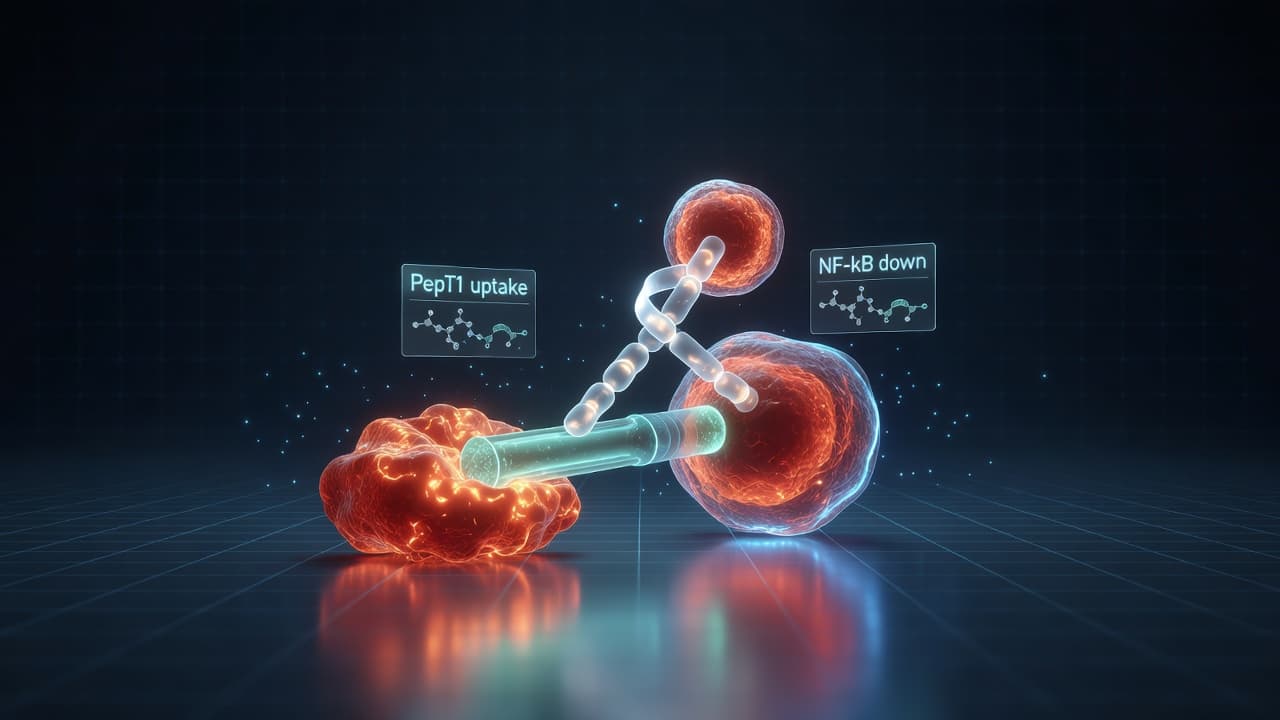
KPV is a small but mechanistically elegant peptide. It consists of just three amino acids (lysine-proline-valine) and is the C-terminal sequence of Alpha-MSH (Alpha-Melanocyte-Stimulating Hormone), an endogenous messenger with known anti-inflammatory properties. What is interesting about KPV is that it apparently retains most of the anti-inflammatory action of Alpha-MSH without its pigmenting activity.
In research, KPV has drawn attention mainly because of a gut-directed mechanism: it preferentially reaches the site where inflammation is strongest. This overview explains the mechanism, frames the preclinical evidence, and clearly names where the limits lie.
TL;DR: KPV in a Research Overview
Origin: C-terminal tripeptide (Lys-Pro-Val) of Alpha-MSH, anti-inflammatory without pigmenting action. Mechanism: inhibits NF-κB and MAP kinase signaling pathways in the nanomolar range and lowers pro-inflammatory cytokines. Gut targeting: uptake via the peptide transporter PepT1, which is upregulated in the inflamed gut. KPV therefore preferentially accumulates in inflamed tissue. Evidence: oral administration reduces the severity of DSS and TNBS colitis in mouse models. Important: purely preclinical. As of 2026 there are no published human randomized studies.
Mechanism: Why KPV Acts Specifically in the Inflamed Gut
The most elegant part of KPV biology is the targeting. PepT1 is a di- and tripeptide transporter that normally occurs mainly in the small intestine and is only weakly expressed in the healthy colon. In inflammatory bowel disease this changes: PepT1 is upregulated in inflamed colon tissue.
Because KPV is a tripeptide, it is taken up via exactly this transporter. The result is a kind of self-focusing effect: the peptide preferentially accumulates in the tissue with the most inflammation and thus the most PepT1 expression. Inside the cells, KPV then inhibits, in the nanomolar range, the activation of NF-κB and MAP kinase signaling pathways, two central hubs of the inflammatory response, and lowers the secretion of pro-inflammatory cytokines.
KPV is the C-terminal tripeptide of alpha-MSH, Lys-Pro-Val (positions 11 to 13). Studied in cell and mouse models for NF-kB signalling, PepT1 transport in intestinal cells and antimicrobial activity in vitro. Batch-specific third-party CoA.
Primary Source
The mechanistic core goes back to Dalmasso and colleagues (Gastroenterology, 2008, PMID 18061177). The work showed that KPV is taken up via PepT1 into intestinal epithelial and immune cells and acts anti-inflammatorily in two mouse colitis models. Later work also examined the PepT1-KPV axis in the context of colitis-associated processes.
What the Preclinical Evidence Shows
The animal-model data are remarkably consistent for such a small peptide. Orally administered KPV reduced the severity of colitis in DSS- and TNBS-induced models, two established standard models of intestinal inflammation. Observed were lower inflammation scores, less histological damage, and a more favorable cytokine profile.
The oral efficacy is notable. Many peptides are rapidly degraded in the digestive tract. The fact that KPV is taken up via PepT1 and shows oral anti-inflammatory effects makes it one of the few peptides with demonstrated gut-directed bioactivity by this route.
The Honest Limit: No Human Data
As clean as the mechanism is, the limitation must be named just as clearly.
Important: Purely Preclinical Status
As of 2026 there are no published human randomized controlled trials of KPV. The entire body of evidence is preclinical (cell culture and animal models) or anecdotal from user communities. Mechanistic elegance is no substitute for clinical efficacy. Any research question about KPV should be framed cautiously accordingly.
This is not an argument against the compound, but for linguistic discipline. KPV is a promising preclinical candidate with a plausible, well-described mechanism. It is not a proven therapeutic.
KPV in the Context of Other Regeneration and Skin Peptides
KPV often comes up in discussion alongside other inflammation- and healing-oriented peptides, sometimes in blends as well. The relevant neighbors are represented in the catalog.
LL-37 is the mature 37-residue human cathelicidin, cleaved from the hCAP18 precursor. Studied for membrane permeabilisation, biofilm assays, LPS binding and vitamin D-driven expression. Lyophilized powder with a batch-specific third-party CoA.
BPC-157 is a synthetic 15-amino-acid gastric pentadecapeptide, studied in rodent and cell-culture models for angiogenesis, cell migration and nitric-oxide pathway activity. Lyophilized powder, specified purity at or above 98% (HPLC), batch CoA.
LL-37 is an antimicrobial peptide with its own role in immune defense and wound healing, BPC-157 a much-discussed regeneration peptide. KPV also appears as a component in four-peptide blends like KLOW, where it contributes the anti-inflammatory and dermatological layer.
Inflammation and gut focus
KPV is the C-terminal tripeptide of alpha-MSH, Lys-Pro-Val (positions 11 to 13). Studied in cell and mouse models for NF-kB signalling, PepT1 transport in intestinal cells and antimicrobial activity in vitro. Batch-specific third-party CoA.
LL-37 is the mature 37-residue human cathelicidin, cleaved from the hCAP18 precursor. Studied for membrane permeabilisation, biofilm assays, LPS binding and vitamin D-driven expression. Lyophilized powder with a batch-specific third-party CoA.
Blend with a regeneration core
KLOW is a co-lyophilized vial holding GHK-Cu, BPC-157, TB-500 and KPV at a fixed 50:10:10:10 mass ratio, 80 mg total. Each peptide has its own published literature; no study has tested the four together. Per-component content on the batch CoA.
GLOW is a co-lyophilized vial holding GHK-Cu, BPC-157 and TB-500 at a fixed 50:10:10 mass ratio, 70 mg total. Each peptide has its own published literature; no study has tested the three together. Per-component content on the batch CoA.
Practical Consequences for Lab Work
1. Use the PepT1 mechanism as a design basis. The targeting depends on PepT1 expression in inflamed tissue. That is mechanistically relevant for any question about the site of action.
2. Document preclinical as preclinical. Without human data, phrasings like "reduces inflammation" must be cleanly tied to model and context.
3. Separate single peptide from blend. KLOW contains KPV alongside other peptides. For documentation, the individual peptide identity counts more than the blend name.
Further Reading
- Purchase page and product details: Buy KPV
- Antimicrobial neighbor peptide: Buy LL-37
- Healing peptides overview: Healing Peptide Overview
Frequently Asked Questions
For research purposes only. This article summarizes published literature. It is not medical advice and is not an endorsement of any particular protocol.
Research context for English-speaking buyers
Most of our English-speaking customers ship to the UK, Ireland, Malta or other English-as-second-language EU territories. The regulatory picture differs per country.
- Relevant authorities
- MHRA (UK, post-Brexit), HPRA (Ireland, EU-aligned), FDA Section 503A bulks list (US, restricted Cat 2 status of several peptides as of 2026)
- Customs and VAT
- EU shipments include VAT, the rate depends on the destination country; UK shipments after Brexit are now extra-EU and may attract UK VAT plus a handling fee at import
- Typical shipping window
- EU 2-4 working days, UK 4-7 working days, other international 7-14 working days, depending on customs
Research-grade peptides shipped from our EU warehouse are sold for laboratory use only and are not authorised for human or veterinary therapeutic application in any of the destination jurisdictions. US customers should be aware that the FDA Section 503A bulks list classification (and the April 2026 reclassification of twelve compounds) only governs compounding pharmacies, not direct-to-researcher imports for non-clinical work. UK buyers should declare the consignment on import and may be asked for a research justification by HMRC. We provide a CoA per batch identified by colour code rather than serial number; customs sometimes asks for this document when clearing the parcel.