BPC-157 Dosing in Research: Published Concentrations and Preclinical Protocols
BPC-157 research dosing: the concentrations and preclinical protocols reported in the literature, cited by PMID, in a research-use context.
TL;DR: What the published dosing literature actually shows
Rat data only, mostly: Effective doses in the rat literature span roughly six orders of magnitude, from 10 picograms per kilogram to 10 micrograms per kilogram, depending on model, route and endpoint. There is no single "the" rat dose. Human data is a single 2-subject pilot: The only published human concentration data comes from an IV safety pilot (Lee and Burgess 2025, PMID 40131143) with two participants, not a dosing study designed to establish a working human dose. No approved human dose exists: No FDA-approved drug product and no EMA marketing authorization exist for BPC-157 anywhere. Nothing in this article is a usage instruction. Route matters: Nearly all rat efficacy data used intraperitoneal, intramuscular, intragastric, oral or topical routes. The only human data point used intravenous infusion, a route with essentially no matching rodent toxicology in the cited literature. Concentration math is a separate skill from dosing: Converting a stated milligram figure into a mcg per mL concentration, or diluting a stock solution, is arithmetic that researchers can verify independently of any dosing decision.
BPC-157 (Body Protection Compound-157) is one of the most extensively studied research peptides in the preclinical soft-tissue-healing literature, and also one of the most frequently misquoted when it comes to dosing. Online forums circulate fixed daily microgram figures as though they were an established protocol. They are not. This article walks through what the published, PubMed-indexed literature actually reports: rat study concentrations by model and route, the single published human pilot, and a worked example of concentration math using our reconstitution calculator, all cited by PMID.
Disclaimer: Every figure below is a study-register citation, either a dose administered to animals in a published experiment or a concentration used in a single small human safety pilot. None of it is a recommendation, protocol, or instruction for human use. BPC-157 is sold on this site strictly as a research-use-only (RUO) laboratory compound.
What BPC-157 is, and what its mechanism data actually shows
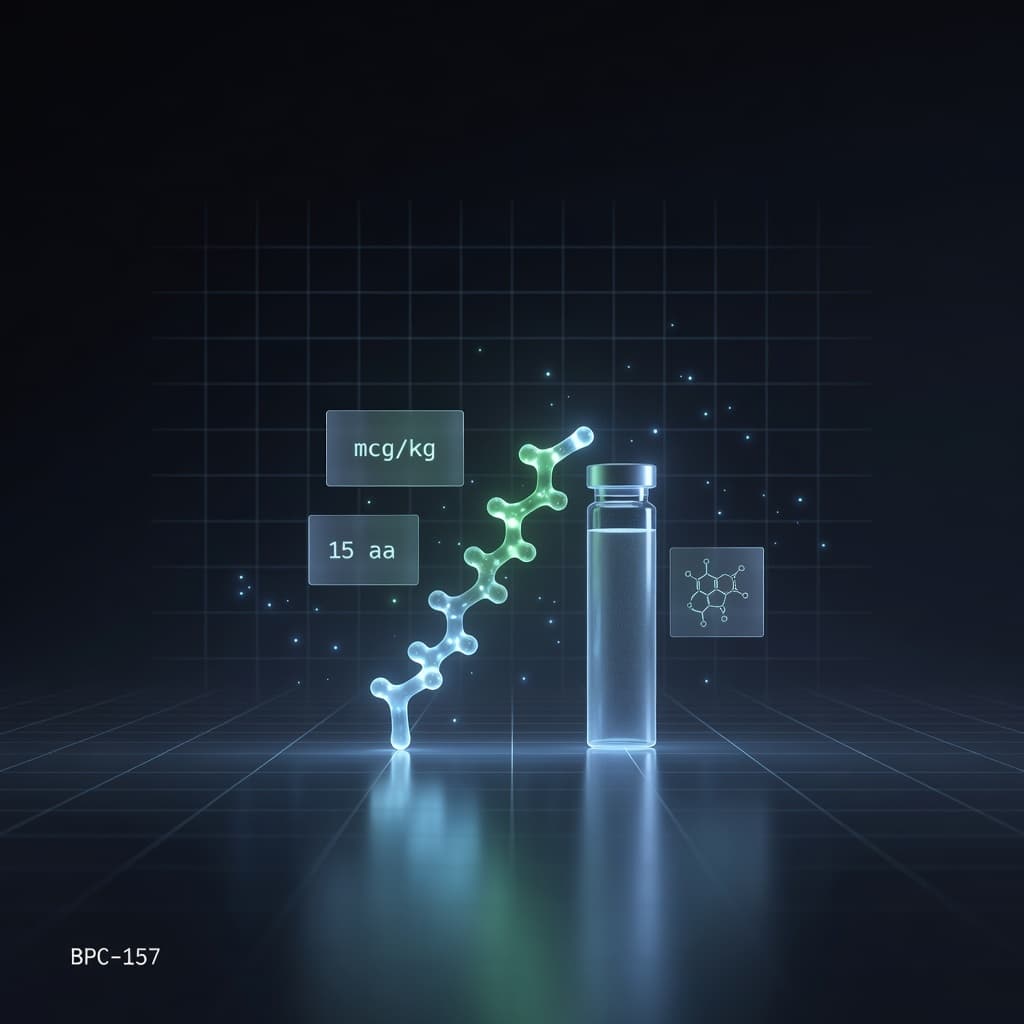
BPC-157 is a synthetic pentadecapeptide, 15 amino acids, sequence Gly-Glu-Pro-Pro-Pro-Gly-Lys-Pro-Ala-Asp-Asp-Ala-Gly-Leu-Val, molecular weight approximately 1419.53 Da. It is a fragment or analog inspired by a protective protein identified in human gastric juice, not itself a native circulating hormone, first described by the Sikiric group at the University of Zagreb in 1993. Unlike most peptides, it is reported to remain intact in human gastric juice for more than 24 hours.
Nearly all mechanistic data comes from rodent and cell-culture experiments, not confirmed human pharmacology. The best independently replicated pathway, from a group not affiliated with the original Zagreb team, is angiogenic: BPC-157 upregulates and promotes internalization of VEGFR2 on vascular endothelial cells, activating the VEGFR2-Akt-eNOS signaling cascade and driving new vessel formation in vitro, an effect blocked by the endocytosis inhibitor dynasore (Hsieh et al. 2017, PMID 27847966). The Sikiric group's own review body additionally proposes a broader "brain-gut axis" of cytoprotective signaling, explicitly framed by the authors as theoretical, not an established mechanism (Sikiric et al. 2011, PMID 21548867; Sikiric et al. 2016, PMID 27138887).
Rat and dog pharmacokinetic data show BPC-157 is cleared very quickly: elimination half-life under 30 minutes after IV or IM dosing, plasma undetectable by roughly 4 hours, metabolized hepatically into small peptide fragments and free amino acids (He et al. 2022, PMID 36588717). Intramuscular bioavailability was approximately 14 to 19 percent in rats and 45 to 51 percent in dogs. This fast clearance is the direct reason the rat efficacy literature below uses once- or twice-daily repeated dosing rather than single-dose designs.
Mechanism is preclinical, not confirmed human pharmacology
Every mechanistic claim above, VEGFR2-Akt-eNOS signaling, the L-arginine-nitric-oxide system, the proposed brain-gut axis, comes from animal or cell-culture experiments. No confirmed human pharmacodynamic study exists for BPC-157 as of this writing.
Gastric pentadecapeptide (15 amino acids) known for exceptional tissue repair properties. Promotes wound healing, angiogenesis, and cytoprotection across tendons, muscles, gut, and nerves. Over 30 years of preclinical research.
Preclinical dosing data: what the rat literature reports, study by study
The table below summarizes the core dosing data from the rat literature, exactly as published. Read it as a record of what was administered in a specific experiment, not as a menu of options.
- Model
- Rat, Achilles tendon-to-bone healing after surgical detachment
- Dose(s) reported
- 10 mcg/kg, 10 ng/kg, or 10 pg/kg per dose
- Route
- Intraperitoneal
- Duration
- Once daily from within 30 min of surgery, assessed to day 21
- Model
- Rat, medial collateral ligament transection
- Dose(s) reported
- 10 ng/kg (IP); 1.0 mcg per gram cream (topical); 0.16 mcg/mL in drinking water, about 12 mL/rat/day (oral)
- Route
- Intraperitoneal, topical, per-oral, compared
- Duration
- Up to 90 days
- Model
- Rat, disabled quadriceps myotendinous junction
- Dose(s) reported
- 10 mcg/kg or 10 ng/kg (IP); 0.16 mcg/mL or 0.16 ng/mL in drinking water (oral)
- Route
- Intraperitoneal, per-oral
- Duration
- Sacrifice at days 7, 14, 28, 42
- Model
- Rat, gastric ulcer (acute, chronic, pylorus-ligation models)
- Dose(s) reported
- 200, 400, or 800 ng/kg per dose
- Route
- Intramuscular or intragastric, compared
- Duration
- Single or continuous, per model
- Model
- Rat, sciatic nerve transection
- Dose(s) reported
- 10 ng/kg
- Route
- Intraperitoneal, intragastric, local at the anastomosis
- Duration
- Followed over the post-injury regeneration period
- Model
- Mice, rats, rabbits, dogs, multi-species toxicology
- Dose(s) reported
- Highest specifically reported dose: 2 mg/kg (dogs)
- Route
- Oral, intramuscular
- Duration
- Repeated-dose, with a 2-week withdrawal/recovery period in dogs
Two things stand out reading the studies side by side. The dose range is enormous, the Achilles-tendon study alone tested doses spanning six orders of magnitude and all three produced improvement over controls, and route changes the effective concentration: the gastric-ulcer study found intramuscular dosing more effective than intragastric at a lower dose. No published interspecies allometric scaling factor exists for BPC-157, so there is no validated formula for converting any rat figure into a human-equivalent number.
Rat doses cannot be linearly scaled to a human dose
Published rat effective doses span from about 10 picograms per kilogram to 10 micrograms per kilogram, depending on model, route and endpoint. No validated allometric scaling factor for BPC-157 has been published. Treating any single number from this table as a human-equivalent starting point is not supported by the cited literature.
On safety, the only multi-species preclinical toxicology study (Xu et al. 2020, PMID 32334036, covering mice, rats, rabbits and dogs) found BPC-157 well tolerated up to the highest specifically reported dose, 2 mg/kg in dogs, with only a reversible decrease in serum creatinine that resolved after a 2-week withdrawal. No genotoxicity or embryo-fetal toxicity was reported, and no LD50 was established. This is animal toxicology only, not a human safety margin.
Human data: the IV pilot study and how little else exists
Independent narrative reviews are consistent on this point. A 2025 systematic review of orthopedic sports-medicine literature identified 36 studies on BPC-157, of which 35 were preclinical and only one was clinical (Vasireddi et al. 2025, PMID 40756949). A separate 2025 narrative review states plainly that only three human pilot studies exist for BPC-157 in total, and concludes it "should be considered investigational" pending well-designed clinical trials (McGuire et al. 2025, PMID 40789979).
The only published human intravenous data point is a small pilot: 2 healthy adult volunteers, both prior BPC-157 users, under IRB approval (Lee and Burgess 2025, PMID 40131143). On day 1, participants received 10 mg of BPC-157 in 250 mL of normal saline, infused over 1 hour. On day 2, the dose was 20 mg in the same volume, again over 1 hour. No adverse events were reported, and no measurable change occurred in cardiac, hepatic, renal, thyroid or glucose biomarkers on either day.
The authors describe this explicitly as preliminary. Two people does not support statistical inference, there was no control arm, and no long-term follow-up was reported; it answers only whether an acute IV infusion in this range produced measurable biomarker changes in two people, not repeated dosing, other routes, or other populations.
What is registered but not yet reported
The first registered human efficacy trial for BPC-157 is NCT07437547, a Phase 2 randomized, double-blind, placebo-controlled trial in acute MRI-confirmed grade II hamstring strain, with roughly 120 participants planned and co-primary endpoints of time to unrestricted return to sport and Day-14 MRI injury volume. It is registered and underway. No results have been reported as of this writing.
Regulatory status: a US compounding process, not a drug approval, and no change in the EU
BPC-157 has no FDA-approved drug product and no EMA marketing authorization anywhere. What has changed recently is a narrower US compounding-pharmacy classification process, not drug approval. In September 2023 the FDA had placed BPC-157 on its "Category 2" list of nominated bulk drug substances, barring 503A and 503B compounding pharmacies from preparing it. On 16 April 2026 the FDA removed BPC-157 and 11 other peptides from Category 2, and a Pharmacy Compounding Advisory Committee (PCAC) hearing on 23 and 24 July 2026 is now reviewing whether to add BPC-157, alongside TB-500, KPV, MOTS-C, DSIP, Semax and Epitalon, to the 503A "positive bulks list" (see our FDA PCAC July 2026 explainer). FDA staff's own pre-hearing briefing documents were proposing that BPC-157 not be added.
Even a positive PCAC vote would only let US licensed compounding pharmacies prepare BPC-157 under a physician's prescription. It is not FDA drug approval and does not certify safety for human use. This is a US compounding-law question, legally irrelevant to the EU: BPC-157 has not been evaluated by the EMA and is sold here only as a research-use-only laboratory compound; the EMA's June 2026 synthetic-peptide guideline applies solely to pharma-grade products and explicitly excludes RUO material.
Read our companion piece on the Lee and Burgess IV pilot for the full study breakdown.
Working with concentrations: a reconstitution math walkthrough
Separate from any dosing decision, there is a purely mathematical skill in reading this literature: converting a stated milligram figure into a concentration. The published human IV pilot gives two clean worked examples. Day 1: 10 mg of BPC-157 in 250 mL of saline is 10 mg divided by 250 mL, or 0.04 mg per mL, equivalently 40 mcg per mL. Day 2: 20 mg in the same volume works out to 0.08 mg per mL, or 80 mcg per mL. Those two figures are the only published human infusate concentrations in the literature.
Contrast that with a typical research vial: 5 mg reconstituted with 5 mL of bacteriostatic water yields a stock of 1 mg/mL, or 1000 mcg/mL, far more concentrated than the two infusate figures above. Reaching the nanogram- or picogram-per-kilogram scale used in several rat studies from a milligram-per-mL stock requires serial dilution across several orders of magnitude, arithmetic that is easy to get wrong by a decimal place by hand. Our reconstitution calculator and unit converter can check that kind of conversion independently.
Concentration math and dosing decisions are two separate questions
Working out that 10 mg in 250 mL equals 40 mcg per mL is arithmetic. Deciding what concentration or amount to use in a given experiment is a study-design decision, outside the scope of this article.
Some researchers working across BPC-157 and complementary soft-tissue peptides use a combined vial to simplify reconstitution and storage into a single workflow.
USP-grade sterile water with 0.9% benzyl alcohol (near-neutral, pH 6.2 to 6.4) - the standard solvent for reconstituting lyophilized peptides. Essential accessory for any peptide research. Each vial is sealed and ready to use.
Sterile 1 mL graduated laboratory syringe with a 31G x 6 mm fine tip. Individually wrapped, latex-free, pyrogen-free, PVC-free, with a high-contrast 0.01 mL black scale for precise liquid measuring and transfer.
The Wolverine Stack: BPC-157 + TB-500 in equal parts in one vial (50/50: 10mg = 5mg each, 20mg = 10mg each). The most researched healing peptide duo for tissue repair, tendon recovery, and systemic regeneration. Batch-specific Janoshik COA.
Tissue repair, wound healing, and recovery peptides
Researching tendon, ligament and gastric mucosal healing models
Researching combined soft-tissue and healing pathways in one preparation
Setting up reconstitution and precise handling technique
USP-grade sterile water with 0.9% benzyl alcohol (near-neutral, pH 6.2 to 6.4) - the standard solvent for reconstituting lyophilized peptides. Essential accessory for any peptide research. Each vial is sealed and ready to use.
Sterile 1 mL graduated laboratory syringe with a 31G x 6 mm fine tip. Individually wrapped, latex-free, pyrogen-free, PVC-free, with a high-contrast 0.01 mL black scale for precise liquid measuring and transfer.
Every batch we list ships with an independent, third-party Certificate of Analysis from Janoshik, viewable on our CoA page, and we publish our purity methodology at /purity. Dispatch for EU orders is intra-EU, which keeps lead times and customs exposure lower than importing from outside the bloc.
Frequently asked questions
This article summarizes published preclinical and pilot-scale human research literature for informational purposes only. It is not medical advice and does not describe a human dosing protocol. All peptides referenced are sold exclusively as research-use-only laboratory material.
Research context for English-speaking buyers
Most of our English-speaking customers ship to the UK, Ireland, Malta or other English-as-second-language EU territories. The regulatory picture differs per country.
- Relevant authorities
- MHRA (UK, post-Brexit), HPRA (Ireland, EU-aligned), FDA Section 503A bulks list (US, restricted Cat 2 status of several peptides as of 2026)
- Customs and VAT
- EU shipments include 19% VAT; UK shipments after Brexit are now extra-EU and may attract UK VAT plus a handling fee at import
- Typical shipping window
- EU 2-4 working days, UK 4-7 working days, other international 7-14 working days, depending on customs
Research-grade peptides shipped from our EU warehouse are sold for laboratory use only and are not authorised for human or veterinary therapeutic application in any of the destination jurisdictions. US customers should be aware that the FDA Section 503A bulks list classification (and the April 2026 reclassification of twelve compounds) only governs compounding pharmacies, not direct-to-researcher imports for non-clinical work. UK buyers should declare the consignment on import and may be asked for a research justification by HMRC. We provide a CoA per batch identified by colour code rather than serial number; customs sometimes asks for this document when clearing the parcel.