Buy Pinealon (EDR): What to Check Before You Order
Pinealon for research use: what the Khavinson evidence really supports, why the doses circulating online are far above the published human figures, and what a batch certificate has to show.
Pinealon is sold here exclusively for in-vitro and laboratory research use. It is not a medicine, not a supplement, and not intended for human consumption. Nothing in this article is a dosing recommendation.
TL;DR: what actually matters before you order Pinealon
Pinealon is a synthetic tripeptide (Glu-Asp-Arg, EDR) from the same Khavinson bioregulator programme that produced Epitalon, not a thymus-derived complex like Thymalin. The evidence is almost entirely cell and animal work, with the gene-regulation mechanism proposed rather than proven. The only published human dose is oral and in micrograms (200 mcg/day), which is far below the milligram-per-day figures you may have seen on other sites. No controlled human safety database exists, and Pinealon holds no marketing authorisation anywhere. We currently have no Certificate of Analysis for Pinealon, because no batch has arrived yet; one will be published on the product page before it goes on sale.
Short-peptide bioregulator (Glu-Asp-Arg, EDR) from the Khavinson programme, studied for gene-expression effects in neuronal tissue and for protection of nerve cells under stress. The brain-focused counterpart to Epitalon in the same cytogen series.
What Pinealon actually is
Pinealon is a synthetic tripeptide made of three amino acids in sequence: glutamic acid, aspartic acid and arginine, abbreviated EDR. It belongs to the short-peptide bioregulator research programme associated with the St. Petersburg group led by Vladimir Khavinson, the same programme that produced Epitalon (Ala-Glu-Asp-Gly), a tetrapeptide with a considerably longer publication history that we cover separately.
It is worth being precise about what Pinealon is not. Thymalin, another name that comes up in the same longevity discussions, is a thymus-derived peptide complex, a mixture of naturally occurring low-molecular-weight peptides extracted from thymus tissue, not a single defined amino acid sequence. Calling Thymalin a "short peptide" the way Pinealon and Epitalon are short peptides would be inaccurate: it is a different class of research material with a different manufacturing logic and a different kind of batch-to-batch characterisation problem. If you are comparing the three, keep that distinction in mind rather than treating them as interchangeable variants of the same thing.
Within the Khavinson research tradition, Pinealon is generally framed as the member of the family oriented toward neuronal and central nervous system research models, in contrast to Epitalon's pineal and endocrine framing. That framing comes from the research literature's choice of experimental models, not from any approved indication.
What the evidence actually supports
It is tempting, when a peptide has a tidy three-letter research shorthand and a named research programme behind it, to assume the human evidence is further along than it is. For Pinealon, it is not. The published literature we can point to is concentrated in cell culture and animal models, with only a small amount of human data, most of it from a single research group and much of it originally published in Russian-language journals.
In neuronal cell cultures, Pinealon has been studied for effects on markers of oxidative stress and on cell viability under experimental challenge (PMID 21978084). In a separate in-vitro model built to approximate features of Alzheimer's disease pathology, exposure to Pinealon was associated with a degree of recovery in dendritic spine structures, the small protrusions on neurons that are central to synaptic connectivity (PMID 28853087). A more recent paper examined Pinealon's effects on aged human-derived neuronal cells under stress conditions and reported a protective effect (PMID 39518916). Separately, a rat study administered Pinealon during the prenatal period to look at effects on the developing nervous system (PMID 22567179).
The mechanism is proposed, not established
Two mechanistic papers are often cited together. One used a labelled version of the peptide and found it entering cell nuclei in an experimental system (PMID 22117547). A separate, cell-free biochemical study reported that the peptide interacts directly with DNA (PMID 30762356). Together these are read as support for a hypothesis that Pinealon, despite being only three amino acids long, might influence gene expression directly. That is a genuinely interesting question for basic peptide biology. It is not, on this evidence, an established mechanism: nuclear localisation in one system and DNA interaction in a cell-free assay are consistent with the hypothesis, they do not confirm that this is how Pinealon produces any of the effects reported in cell or animal models, and no causal chain from binding to a specific transcriptional or physiological outcome has been demonstrated.
If you are looking for large randomised controlled trials in humans, a validated clinical endpoint, or independent replication of the cell and animal findings by groups outside the original programme, we are not aware of any that meet that bar. That does not mean the underlying biology is uninteresting. It means the evidence should be read as early-stage and hypothesis-generating, not as proof of a clinical effect.
It is also worth being explicit about a gap that gets glossed over in a lot of secondary summaries: a result in cultured neurons or in a rodent model is not automatically a result in a living human being. Culture systems strip away circulation, metabolism, the blood-brain barrier, and the enormous complexity of an intact nervous system, and rodent physiology diverges from human physiology in ways that have sunk plenty of otherwise-promising compounds at the next stage of testing. None of that means the cell and animal findings on Pinealon are wrong or unimportant as basic research. It means the distance between "an effect observed in a dish or in a rat" and "an effect you could expect in a person" is real, and for Pinealon that distance has not been closed by the kind of large, independently replicated human trial that would close it.
The dose question, and why the numbers you have probably seen are wrong
This is the single most useful thing we can tell you before you order, and it is also the thing most vendor pages will not say clearly.
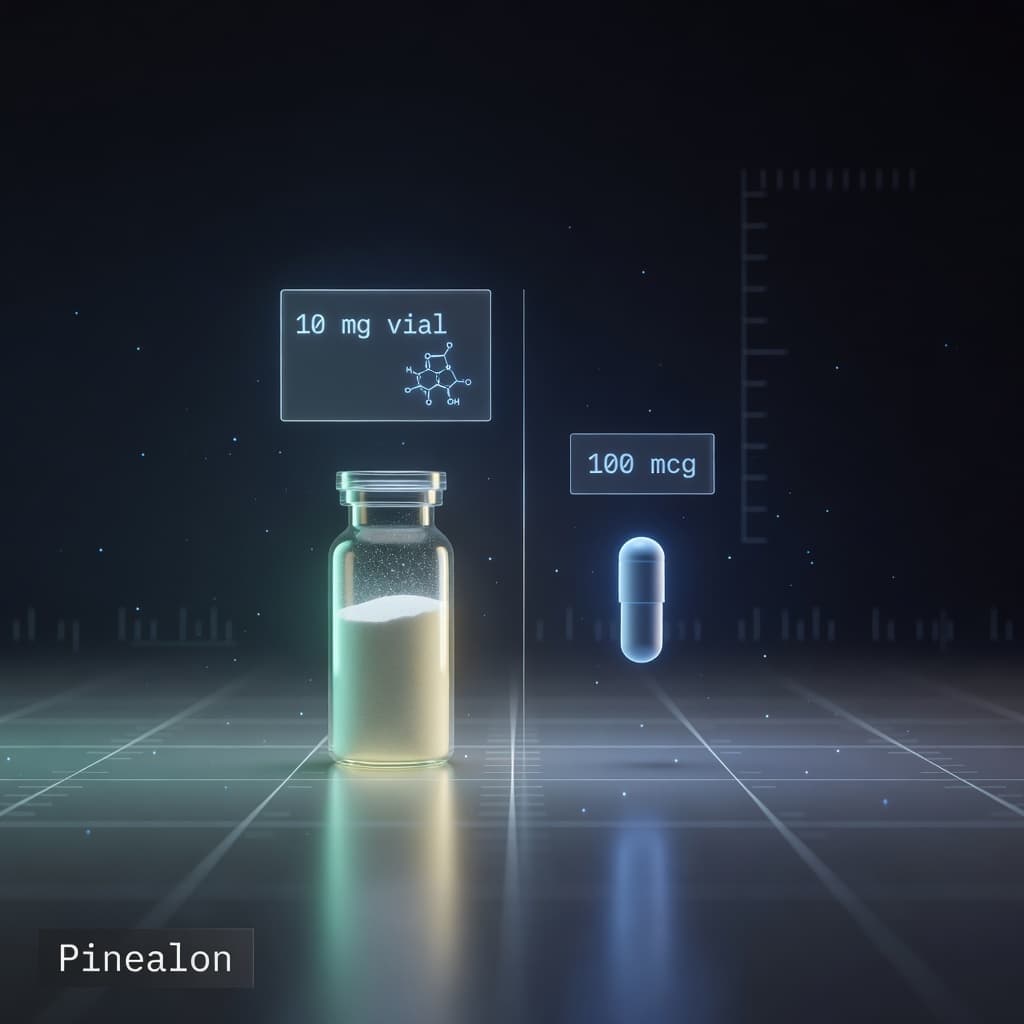
The only published human dosing figure we can point to for Pinealon is oral, not injectable, and it is measured in micrograms, not milligrams. In that small human report, participants took one capsule containing 100 micrograms of Pinealon twice a day for two weeks, for a total of 200 micrograms per day, taken by mouth (PMID 22708445). Two further small human reports exist in the literature without a dose figure we can independently confirm from the abstract-level record available to us (PMID 26390612, PMID 28539017).
That is the entire published human dosing record we can verify. Compare that to what circulates on vendor pages, forums and dosing calculators aimed at people reconstituting a vial for subcutaneous research use, where you will often see schedules quoted in whole milligrams per day, sometimes several milligrams. Those figures sit far above the one confirmed human dose in the published literature. They are not derived from the controlled research we can cite, and we do not reproduce them here, because we cannot trace them back to a study we can verify.
There is also a form and route problem underneath the dose problem, and it matters on its own even if you set the numbers aside. The published human data used an oral capsule. A reconstituted vial intended for a different administration route is a different pharmaceutical form entirely: absorption, first-pass handling, and bioavailability are not the same for a peptide swallowed in a capsule as for one delivered another way, so a microgram figure from an oral study and a milligram figure from an injectable protocol are not the same currency and cannot be converted into each other by simple arithmetic. Anyone treating the oral capsule study as if it validates an injectable milligram protocol is making a comparison the data does not support.
What we will not do
We will not publish a "recommended" Pinealon dose, an injectable protocol, or a conversion from the oral capsule study to a vial-based schedule. The published human evidence is 200 micrograms per day, oral, for two weeks, in one small study. That is the fact. Anything beyond that is not supported by the literature we can cite, whatever else you may have read elsewhere.
Being honest about what we do not know
Set the dose question aside for a moment and look at the shape of the evidence base as a whole. Most of the published Pinealon literature comes from one research programme rather than from multiple independent groups working on the same question. A meaningful share of the primary sources were originally published in Russian-language journals, which limits how easily the wider research community can scrutinise, replicate or challenge the findings. We are not aware of large randomised controlled human trials for Pinealon, and there is no controlled human safety database of the kind that exists for approved medicines, where adverse events are systematically recorded across thousands of exposed patients over years of monitoring.
That last point is worth stating plainly because it is easy to misread. The absence of widely reported side effects for Pinealon does not mean it has been shown to be safe. It means that the trials large enough and long enough to detect uncommon or delayed adverse effects simply have not been run. Absence of evidence of harm is not evidence of absence of harm, and with a compound this thinly studied in humans, that distinction matters more, not less.
Pinealon holds no marketing authorisation as a medicinal product anywhere that we are aware of. It is not approved, licensed or registered for any human therapeutic use. Nothing about the research interest in this peptide changes that regulatory fact.
What to check before you order Pinealon anywhere
Whether you order from us or elsewhere, there is a short list of things a batch of Pinealon should be able to show you.
A batch-specific third-party certificate. Not a generic product sheet, a certificate tied to the specific batch you are buying, covering identity confirmation, chromatographic purity, and the measured peptide content per vial, with a report number you can look up rather than a document that simply asserts a result.
Who actually commissioned that certificate. Our reports, where we have them, come from Janoshik, an independent analytical laboratory. Janoshik is commissioned through the supply chain, not by us directly, and we do not test peptides ourselves. We think that distinction matters and we would rather state it plainly than let a certificate imply an in-house guarantee it is not.
The current, honest state of the Pinealon certificate specifically. This is the part we want to be completely unambiguous about: Pinealon currently has no Certificate of Analysis, because no batch has arrived yet. We are not publishing one, we are not implying one exists, and if you see a claim anywhere that a tested Pinealon CoA is already available for this listing, that claim is not accurate as things stand. Once a batch lands, the report will be published on the product page before that batch goes on sale, not after.
Storage conditions. Pinealon is supplied as a lyophilised powder. Sealed and unreconstituted, it should be kept refrigerated between 2 and 8 degrees Celsius and protected from light. Once reconstituted, it should also be kept refrigerated between 2 and 8 degrees Celsius, and used within roughly four weeks.
Where it ships from, and what crossing a border means. Our shipments originate inside the EU. If you are ordering from a country outside the EU customs union, including Norway or the United Kingdom, your order crosses a customs border, and any import duties, taxes, or customs handling on that leg of the journey are your own responsibility as the importer, not something we can predict or absorb on your behalf.
No Pinealon CoA exists yet, by design of the timeline, not by oversight
We would rather tell you this clearly than let silence read as availability. No batch has arrived, so no test result exists yet to publish. The certificate will appear on the product page ahead of the first sale of a real batch.
Why anyone would research it at all
Set the marketing framing aside and the honest answer is fairly narrow: Pinealon is the brain-oriented member of a peptide family whose best-known member, Epitalon, has a considerably longer publication record and a somewhat wider (though still limited) base of human data. Pinealon inherits some of the same scientific interest as Epitalon almost by association, and the underlying mechanistic question, whether a peptide only three amino acids long can meaningfully influence gene transcription rather than simply acting through a conventional receptor, is a genuinely open one in peptide biology. It has not been settled by the current evidence, in either direction. That open question, not a finished clinical story, is what the current Pinealon literature actually offers.
Frequently asked questions
Related reading
Check current Pinealon batch status and specifications
See the longer publication record behind the related tetrapeptide Epitalon
Compare with Thymalin, a thymus-derived peptide complex in the same longevity category
Mitochondrial function, NAD+ metabolism, telomere maintenance
This article is for informational and research purposes only. All products are intended exclusively for in-vitro research and laboratory use, not for human consumption or ingestion. Pinealon is not an approved medicinal product, and nothing in this article constitutes a dosing recommendation.
Research context for English-speaking buyers
Most of our English-speaking customers ship to the UK, Ireland, Malta or other English-as-second-language EU territories. The regulatory picture differs per country.
- Relevant authorities
- MHRA (UK, post-Brexit), HPRA (Ireland, EU-aligned), FDA Section 503A bulks list (US, restricted Cat 2 status of several peptides as of 2026)
- Customs and VAT
- EU shipments include 19% VAT; UK shipments after Brexit are now extra-EU and may attract UK VAT plus a handling fee at import
- Typical shipping window
- EU 2-4 working days, UK 4-7 working days, other international 7-14 working days, depending on customs
Research-grade peptides shipped from our EU warehouse are sold for laboratory use only and are not authorised for human or veterinary therapeutic application in any of the destination jurisdictions. US customers should be aware that the FDA Section 503A bulks list classification (and the April 2026 reclassification of twelve compounds) only governs compounding pharmacies, not direct-to-researcher imports for non-clinical work. UK buyers should declare the consignment on import and may be asked for a research justification by HMRC. We provide a CoA per batch identified by colour code rather than serial number; customs sometimes asks for this document when clearing the parcel.