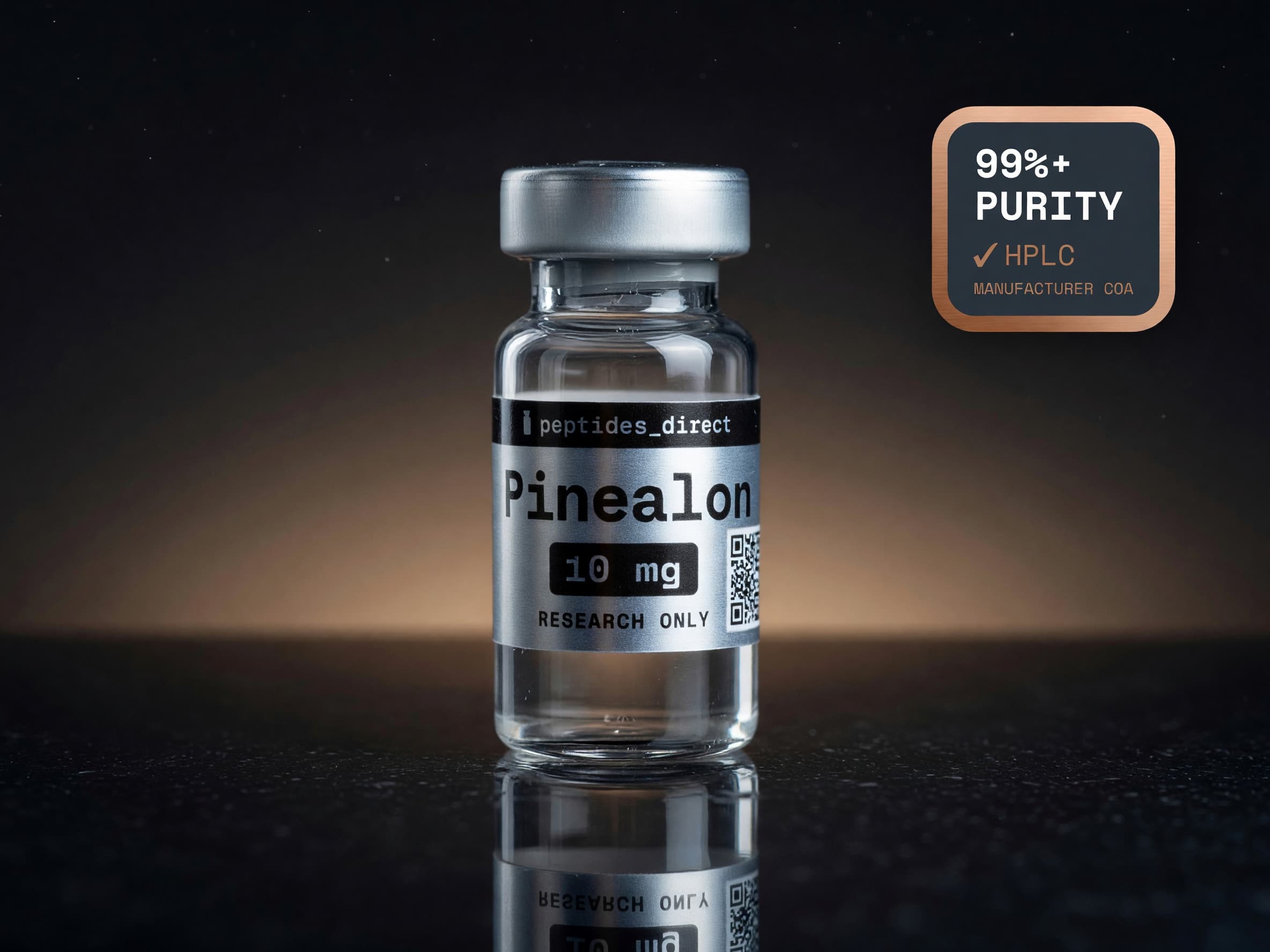
Pinealon
Short-peptide bioregulator (Glu-Asp-Arg, EDR) from the Khavinson programme, studied for gene-expression effects in neuronal tissue and for protection of nerve cells under stress. The brain-focused counterpart to Epitalon in the same cytogen series.
99.39%Third-party lab: JanoshikView COA€43.99
€49.99
−12%(€6.00)savedFor Research Use Only
This product is sold strictly for in-vitro research and laboratory use. Not intended for human consumption or any in-vivo application.
Payment Methods
Khavinson tripeptide
A three-amino-acid peptide (Glu-Asp-Arg, abbreviated EDR) from the Russian short-peptide bioregulator programme.
Neuro-focused bioregulator
Studied in the context of brain and neuronal tissue, the nerve-cell counterpart to Epitalon's pineal focus.
Gene-expression research
Studied for effects on gene expression rather than as a classic receptor agonist. The proposed DNA-level mechanism is not established.
Cell-protection endpoints
Laboratory work examines neuronal cultures under oxidative stress or oxygen deprivation.
Same series as Epitalon
Part of the cytogen/bioregulator series developed at the St. Petersburg Institute of Bioregulation and Gerontology.
Lyophilized powder
Supplied freeze-dried, the standard form used across the published research.
Research areas
What is Pinealon
Pinealon is a synthetic tripeptide made of three amino acids: glutamic acid, aspartic acid and arginine (Glu-Asp-Arg, usually abbreviated EDR). It comes from the short-peptide "bioregulator" programme led by the Russian gerontologist Vladimir Khavinson at the St. Petersburg Institute of Bioregulation and Gerontology, the same programme that produced Epitalon and Thymalin.
Within that programme, each synthetic short peptide is matched to a tissue: Epitalon is the synthetic pineal peptide (Ala-Glu-Asp-Gly), while Pinealon is studied in the context of brain and neuronal tissue. Thymalin, from the same programme, is a different kind of preparation: a peptide complex extracted from thymus tissue with no single defined sequence, not a synthetic short peptide of the same class as Epitalon. That is the reason Pinealon is usually presented as a companion to Epitalon rather than a replacement for it.
We supply it as a lyophilized (freeze-dried) powder, the same form used across the published research.
How it works
The mechanism proposed for the Khavinson short peptides is different from a classic drug-receptor interaction. These peptides are small enough to enter cells: fluorescently labelled Pinealon has been detected inside the cell nucleus, and separately, the intact peptide has interacted with isolated DNA in cell-free biophysical assays. Direct binding to chromatin inside living neuronal cells, and a causal effect on which genes get transcribed, have not been established: the programme proposes gene-expression regulation as the underlying mechanism, but this remains a model rather than a demonstrated pathway. Pinealon is therefore studied as a candidate regulator of gene expression in neuronal tissue rather than as a receptor agonist.
The laboratory work concentrates on neuronal cell cultures placed under stress, for example oxidative stress or oxygen deprivation, where the peptide is examined for effects on cell survival and on markers of programmed cell death. Animal work within the programme looks at behavioural and cognitive endpoints.
An honest note on the evidence base: the great majority of this literature comes from the Khavinson group itself and is published largely in Russian-language journals. Independent replication outside that programme is limited. The findings should therefore be read as preliminary rather than established. Pinealon holds no marketing authorisation anywhere and is not an approved medicinal product.
Often studied alongside
Epitalon is the pineal peptide from the same series and the compound Pinealon is most often paired with in longevity research.
The pineal peptide from the same Khavinson series
Tetrapeptide (Ala-Glu-Asp-Gly) that activates telomerase, the enzyme responsible for maintaining telomere length. One of the most studied peptides in longevity research, developed by Prof. Khavinson at the St. Petersburg Institute of Bioregulation.
Thymalin covers the immune side of the same bioregulator programme.
Thymus peptide from the same programme
Thymus-derived immune peptide developed by Prof. Khavinson. Restores T-cell function and thymic activity that naturally decline with age. Over 40 years of clinical use in Russia for immune support and anti-aging research.
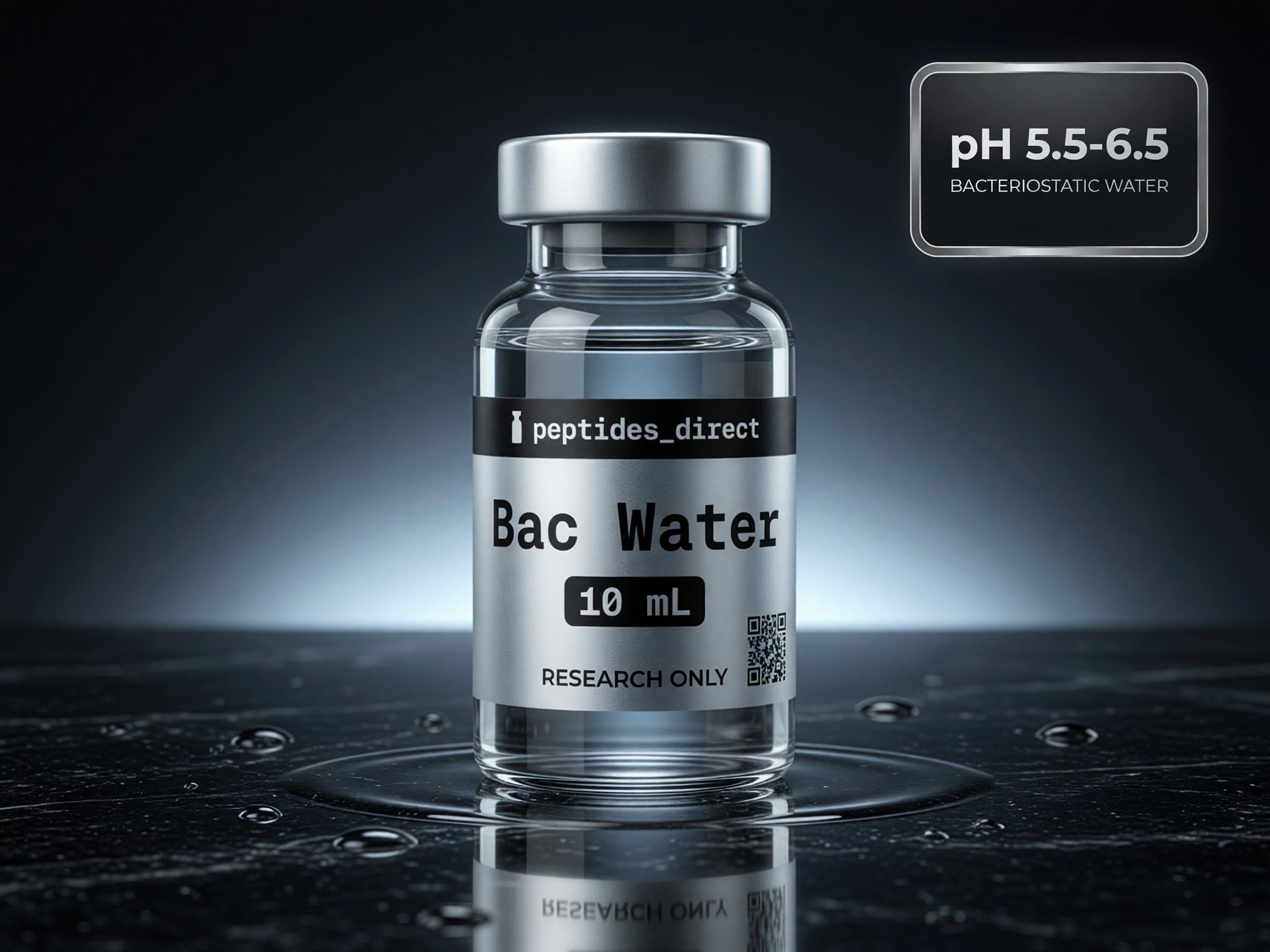
For reconstitution, the standard solvent in published protocols is bacteriostatic or sterile water.
Standard solvent for reconstitution
USP-grade sterile water with 0.9% benzyl alcohol (near-neutral, pH 6.2 to 6.4) - the standard solvent for reconstituting lyophilized peptides. Essential accessory for any peptide research. Each vial is sealed and ready to use.
Documentation
Material specification
Purity
Test method
Form
Storage (sealed)
Storage (reconstituted)
CoA
Selected research
- PMID 22117547
Fedoreyeva LI et al. Penetration of short fluorescence-labeled peptides into the nucleus in HeLa cells and in vitro specific interaction of the peptides with deoxyribooligonucleotides and DNA
Biochemistry (Mosc), 2011, detected labelled Pinealon in cell nuclei and, separately, interaction between the peptide and isolated DNA in cell-free assays - PMID 30762356
Silanteva IA et al. Role of Mono- and Divalent Ions in Peptide Glu-Asp-Arg-DNA Interaction
J Phys Chem B, 2019, biophysical study of how the EDR tripeptide interacts with DNA - PMID 21978084
Khavinson V et al. Pinealon increases cell viability by suppression of free radical levels and activating proliferative processes
Rejuvenation Res, 2011, free-radical and cell-viability work in neuronal cultures - PMID 28853087
Kraskovskaya NA et al. Tripeptides Restore the Number of Neuronal Spines under Conditions of In Vitro Modeled Alzheimer's Disease
Bull Exp Biol Med, 2017, dendritic-spine recovery in a cell model of Alzheimer's disease - PMID 39518916
Kraskovskaya N et al. Short Peptides Protect Fibroblast-Derived Induced Neurons from Age-Related Changes
Int J Mol Sci, 2024, oxidative DNA damage in human-derived neurons - PMID 22567179
Arutjunyan A et al. Pinealon protects the rat offspring from prenatal hyperhomocysteinemia
Int J Clin Exp Med, 2012, animal model looking at offspring cognition - PMID 22708445
Nazimko VA et al. Analysis of some parameters of biological age and adaptation possibilities of workers of locomotive brigades
Adv Gerontol, 2012, small Russian-language occupational study, the only published human report that states a Pinealon dose - PMID 33396470
Khavinson V et al. EDR Peptide: Possible Mechanism of Gene Expression and Protein Synthesis Regulation Involved in the Pathogenesis of Alzheimer's Disease
Molecules, 2020, review of the proposed gene-expression mechanism
Research use only
This material is sold strictly for in-vitro research and laboratory use. Not intended for human or animal consumption, medical, cosmetic, or household applications. Suitable only for professional laboratory environments.
Storage and stability
- Dry, lyophilized vials keep for months refrigerated, or up to 24 months frozen at -20°C.
- After reconstitution in bacteriostatic water, use within about 30 days at 2 to 8°C, and avoid repeated freeze-thaw.
Reviews
No reviews yet. Write the first one!
Only customers who ordered the product from us can leave a review; we verify this automatically against the order number. Every review submitted is published, regardless of star rating. Rewarded reviews from our coupon program are individually labelled.
Frequently Asked Questions
Frequently bought together
Complete your subcutaneous research workflow