Epitalon and Pinealon: What the Khavinson Programme Actually Pairs
Epitalon and Pinealon are routinely sold as a pair. What the two peptides really are, what the combination research does and does not show, and where the pairing comes from.
Epitalon, Pinealon and every other compound named on this page are sold by peptidesdirect.io for laboratory and research use only. Nothing below is a recommendation to consume, inject, reconstitute or combine any peptide, and nothing here is medical advice.
TL;DR: what the pairing is actually built on
- The pairing is a classification, not a trial. Epitalon and Pinealon are sold together almost everywhere, but no controlled study testing the two peptides in combination appears to exist.
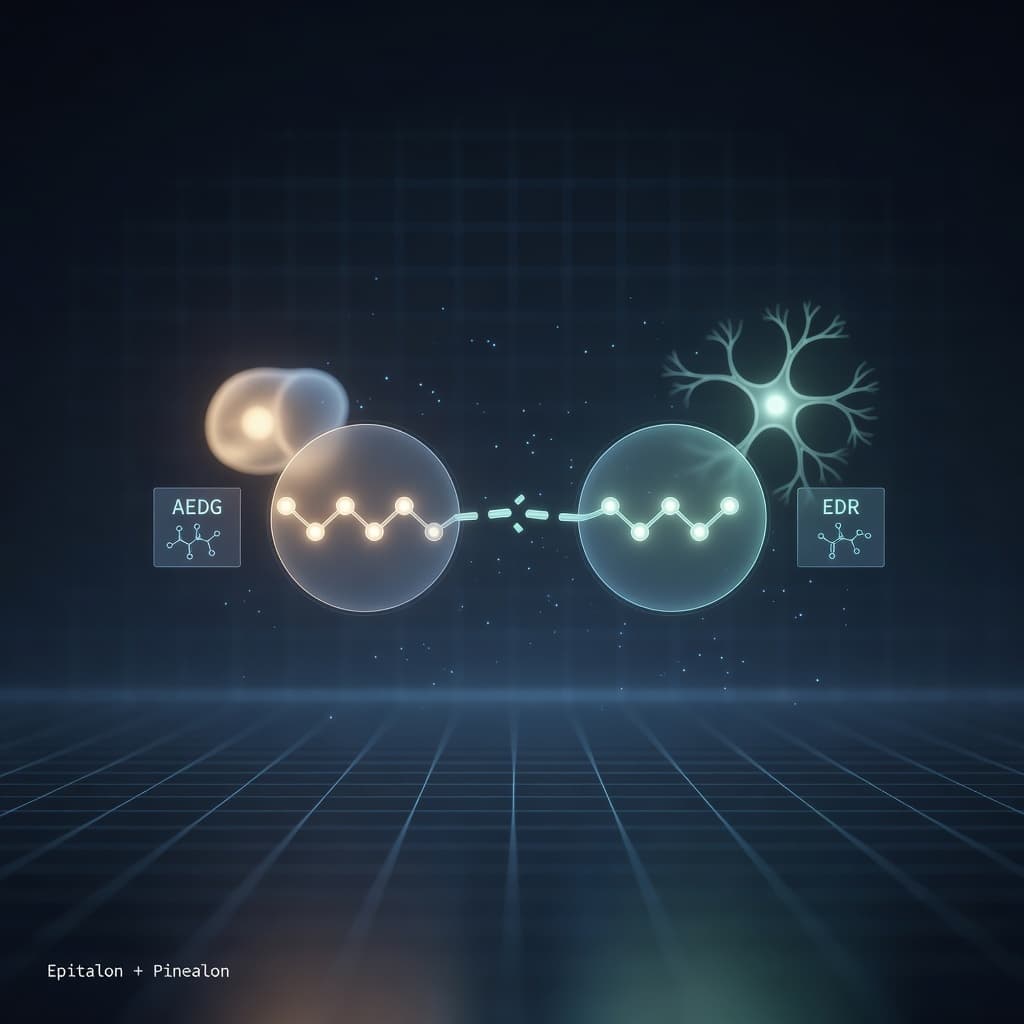
- They are not two versions of one molecule. Epitalon is a four-amino-acid chain (Ala-Glu-Asp-Gly), Pinealon is a three-amino-acid chain (Glu-Asp-Arg), and they sit on separate, unequal evidence bases.
- Thymalin is a different category of preparation entirely, a thymus-derived peptide complex without a single defined sequence, not a short synthetic peptide like the other two.
- Epitalon's published record is older, deeper and better cited, running from foundational telomerase work in the early 2000s through a 2025 overview.
- Human combination data does exist, just not for this pair. One published paper reports combined use of Pinealon with a different bioregulator peptide from the same programme (PMID 28539017), while another compared the two in separate groups rather than combining them (PMID 26390612). Neither involves Epitalon.
Tetrapeptide (Ala-Glu-Asp-Gly) that activates telomerase, the enzyme responsible for maintaining telomere length. One of the most studied peptides in longevity research, developed by Prof. Khavinson at the St. Petersburg Institute of Bioregulation.
Short-peptide bioregulator (Glu-Asp-Arg, EDR) from the Khavinson programme, studied for gene-expression effects in neuronal tissue and for protection of nerve cells under stress. The brain-focused counterpart to Epitalon in the same cytogen series.
Two molecules, two different evidence bases
Start with what each name actually refers to, because the marketing around "pineal and brain support stacks" tends to blur it.
Epitalon (also written Epithalon or Epithalone) is the synthetic tetrapeptide Ala-Glu-Asp-Gly, usually abbreviated AEDG. It was developed as a synthetic analogue of a naturally occurring pineal gland peptide fraction studied by Vladimir Khavinson's group in St. Petersburg. Four amino acids, one defined sequence, a molecule you can specify completely on a certificate of analysis.
Pinealon is the synthetic tripeptide Glu-Asp-Arg, abbreviated EDR. It is shorter than Epitalon by one residue and carries a completely different sequence. Despite the name's obvious echo of "pineal," Pinealon in the literature is studied predominantly as a neuronal or cerebral peptide rather than a pineal-specific one, alongside Epitalon within the same broader "cytogen" or peptide bioregulator series but not interchangeable with it.
Thymalin belongs to the same research programme but is not a short synthetic peptide at all. It is a polypeptide complex extracted from thymus tissue, standardized by biological activity rather than defined as one sequence. That distinction matters more than it sounds: both can be reported by mass, but Thymalin has no single molecular weight, so its dose cannot be converted into a molar quantity or equated molecule-for-molecule with Epitalon. Treat any claim that groups all three as "short peptides" with the same scrutiny you would apply to grouping an amino acid with a protein extract.
What the Epitalon literature actually contains
Epitalon's published record is the more substantial of the two, and it starts with cell biology rather than whole-animal outcomes. The foundational finding, in cultured human somatic cells, was that Epitalon treatment was associated with telomerase activation and telomere elongation (PMID 12937682). A follow-up from the same line of work examined whether the peptide could extend the number of divisions a human cell population undergoes before reaching its replicative limit (PMID 15455129). Together these two papers are the basis for essentially every "telomere peptide" claim made about Epitalon anywhere online, and they are worth reading as what they are: in-vitro cell culture work, not a demonstration of a life-extension effect in an intact human.
A separate mechanistic strand ties Epitalon's effects to the pineal gland's own signalling chemistry, specifically its relationship to melatonin regulation (PMID 22816096). This is the closest the literature comes to explaining why a "pineal peptide" classification was applied to Epitalon in the first place: the proposed mechanism runs through the same neuroendocrine axis the pineal gland already governs, not through an unrelated pathway.
Whole-animal work exists in two species. A rat study followed lifespan and the incidence of spontaneous tumours under Epitalon administration (PMID 18856211). A separate line of work looked at lifespan effects in Drosophila, the fruit fly (PMID 11103316). Both are legitimate lifespan studies in their respective organisms, and both are exactly that: animal studies. Rat physiology is not human physiology, and fruit fly physiology is further still. Neither paper reports a human dose, and no human dosing study for Epitalon appears anywhere in the evidence base cited in this article. If you see a milligram schedule attributed to Epitalon dosing "based on the research," ask which paper it actually cites; it is very unlikely to be one of the two lifespan studies above, since those studies were not designed to produce a human protocol.
More recent mechanistic work has looked at gene expression and protein synthesis during neurogenesis (PMID 32019204), and a 2025 overview brings the accumulated Epitalon literature together in one place (PMID 40141333). That overview is a useful marker of how mature this specific research line is relative to Pinealon's: it has enough published history to be worth summarizing.
What the telomerase finding does and does not show
The telomerase and telomere-elongation result (PMID 12937682) and its division-limit follow-up (PMID 15455129) were both generated in cultured human cells, not in living human subjects. They are the mechanistic backbone for Epitalon's reputation, and they are a genuinely interesting starting point for further research. They are not evidence that a course of Epitalon extends a person's lifespan, and no paper in this evidence base claims that they are.
What the Pinealon literature actually contains
Pinealon's published record leans almost entirely on neuronal cell culture and rodent models rather than whole human outcomes. Several papers report protective or supportive effects on neurons under various stress conditions in culture and in animals (PMID 21978084, PMID 28853087, PMID 39518916, PMID 22567179). Read together, they describe a peptide being tested as a tool for neuronal cell biology and brain-aging models, not a peptide with an established human clinical dataset behind it.
A second strand of Pinealon research is mechanistic and more speculative: work proposing that short regulatory peptides of this type can enter the cell nucleus and interact with DNA or chromatin, potentially influencing which genes get expressed (PMID 22117547, PMID 30762356). This is a proposed mechanism, argued from molecular and structural observations, not a mechanism demonstrated as the causal explanation for any specific downstream effect in a living organism. Treat "Pinealon works by regulating gene expression in neurons" as a hypothesis under investigation, not a settled fact, because that is how the papers themselves frame it.
Proposed, not established
The nucleus/DNA interaction papers for Pinealon (PMID 22117547, PMID 30762356) describe a plausible molecular mechanism. Plausible is not the same as proven: none of the papers in this evidence base trace a direct causal line from "Pinealon enters the nucleus" to a specific measured outcome in a whole organism.
The combination question: taxonomy, not a tested pair
This is the part worth being blunt about, because it is the entire reason Epitalon and Pinealon get sold side by side.
Vladimir Khavinson's research programme did not produce one peptide. It produced a series of peptide preparations, each historically associated with a different tissue or organ system: a pineal-associated short peptide, a short peptide studied in neuronal and brain contexts, a thymus-derived extract complex, and others beyond the scope of this article. The programme's own internal logic groups these by target tissue, the same way a textbook chapter groups "endocrine peptides" together because they share a category, not because every pair within the chapter has been tested together.
That is what is happening when Epitalon and Pinealon are marketed as a stack. It reflects the programme's tissue taxonomy: a pineal peptide and a peptide studied in neuronal contexts, filed under a shared research lineage. It does not reflect a controlled study that dosed the two together and measured a combined or synergistic effect. We looked for one specifically while researching this article and could not find a citation for it. If a Epitalon-plus-Pinealon combination trial exists, it is not part of the evidence base we can point to here, and until one surfaces, any claim that the pair works better together than either alone is marketing language, not a research finding.
What human combination literature does exist involves Pinealon, but paired with a different bioregulator peptide from the same programme, not with Epitalon. One paper compared the two peptides in separate groups across 32 patients ranging from 41 to 83 years old, 17 on Pinealon and 15 on the other, rather than administering them together (PMID 26390612). A second, larger paper compared it as one of several geroprotective methods across 110 patients (PMID 28539017). Both are genuinely interesting as human data involving Pinealon. Neither is evidence for the Epitalon-Pinealon pairing specifically, because Epitalon was not the peptide combined with Pinealon in either study. Conflating the two is an easy mistake to make when scanning abstracts quickly, and it is the mistake most vendor copy makes.
No controlled Epitalon plus Pinealon study to cite
The human papers pairing Pinealon with another bioregulator peptide do not involve Epitalon: PMID 26390612 compared separate groups, and PMID 28539017 reported combined use. We are not aware of a published controlled study that tests Epitalon and Pinealon together. The pairing sold as a "stack" rests on the programme's shared tissue classification, not on a joint trial.
Doses, exactly as studied and no further
The only published human dosing figure for Pinealon in this evidence base is oral, not injectable, and measured in micrograms rather than milligrams. In that study, participants took one capsule of 100 micrograms twice a day for two weeks (PMID 22708445). That is a small oral dose, in a fundamentally different delivery form (a formulated capsule) than a reconstituted vial intended for laboratory use. Milligram-scale Pinealon schedules that circulate on vendor sites and forums sit far above that published figure and do not trace back to a controlled study; treat them as unsourced, not as a research-derived protocol scaled up for convenience.
Epitalon's animal work does not translate into a human figure at all, and we are not going to pretend otherwise. The rat lifespan and spontaneous tumour study administered the peptide across a defined injection schedule to rats over extended observation periods (PMID 18856211). The Drosophila lifespan work delivered the peptide to fruit flies through their food (PMID 11103316). Both are legitimate protocols for their respective animal models. Neither is a human dosing study, and no paper in this evidence base reports one for Epitalon. Any milligram figure attached to Epitalon and presented as "the research dose" is, at best, an unsourced extrapolation from an animal protocol that was never designed to produce one.
How strong is this evidence, honestly?
Both compounds come overwhelmingly from one research programme rather than from a broad, independently replicated literature. A meaningful share of the underlying work was originally published in Russian-language journals, which limits how easily outside labs have been able to scrutinise, repeat, or extend it. Independent replication by groups outside the original programme is limited for both peptides. Neither Epitalon nor Pinealon holds a marketing authorisation as a medicine anywhere; both remain research compounds, not approved drugs.
Within that shared context, Epitalon is clearly the more mature of the two. Its published record stretches back further, spans more experimental systems (human cell culture, rats, fruit flies), and was recent enough to be worth a 2025 summary overview (PMID 40141333). Pinealon's literature is newer, thinner, and concentrated much more narrowly on neuronal cell culture and rodent models, with far less independent citation outside the originating group. That asymmetry is exactly why treating the two as an interchangeable or automatically complementary pair understates how differently supported they actually are.
What a researcher can actually verify
Given all of the above, the honest answer to "should I combine these" is that the published research does not currently let anyone answer that question either way. What a researcher can control, regardless of which peptide or peptides are in front of them, is identity: is the vial what the label says it is, at the purity the label claims, at the content the label claims. That is only verifiable through a batch-specific third-party analytical report carrying a verifiable lot number, not through vendor copy or a generic "lab tested" badge.
Epitalon on this shop carries published batch documentation of that kind. Pinealon is a new listing here, and its first batch report has not been published yet; it will be published before the product goes on sale, not after. We are stating that plainly rather than implying a report exists before it does, because the gap between "the label says pure" and "an independent lab measured it" is exactly the gap this entire article has been about.
Frequently asked questions
Related reading
Telomerase and telomere-elongation research in a defined tetrapeptide
Neuronal and brain-aging peptide research, a separate evidence base
Thymus peptide complex research, a different class of preparation
Mitochondrial function, NAD+ metabolism, telomere maintenance
Epitalon, Pinealon, Thymalin and every other peptide discussed on this page are sold by peptidesdirect.io for laboratory and research use only. They are not medicines, they are not approved for human consumption, and nothing in this article should be read as a dosing recommendation, a treatment protocol, or medical advice.
Research context for English-speaking buyers
Most of our English-speaking customers ship to the UK, Ireland, Malta or other English-as-second-language EU territories. The regulatory picture differs per country.
- Relevant authorities
- MHRA (UK, post-Brexit), HPRA (Ireland, EU-aligned), FDA Section 503A bulks list (US, restricted Cat 2 status of several peptides as of 2026)
- Customs and VAT
- EU shipments include 19% VAT; UK shipments after Brexit are now extra-EU and may attract UK VAT plus a handling fee at import
- Typical shipping window
- EU 2-4 working days, UK 4-7 working days, other international 7-14 working days, depending on customs
Research-grade peptides shipped from our EU warehouse are sold for laboratory use only and are not authorised for human or veterinary therapeutic application in any of the destination jurisdictions. US customers should be aware that the FDA Section 503A bulks list classification (and the April 2026 reclassification of twelve compounds) only governs compounding pharmacies, not direct-to-researcher imports for non-clinical work. UK buyers should declare the consignment on import and may be asked for a research justification by HMRC. We provide a CoA per batch identified by colour code rather than serial number; customs sometimes asks for this document when clearing the parcel.