GHK-Cu Topical vs Injectable: How Route of Administration Shapes Copper-Peptide Skin Research
GHK-Cu topical vs injectable for skin research: how route shapes delivery and penetration, and what the copper-peptide literature actually tested.
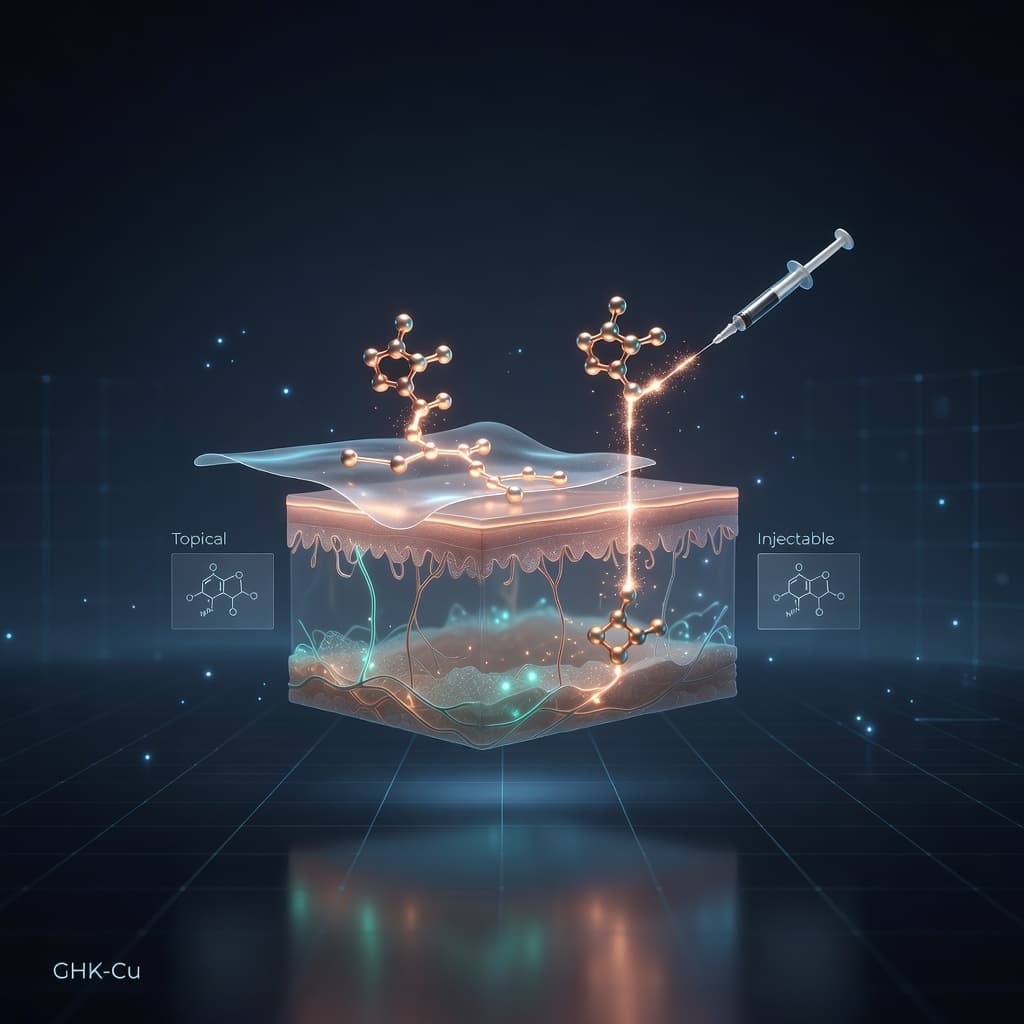
GHK-Cu, the copper(II) complex of the tripeptide glycyl-L-histidyl-L-lysine, is one of the most commercially visible research peptides in the skin space, sold as a cosmetic cream ingredient under one label and as an injectable research vial under another. Buyers frequently assume the two routes are interchangeable, or that the strongest evidence sits behind the injectable form. Neither assumption survives a close read of the literature. This article walks through what the topical, injectable and oral evidence for GHK-Cu and skin actually shows, strictly in a research and cosmetic-ingredient context, not as a human medical or injection guide.
Update 28 August 2026: the FDA withdrawal covered only the injectable route
The route split survives. The FDA's Section 503A bulk drug substances list, updated 14 May 2026, records that the April 2026 withdrawal applied to the injectable nomination alone: "GHK-Cu (except for injectable routes of administration) was removed from category 1 on April 22, 2026, because the nominations for GHK-Cu were withdrawn by the nominators. On May 5, 2026, one of those nominators clarified that it intended to withdraw only its nomination of the injectable route of administration with respect to GHK-Cu ... GHK-Cu (except for injectable routes of administration) will be added back to category 1." What that means: non-injectable GHK-Cu is on the FDA's Category 1 list, while the injectable nomination now sits in the agency's nominated-but-withdrawn table, where FDA's stated concern is a "risk for immunogenicity due to the potential for aggregation and peptide-related impurities" alongside "limited data in humans to inform safety-related considerations". The same document states that FDA intends to consult the Pharmacy Compounding Advisory Committee before the end of February 2027 on whether GHK-Cu belongs on the 503A bulks list. What it does not mean: Category 1 is enforcement discretion, not an approval, and Section 503A is United States law about American compounding pharmacies. Nothing here changes the EU position or our research-use-only classification.
TL;DR: GHK-Cu route of administration for skin research
- The strongest in vivo collagen-synthesis data for GHK-Cu comes from a rodent subcutaneous injected wound-chamber model, never replicated in a human injectable trial.
- Essentially all human skin-appearance data (procollagen biopsies, post-laser recovery) used topical creams, not injections.
- Intact human skin allows almost no GHK-Cu peptide or copper to permeate on its own; meaningful topical delivery required microneedle pretreatment in the only independent pharmaceutics study found.
- Topical use is legally covered by a cosmetic-ingredient safety review (Copper Tripeptide-1); injectable GHK-Cu has no FDA approval and no confirmed US compounding pathway as of writing.
- No dedicated human oral study for GHK-Cu exists, and general peptide pharmacology predicts poor oral stability for the bare tripeptide.
Topical or injectable: which route does the GHK-Cu literature actually use?
The confusion starts at the origin point. The foundational 1988 mechanism paper did not use either route: Maquart and colleagues added GHK-Cu directly to cultured human fibroblasts and found dose-dependent stimulation of collagen synthesis starting at 10 to the -12 to 10 to the -11 molar and peaking around 10 to the -9 molar, independent of any change in cell number (PMID 3169264). That in vitro result is the mechanistic root cited by nearly every later topical and injectable paper, but it is neither.
The first true in vivo route comparison is injectable, and it is rodent, not human. A 1993 study implanted wire-mesh wound chambers subcutaneously in rats and gave sequential injections of GHK-Cu or saline into the chamber (PMID 8227353). GHK-Cu produced a concentration-dependent increase in dry weight, DNA, protein, collagen and glycosaminoglycan content, with collagen-synthesis stimulation running roughly twice that of noncollagen protein. A copper-free control peptide had negligible effect, which is the clearest evidence that the copper coordination itself, not just the tripeptide backbone, is doing mechanistic work. This remains the single strongest injectable-route data point for GHK-Cu and skin, and it has never been repeated in a human injectable trial.
Almost everything on the human side runs the other direction, through the skin rather than under it. A small 1998 pilot applied topical creams, including a copper-binding peptide formulation, to thigh skin in 20 subjects for one month and reported increased dermal procollagen on biopsy in most subjects, comparable to or exceeding a tretinoin comparator in this small sample. A more rigorous 2006 randomized trial applied a topical GHK-Cu product after CO2 laser resurfacing in 13 patients over 12 weeks (PMID 16847171), and a 2006 animal study applied topical tripeptide-copper complex, alone and with zinc oxide, to open surgical wounds in rabbits (PMID 17083573). All three are topical, so the honest summary inverts what marketing content usually implies: the mechanistic, highest-magnitude in vivo numbers are injectable-rodent, and the human evidence base is topical.
Does topical GHK-Cu actually penetrate the skin?
This is the question that separates pharmaceutics from marketing, and it has a real, independently generated answer. A 2015 study used Franz diffusion cells with intact ex vivo human skin and found that essentially no GHK-Cu peptide or copper crossed the barrier on its own (PMID 25690343). After pretreating the skin with polymeric microneedles, permeation over nine hours rose to 134 plus or minus 12 nanomoles of peptide and 705 plus or minus 84 nanomoles of copper, with the amount tracking microneedle application force. In other words, the bottleneck is the stratum corneum, and topical efficacy for the bare peptide is formulation and delivery-method dependent, not automatic.
That finding sits in direct tension with a widely cited review stating that GHK-Cu appears to pass the skin's horny layer in quantities sufficient to activate regenerative events (PMID 26236730). The review's lead author is the original discoverer of GHK-Cu and holds commercial and patent ties to copper-peptide skincare products, a conflict of interest worth flagging whenever a penetration claim traces back only to that review lineage rather than to an independent study. This is a real disagreement between a promotional-adjacent review and an independent delivery study, best presented as unresolved rather than settled in either direction, and it is also why commercial GHK-Cu creams tend to lean on liposomes, penetration enhancers or adjunct procedures like microneedling rather than the bare peptide alone.
What the topical and injectable skin studies actually measured
Putting the individual studies side by side clarifies what each route's evidence base can and cannot support. The injected rodent wound-chamber data (PMID 8227353) is mechanistically the cleanest: same-animal dose response, a copper-free negative control, and multiple converging tissue-composition markers, but it is exclusively rat, exclusively subcutaneous, and has no human injectable counterpart. The 1998 topical pilot reported a procollagen signal on biopsy but was published in a non-PubMed-indexed venue, so specific responder-percentage figures that circulate on secondary and marketing sites could not be verified against primary text here and should be treated with caution. The 2006 post-laser randomized trial (PMID 16847171) is the most methodologically honest human topical result available: no statistically significant objective difference from the comparator in erythema or wrinkle scores, but a significant patient-satisfaction difference (P=.04). The 2006 rabbit open-wound study (PMID 17083573) supports a topical wound-healing signal in an animal model, again not human skin.
None of these studies compared topical against injectable GHK-Cu head to head in the same skin model, so any claim that one route is categorically better for skin outcomes is an extrapolation, not a finding. For laboratories running injectable-route research protocols specifically, the GHK-Cu vial itself, reconstitution water and fine-gauge syringes are the relevant bench items.
Naturally occurring copper tripeptide complex for skin regeneration and anti-aging research. Stimulates collagen synthesis, accelerates wound healing, and modulates 4000+ genes. Plasma levels decline with age, making it a key target in longevity research.
USP-grade sterile water with 0.9% benzyl alcohol (near-neutral, pH 6.2 to 6.4) - the standard solvent for reconstituting lyophilized peptides. Essential accessory for any peptide research. Each vial is sealed and ready to use.
Sterile 1 mL graduated laboratory syringe with a 31G x 6 mm fine tip. Individually wrapped, latex-free, pyrogen-free, PVC-free, with a high-contrast 0.01 mL black scale for precise liquid measuring and transfer.
Reconstitution, storage and route considerations for laboratory use
Injectable-route research protocols in the literature reconstitute lyophilized GHK-Cu the way most lyophilized research peptides are handled: bacteriostatic water added slowly, gentle swirling rather than shaking to avoid disrupting the peptide, and refrigerated storage of the reconstituted vial within a defined window. Our reconstitution calculator at /research/reconstitution-calculator works out concentration and draw volume for a given research protocol; this is a calculation tool for laboratory use, not a human dosing instruction, and no GHK-Cu-specific official reconstitution pH citation was located in the peer-reviewed literature during this review.
Topical-route research sits in a different category entirely: it is a cosmetic-formulation question (carrier, penetration enhancer, concentration in the finished product) rather than a reconstitution question, and the Li and Kang 2015 delivery data above is the relevant reference point for anyone evaluating why a given topical formulation might or might not deliver measurable peptide past intact skin. For labs working with a ready-formulated skin-regeneration blend rather than the bare peptide, our GLOW blend combines GHK-Cu with other research peptides.
3-in-1 skin peptide blend: GHK-Cu 50mg + BPC-157 10mg + TB-500 10mg. Targets collagen synthesis, tissue regeneration, and skin repair for comprehensive dermatological research.
Verify before you use
Whichever route a protocol calls for, confirm the specific batch on /coa before use, and review our purity-testing methodology at /purity. These are supplier third-party analyses, not independent clinical-grade certification, and they apply to the research material itself, not to any downstream formulation you might prepare from it.
Regulatory status: cosmetic ingredient, research chemical, and the FDA compounding question
The two routes have entirely separate legal footings, and conflating them is a common mistake. Topical use of GHK-Cu, under the INCI name Copper Tripeptide-1, was formally reviewed by the Cosmetic Ingredient Review Expert Panel, which concluded the ingredient and related compounds are safe as used in finished cosmetic products at typical concentrations, generally below 10 ppm, functioning as skin-conditioning agents with only mild, occasional local irritation reported (Int J Toxicol 2018;37(3_suppl):90S-102S). That is a cosmetic-ingredient safety finding, not a drug-efficacy approval, and no disease or medical claims may legally attach to a cosmetic product containing it.
Injectable GHK-Cu sits on a different, unresolved track. Per our own fact-checked coverage of the FDA's compounding review process, injectable GHK-Cu was one of twelve peptides removed from the FDA's Category 2 restricted-compounding list in April 2026, but it was explicitly not among the seven peptides scheduled for the July 23 to 24, 2026 Pharmacy Compounding Advisory Committee hearing; a further review is anticipated in autumn 2026 or spring 2027, with no confirmed date. See our companion article, FDA PCAC Hearing July 2026, for the full seven-peptide breakdown. Removal from a restricted list is not an approval, so injectable GHK-Cu's US status remains pending, and no EMA evaluation or approval was identified for any route. On peptidesdirect.io, GHK-Cu is sold strictly as a research chemical, topical or injectable form alike, separate from its legal status as a finished-cosmetic ingredient elsewhere in the market.
This skin-and-route article is also a different question from our earlier coverage of GHK-Cu and cognitive aging, a 2026 rodent preprint comparing intranasal against intraperitoneal administration in the hippocampus of aged mice (PMID 42245779), which we cover separately at GHK-Cu: Route of Administration Shapes the Hippocampal Profile. Different tissue, different route comparison, different preprint; the two should not be cited interchangeably.
Three misconceptions worth correcting
- Injectable is not the stronger-evidence route for skin. The only rigorous in vivo collagen data is a rodent injected model, while essentially all human skin-appearance data used topical creams.
- Topical GHK-Cu does not obviously pass intact skin. The only independent pharmaceutics study found near-zero permeation without microneedle pretreatment, in tension with review claims from a source with commercial ties to copper-peptide skincare.
- GHK-Cu is not FDA approved by any route. Topical use is a reviewed cosmetic ingredient with no disease claims permitted; injectable use has an unresolved US compounding review pending.
Tissue repair, wound healing, and recovery peptides
Bare copper-peptide skin research, injectable or topical formulation study
Reconstitution for injectable-route protocols
Ready-formulated skin-regeneration blend research
Frequently asked questions
This article discusses GHK-Cu strictly as a research chemical and reviewed cosmetic ingredient. Nothing here is a human injection, dosing or treatment instruction.
Research context for English-speaking buyers
Most of our English-speaking customers ship to the UK, Ireland, Malta or other English-as-second-language EU territories. The regulatory picture differs per country.
- Relevant authorities
- MHRA (UK, post-Brexit), HPRA (Ireland, EU-aligned), FDA Section 503A bulks list (US, restricted Cat 2 status of several peptides as of 2026)
- Customs and VAT
- EU shipments include 19% VAT; UK shipments after Brexit are now extra-EU and may attract UK VAT plus a handling fee at import
- Typical shipping window
- EU 2-4 working days, UK 4-7 working days, other international 7-14 working days, depending on customs
Research-grade peptides shipped from our EU warehouse are sold for laboratory use only and are not authorised for human or veterinary therapeutic application in any of the destination jurisdictions. US customers should be aware that the FDA Section 503A bulks list classification (and the April 2026 reclassification of twelve compounds) only governs compounding pharmacies, not direct-to-researcher imports for non-clinical work. UK buyers should declare the consignment on import and may be asked for a research justification by HMRC. We provide a CoA per batch identified by colour code rather than serial number; customs sometimes asks for this document when clearing the parcel.