HGH/Somatropin: Mechanism and Evidence Explained
How recombinant HGH (Genotropin, Norditropin) works, what controlled trials actually show on muscle and strength, and why it is prescription-only.
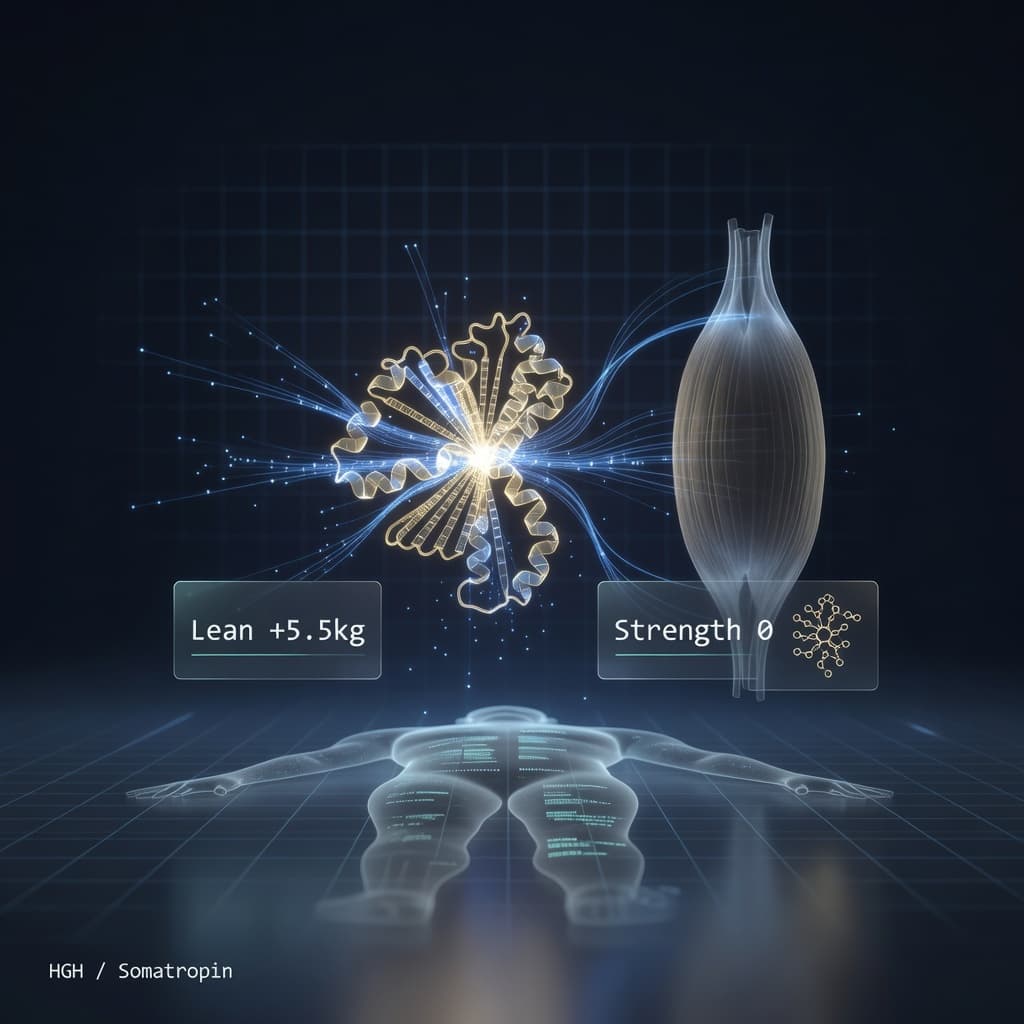
TL;DR: What the data actually says about HGH
Recombinant human growth hormone (rhGH, somatropin) is a prescription-only, physician-administered drug for diagnosed growth hormone deficiency and a handful of other rare conditions. In true deficiency, six months of rhGH added 5.5 kg of lean mass and removed 5.7 kg of fat versus no change on placebo (PMID 2687691). In healthy, non-deficient adults, controlled trials show something different: GH raises lean body mass on the scale but does not improve strength or sprint performance, and comes with more edema and fatigue (PMID 18347346). Animal work suggests why: GH-driven mass gain does not track cleanly with contractile strength and can rise alongside myostatin, not against it (PMID 30443216). It is illegal to possess or use without a prescription in most jurisdictions and is banned in competition by WADA (PMID 29932857). We do not sell it. This article explains the mechanism, then introduces the GH-secretagogue research peptides we do carry.
What HGH/Somatropin Actually Is
Somatropin is the generic name for recombinant human growth hormone, a laboratory-manufactured, 191-amino-acid protein that is an exact structural copy of the growth hormone your pituitary gland produces naturally. It is manufactured by several pharmaceutical companies under brand names including Genotropin (Pfizer) and Norditropin (Novo Nordisk), among others, and is dispensed as a prescription injectable, typically self-administered subcutaneously once daily.
Its approved medical indications are narrow and specific: adult and pediatric growth hormone deficiency, Prader-Willi syndrome, Turner syndrome, growth failure associated with chronic kidney disease, children born small for gestational age who fail to catch up in growth, and HIV-associated wasting. Every one of these indications requires a confirmed diagnosis, typically involving stimulation testing and IGF-1 measurement, before a prescription is written. There is no approved indication for healthy adults seeking muscle gain, fat loss, or anti-aging effects, and no legitimate over-the-counter or research-chemical version exists.
Mechanism: How Exogenous GH Differs From Your Own GH/IGF-1 Axis
Under normal physiology, growth hormone is not released as a steady drip. The hypothalamus secretes growth hormone-releasing hormone (GHRH) in pulses, which the pituitary answers with corresponding pulses of GH, counterbalanced by somatostatin, a competing hypothalamic signal that suppresses release. This pulsatility, largest during deep sleep, is thought to matter for how target tissues respond, and it is tightly self-limited: as GH and downstream IGF-1 rise, feedback loops rein the system back in.
Injecting exogenous rhGH bypasses this entire regulatory architecture. A subcutaneous dose of somatropin raises circulating GH and, in turn, hepatic and systemic IGF-1 directly, without going through the hypothalamic-pituitary pulse-generation step. The body's own feedback loops can still act on downstream IGF-1, but the upstream trigger, GHRH-driven pituitary pulsing, is skipped entirely. That distinction, replacing a pulse-generating axis versus flooding its output, is the central mechanistic reason rhGH and the GH-secretagogue peptides described later in this article behave differently in the body, even though both ultimately raise IGF-1.
The Evidence: What Controlled Trials Actually Show
The clinical picture on rhGH splits cleanly along one line: is the recipient actually deficient, or not.
Trial design matters: deficiency correction versus healthy-adult enhancement
Salomon et al. (PMID 2687691) enrolled adults with a confirmed diagnosis of adult-onset growth hormone deficiency in a double-blind, placebo-controlled design, the gold standard for isolating a drug's true effect from expectation or natural variation. Liu et al. (PMID 18347346), by contrast, is a systematic review pooling controlled trials conducted in healthy or athletic subjects who were not GH-deficient. The two bodies of evidence answer different questions, and conflating them is the single most common error in popular claims about HGH.
In the foundational 1989 trial (PMID 2687691), 24 adults with genuine growth hormone deficiency received either rhGH or placebo for six months in a double-blind design. The rhGH group gained 5.5 plus or minus 1.1 kg of lean body mass and lost 5.7 plus or minus 0.9 kg of fat mass (both P less than 0.0001), while the placebo group showed no meaningful change on either measure. This is a correction of a genuine physiological deficit, not an enhancement effect layered on top of normal function, and it remains one of the strongest pieces of evidence that GH replacement therapy works exactly as intended when a true deficiency exists.
The picture changes entirely once the subjects are healthy. Liu and colleagues' 2008 systematic review in the Annals of Internal Medicine (PMID 18347346), conducted by a Stanford-affiliated group, pooled controlled trials of GH administration in healthy and athletic populations. GH did increase lean body mass on the scale, but it did not improve strength, and it did not improve sprint capacity. It was also associated with more soft-tissue edema, more fatigue, and a higher overall rate of adverse events than placebo. The review's own conclusion is unambiguous: "Claims that growth hormone enhances physical performance are not supported by the scientific literature."
Muscle and GH/IGF-1 Relevance: Why More Mass Has Not Meant More Strength
The gap between "more lean mass" and "no more strength" in the healthy-adult trials is not just an odd footnote, it points to a real mechanistic wrinkle in how GH and IGF-1 signaling interact with the pathways that actually govern muscle growth.
Lozier, Kopchick and de Lacalle (PMID 30443216) examined this directly in mouse models with either GH excess (bovine GH-overexpressing mice) or GH-receptor knockout. In the GH-excess animals, lean mass and total body weight rose as expected, but grip strength, a functional readout of muscle quality rather than muscle size, actually fell, and this occurred alongside an increase in mature myostatin, a well-characterized negative regulator of muscle growth. The GH-receptor-knockout animals showed the mirror-image pattern. In other words, GH/IGF-1 signaling and myostatin do not simply cancel each other out in a straightforward inverse relationship; excess GH signaling can drive lean-mass accumulation while simultaneously permitting, or even encouraging, higher myostatin activity, which works against contractile strength.
This gives a plausible mechanistic explanation for what the human trials already showed: HGH-driven "lean mass" gain in non-deficient people appears to be disproportionately water retention, connective tissue, and organ growth rather than functional contractile muscle, which is exactly why scale weight and lean-mass measurements can rise while grip strength and athletic performance do not.
What the Community Reports
Anecdotal only, not clinical evidence
The following is a summary of recurring themes from public bodybuilding and GH-focused discussion forums (primarily MESO-Rx/thinksteroids.com; direct Reddit thread content could not be retrieved via search for this article and is not represented here). None of it is peer-reviewed, none of it is verified, and none of it should be read as guidance. It is included only to describe what people discuss, not to endorse any practice.
Community dosing discussion splits roughly into two camps: self-described "low-dose" users in the 2-4 IU per day range, who frame HGH as a recovery or general-wellness tool, and "high-dose" users at 5-10 or more IU per day, who argue that range is the threshold for visible body-recomposition change. Posters repeatedly describe highly individual responses, with some reporting large IGF-1 increases from 2-4 IU while others report noticing nothing at the same dose.
Perceived effects cluster more around recovery than raw muscle growth: better joint and soft-tissue recovery, improved sleep quality, a subjective mood or cognitive lift, and a "fuller" muscle appearance that posters themselves frequently attribute to fluid retention rather than new tissue. Actual fat loss is often described as underwhelming relative to marketing claims, with several posters saying meaningful recomposition takes months rather than weeks. A recurring caveat across threads is that HGH is generally described as doing "little alone," with community members typically framing it as a force-multiplier used alongside anabolic steroids or TRT rather than a standalone muscle builder; solo-use accounts describe modest results.
Reported side-effect chatter, again anecdotal and not clinical, includes water retention and joint puffiness, occasional carpal-tunnel-type sensations, lethargy at higher doses, and glucose or insulin-resistance concerns above roughly 8 IU per day. A small number of posters describe pairing high-dose HGH with self-administered insulin-management strategies; this is a genuine, serious medical risk practice discussed on forums, not a mainstream or safe recommendation, and is flagged here explicitly as such rather than reproduced as advice.
Sourcing anxiety runs through nearly every thread. HGH is repeatedly described as one of the most counterfeited hormone products in these communities, with fake Genotropin and Norditropin pen packaging specifically named as a target, along with substituted 192-amino-acid variants and "too cheap to be real" pricing treated as a red flag. Community-recommended verification generally centers on blood or serum IGF-1 testing and third-party lab documentation, though some threads note skepticism that even lab verification can be gamed if the tester works from a known, labeled vial rather than a blind sample. Sentiment on generic or underground-lab product is split: one thread captured a poster's fear that generic HGH might be "a mild scam" (working biomarkers but underwhelming subjective effect), which others pushed back on as low-grade paranoia, while a few countered that certain generics have tested with better purity or lower dimer content than branded pharma product on independent panels, a claim that came from single forum posts and was not corroborated across threads, and should not be treated as established fact. Overall sentiment is polarized rather than uniformly enthusiastic, with threads literally titled "Is HGH overrated?" showing real division between long-time users who defend it as a genuine long-game recovery and health tool worth the cost, and others who call low or moderate doses placebo-adjacent and argue it is only worthwhile at doses most people find financially or medically impractical to sustain.
Why We Do Not Sell HGH
Prescription-only, controlled substance, not a research chemical
Recombinant human growth hormone is a prescription-only medication across the European Union and a Schedule III controlled substance in the United States (PMID 29932857). Legitimate use requires a confirmed diagnosis, physician-supervised dosing titration, and ongoing IGF-1 monitoring, categorically different from the self-directed research-peptide model. Non-prescribed possession, distribution, or use for muscle or performance enhancement is illegal in most jurisdictions, and rhGH is banned in-competition by the World Anti-Doping Agency, with active biomarker and isoform testing in place. peptidesdirect.io does not sell HGH/somatropin, does not facilitate obtaining it, and nothing in this article is a guide to sourcing, dosing, or using it. This article is educational only and does not constitute medical advice.
There is no legitimate research-use framing for a diagnosed patient's prescribed medication, and the risk profile the community itself describes, glucose disturbance, edema, joint issues, and cardiomyopathy risk with chronic supraphysiologic dosing, is not something any responsible research-peptide supplier can wave past. That is the plain reason HGH sits outside our catalog while the upstream GH-secretagogue peptides below do not: they act on a different point in the axis, with a different evidence base and a different regulatory status.
The Research Peptides We Carry
The peptides below do not replace HGH. They work upstream of it, stimulating the body's own GHRH or ghrelin receptors rather than supplying exogenous GH directly, and each carries its own separate evidence base. They are offered exclusively for laboratory research use.
GHRH(1-29) analog for physiological growth hormone stimulation research
CJC-1295 without DAC (Mod GRF 1-29) is a short-acting GHRH(1-29) analog for GH/IGF-1 research. Research-grade lyophilized powder, specified purity >=99% (HPLC). Laboratory use only.
Highly selective growth hormone releaser that triggers natural GH pulses without raising cortisol or prolactin. Clean GH stimulation with minimal side effects - the most targeted growth hormone peptide available.
Modified GHRH analog for lipodystrophy and metabolic liver research
Growth hormone secretagogues and gonadotropins
Growth hormone axis
GHRH(1-29) analog for physiological growth hormone stimulation research
CJC-1295 without DAC (Mod GRF 1-29) is a short-acting GHRH(1-29) analog for GH/IGF-1 research. Research-grade lyophilized powder, specified purity >=99% (HPLC). Laboratory use only.
Highly selective growth hormone releaser that triggers natural GH pulses without raising cortisol or prolactin. Clean GH stimulation with minimal side effects - the most targeted growth hormone peptide available.
Modified GHRH analog for lipodystrophy and metabolic liver research
Sermorelin and CJC-1295 are both GHRH-receptor agonists: they mimic the hypothalamus's own signal to the pituitary, amplifying the amplitude of the body's existing GH pulse rather than overriding it. Sermorelin, the biologically active GHRH(1-29) fragment, is cleared within minutes and produces a short pulse close to the physiological pattern. CJC-1295, in its DAC form, which we do not sell, persists for days, producing more sustained receptor stimulation than a single discrete pulse; the No-DAC form we do sell (Mod GRF 1-29) clears in about 30 minutes. Ipamorelin works through an entirely different receptor, the ghrelin receptor GHS-R1a, as a growth hormone-releasing peptide (GHRP); it is generally considered more selective than older GHRPs, with comparatively lower reported effects on cortisol and prolactin. Combining a GHRH-receptor agonist with a ghrelin-receptor agonist is described in the literature as synergistic, since the two receptor systems can potentiate each other's GH-release signal more than either alone.
Tesamorelin stands apart from the other three because it has actual placebo-controlled outcome data behind a specific clinical indication. Falutz et al. (PMID 20101189) randomized HIV-infected patients with abdominal fat accumulation to tesamorelin or placebo and found a 10.9 percent reduction in visceral adipose tissue (about 21 cm2) at six months, versus a 0.6 percent change on placebo, with roughly 18 percent reduction sustained at 12 months and no significant glucose disturbance. Tesamorelin is the one GH-secretagogue with genuine FDA-approved, trial-backed evidence, and it demonstrates that stimulating endogenous GHRH signaling can produce a measurable metabolic effect with a comparatively clean safety profile, a materially different position than exogenous rhGH in a non-deficient adult, where the same body of trial evidence (PMID 18347346) shows no strength or performance benefit and a worse adverse-event profile.
Questions about availability or sourcing
peptidesdirect.io does not sell HGH/somatropin (Genotropin, Norditropin) and cannot help source it. If you have questions about the research peptides in our catalog, including sermorelin, CJC-1295, ipamorelin or tesamorelin, contact support@peptidesdirect.io.
Community and Further Reading
FAQ
This article is for informational and educational purposes only. All mentioned peptides are intended exclusively for laboratory research and not for human consumption. We do not sell the drug this article is about. For Research Purposes Only.
Research context for English-speaking buyers
Most of our English-speaking customers ship to the UK, Ireland, Malta or other English-as-second-language EU territories. The regulatory picture differs per country.
- Relevant authorities
- MHRA (UK, post-Brexit), HPRA (Ireland, EU-aligned), FDA Section 503A bulks list (US, restricted Cat 2 status of several peptides as of 2026)
- Customs and VAT
- EU shipments include 19% VAT; UK shipments after Brexit are now extra-EU and may attract UK VAT plus a handling fee at import
- Typical shipping window
- EU 2-4 working days, UK 4-7 working days, other international 7-14 working days, depending on customs
Research-grade peptides shipped from our EU warehouse are sold for laboratory use only and are not authorised for human or veterinary therapeutic application in any of the destination jurisdictions. US customers should be aware that the FDA Section 503A bulks list classification (and the April 2026 reclassification of twelve compounds) only governs compounding pharmacies, not direct-to-researcher imports for non-clinical work. UK buyers should declare the consignment on import and may be asked for a research justification by HMRC. We provide a CoA per batch identified by colour code rather than serial number; customs sometimes asks for this document when clearing the parcel.