Intranasal Peptides: Delivery, Bioavailability and Which Ones Are Studied This Way
How the intranasal route works for peptides: the olfactory and trigeminal nose-to-brain pathways, why peptides struggle to reach the brain, and which research peptides (Semax, Selank, DSIP) are studied intranasally.
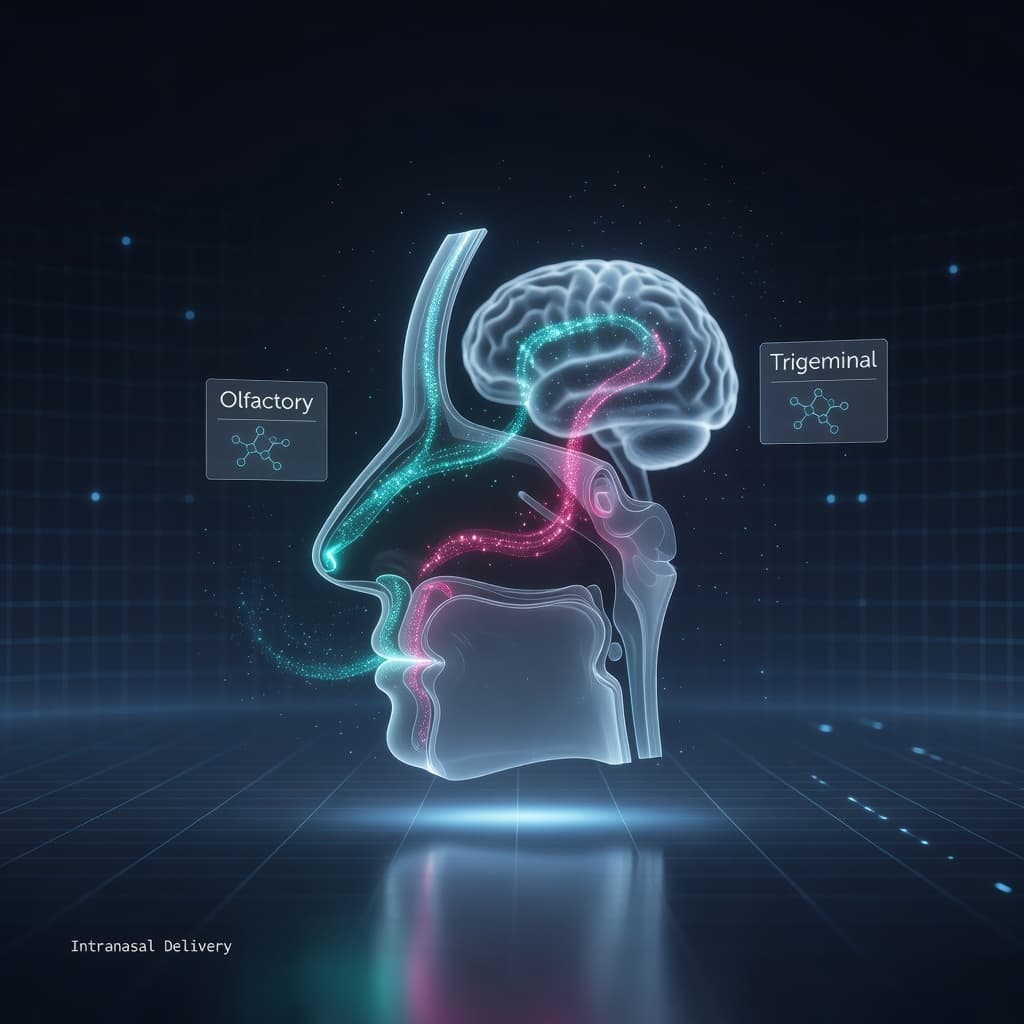
TL;DR: The nose-to-brain route in one screen
Peptides reach the brain poorly by other routes: they cross the blood-brain barrier badly and are rapidly cleaved by peptidases, which is the core reason non-invasive CNS delivery is hard (PMID 25805003). Two nose-to-brain pathways exist: the olfactory route (through the cribriform plate to the olfactory bulb) and the trigeminal route (along trigeminal nerve branches to the brainstem), both largely bypassing the systemic barrier (PMID 20420446, 22119441). It is part direct-brain, part systemic, not 100 percent brain-targeted; its direct-CNS transport has a faster extracellular component and a slower intracellular one. Semax and Selank are engineered for it via a Pro-Gly-Pro tail that resists enzymatic breakdown (PMID 14682258); DSIP is studied more for its intrinsic membrane permeability (PMID 3768731). Human and primate proof-of-concept: intranasal insulin in human cognition and biomarker trials, and oxytocin in macaque CSF data, prescription hormones we do not sell (PMID 21911655, 25133536).
The intranasal route keeps coming up in peptide research for a simple reason: it is one of the few non-invasive ways to get a large, fragile molecule close to the brain. This article explains how the route actually works, how much really reaches the CNS, what makes a peptide suitable for it, and which research peptides are studied this way. It is a delivery and mechanism explainer for laboratory research context only. It contains no dosing, no nasal-spray concentrations and no usage protocols, and it names conditions such as stroke or anxiety solely to describe what published studies investigated.
Neuroprotective and nootropic peptides
Why Peptides Struggle to Reach the Brain
Peptides cross the blood-brain barrier poorly and are rapidly degraded by peptidases (PMID 25805003), and they are also poorly absorbed when swallowed. Swallowed, most of a peptide is destroyed in the gut and liver before it ever reaches the circulation; injected, it still faces the barrier that keeps most large molecules out of the brain. That pharmacokinetic wall is why researchers explore alternative routes for CNS-directed peptides, and why the nose has drawn so much attention.
The Two Nose-to-Brain Pathways
Olfactory and trigeminal transport (PMID 20420446, 22119441)
There are two anatomical routes from the nasal cavity to the brain. The olfactory route carries drug across the olfactory epithelium at the roof of the nose, through and around olfactory sensory neurons via the cribriform plate, to the olfactory bulb. The trigeminal route carries it along branches of the trigeminal nerve to the brainstem. A low-molecular-weight tracer study demonstrated the trigeminal pathway delivering to the CNS while largely bypassing the blood-brain barrier, and a comprehensive review established both routes as the mechanism by which intranasally applied biologics reach the brain without crossing the systemic barrier.
Transport along these routes is a mix of a faster extracellular component (bulk flow and paracellular movement along perineural spaces) and a slower intracellular axonal component (PMID 20420446, 22119441). The extracellular component is the faster route by which intranasally applied agents can reach CNS extracellular and perivascular spaces, though the exact timing depends on the molecule and study.
How Much Actually Reaches the Brain?
Honesty matters here. Intranasal delivery is not a magic direct line: a fraction of any nasal dose is also absorbed across the vascular nasal mucosa into the bloodstream, so the effect is part direct-to-CNS and part systemic. The direct-brain fraction is real and measurable, but it is not the whole dose. You will sometimes see very precise bioavailability percentages quoted for specific research peptides on vendor pages; several of those figures cannot be traced to primary literature, so the accurate way to describe the route is qualitatively: better than oral for a CNS target, part direct-CNS and part systemic, and fast for the extracellular component.
What Makes a Peptide Intranasal-Ready: The Pro-Gly-Pro Design
For a peptide to survive the nasal mucosa and reach the brain, it has to resist the peptidases that would otherwise shred it. This is where the "glyproline" design principle comes in. Ashmarin's group developed stable regulatory oligopeptides whose C-terminal Pro-Gly-Pro (PGP) moiety confers marked resistance to enzymatic degradation (PMID 14682258), and this class shows characteristic tissue distribution after various routes of administration (PMID 18695718).
That is exactly the chemistry behind the two most prominent intranasal research peptides. Semax is the heptapeptide Met-Glu-His-Phe-Pro-Gly-Pro (an ACTH(4-7) core, a functional ACTH(4-10) analogue, plus the Pro-Gly-Pro tail), and Selank is Thr-Lys-Pro-Arg-Pro-Gly-Pro (the immune peptide tuftsin plus the same tail). The terminal proline-containing tail increases resistance to enzymatic degradation, slowing breakdown of the parent heptapeptide enough for mucosal absorption.
Semax: Structure and the Intranasal Research
Semax is a synthetic analogue of the ACTH(4-10) melanocortin fragment. In rats it binds specifically in brain tissue and increases BDNF (PMID 16635254), and it up-regulates BDNF and its receptor trkB in the hippocampus (PMID 16996037). Its effects in disease models extend beyond a single pathway: in a rat focal cerebral-ischemia model it broadly altered immune- and vascular-system gene expression (PMID 24661604), and it modulated immune-response genes during ischemic brain injury (PMID 28255762). Semax has also been evaluated clinically in ischemic-stroke patients in Russia with reported benefit (PMID 29798983), but that is a Russian-language clinical report that should be read as region-specific, methodologically limited evidence rather than EU-approved efficacy.
Brain-boosting nootropic peptide derived from ACTH. Increases BDNF (brain-derived neurotrophic factor), enhances focus, memory, and mental clarity. Widely used in Russian clinical practice for cognitive enhancement.
Selank: Structure and the Intranasal Research
Selank is a synthetic analogue of the immune peptide tuftsin, studied for anxiolytic and immunomodulatory effects. It was assessed clinically for generalised anxiety disorder and neurasthenia with reported anxiolytic efficacy (PMID 18454096), again a Russian-language study of older, small-scale design that should be treated as investigational rather than established. Like Semax, it is stabilised by the Pro-Gly-Pro tail, which is why the two are the archetypal intranasal research peptides.
Synthetic tuftsin analog with anxiolytic, nootropic, and immunomodulatory properties. Developed at the Russian Academy of Sciences.
Nootropic and neuroprotection research
Anxiolytic and stress-modulation research
DSIP: A Different Kind of Candidate
DSIP (delta-sleep-inducing peptide), named for an early reported sleep association, is the odd one out. It is a naturally occurring nonapeptide rather than a Pro-Gly-Pro-stabilised designer peptide. Its best-characterised property is physicochemical: in a dog study it crossed into cerebrospinal fluid as a small, relatively membrane-permeable peptide (PMID 3768731), and solution conformational studies describe it as a membrane-permeable peptide that interacts with lipid membranes (PMID 8312250). Its precise receptor target and even its endogenous role remain poorly defined, and its human evidence is sparse and old, so it sits at the weakest evidence tier of the peptides here. It is studied more for intrinsic membrane permeability than for an engineered intranasal-delivery advantage.
DSIP (Delta Sleep-Inducing Peptide), a nonapeptide isolated in 1977. Research material for sleep, HPA-axis, and stress regulation. Research-grade lyophilized powder, laboratory use only.
Human and Primate Proof-of-Concept: Insulin and Oxytocin
The strongest evidence that the nose-to-brain route is real comes from two peptides we do not sell, used here only as scientific context. Intranasal insulin improved verbal memory and modulated beta-amyloid in early Alzheimer's disease (PMID 17942819), with dose-dependent effects on memory and plasma amyloid-beta that differed by APOE-e4 status, an honest reminder that the benefit was not uniform (PMID 18430999). A randomised pilot trial found intranasal insulin improved cognition in Alzheimer's and amnestic mild cognitive impairment (PMID 21911655), and a review summarised both the evidence and its dosing and reproducibility limitations (PMID 23719722). Separately, intranasal oxytocin raised oxytocin concentrations in the cerebrospinal fluid of macaques, direct primate evidence that an intranasally applied neuropeptide reaches the central compartment (PMID 25133536), and it has become an established research paradigm in human neuropsychiatric studies (PMID 37837804). These are prescription hormones, not products, but they support that the route delivers to the CNS.
Preclinical Versus Human: An Honest Look
Where the evidence stands
The route itself is well supported: controlled human studies show functional CNS effects for intranasal insulin, and macaque data directly show increased CSF oxytocin. For the research peptides we stock, the picture is thinner: Semax has solid preclinical mechanism data plus Russian clinical stroke reports; Selank's clinical evidence is mainly older Russian anxiety studies; DSIP's mechanism and human evidence are the weakest. None of Semax, Selank or DSIP is approved by the EMA or FDA (Semax and Selank are approved pharmaceuticals in Russia but not in the EU or US). Everything here is research context, not evidence that these products treat any condition.
Research Context and Handling
Semax, Selank and DSIP are supplied for laboratory research only and are not intended for human consumption. This article deliberately gives no dosing, no nasal-spray concentrations and no protocol numbers. For handling, follow product-specific manufacturer documentation and verify identity and purity against a batch-specific third-party Certificate of Analysis. For the compound-level detail, see the Semax and Selank overview and the DSIP research guide.
Frequently Asked Questions
This article is for research and educational purposes only. Delivery routes and study findings are described for scientific context; conditions are named only to describe what published research investigated. Nothing here is medical advice, a health claim, dosing guidance or a recommendation for use. All compounds mentioned are sold exclusively for laboratory research.
Research context for English-speaking buyers
Most of our English-speaking customers ship to the UK, Ireland, Malta or other English-as-second-language EU territories. The regulatory picture differs per country.
- Relevant authorities
- MHRA (UK, post-Brexit), HPRA (Ireland, EU-aligned), FDA Section 503A bulks list (US, restricted Cat 2 status of several peptides as of 2026)
- Customs and VAT
- EU shipments include 19% VAT; UK shipments after Brexit are now extra-EU and may attract UK VAT plus a handling fee at import
- Typical shipping window
- EU 2-4 working days, UK 4-7 working days, other international 7-14 working days, depending on customs
Research-grade peptides shipped from our EU warehouse are sold for laboratory use only and are not authorised for human or veterinary therapeutic application in any of the destination jurisdictions. US customers should be aware that the FDA Section 503A bulks list classification (and the April 2026 reclassification of twelve compounds) only governs compounding pharmacies, not direct-to-researcher imports for non-clinical work. UK buyers should declare the consignment on import and may be asked for a research justification by HMRC. We provide a CoA per batch identified by colour code rather than serial number; customs sometimes asks for this document when clearing the parcel.