DSIP
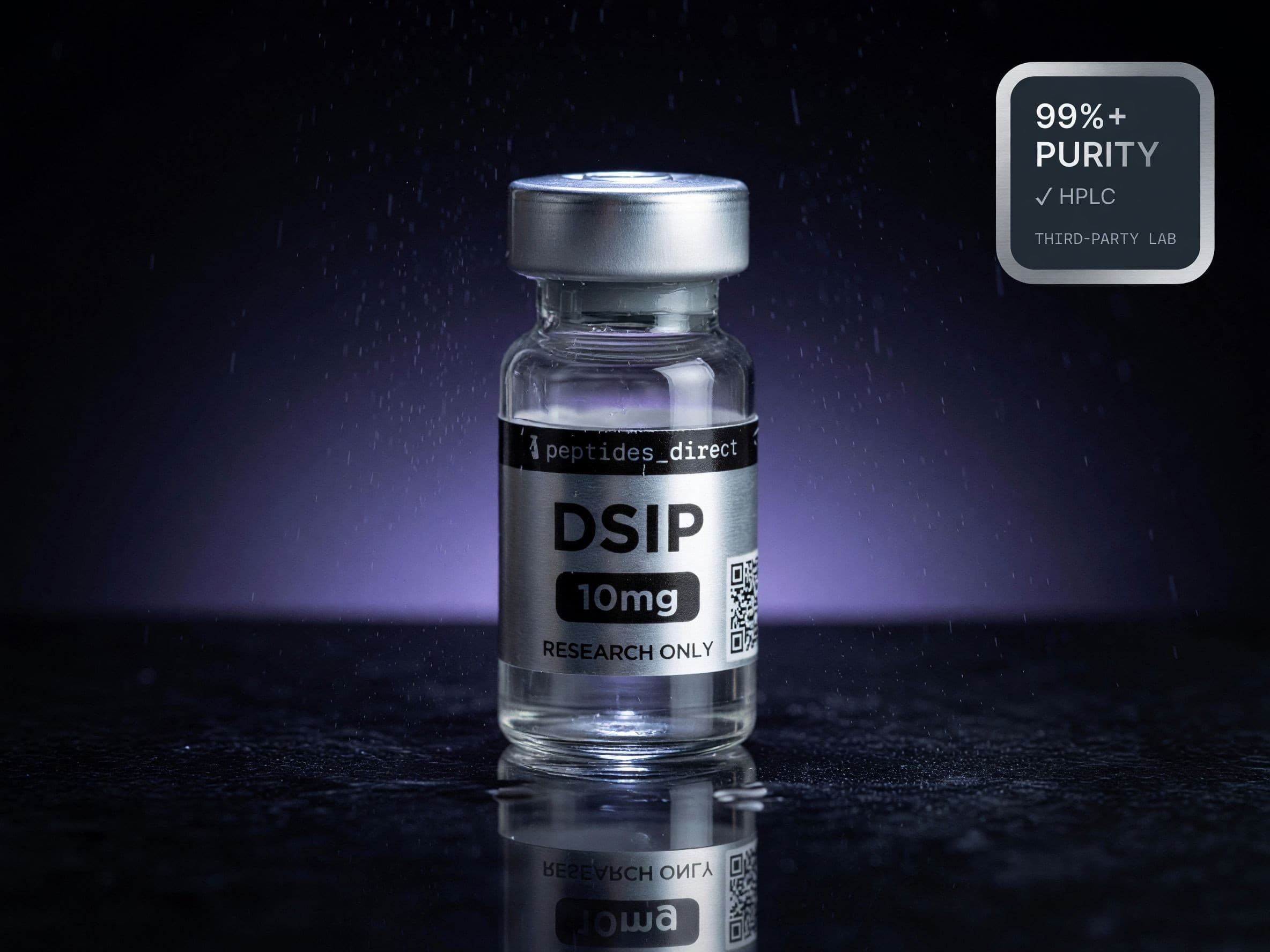
DSIP (Delta Sleep-Inducing Peptide) is a nonapeptide, Trp-Ala-Gly-Gly-Asp-Ala-Ser-Gly-Glu, isolated in 1977. No DSIP gene or receptor has ever been identified. Rodent work measures HPA-axis and antioxidant enzyme markers. Lyophilized powder, third-party CoA.
99.52%Third-party lab: Kovera LabsView COA€39.99
€49.99
−20%(€10.00)savedFor Research Use Only
This product is sold strictly for in-vitro research and laboratory use. Not intended for human consumption or any in-vivo application.
Payment Methods
Nonapeptide
DSIP is a nonapeptide with the sequence Trp-Ala-Gly-Gly-Asp-Ala-Ser-Gly-Glu, isolated in 1977 from the blood of rabbits during delta-wave EEG activity. That circumstance is where the name comes from.
Unresolved mechanism
After nearly fifty years of study, no DSIP gene and no single confirmed receptor have been identified (PMID 16539679), so there is no defined molecular target to reason from.
HPA-axis markers in rats
A rat model of emotional stress measured hypothalamic substance P and structural stress markers rather than a receptor readout (PMID 1382246).
Antioxidant enzyme readouts
Rat studies of cold and oxidative stress measure lipid peroxidation and the activity of SOD, catalase and glutathione peroxidase (PMID 11421812, PMID 21809625).
Very short half-life
Pharmacokinetic work gives intravenous half-lives of 4.0 minutes in dogs, 2.9 in monkeys and 2.0 in rats, at a clearance of about 30.7 ml/kg/min (PMID 6379493).
Regulatory status
Not an approved drug and not patented. As Emideltide, DSIP left the FDA 503A Category 2 list effective 22 April 2026, which is not a compounding clearance. A Pharmacy Compounding Advisory Committee review took place at the 23-24 July 2026 meeting.
Research areas
What is DSIP
DSIP is a nonapeptide with the sequence Trp-Ala-Gly-Gly-Asp-Ala-Ser-Gly-Glu. Schoenenberger and Monnier isolated it in 1977 from the blood of rabbits showing delta-wave EEG activity, and that circumstance, not an established function, is where the name Delta Sleep-Inducing Peptide comes from. A 2006 review in the Journal of Neurochemistry describes the underlying factor hypothesis as still unresolved and notes the possibility that a different, DSIP-like peptide accounts for some of the older animal findings (PMID 16539679).
DSIP is not an approved drug and is not patented. Under the pharmaceutical name Emideltide, covering both the acetate and the free-base form, it appeared on the FDA 503A Category 2 list for substances with significant safety concerns. The updated list published 15 April 2026 removed Emideltide from Category 2 effective 22 April 2026, as one of twelve peptides removed after their sponsors withdrew petitions. Removal from Category 2 is not by itself a compounding clearance: a Pharmacy Compounding Advisory Committee review took place at the 23-24 July 2026 meeting, and only addition to the 503A bulks list would open a compounding path.
We supply it as research-grade lyophilized powder with a batch-specific third-party certificate of analysis.
How it works
The honest answer is that the mechanism is unresolved. No DSIP gene and no single receptor have been identified in nearly fifty years of published work (PMID 16539679), so every statement about this peptide rests on observed readouts in model systems rather than on a defined molecular target.
At the level of the stress axis, a rat model of emotional stress measured hypothalamic substance P together with structural stress markers, adrenal and thymus tissue changes, rather than circulating hormone measurements (PMID 1382246). That distinction matters when reading secondary summaries, which often describe this work as a direct ACTH or cortisol measurement.
A second line of rodent findings is antioxidant. In rat studies of cold and oxidative stress, lipid peroxidation and the activity of superoxide dismutase, catalase and glutathione peroxidase were the measured endpoints (PMID 11421812). A longer rat study run over several months measured the same panel with ceruloplasmin added (PMID 21809625).
Pharmacokinetics sets a hard constraint on all of it: an enzyme-immunoassay study measured intravenous half-lives of 4.0 minutes in dogs, 2.9 in monkeys and 2.0 in rats, with clearance of about 30.7 ml/kg per minute (PMID 6379493). Whatever the downstream readouts depend on, it is not the parent peptide staying in circulation.
For reconstitution, the standard solvent in published protocols is bacteriostatic water.
Documentation
Material specification
Purity
Test method
Form
Typical storage (sealed)
Typical storage (reconstituted)
CoA
Selected research
- PMID 16539679
Delta sleep-inducing peptide (DSIP): a still unresolved riddle
J Neurochem, 2006; literature review, no DSIP gene or receptor identified - PMID 1382246
Delta sleep-inducing peptide as a factor increasing the content of substance P in the hypothalamus and the resistance of rats to emotional stress
Rat model; hypothalamic substance P and structural stress markers as endpoints - PMID 11421812
Regulation of free radical processes by delta-sleep inducing peptide in rat tissues under cold stress
Rat study; SOD, catalase, glutathione peroxidase and lipid peroxidation - PMID 21809625
[Mechanism of delta-sleep inducing peptide geroprotective activity]
Rat study over several months - PMID 6379493
Development of an enzyme immunoassay for delta sleep-inducing peptide (DSIP) and its use in the determination of the metabolic clearance rate of DSIP administered to dogs
Enzyme-immunoassay study; intravenous half-lives of 4.0, 2.9 and 2.0 minutes
Research use only
This material is sold strictly for in-vitro research and laboratory use. Not intended for human or animal consumption, medical, cosmetic, or household applications. Suitable only for professional laboratory environments.
Storage and stability
- Dry, lyophilized vials keep for months refrigerated, or up to 24 months frozen at -20°C.
- After reconstitution in bacteriostatic water, use within about 30 days at 2 to 8°C, and avoid repeated freeze-thaw.
Reviews
No reviews yet. Write the first one!
Only customers who ordered the product from us can leave a review; we verify this automatically against the order number. Every review submitted is published, regardless of star rating. Rewarded reviews from our coupon program are individually labelled.
Frequently Asked Questions
Technical data sheet
- CAS number
- 62568-57-4
- Molecular formula
- C₃₅H₄₈N₁₀O₁₅
- Molar mass
- 848.8 g/mol
- Type / receptor
- Delta sleep-inducing nonapeptide
- Form
- White lyophilized powder
- Solubility
- Bacteriostatic water (BAC)
- Storage
- -20°C for up to 24 months; 30 days at 2-8°C after reconstitution
Identity data from public chemical references (PubChem). Per-batch purity: see lab reports below.