NAD+ 2026: Aging, Brain Health and What the NMN Human Studies Really Show
NAD+ in a 2026 research overview: sirtuins, mitochondrial function, new data on brain aging, plus what the NMN human studies do and do not prove.
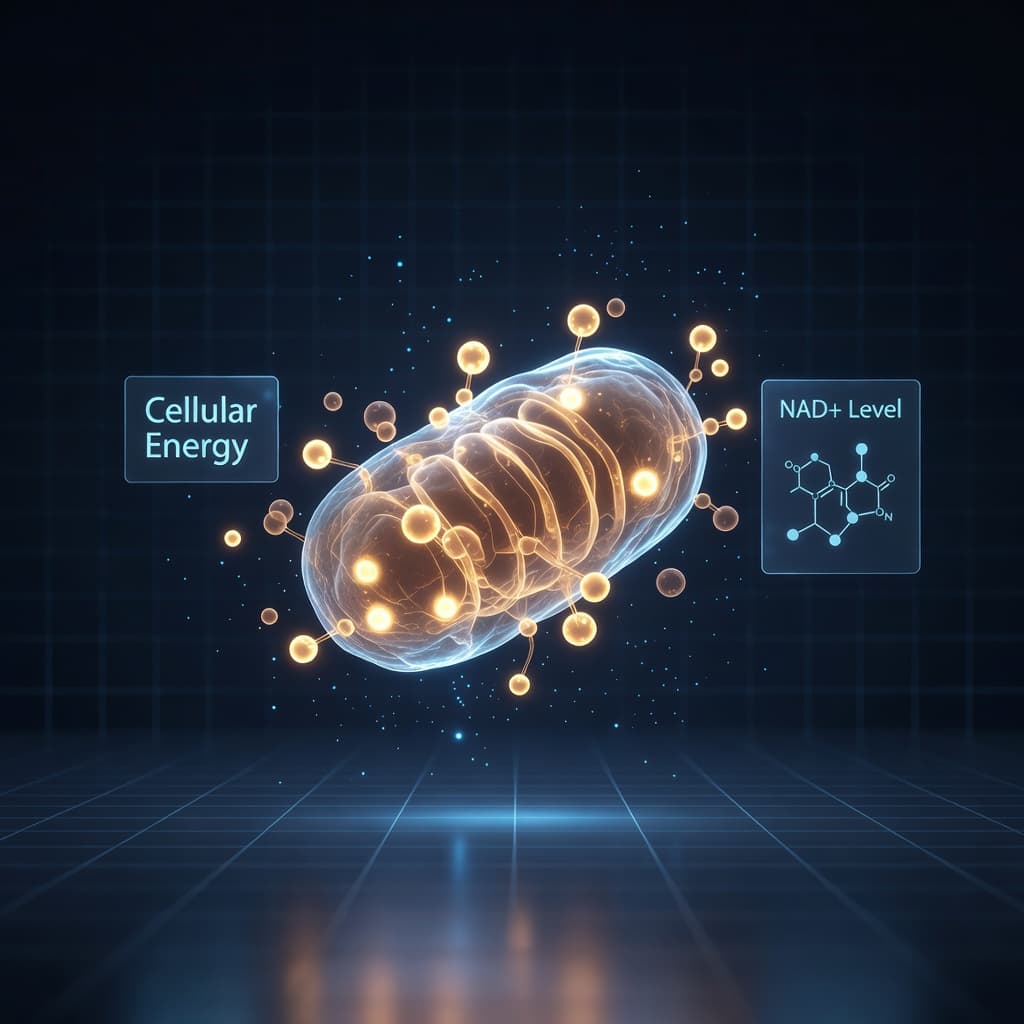
NAD+ (nicotinamide adenine dinucleotide) is one of the most discussed molecules in longevity research. It is a central coenzyme of energy metabolism and a substrate for enzyme families that govern DNA repair and the cellular stress response. The claim that NAD+ declines with age is what drives research interest in raising it again, and in 2026 that claim became more complicated: it still holds for several tissues, but a large human study found no decline at all in whole blood.
In 2026 the topic gained fresh attention, both through work on brain aging and through human studies of oral NAD+ precursors. This overview separates what is proven from what is still hypothesis, and names an important distinction between the studied forms.
TL;DR: NAD+ in 2026
Role: central coenzyme for mitochondria, substrate for sirtuins and PARP enzymes (energy metabolism, DNA repair). Age-related decline: tissue NAD+ decline is the basis of the restoration hypothesis, but it does not hold everywhere. A 2026 Nature Metabolism study across seven human cohorts found whole-blood NAD+ remarkably stable with age (PMID 42135539). Brain: work published in 2026 examines NAD+ augmentation in the context of Alzheimer's and Parkinson's, including brain pharmacokinetics. Human data: come predominantly from oral precursors (NMN, NR), not from injectable NAD+. NMN raises blood NAD+ levels and is well tolerated up to 900 mg/day. Important: most hard endpoints are not yet proven. Much remains mechanism and surrogate marker.
Why NAD+ Is at the Center at All
NAD+ fulfills two linked roles. First, it is an electron carrier in energy metabolism, indispensable for mitochondrial ATP production. Second, it is a substrate for sirtuins and PARP enzymes. Sirtuins modulate gene expression and the stress response, PARPs are involved in DNA repair. Both consume NAD+, which means DNA damage and stress place an additional burden on the supply.
With age, NAD+ levels fall in many tissues. The restoration hypothesis accordingly runs: if you raise NAD+ again, mitochondrial function, repair capacity and metabolic flexibility could be partly supported. That is a plausible and well-motivated hypothesis, but the jump from "raise levels" to "slow aging" is exactly the point where the evidence thins out.
The tissue qualifier matters more than it looks, because the most convenient place to measure NAD+ is exactly the place where the decline does not show up.
2026 correction: whole-blood NAD+ does not fall with age
A study published in Nature Metabolism in June 2026 (Trętowicz et al., Amsterdam UMC, PMID 42135539) measured NAD+ across seven independent human cohorts using a rigorously validated UHPLC-HRMS method built to account for real-world analytical variability. The result: whole-blood NAD+ stayed remarkably stable with age and across lifestyle interventions, while still rising in response to nicotinamide riboside supplementation, as expected. The authors conclude that their results "challenge the utility of blood NAD+ levels as a biomarker of ageing or lifestyle factors".
Read the scope precisely, because it is easy to overclaim in both directions. The study measured blood, not tissue. It does not refute the tissue-level decline that motivates the restoration hypothesis, and it does not show that precursors fail to do anything. What it does undercut is the widespread shorthand that a blood NAD+ number tells you how well you are ageing, and any marketing that rests on it.
Essential cellular coenzyme that declines with age. Powers energy metabolism in every cell, activates sirtuins (longevity genes), and supports DNA repair. A cornerstone molecule in aging and longevity research.
The Most Important Distinction: Injectable NAD+ vs. Oral Precursors
Here precision is decisive, and many popular texts blur it. The bulk of controlled human evidence concerns oral NAD+ precursors, above all NMN (nicotinamide mononucleotide) and NR (nicotinamide riboside). These molecules are metabolized to NAD+ in the body. Injectable NAD+ is a different route of administration, for which the controlled data situation is considerably thinner.
Important: Assign the Data Cleanly
When studies say "NAD+ raises the blood level," that usually refers to oral precursors such as NMN or NR. Findings on NMN cannot be transferred one to one to injectable NAD+. Anyone researching NAD+ should explicitly document the form, the route and the dose, otherwise results become incomparable.
What the NMN Human Studies Show
The most robust human evidence comes from randomized, placebo-controlled NMN studies. A multicenter, double-blind, dose-dependent study in healthy middle-aged adults found that NMN raises blood NAD+ levels and is safe and well tolerated up to 900 mg daily, with the highest efficacy around 600 mg daily (PMC9735188).
Another study in older men showed elevated NAD+ concentrations under chronic NMN administration and nominally significant improvements in gait speed and grip strength, a hint at possible effects against age-related muscle dysfunction (PMC9158788).
Methodology Note
"Nominally significant" means: an effect that reaches the statistical threshold but is not necessarily corrected for multiple testing. Such signals are encouraging but preliminary. Surrogate markers like the blood NAD+ level are also not the same as a clinical endpoint.
The Brain Thread in 2026
Newer and more speculative is the work on brain aging. In 2026, research reports described NAD+ augmentation in the context of neurodegenerative diseases such as Alzheimer's and Parkinson's, including pharmacokinetic studies of how NAD+ precursors reach blood and brain (ScienceDaily, March 2026).
The mechanistic link is clear: neurons are extremely energy-dependent, and mitochondrial dysfunction is a common denominator of many neurodegenerative processes. The path from this mechanism to a proven clinical benefit is, however, long and currently not complete.
NAD+ in the Context of Other Longevity Peptides
NAD+ is rarely considered in isolation. In longevity research, mitochondrial and senescence-oriented compounds appear alongside it, and these are represented in the catalog.
Mitochondrial-derived signaling peptide (16 amino acids) that mimics the effects of exercise at the cellular level. Activates AMPK, improves glucose uptake, and enhances fat metabolism - a key tool in metabolic and longevity research.
Mitochondria-targeted tetrapeptide (Elamipretide) that stabilizes cardiolipin and prevents ROS formation at the source.
MOTS-c is a mitochondria-encoded peptide linked to NAD+ metabolism and metabolic regulation, SS-31 targets the mitochondrial membrane and bioenergetics. The common bracket is the mitochondrial axis. More on the interplay of MOTS-c and NAD+ is in the post MOTS-c, Liver Protection and NAD+.
Practical Consequences for Lab Work
1. Document form and route. Injectable NAD+, NMN and NR are not interchangeable. Every tracking measurement should record the exact compound.
2. Separate surrogate from endpoint. An elevated blood NAD+ level is a surrogate marker. It is evidence of bioavailability, not of a functional benefit.
3. Mind the dose-response window. The NMN data point to a plateau (efficacy around 600 mg, safety up to 900 mg). More is not automatically better.
Further Reading
- Purchase page and product details: Buy NAD+
- Mitochondrial axis: MOTS-c, Liver Protection and NAD+
- Longevity peptides overview: Longevity Peptides Overview
Frequently Asked Questions
For research purposes only. This article summarizes published literature and research reports. It is not medical advice and is not an endorsement of any particular protocol.
Research context for English-speaking buyers
Most of our English-speaking customers ship to the UK, Ireland, Malta or other English-as-second-language EU territories. The regulatory picture differs per country.
- Relevant authorities
- MHRA (UK, post-Brexit), HPRA (Ireland, EU-aligned), FDA Section 503A bulks list (US, restricted Cat 2 status of several peptides as of 2026)
- Customs and VAT
- EU shipments include 19% VAT; UK shipments after Brexit are now extra-EU and may attract UK VAT plus a handling fee at import
- Typical shipping window
- EU 2-4 working days, UK 4-7 working days, other international 7-14 working days, depending on customs
Research-grade peptides shipped from our EU warehouse are sold for laboratory use only and are not authorised for human or veterinary therapeutic application in any of the destination jurisdictions. US customers should be aware that the FDA Section 503A bulks list classification (and the April 2026 reclassification of twelve compounds) only governs compounding pharmacies, not direct-to-researcher imports for non-clinical work. UK buyers should declare the consignment on import and may be asked for a research justification by HMRC. We provide a CoA per batch identified by colour code rather than serial number; customs sometimes asks for this document when clearing the parcel.