TB-500 vs Thymosin Beta-4: Why the Fragment vs Full-Length Distinction Matters for Research
TB-500 vs Thymosin Beta-4 explained: full-length 43-aa peptide vs fragments, the actin-binding domain and what our product actually is.
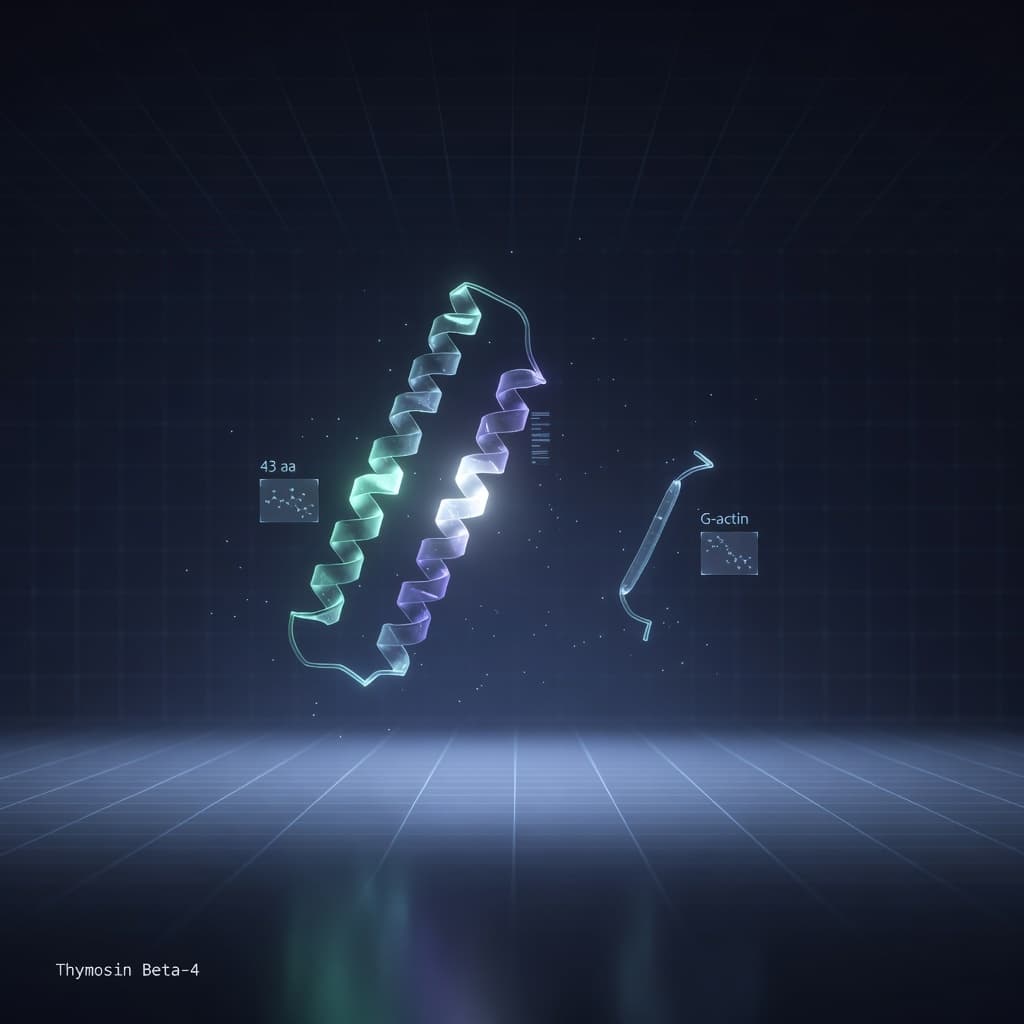
"TB-500" is not a molecule. It is a name, and the research-peptide market uses that name for two different things: sometimes the full 43-amino-acid Thymosin Beta-4 protein, sometimes a short seven-amino-acid synthetic fragment of it. Both are real, both show up in the literature, and they are not interchangeable. If you are citing a study, comparing a CoA, or just trying to understand what is in the vial in front of you, the distinction is the whole ballgame.
TL;DR: What TB-500 actually is
Thymosin Beta-4 (Tβ4) is a naturally occurring 43-amino-acid, N-terminally acetylated peptide, molecular weight approximately 4,963 Da, CAS 77591-33-4. The doping-control and veterinary literature coined "TB-500" specifically for a short synthetic fragment, the N-acetylated heptapeptide Ac-LKKTETQ (residues 17-23), which contains the actin-binding motif. Many research-peptide vendors (including this one) sell and CoA-verify the full 43-aa protein under the same "TB-500" label. The name alone does not tell you which molecule you are holding. Our TB-500 is the full-length 43-amino-acid Thymosin Beta-4, confirmed by third-party Janoshik CoA on mass and sequence, not the short fragment. This is research material for laboratory use only. Nothing here is a human dosing recommendation.
For research purposes only
This article discusses research peptides for laboratory and in-vitro use. It is not medical advice, not a treatment recommendation, and not an instruction for human or animal administration. Any figures cited from the literature describe what was measured in a study, not a usage guideline.
The founding sequence: what Thymosin Beta-4 actually is
Thymosin Beta-4 (Tβ4) was first sequenced in 1981 by Low, Hu and Goldstein, who isolated it from bovine thymus and published the complete 43-amino-acid sequence [PMID 6940133]. That paper is the reference point for what "full-length Tβ4" means: 43 residues, N-terminally acetylated (Ac-Ser-Asp-Lys-Pro...), molecular weight 4,982 Da in the founding paper (later literature commonly cites approximately 4,963 Da for the free acid), isoelectric point around 5.1, CAS number 77591-33-4.
Tβ4 turned out to be the founding member of the beta-thymosin family. Its core, defining biochemical function was worked out over the following decade: Tβ4 binds monomeric G-actin in a 1:1 complex, buffering the cytoplasmic actin pool and regulating how fast actin polymerizes into filaments (F-actin). Sanders, Goldstein and Wang confirmed Tβ4 as the principal G-actin-sequestering peptide operating in living cells, directly tying it to actin polymerization dynamics [PMID 1584803]. That single mechanism, actin sequestration, sits upstream of almost everything else studied about Tβ4: cell shape, cell migration, and by extension wound repair and vessel formation.
This is the molecule this article calls "full-length Thymosin Beta-4." It is also, per our CoA, what we sell as TB-500.
Where "TB-500" as a fragment name comes from
The name "TB-500" did not originate in the Goldstein/Kleinman/Sosne academic lineage that built the Tβ4 mechanistic case. It originated in veterinary and anti-doping chemistry. Ho and colleagues published a doping-control analytical method in 2012 for detecting "TB-500, a synthetic version of an active region of thymosin beta 4," in equine urine and plasma by liquid chromatography-mass spectrometry [PMID 23084823]. Their target analyte was not the 43-aa protein. It was the short, N-acetylated heptapeptide Ac-LKKTETQ, corresponding to residues 17-23 of the parent sequence, the internal segment that carries the actin-binding activity. Their method could detect this fragment down to 0.02 ng/mL in plasma and 0.01 ng/mL in urine.
That paper is, as far as the indexed literature shows, the historical origin of "TB-500" as shorthand for the short synthetic fragment rather than the full protein. It spread from racing and veterinary contexts into the retail research-peptide market, where it is now used inconsistently: some vendors mean the fragment, others mean the full-length protein, and the product label alone does not tell you which. A more recent 2025 doping-control paper continues to treat this distinction as analytically live, differentiating full-length Tβ4 misuse from fragment or synthetic-impurity signatures in equine plasma [PMID 39314109], which tells you regulators still find the fragment-versus-full-length question relevant today, not just as a historical footnote.
Why does the fragment matter biologically in the first place? Because the actin-binding activity really does localize to a short internal region. Philp, Huff, Gho, Hannappel and Kleinman mapped the actin-binding site to the internal heptapeptide 17LKKTETQ23 and showed that this short synthetic peptide alone, isolated from the rest of the molecule, can promote endothelial cell migration in vitro and vessel sprouting in an ex vivo chick aortic-arch assay [PMID 14500546]. So the fragment is not a fabrication, it is a real, independently active piece of the parent protein. That is exactly why it got its own name and its own doping-control assay.
Fragment or full-length: they are not interchangeable
Here is the part that gets lost when "TB-500" is treated as a single fixed thing: fragments and the intact 43-aa protein do not reproduce the same activity profile.
Hannappel and Wartenberg directly compared full-length Tβ4 against various Tβ4 fragments and Tβ4-like peptides. Short fragments did not reproduce full actin-sequestering function to the same degree as the intact molecule [PMID 8471179]. Sosne, Qiu, Goldstein and Wheater went further, mapping which specific short internal sequences of Tβ4 reproduce which specific bioactivities: actin binding and angiogenesis map largely to the LKKTETQ region, while anti-inflammatory and other effects map to other internal motifs [PMID 20179146]. Their conclusion is the important one for anyone reading Tβ4 literature critically: Tβ4's overall biological profile is distributed across multiple regions of the full sequence. No single fragment reproduces the whole activity picture of the intact peptide, it is not simply "LKKTETQ plus inert padding."
There is also a second, unrelated fragment worth knowing about, because it is easy to confuse with the LKKTETQ region: Ac-SDKP. This is the N-acetylated tetrapeptide corresponding to residues 1-4 of Tβ4 (Ac-Ser-Asp-Lys-Pro), released by enzymatic cleavage of the N-terminus by prolyl oligopeptidase. Pradelles and colleagues characterized Ac-SDKP as a negative regulator of hematopoietic stem cell proliferation, distributed across mouse tissues [PMID 1915845], and it has its own separate literature on antifibrotic effects. Leeanansaksiri and colleagues directly compared full-length Tβ4 against its Ac-SDKP fragment on mast cells and found overlapping but non-identical effects [PMID 17191900]. Ac-SDKP is not the same fragment as the actin-binding LKKTETQ heptapeptide, and it is not what most vendors mean when they say "TB-500," but it illustrates the same underlying point: this 43-aa protein has multiple biologically distinct sub-regions, and citing "a Tβ4 fragment study" without specifying which fragment is imprecise.
A citation only transfers if the molecule matches
If a study used the full 43-aa protein, its findings describe the full protein, not a short fragment sold under the same brand name, and vice versa. Dosing, safety data, and outcome percentages from one form do not automatically apply to the other. The only way to know which molecule a given research product actually is, is a CoA with mass and sequence data, not the product name on its own.
What the full-length protein literature actually shows
Because our product is the full-length 43-aa protein, the relevant evidence base is the Goldstein/Kleinman/Sosne body of work built around the intact molecule, not the doping-control fragment literature.
In rodent dermal wound models, full-length Tβ4 (applied topically and intraperitoneally) increased reepithelialization by 42 percent over saline controls at day four, and up to 61 percent by day seven, along with increased collagen deposition and greater keratinocyte migration in a companion in vitro assay [PMID 10469335]. A later review by Kleinman and Sosne consolidated the mechanistic picture behind that result: keratinocyte and fibroblast migration, angiogenesis, reduced local inflammation, and reduced scarring [PMID 27450738].
Angiogenesis is a recurring theme independent of skin. Smart, Rossdeutsch and Riley reviewed Tβ4's role in endothelial migration, adhesion, tubule formation and aortic ring sprouting, with translational interest in cardiac repair after myocardial injury through activation of epicardial progenitor cells and support for neovascularization [PMID 17632766]. That cardiac-repair interest is not uniformly supported: a separate large-animal pig ischemia-reperfusion study found no cardioprotective effect at 6 mg/kg IV, a negative result that runs counter to the positive cardiac-repair signal described above [PMID 27199757].
The eye is where the full-length molecule has gone furthest into human testing. Sosne, Qiu and Kurpakus-Wheater reviewed Tβ4's corneal actions: promoting corneal epithelial cell migration, decreasing inflammation, reducing apoptosis, and upregulating laminin-5, a subepithelial adhesion protein [PMID 19668473]. In a mouse alkali-injury corneal model, topical full-length Tβ4 reduced matrix metalloproteinase activity (MMP-2 and MMP-9) and neutrophil infiltration compared with a PBS control [PMID 15980226]. Philp and Kleinman's broader animal-data review extends this same molecule across tissue types: dermal wounds, cornea, cardiac tissue, hair follicles and nerve regeneration models [PMID 20536453].
That translational path led to RGN-259, a 0.1 percent topical ophthalmic solution of full-length Tβ4, developed for dry eye and neurotrophic keratopathy, and reviewed by Sosne and colleagues as the field moved toward human ophthalmic trials [PMID 20536468]. The strongest human dataset that exists anywhere for this molecule is the Phase III SEER-1 trial of RGN-259 in neurotrophic keratopathy, published in 2022: 18 patients (10 treated, 8 placebo), dosed five times daily. Complete corneal healing by day 29 occurred in 60 percent of treated patients (6 of 10) versus 12.5 percent of placebo patients (1 of 8). Fisher's exact test on that comparison was not significant (p=0.0656), but an ad hoc chi-square test was (p=0.0400), with a 95 percent confidence interval on the difference of 9.5 to 85.5 percent; healing maintenance at day 43 reached significance (p=0.0359). Adverse events were mostly ocular and mild, with only one treatment-related event and no serious treatment-related events [PMID 36613994].
Read the trial statistics honestly
An 18-patient trial with a borderline primary-endpoint result by one statistical test and a significant result by a different, ad hoc test is a real but fragile signal, not a settled finding. RGN-259 carries FDA Orphan Drug Designation for neurotrophic keratopathy, which is a development incentive, not marketing approval. Neither RGN-259 nor any Tβ4-based product is approved by the FDA or the EMA for any indication. A subsequent Phase III trial in the same program is reported to have missed its primary corneal-healing endpoint. This is genuinely still an open research question, not a resolved one.
What our TB-500 is, and what it is not
Identity
Not the fragment
Verification
Scope
EU research framing vs the fragment-driven doping narrative
The "TB-500" name, in its fragment sense, originates in the veterinary and anti-doping corner of the literature, which is a different molecule with a different, thinner evidence base than the full-length protein. Our positioning is deliberately the opposite: full-length, CoA-verified, cited against the mechanistic and clinical literature that actually used the intact 43-aa molecule.
BPC-157 is sold on its own and also pre-combined with TB-500 in a single vial, informally known as the "Wolverine" pairing, for researchers who want to reconstitute one vial instead of two. The related products below cover single-vial combinations and broader multi-peptide panels that include TB-500.
Full-length 43-amino-acid Thymosin Beta-4, a naturally occurring repair protein, independently confirmed by a third-party CoA from Janoshik. Promotes cell migration and new blood vessel formation for systemic tissue healing. Especially researched for muscle, tendon, and cardiac repair.
Gastric pentadecapeptide (15 amino acids) known for exceptional tissue repair properties. Promotes wound healing, angiogenesis, and cytoprotection across tendons, muscles, gut, and nerves. Over 30 years of preclinical research.
The Wolverine Stack: BPC-157 + TB-500 in equal parts in one vial (50/50: 10mg = 5mg each, 20mg = 10mg each). The most researched healing peptide duo for tissue repair, tendon recovery, and systemic regeneration. Batch-specific Janoshik COA.
3-in-1 skin peptide blend: GHK-Cu 50mg + BPC-157 10mg + TB-500 10mg. Targets collagen synthesis, tissue regeneration, and skin repair for comprehensive dermatological research.
4-in-1 anti-aging peptide blend: GHK-Cu 50mg + BPC-157 10mg + TB-500 10mg + KPV 10mg. Targets collagen synthesis, tissue regeneration, skin repair, and anti-inflammatory pathways.
Tissue repair, wound healing, and recovery peptides
Choosing by research goal
Actin-cytoskeleton and cell-migration mechanism research
BPC-157 plus TB-500 combination vial research
Frequently asked questions
The peptides discussed in this article are supplied strictly as research chemicals for laboratory and in-vitro use. Nothing here is medical advice, a treatment claim, or an instruction for human or animal administration.
Research context for English-speaking buyers
Most of our English-speaking customers ship to the UK, Ireland, Malta or other English-as-second-language EU territories. The regulatory picture differs per country.
- Relevant authorities
- MHRA (UK, post-Brexit), HPRA (Ireland, EU-aligned), FDA Section 503A bulks list (US, restricted Cat 2 status of several peptides as of 2026)
- Customs and VAT
- EU shipments include 19% VAT; UK shipments after Brexit are now extra-EU and may attract UK VAT plus a handling fee at import
- Typical shipping window
- EU 2-4 working days, UK 4-7 working days, other international 7-14 working days, depending on customs
Research-grade peptides shipped from our EU warehouse are sold for laboratory use only and are not authorised for human or veterinary therapeutic application in any of the destination jurisdictions. US customers should be aware that the FDA Section 503A bulks list classification (and the April 2026 reclassification of twelve compounds) only governs compounding pharmacies, not direct-to-researcher imports for non-clinical work. UK buyers should declare the consignment on import and may be asked for a research justification by HMRC. We provide a CoA per batch identified by colour code rather than serial number; customs sometimes asks for this document when clearing the parcel.