What a Certificate of Analysis Does Not Test: Our 58 Reports, Counted Honestly
Identity and purity are on all 58 reports on our own page. Microbial and heavy-metal testing are on only three. We counted every report to show exactly where the gap is.
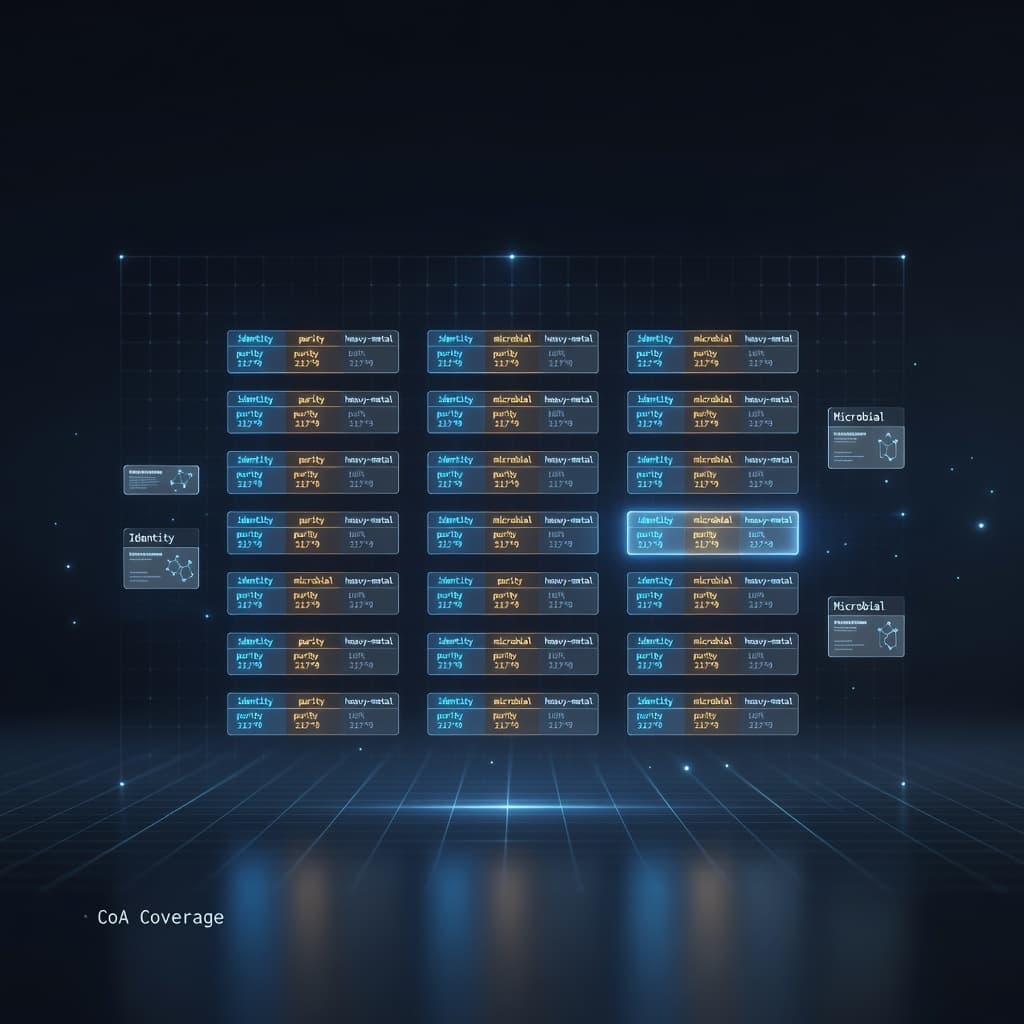
"Third-party tested" is a reassuring phrase, and a certificate showing 99% purity is the proof pinned to it. Purity is real information. It is also a narrow slice of what a certificate could cover, and the slices that get left out are the ones that matter for a material you are handling.
Rather than argue this in the abstract, we counted. Every certificate on our own lab reports page was tallied across the dimensions a CoA can carry. The result is a clear picture of our own page, drawn from our own data, not a competitor's.
TL;DR: what the count shows
58 reports across 30 products. Every one confirms identity and purity. Content (mg) is on 57 of 58. Almost every report also states how much peptide was measured, not just how pure it was. Microbial and heavy-metal testing appear on 3 reports. Only the three we commissioned ourselves from an independent lab carry them. "Third-party tested" is three different things. 43 of the 58 were commissioned by the manufacturer, 12 came from the community, and 3 by us. Absence of a test is not evidence of a problem. It is absence of that specific data, which is exactly why knowing what is missing matters.
Six dimensions a certificate can measure
A certificate of analysis is a container, and different labs fill it to different depths. The dimensions worth separating:
- Identity confirms the substance is the peptide it claims to be, usually by mass and sometimes by a spectral or retention-time match.
- Purity is usually reported as an HPLC area percentage: the target peak's share of the total integrated detector response under that method, not a direct mass fraction of everything in the vial. We cover how that number is built from a chromatogram separately.
- Content is the quantity in milligrams: how much peptide is actually in the vial, which is a different question from how pure it is.
- Microbial testing cultures the sample for bacteria, yeast and mould.
- Endotoxin measures bacterial cell-wall fragments, which a sterile-filtered but previously contaminated sample can still contain.
- Heavy metals screens for elemental impurities such as lead, arsenic, cadmium and mercury.
The first three describe what the molecule is. The last three describe whether anything unwanted came along with it. On our own page, as the count below shows, all 58 cover identity and purity, 57 include content, four include at least one of the last three dimensions, and three include all six. These are the six dimensions we counted; a certificate can also report others, such as residual solvents, moisture or counterion content.
Our own 58 reports, counted dimension by dimension
Here is the actual tally from our lab reports page, grouped by the lab that issued each report:
- Reports
- 43
- Identity
- 43
- Purity
- 43
- Content
- 42
- Microbial
- 0
- Endotoxin
- 0
- Heavy metals
- 0
- Reports
- 7
- Identity
- 7
- Purity
- 7
- Content
- 7
- Microbial
- 0
- Endotoxin
- 0
- Heavy metals
- 0
- Reports
- 3
- Identity
- 3
- Purity
- 3
- Content
- 3
- Microbial
- 3
- Endotoxin
- 3
- Heavy metals
- 3
- Reports
- 3
- Identity
- 3
- Purity
- 3
- Content
- 3
- Microbial
- 0
- Endotoxin
- 0
- Heavy metals
- 0
- Reports
- 2
- Identity
- 2
- Purity
- 2
- Content
- 2
- Microbial
- 0
- Endotoxin
- 1
- Heavy metals
- 0
- Reports
- 58
- Identity
- 58
- Purity
- 58
- Content
- 57
- Microbial
- 3
- Endotoxin
- 4
- Heavy metals
- 3
Read down the columns. Identity and purity are universal: all 58 reports carry both. Content is nearly universal, on 57 of 58. Then the coverage collapses. Microbial testing appears on exactly 3 reports. Heavy-metal screening, on exactly 3. Endotoxin, on 4. And the three reports carrying both microbial and heavy-metal results are the same three: the ones we commissioned ourselves.
The three deepest reports are the ones we commissioned
The only certificates on our page that culture for microbial contamination and screen for heavy metals are the three we commissioned from Liquilabs, on our GLOW blend, our CJC-1295/Ipamorelin blend, and our tirzepatide. Those are also the only three where the Client field on the certificate says Peptidesdirect.io. We did not commission microbial testing on the rest, and we do not pretend the manufacturer reports contain it. The honest version of "third-party tested" is that a third-party lab ran an analysis, and on 53 of 58 reports that analysis was identity, purity and content, with no contamination panel. One more report stops at identity and purity, one adds an endotoxin figure, and only the three Liquilabs reports carry all six dimensions we counted.
What a missing test means, and what it does not
This is where fairness matters more than scoring points. A certificate without a microbial or heavy-metal panel is not evidence that the vial is contaminated. It is evidence that the certificate does not report that test. Those are different statements, and conflating them is its own kind of dishonesty.
Two things follow, and both are worth stating plainly:
- Absence of data is not presence of a problem. None of the 43 manufacturer-commissioned reports on our page carries a microbial or elemental result. That silence tells you what the certificate does not report, not what is wrong.
- Knowing what is missing is the actual skill. A reader who understands that a 99.5% purity figure says nothing about endotoxin will not mistake one for the other. The point of counting is not to alarm, it is to calibrate what a given certificate does and does not license you to conclude.
None of these products are approved medicines, and none of this is a safety assessment for any use in a person. A CoA, however deep, is a materials-quality document about a research chemical.
"Third-party tested" decomposes into three different claims
The phrase hides a distinction that changes how much weight the certificate carries. On our own 58 reports:
- 43 were commissioned by the manufacturer. A third-party lab did the analysis, but the manufacturer commissioned it, not an independent party. The lab is independent; the commissioning is not. We walk through exactly how to read that in a real certificate, field by field.
- 12 are labelled community-submitted. These reports came to us from the community rather than being commissioned by us. The label does not by itself establish who sent the sample or how it was handled, so we publish them as community-submitted and weight them accordingly.
- 3 were commissioned by us. The Liquilabs reports above, the only ones where the certificate's Client field says Peptidesdirect.io.
We publish all three categories and label which is which, rather than folding them into one "third-party tested" badge. That labelling is the point: it lets you weight each certificate for yourself instead of taking the phrase at face value.
Products and Categories Referenced
The three reports that cover all six counted dimensions belong to these products, and every certificate counted above is on our lab reports page.
GIP/GLP-1/Glucagon agonists and metabolic pathways
3-in-1 skin peptide blend: GHK-Cu 50mg + BPC-157 10mg + TB-500 10mg. Targets collagen synthesis, tissue regeneration, and skin repair for comprehensive dermatological research.
A first-in-class dual GIP and GLP-1 receptor agonist, and one of the most extensively studied compounds in modern metabolic and weight-regulation research. Supplied as a lyophilised research peptide with a per-batch certificate of analysis, for laboratory and in-vitro use only.
2-in-1 growth hormone stack: CJC-1295 no-DAC (Modified GRF 1-29) + Ipamorelin, available as a 10 mg blend vial (5 mg + 5 mg co-lyophilized) or as the 20 mg option with two separately sealed single vials (10 mg + 10 mg). The CJC-1295 component is the short-acting no-DAC variant (about 30 minute half-life), not the long-acting DAC form. Stimulates natural GH release through two different pathways for amplified, more physiological growth hormone pulses.
Products with a we-commissioned lab report
3-in-1 skin peptide blend: GHK-Cu 50mg + BPC-157 10mg + TB-500 10mg. Targets collagen synthesis, tissue regeneration, and skin repair for comprehensive dermatological research.
A first-in-class dual GIP and GLP-1 receptor agonist, and one of the most extensively studied compounds in modern metabolic and weight-regulation research. Supplied as a lyophilised research peptide with a per-batch certificate of analysis, for laboratory and in-vitro use only.
2-in-1 growth hormone stack: CJC-1295 no-DAC (Modified GRF 1-29) + Ipamorelin, available as a 10 mg blend vial (5 mg + 5 mg co-lyophilized) or as the 20 mg option with two separately sealed single vials (10 mg + 10 mg). The CJC-1295 component is the short-acting no-DAC variant (about 30 minute half-life), not the long-acting DAC form. Stimulates natural GH release through two different pathways for amplified, more physiological growth hormone pulses.
Frequently Asked Questions
FOR RESEARCH USE ONLY. Not for human consumption. Nothing in this article is medical advice or a therapeutic claim. A certificate of analysis, including any microbial, endotoxin or heavy-metal panel, describes material properties of a research chemical and is not a safety assessment for any use in humans.
Research context for English-speaking buyers
Most of our English-speaking customers ship to the UK, Ireland, Malta or other English-as-second-language EU territories. The regulatory picture differs per country.
- Relevant authorities
- MHRA (UK, post-Brexit), HPRA (Ireland, EU-aligned), FDA Section 503A bulks list (US, restricted Cat 2 status of several peptides as of 2026)
- Customs and VAT
- EU shipments include 19% VAT; UK shipments after Brexit are now extra-EU and may attract UK VAT plus a handling fee at import
- Typical shipping window
- EU 2-4 working days, UK 4-7 working days, other international 7-14 working days, depending on customs
Research-grade peptides shipped from our EU warehouse are sold for laboratory use only and are not authorised for human or veterinary therapeutic application in any of the destination jurisdictions. US customers should be aware that the FDA Section 503A bulks list classification (and the April 2026 reclassification of twelve compounds) only governs compounding pharmacies, not direct-to-researcher imports for non-clinical work. UK buyers should declare the consignment on import and may be asked for a research justification by HMRC. We provide a CoA per batch identified by colour code rather than serial number; customs sometimes asks for this document when clearing the parcel.