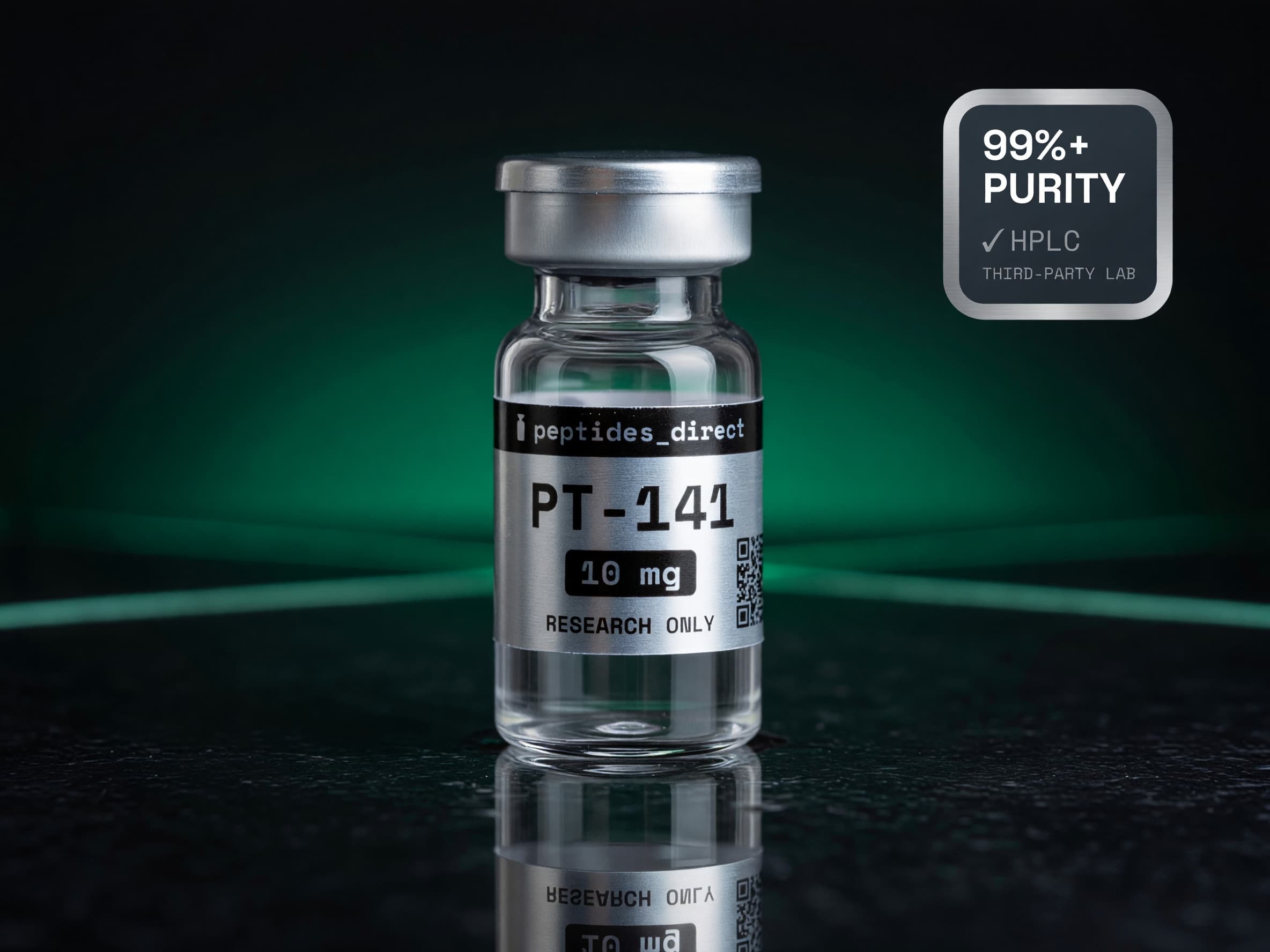
PT-141
Cyclic heptapeptide (bremelanotide) that acts as a melanocortin receptor agonist at MC3R and MC4R in the central nervous system. The active metabolite of Melanotan-II, studied for sexual-function endpoints via a central rather than vascular pathway.
99.91%Third-party lab: JanoshikView COA€33.99
€37.99
−11%(€4.00)savedFor Research Use Only
This product is sold strictly for in-vitro research and laboratory use. Not intended for human consumption or any in-vivo application.
Payment Methods
Melanocortin receptor agonist
Acts on melanocortin receptors, with research attention focused on MC3R and MC4R in the central nervous system.
Cyclic heptapeptide
A ring-shaped peptide of seven amino acids, chemically the active metabolite of the melanocortin analogue Melanotan-II.
Central, not vascular
Studied for signalling in the hypothalamus, a mechanism described in the literature as central rather than acting on blood vessels.
Clinically studied compound
Unusually for this category, bremelanotide has been through randomised, placebo-controlled clinical trials.
No EU marketing authorisation
Authorised in the United States under a brand name, but not approved as a medicinal product in the EU. Supplied strictly as a research material.
Lyophilized powder
Supplied freeze-dried, the standard form used across the published research.
Research areas
What is PT-141
PT-141, also called bremelanotide, is a synthetic cyclic peptide built from seven amino acids arranged in a ring. Chemically it shares the same seven residues as Melanotan-II and differs only in that the C-terminal amide of Melanotan-II is hydrolysed to a free acid in bremelanotide, which was identified as its active metabolite.
The peptide came out of melanocortin research at the University of Arizona and was developed further by Palatin Technologies. Unlike most compounds in this category, bremelanotide went through the full clinical development path, including randomised, placebo-controlled Phase 3 trials, and holds a marketing authorisation in the United States for a specific indication in premenopausal women.
There is no EU marketing authorisation for bremelanotide. We supply it as a lyophilized (freeze-dried) powder for laboratory research only, not as a medicine.
How it works
Bremelanotide is a melanocortin receptor agonist. The melanocortin system is a family of five receptors (MC1R to MC5R) sitting at the centre of several regulatory circuits: pigmentation, inflammation, energy balance and sexual function. Bremelanotide is active at several of them, and the research attention sits on MC3R and MC4R.
The distinction the literature keeps returning to is where it is thought to act, not whether the effect is proven in humans. Research compounds targeting PDE5 work on vascular smooth muscle and change blood flow; bremelanotide is not that kind of mechanism. Preclinical work implicates melanocortin, MC4R-linked neural pathways in the hypothalamus rather than a direct vascular action, and animal studies show activation of MC4R in hypothalamic circuits altering signalling associated with sexual behaviour independently of the vascular route. The mechanism behind the effects seen in human clinical trials, however, is not established: the central, MC4R-linked pathway is the leading hypothesis drawn from preclinical work, not a demonstrated human mechanism.
Its relationship to Melanotan-II explains part of the receptor profile. Melanotan-II is a broad melanocortin agonist with strong MC1R activity, and MC1R is the receptor that drives pigmentation. Bremelanotide differs structurally at the C-terminus and shows comparatively less of that pigmentation-driving activity, but the effect is reduced, not absent: focal hyperpigmentation was reported in the clinical development programme after repeated daily dosing above the approved regimen (PMID 35147466). This is part of why the two peptides continue to be studied for different endpoints despite being closely related.
One caution that matters for interpreting the literature: bremelanotide, Melanotan-II and afamelanotide are three distinct chemical entities. Findings for one should not be transferred to the others.
Often studied alongside
Melanotan-II is the parent compound PT-141 derives from, and the two are routinely discussed together in melanocortin research.
The parent melanocortin peptide
Tanning peptide that activates melanin production in the skin. Stimulates melanocyte receptors for natural UV-free pigmentation. Also researched for appetite regulation and libido effects.
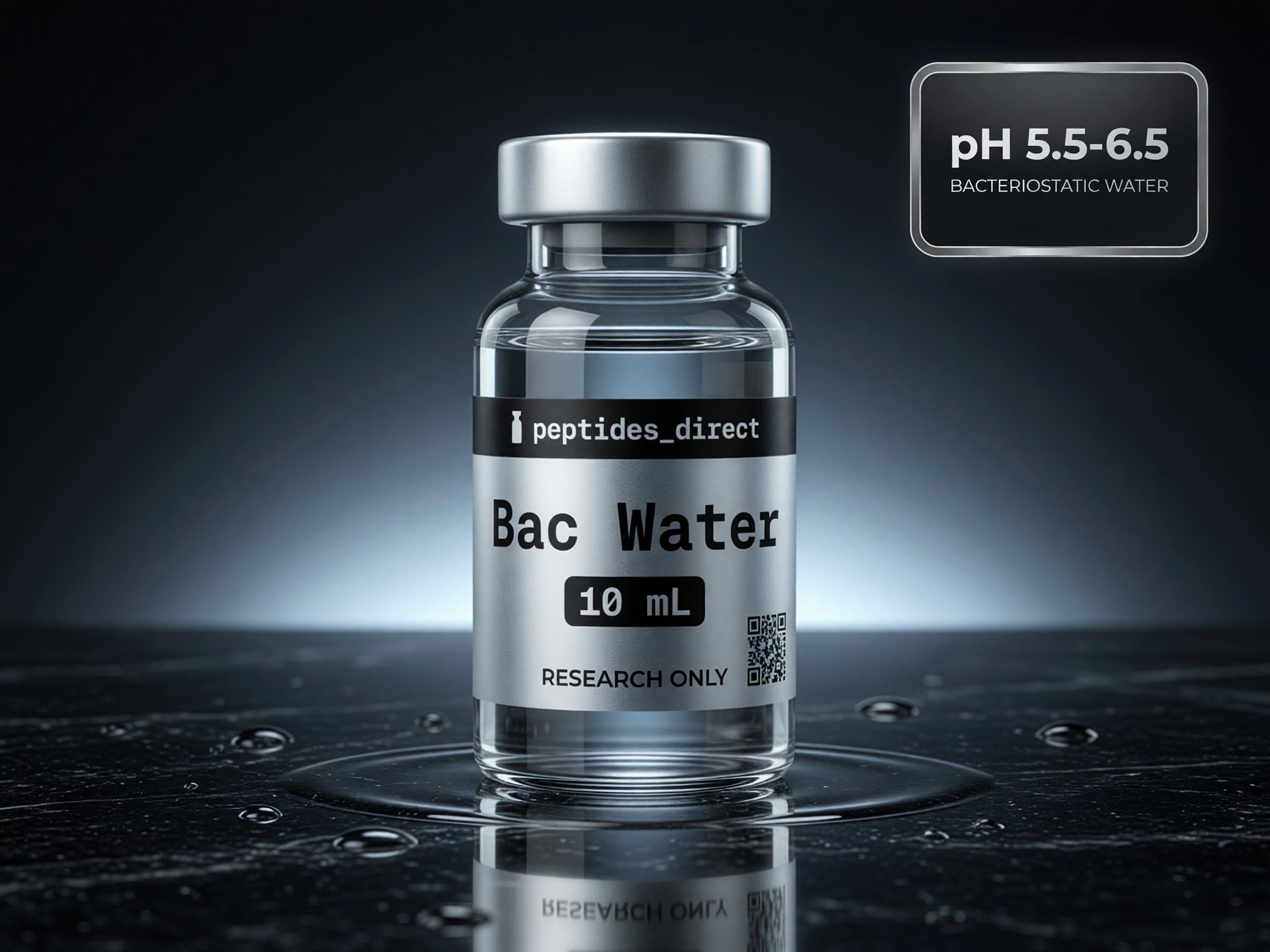
For reconstitution, the standard solvent used in published protocols is bacteriostatic or sterile water.
Standard solvent for reconstitution
USP-grade sterile water with 0.9% benzyl alcohol (near-neutral, pH 6.2 to 6.4) - the standard solvent for reconstituting lyophilized peptides. Essential accessory for any peptide research. Each vial is sealed and ready to use.
Documentation
Material specification
Purity
Test method
Form
Storage (sealed)
Storage (reconstituted)
CoA
Selected research
- PMID 12172010
Van der Ploeg LH et al. A role for the melanocortin 4 receptor in sexual function
Proc Natl Acad Sci U S A, 2002, mouse work with the non-peptide MC4R agonist THIQ, implicating neural pathways rather than direct action on penile smooth muscle - PMID 12851303
Molinoff PB et al. PT-141: a melanocortin agonist for the treatment of sexual dysfunction
Ann N Y Acad Sci, 2003, manufacturer-authored report of PT-141 activity at MC3R and MC4R and of hypothalamic neuronal activation in rats - PMID 31599840
Kingsberg SA et al. Bremelanotide for the Treatment of Hypoactive Sexual Desire Disorder: Two Randomized Phase 3 Trials
Obstet Gynecol, 2019, the two pivotal phase 3 trials, 1267 participants randomised, manufacturer-sponsored - PMID 35147466
Clayton AH et al. Safety Profile of Bremelanotide Across the Clinical Development Program
J Womens Health, 2022, the manufacturer's own integrated safety analysis, the source of the nausea, flushing and headache rates - PMID 33678061
Spielmans GI. Re-Analyzing Phase III Bremelanotide Trials for 'Hypoactive Sexual Desire Disorder' in Women
J Sex Res, 2021, independent re-analysis that reproduces the efficacy estimates but criticises selective outcome reporting and finds far higher adverse-event discontinuation than placebo - PMID 40543759
Toledo RG et al. Female Sexual Desire, Arousal, and Orgasmic Dysfunctions: A Systematic Review and Meta-Analysis of Treatment Options
J Minim Invasive Gynecol, 2026, independent systematic review and meta-analysis of treatment options - PMID 16412534
Hadley ME, Dorr RT. Melanocortin peptide therapeutics: historical milestones, clinical studies and commercialization
Peptides, 2006, traces the line from Melanotan-II to PT-141
Research use only
This material is sold strictly for in-vitro research and laboratory use. Not intended for human or animal consumption, medical, cosmetic, or household applications. Suitable only for professional laboratory environments.
Storage and stability
- Dry, lyophilized vials keep for months refrigerated, or up to 24 months frozen at -20°C.
- After reconstitution in bacteriostatic water, use within about 30 days at 2 to 8°C, and avoid repeated freeze-thaw.
Reviews
No reviews yet. Write the first one!
Only customers who ordered the product from us can leave a review; we verify this automatically against the order number. Every review submitted is published, regardless of star rating. Rewarded reviews from our coupon program are individually labelled.
Frequently Asked Questions
Frequently bought together
Complete your subcutaneous research workflow