Vendor Bac Water or Pharma-Grade? What 'USP' Certifies and What a CoA Cannot See
What the Hospira label and a certificate of analysis actually certify, why bacteriostatic water drifts out of spec, and why an outlier pH must be re-measured.
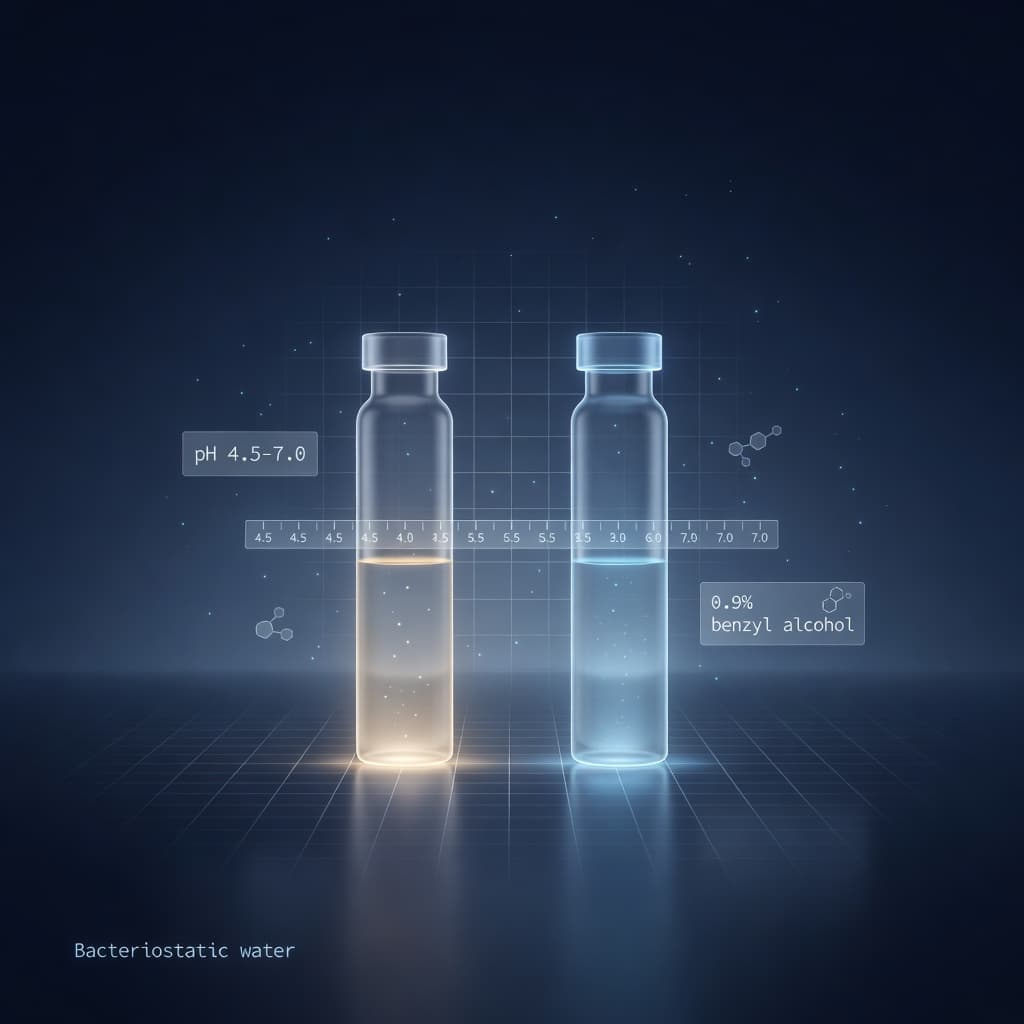
Bacteriostatic water looks like the simplest item on this shelf: a clear liquid, a printed label, a lot number. It is also the one item where "looks right" and "is right" can diverge unseen, because two documented ways a vial can drift out of spec, an oxidizing preservative and an alkaline-leaching glass container, are chemistry, not appearance. This article compares what the US pharmacopoeial standard actually certifies, what a research-vendor label or certificate of analysis can and cannot prove, and what a community market survey found when someone checked. It does not cover reconstitution volumes or injection technique; those live in our other water articles, linked throughout.
TL;DR: what pharma-grade certifies, and what a CoA cannot see
Pharma-grade means tested, not just labeled. The Hospira label states 0.9% or 1.1% benzyl alcohol and a pH of 5.7 (4.5 to 7.0), and the USP monograph behind it requires sterility testing (USP <71>), an endotoxin limit of not more than 0.5 USP Endotoxin Units per mL, and that same pH range.
A certificate of analysis is a snapshot, not a guarantee. It reports what was tested on one lot; a 2025 community market survey of 12 commercial bacteriostatic waters found only two products passed every parameter tested.
A vial can drift out of spec in two directions. The benzyl alcohol preservative can oxidize and push pH down; an unbuffered water sitting in lower-grade glass can leach sodium and push pH up.
A bench pH reading far outside the range means re-measure, not conclude. Unbuffered water gives noisy pH readings; the 2023 Journal of Pharmaceutical Sciences paper explains why, and the same caveat applies to any figure quoted in a survey or on a forum.
What you can verify is documentation, not appearance. A lot number, a stated pH result, and sterility and endotoxin figures, covered in the checklist below.
Research use only
Bacteriostatic water is sold here as a laboratory reagent for reconstituting other research materials, not as a medicine, not for administration to a person or animal. This article covers chemistry, standards, and documentation only: no reconstitution volumes, injection technique, dosing, or other use instructions.
USP-grade sterile water with 0.9% benzyl alcohol (near-neutral, pH 6.2 to 6.4) - the standard solvent for reconstituting lyophilized peptides. Essential accessory for any peptide research. Each vial is sealed and ready to use.
Dilute 0.6% acetic-acid diluent at around pH 3.8, for reconstituting research peptides that stay cloudy in plain bacteriostatic water, such as IGF-1 LR3 and Cagrilintide. Two-step protocol. Each vial is sealed and ready to use.
Bacteriostatic water and research supplies
The question people actually ask
In a year of Reddit posts we pulled across seven research-peptide subreddits (r/Retatrutide, r/Peptides, r/PeptideDiscussion, r/Biohackers, r/tirzepatidecompound, r/Semaglutide, r/BPC157, 12 months to August 2026), 3,760 posts mention bacteriostatic water. The largest theme, 523 posts, is how long an opened vial lasts. Close behind, 436 posts ask about vendor water quality directly: legit, reputable, or fake. 407 posts reference the pharmacy product, Hospira, or a prescription by name. 259 mention sterility, endotoxin, or contamination outright.
The subtext is a supply problem. In spring 2026 the community reported Amazon had removed bacteriostatic water listings, one reason 181 posts ask where to buy in the EU or UK, and 157 mention Amazon, eBay, or Etsy as sourcing channels people used anyway. A widely upvoted thread (163 upvotes) describes a supplier testing ten Amazon-sold solvents and finding seven failed. A 351-upvote thread, "Local Pharmacy Score," is a photo of a dusty case of pharmacy-grade BWFI found for 3.50 USD a vial, treated as a small windfall precisely because the pharmacy product is trusted and hard to get without a prescription. A 76-upvote post, "It was the BAC water," describes a user attributing hives and nausea to an Amazon-sourced vial and reporting no issues after switching: one account, no control, the kind of anecdote that keeps the question alive rather than evidence of a mechanism.
What the corpus shows, thread after thread, is how hard it is to verify a vendor's water the way a peptide's certificate of analysis can be checked. That difficulty is the rest of this article, which draws on that Reddit corpus and on primary documents (labels, pharmacopoeial chapters, papers); YouTube content was not reviewed.
What "pharma-grade" means on the Hospira label
Hospira Bacteriostatic Water for Injection, USP is the product this conversation measures itself against, so it is worth reading what its own DailyMed label states, not what people say it states. Hospira supplies it in 30 mL plastic Fliptop vials or a 20 mL fill in 30 mL glass Fliptop vials; the label is Rx only.
- USP monograph requirement
- Antimicrobial agent content (tested)
- What the Hospira label states
- 0.9% (9 mg/mL) or 1.1% (11 mg/mL) benzyl alcohol added as a bacteriostatic preservative
- USP monograph requirement
- 4.5 to 7.0
- What the Hospira label states
- pH 5.7 (4.5 to 7.0)
- USP monograph requirement
USP <71>- What the Hospira label states
- Not stated as a test result on the label; a monograph requirement
- USP monograph requirement
- Not more than 0.5 USP Endotoxin Units per mL
- What the Hospira label states
- Not printed on the label; a monograph requirement, not a label statement
- USP monograph requirement
- Not a monograph test; label statement
- What the Hospira label states
- Store at 20 to 25°C (68 to 77°F)
- USP monograph requirement
- Not a monograph test; label statement
- What the Hospira label states
- Only for diluting or dissolving drugs for intravenous, intramuscular, or subcutaneous injection, according to the instructions of the drug's manufacturer
Three lines on the label matter beyond the numbers. The container statement: "It is supplied in a multiple-dose container from which repeated withdrawals may be made to dilute or dissolve drugs for injection," which is the label's own basis for repeated use. The isotonicity warning: "Do not use Bacteriostatic Water for Injection, USP for intravenous injection unless the osmolar concentration of additives results in an approximate isotonic admixture," a reminder this water is a diluent for another product's instructions, not a general-purpose solvent. And the population restriction, "NOT FOR USE IN NEONATES," a warning rooted in a documented history covered in our buying guide.
What water is, legally, in Europe
The pharmacopoeial reference in Europe is Ph. Eur. Water for injections, monograph 0169, defined as "water for the preparation of medicines for parenteral administration when water is used as vehicle (water for injections in bulk) and for dissolving or diluting substances or preparations for parenteral administration (sterilised water for injections)." Its sterilized form carries its own definition: "Sterilised water for injections is free from any added substances," with a bacterial endotoxin limit of less than 0.25 IU/mL, tighter than the US bacteriostatic limit.
Read that definition again: free from any added substances. There is no Ph. Eur. monograph for a preserved, benzyl-alcohol water; "bacteriostatic water" as the US pharmacopoeia defines it is a US category, not a European one. In our own July 2026 sourcing research we did not find an EU-authorized, benzyl-alcohol-preserved water product at all. What reaches EU researchers under that name is a research-use reagent from life-science manufacturers, not a medicine: a reagent channel, not a pharmacy channel. What such a manufacturer tests is whatever its certificate lists; our supplier's certificate lists appearance, pH, sterility and endotoxin. The standard printed on a label is a claim about tests; the certificate is where you see which tests were run.
The 2025 market survey the community keeps citing
One document keeps resurfacing in the vendor-water debate: a 2025 market survey, commissioned by a testing service the community calls "PTDS," tested 12 commercial bacteriostatic waters, including Hospira and Ocean Pharmaceutical (named here as the survey's positive result), for benzyl alcohol by HPLC-UV, pH, sterility, endotoxin, heavy metals, total organic carbon, container type, and stability. We could not locate a primary publication; what circulates is a Substack summary (7 June 2026) and vendor blog posts repeating its numbers, so treat the figures below as third-party reported, not independently verified.
- What the reported failures looked like
- One sample at 0.00%; two others between 0.087% and 0.23%; for scale, Hospira's label declares 0.9% or 1.1%
- What the reported failures looked like
- Two samples failed, the same two with low benzyl alcohol content
- What the reported failures looked like
- Two samples at 5.4 to 5.9 EU/mL; one further sample at 0.765 EU/mL
- What the reported failures looked like
- One sample reported at 8.84, a reported pH value subject to the same measurement caveat discussed below
- What the reported failures looked like
- Three products met the chemical parameters tested but were not tested for sterility or endotoxin at all
- What the reported failures looked like
- 2 of 12: Hospira and Ocean Pharmaceutical
Even the benchmark was not spotless: the summary reports one anomalous Hospira endotoxin result at 5.013 EU/mL that passed on repeat, a reminder a single measurement is a data point, not a verdict. Context for why this market exists: "In 2025, prescription only restrictions and supply shortages increased reliance on grey market and Amazon sourced BAC water." The point worth taking is not a ranking; it is that "USP" on a research-vendor label is a claim, and this is what happened when someone checked a batch of those claims against the monograph.
Two documented ways a vial can drift out of spec
Two documented, plausible mechanisms move an unbuffered water in opposite directions. The direction of a pH reading alone does not identify the cause, and other process faults exist; each mechanism is still worth knowing because it points at a different part of the supply chain, the preservative or the container.
Down: the preservative oxidizes
Benzyl alcohol, the preservative itself, is not chemically inert on the shelf. The harmonized USP/Ph. Eur. Benzyl Alcohol monograph limits benzaldehyde to 0.05% and includes a peroxide value test with a limit of 5, because benzyl alcohol oxidizes to benzaldehyde and on to benzoic acid; its storage instruction is to keep the excipient protected from oxidation. In a water with, in the words of the 2023 pH-measurement paper, "no buffering capacity," even a small amount of benzoic acid can move the pH noticeably. An acidic vial below the 4.5 floor is consistent with preservative oxidation or with another process fault upstream of it, but pH alone cannot establish the mechanism.
Up: the glass gives back sodium
The opposite drift comes from the container, not the contents. USP <1660> classifies pharmaceutical glass into Type I borosilicate, Type II treated soda-lime-silica, and Type III soda-lime-silica, "on the basis of the hydrolytic resistance of the glass," and states that "Type III glass containers usually are not used for parenteral products... except when suitable stability test data indicate that Type III glass is satisfactory." The mechanism: "the reaction between the glass surface and an aqueous phase (water or water vapor) involves ion exchange between hydrogen ions and alkaline ions in the glass," and "over time, sodium ions migrate into the solution in the container and produce hydroxide ions, resulting in an elevated pH in unbuffered solutions." Soda-lime-silica glass runs 60% to 75% silica with 12% to 18% sodium and potassium oxides, the ions that migrate; boron gives Type I borosilicate its resistance, a distinction Ph. Eur. 3.2.1 mirrors. An alkaline vial, pH above 7.0, is a container-and-process signal, not proof any specific sample here was Type III glass, only that the mechanism is documented.
Both mechanisms are amplified by the same fact: this is unbuffered water. The 2023 Journal of Pharmaceutical Sciences paper notes that, "lacking buffering reagents, bWFI has very low ionic strength, no buffering capacity and is prone to sample contamination," which is also why it reports noisy pH-meter signals, and why the USP monograph recommends adding potassium chloride to raise ionic strength before measuring at all. Unbuffered water has nothing to resist either drift, once it starts.
When a reading deviates strongly: re-measure first
A pH figure for bacteriostatic water, whether it comes from a survey, a forum post or a bench meter, deserves one question before any conclusion: how was it measured? The 2023 Journal of Pharmaceutical Sciences paper on exactly this product describes why the measurement is hard: "lacking buffering reagents, bWFI has very low ionic strength, no buffering capacity and is prone to sample contamination," which produces "long response times and noisy signals, resulting in inconsistent results." The USP monograph's own answer is to add potassium chloride to raise the ionic strength before measuring, and the paper adds that even then, probe suitability, stabilization time and meter settings each move the result.
How to read a strongly deviating pH value
A reading well outside 4.5 to 7.0 on unbuffered water is a signal to re-measure under controlled conditions (ionic strength adjusted, a probe suited to low-ionic-strength samples, a stabilized reading), not a verdict on the vial. Once a deviation is confirmed that way, it can be consistent with preservative oxidation, with alkali release from the glass, or with another process fault; the number alone does not say which.
That is also how the survey's reported pH of 8.84 should be read: as a reported value from an unpublished dataset, meaningful as a flag, not as an assay result, until the method behind it is known.
What a certificate can and cannot tell you
A certificate of analysis reports one lot, tested against a defined specification, at one point in time. It is not a promise about a specific vial reaching a customer months later, which is why a check on receipt is standard practice in a laboratory regardless of the certificate. What it typically does and does not cover on the microbial side is in our CoA limits article.
The other document worth understanding is the beyond-use date on a multi-dose preserved container. USP <797> sets 28 days as the beyond-use date for an opened multiple-dose container with an antimicrobial preservative, unless the manufacturer specifies otherwise, traced to USP <51> antimicrobial effectiveness testing, which assesses antimicrobial effectiveness over that period under specified test conditions: not an arbitrary round number, but the output of a specific test method.
What a preservative actually does is worth stating precisely, because the community sometimes collapses it into one word, "sterile." A preservative inhibits the growth of contaminants introduced at withdrawal; it does not sterilize a solution that is already contaminated. A community post titled "BAC Water is not Magic" (51 upvotes) makes exactly this point: bacteriostatic means it holds a microbial load down, not that it can rescue a solution after the fact.
Does the preservative touch the peptide?
A 2007 review of preservatives in licensed parenteral products (Meyer BK et al., J Pharm Sci) identifies phenol and benzyl alcohol as the two most common in peptide and protein products, selected against dose, antimicrobial functionality, and effect on the active ingredient, with antimicrobial effectiveness testing required before any preservative system is accepted.
Direct evidence on a small peptide is reassuring. A 2022 Molecular Pharmaceutics NMR study found benzyl alcohol did not induce aggregation of an acylated 31-residue peptide and showed no detectable interaction, where, in the same study, 1% m-cresol produced insoluble aggregates in a quarter of the peptide within 24 hours at room temperature: a direct comparison within one study.
The effect is not universal, which is why older protein literature matters. Benzyl alcohol has been shown to unfold or aggregate larger proteins: interferon alpha-2a, recombinant IL-1 receptor antagonist, and rhGCSF, the last with a pH and temperature dependence; a documented drug incompatibility also exists between ifosfamide and benzyl-alcohol-preserved bacteriostatic water. The honest summary is molecule-specific: reassuring for a small acylated peptide, not automatic for a larger protein.
Two historical facts explain why the label carries its warnings. The 1982 New England Journal of Medicine report on "the gasping syndrome" documented benzyl alcohol toxicity in neonates, which is why the Hospira label states "NOT FOR USE IN NEONATES"; our buying guide covers that history in full. A separate 1983 New England Journal of Medicine letter, "Neurotoxicity of bacteriostatic water," sits in the record under that title, which we cite by title only, as a reminder that this water is a diluent for another product, not a substance meant to be administered on its own.
Sterile water instead?
Ph. Eur.'s sterilized water for injections is, by definition, "free from any added substances": no preservative, single-use once opened, unlike a preserved bacteriostatic vial meant for repeated withdrawal. The two are not interchangeable by default; which one applies is a diluent-choice question covered in a separate article.
The community's sterile-water argument sometimes leans on secondhand authority rather than a monograph. A widely shared interview summary circulating on Reddit argues sterile water is fine for multi-use; that claim contradicts the logic of a preserved, USP-labeled multi-dose product, which exists because an unpreserved water is not supposed to be reused. We cannot verify the underlying video content, so we are not repeating who said it, only that the claim conflicts with the multi-dose category's own design.
Reddit anecdotes on both sides exist and should be read as anecdotes. "Fixed my blurry reta" (47 upvotes) describes a European user whose vendor water, and separately a saline attempt, both produced cloudy results, and who reported pharmacy-grade sterile water dissolved clear: a single account, and sterile water is by definition single-use and unpreserved, not a drop-in substitute for a multi-dose vial.
What you can check before ordering
None of the chemistry above is visible in a vial. What you can check is the documentation before you order.
Read the label statements, not just the word USP
Preservative percentage, the 4.5 to 7.0 pH range, and a storage temperature, not just the word "USP" printed once with nothing behind it.
Match the lot number and expiry to the vial
A certificate is only meaningful if its lot number and expiry match what is printed on the vial in front of you.
Check which parameters the certificate actually covers
Confirm a sterility result and an endotoxin figure in EU/mL, not just appearance and pH; the 2025 survey's biggest gap was chemistry tested without sterility or endotoxin at all.
Ask whether pH was measured, not just specified
A specification range, pass or fail against 4.5-7.0, is not the same as a stated measured value; ask the vendor which their certificate reports.
Note the glass type and storage statement
A stated glass type (USP General Chapter 1660 describes Type I borosilicate as suitable for most parenteral products) and a storage temperature are both signals the manufacturer is tracking the same drift mechanisms described above.
Where this sits in our catalogue
Which water you order comes down to how you plan to use it, not which one sounds more clinical.
Single session, no preservative
For the full picture: what bacteriostatic water is and how it is regulated is in our buying guide, and the decision table between bacteriostatic, acetic acid, and sterile water is in bacteriostatic vs acetic acid vs sterile water.
Frequently asked questions
Sources
- Hospira, Inc. Bacteriostatic Water for Injection, USP, prescribing information. DailyMed. https://dailymed.nlm.nih.gov/dailymed/lookup.cfm?setid=87d6e9dc-fe3b-4593-ac9a-d7493d1959c7
- United States Pharmacopeia. Bacteriostatic Water for Injection, monograph. https://doi.usp.org/USPNF/USPNF_M88830_03_01.html
- Critical Aspects of pH Measurement for Bacteriostatic Water for Injection. J Pharm Sci. 2023. PMID 36870668. https://pubmed.ncbi.nlm.nih.gov/36870668/
- European Pharmacopoeia. Water for injections, monograph 0169. EDQM. https://www.edqm.eu/en/-/revised-monograph-water-for-injections-published-for-public-comment-in-pharmeuropa
- United States Pharmacopeia. General Chapter
<1660>Evaluation of the Inner Surface Durability of Glass Containers. https://www.uspnf.com/sites/default/files/usp_pdf/EN/USPNF/revisions/c1660.pdf - European Pharmacopoeia. General chapter 3.2.1 Glass containers for pharmaceutical use. EDQM. https://www.edqm.eu/en/-/ph.-eur.-publishes-revised-general-chapter-3.2.1.-glass-containers-for-pharmaceutical-use-in-pharmeuropa-37.3
- United States Pharmacopeia. Benzyl Alcohol, harmonised monograph (Stage 4, official 1 December 2022). https://www.usp.org/sites/default/files/usp/document/harmonization/excipients/harmonization-november-2021-m8570.pdf
- United States Pharmacopeia. General Chapter
<797>Pharmaceutical Compounding, Sterile Preparations (beyond-use dates for multiple-dose containers). https://www.usp.org/sites/default/files/usp/document/our-work/compounding/proposed-revisions-gc-797.pdf - Meyer BK, Ni A, Hu B, Shi L. Antimicrobial preservative use in parenteral products: past and present. J Pharm Sci. 2007;96(12):3155-67. PMID 17722087. https://pubmed.ncbi.nlm.nih.gov/17722087/
- Molecular Mechanism of Antimicrobial Excipient-Induced Aggregation in Parenteral Formulations of Peptide Therapeutics. Mol Pharm. 2022. PMID 35917158. https://pubmed.ncbi.nlm.nih.gov/35917158/
- Role of benzyl alcohol in the unfolding and aggregation of interferon alpha-2a. J Pharm Sci. 2015. PMID 25100180. https://pubmed.ncbi.nlm.nih.gov/25100180/
- Mechanism for benzyl alcohol-induced aggregation of recombinant human interleukin-1 receptor antagonist in aqueous solution. J Pharm Sci. 2004. PMID 15514986. https://pubmed.ncbi.nlm.nih.gov/15514986/
- Effects of pH, temperature, and sucrose on benzyl alcohol-induced aggregation of recombinant human granulocyte colony stimulating factor. J Pharm Sci. 2006. PMID 16729274. https://pubmed.ncbi.nlm.nih.gov/16729274/
- Incompatibility of ifosfamide with benzyl-alcohol-preserved bacteriostatic water for injection. Am J Hosp Pharm. 1988. PMID 3369469. https://pubmed.ncbi.nlm.nih.gov/3369469/
- Gershanik J, Boecler B, Ensley H, McCloskey S, George W. The gasping syndrome and benzyl alcohol poisoning. N Engl J Med. 1982;307(22):1384-8. PMID 7133084. https://pubmed.ncbi.nlm.nih.gov/7133084/
- Neurotoxicity of bacteriostatic water. N Engl J Med. 1983. PMID 6687625. https://pubmed.ncbi.nlm.nih.gov/6687625/
- Krysia. Bac Water Wars (third-party summary of a 2025 market survey commissioned by "PTDS"). Substack, 7 June 2026. https://krysia0430.substack.com/p/bac-water-wars
- Canvax Reagents S.L.U. Certificate of Analysis, Bacteriostatic Water E0329, lot E26072903 (17 August 2026). Published on our product page /products/bacteriostatic-water.
- Reddit corpus extraction, 12 months to August 2026 (our own count of 3,760 posts across the listed subreddits); individual threads are cited by title in the text, not linked.
Research use only. Bacteriostatic water is supplied for laboratory research and reconstitution of other research materials, not for human or animal administration, and not as a medicine. Nothing in this article is a reconstitution, dosing, or use instruction.
Research context for English-speaking buyers
Most of our English-speaking customers ship to the UK, Ireland, Malta or other English-as-second-language EU territories. The regulatory picture differs per country.
- Relevant authorities
- MHRA (UK, post-Brexit), HPRA (Ireland, EU-aligned), FDA Section 503A bulks list (US, restricted Cat 2 status of several peptides as of 2026)
- Customs and VAT
- EU shipments include 19% VAT; UK shipments after Brexit are now extra-EU and may attract UK VAT plus a handling fee at import
- Typical shipping window
- EU 2-4 working days, UK 4-7 working days, other international 7-14 working days, depending on customs
Research-grade peptides shipped from our EU warehouse are sold for laboratory use only and are not authorised for human or veterinary therapeutic application in any of the destination jurisdictions. US customers should be aware that the FDA Section 503A bulks list classification (and the April 2026 reclassification of twelve compounds) only governs compounding pharmacies, not direct-to-researcher imports for non-clinical work. UK buyers should declare the consignment on import and may be asked for a research justification by HMRC. We provide a CoA per batch identified by colour code rather than serial number; customs sometimes asks for this document when clearing the parcel.