GHK-Cu and Hair Follicle Research: What AHK-Cu Dermal Papilla Studies Reveal About the Related Copper Peptide
GHK-Cu and hair research: what preclinical AHK-Cu dermal papilla cell studies reveal about this related copper peptide, in a research context.
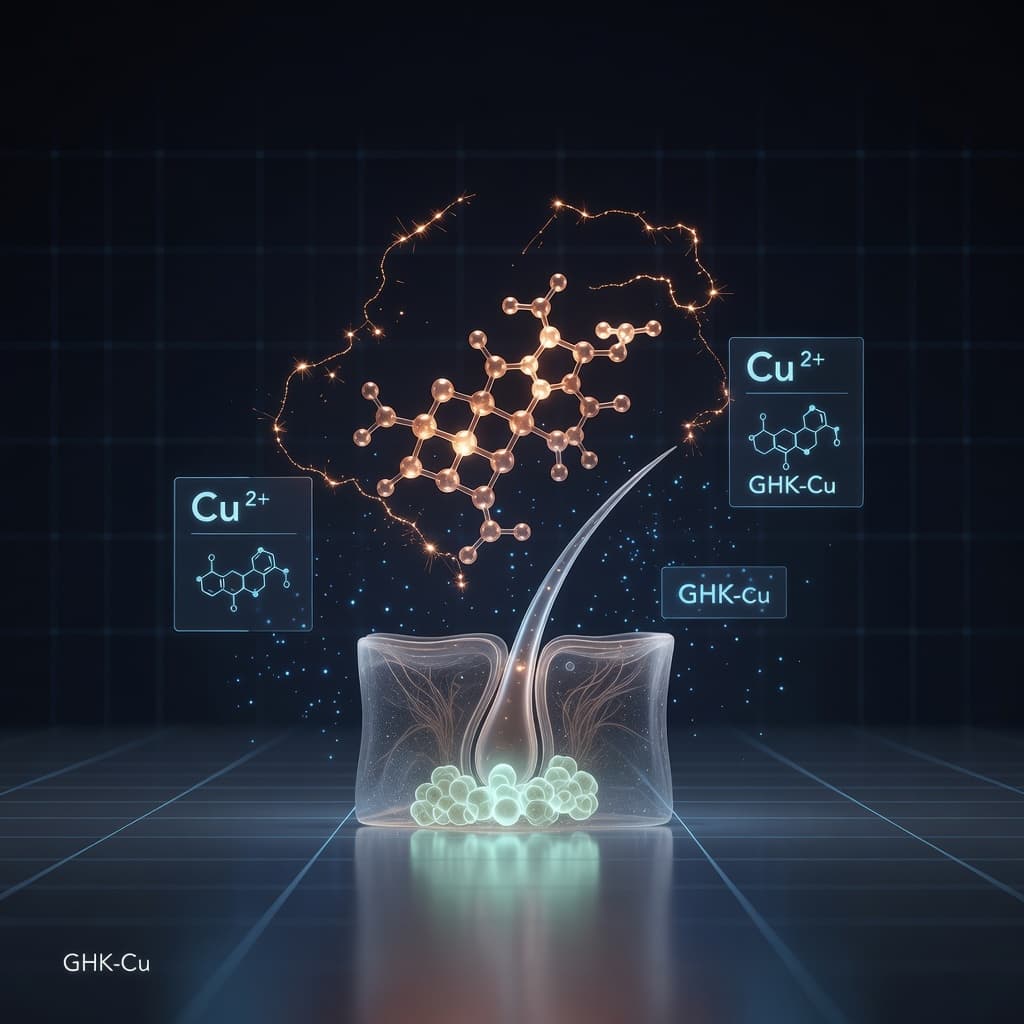
TL;DR: What the GHK-Cu hair-follicle literature actually shows
- The hair-relevant literature is preclinical and indirect: the ex vivo follicle and dermal papilla data used the related compound AHK-Cu, and the older rodent models tested unspecified or related copper-peptide complexes (PC1031), not confirmed GHK-Cu itself. No dedicated human hair-loss trial of GHK-Cu exists.
- The most widely cited 2007 "GHK-Cu hair" paper actually tested AHK-Cu, a closely related but chemically distinct copper tripeptide, a mislabeling repeated across most marketing content (PMID 17703734).
- Mechanistically the story is coherent: copper delivery, raised VEGF, suppressed TGF-beta1, and an apoptosis-resistance shift in dermal papilla cells, but coherence is not proof of a human effect.
- A 1990s fuzzy-rat model reported follicle changes described as "similar to topical minoxidil" (PMID 8326148). That is one animal study on a related copper-peptide complex, not a validated human comparison.
- GHK-Cu carries no FDA or EMA approval for hair loss and is not a hair-loss drug. peptidesdirect.io sells it strictly as a research material, not as a hair-loss product.
GHK-Cu shows up constantly in hair-research discussion, usually cited alongside a single decades-old study and a confident claim that it "regrows hair." The actual literature is thinner, older, and more preclinical than that framing suggests, and one of its most-repeated data points does not even test the molecule it is credited to. This article works through what has actually been published on GHK-Cu, its close relative AHK-Cu, and hair-follicle or dermal-papilla biology: the ex vivo human data, the rodent models, the one human trial that touches this peptide family without being GHK-Cu evidence, and the naming confusion that has let a 2007 finding travel far beyond what it demonstrated.
GHK-Cu, Copper Delivery, and Why Hair Researchers Look at It
GHK-Cu is a tripeptide, glycyl-L-histidyl-L-lysine, three amino acids, bound to a Cu2+ ion. Pickart's review describes the peptide as chelating copper with an affinity similar to the copper-binding site on serum albumin, which is why it is characterized mechanistically as a physiological copper-delivery vehicle into tissue (PMID 18644225).
The downstream effects documented for GHK-Cu, mostly in skin and connective-tissue models rather than hair specifically, are broad. It increases protein synthesis of VEGF, FGF2, NGF and other neurotrophins; it stimulates collagen and elastin synthesis; it modulates matrix metalloproteinases together with their tissue inhibitors, which the literature frames as balanced extracellular-matrix turnover rather than unchecked degradation; and on the inflammatory side it suppresses TGF-beta1, TNF-alpha and thromboxane formation while raising antioxidant enzyme activity (PMID 18644225). A separate review from the same group adds glycosaminoglycan and decorin synthesis to that same tissue-remodeling profile (PMID 26236730). None of that is hair-specific data. It is the general tissue-remodeling profile that makes GHK-Cu a peptide worth testing in a hair-follicle model in the first place, not a hair-growth result on its own.
A 2015 review from the same research group extends the claim further, stating that GHK "accelerates wound-healing of the skin, hair follicles, gastrointestinal tract, boney tissue, and foot pads of dogs," and that GHK-Cu is reported to up- or downregulate roughly 4,000 human genes (PMID 26236730). Both statements are worth flagging for what they are: narrative-review-level claims from the authors' own body of work, not a dedicated hair dataset with its own methods and statistics. The review is useful for orienting the mechanism, not for citing as hair-specific evidence.
Naturally occurring copper tripeptide complex for skin regeneration and anti-aging research. Stimulates collagen synthesis, accelerates wound healing, and modulates 4000+ genes. Plasma levels decline with age, making it a key target in longevity research.
The Ex Vivo Data: Dermal Papilla Cells and a Naming Problem
The one directly relevant dataset sits in a 2007 paper from Pyo and colleagues, and it is the source most often mis-cited as GHK-Cu hair evidence (PMID 17703734). The design combined two systems: human hair follicles maintained in organ culture ex vivo, meaning follicles removed from tissue and kept alive in a dish rather than studied in a living scalp, and cultured human dermal papilla cells (DPCs), the specialized fibroblast-like cells at the base of the follicle that regulate the hair cycle. At concentrations between 10 to the minus 12 and 10 to the minus 9 molar, low picomolar to low nanomolar, the tested compound stimulated elongation of the ex vivo follicles and increased DPC proliferation, measured by MTT assay with a reported significance of p less than 0.001. In the same cell system, the compound raised VEGF production and lowered TGF-beta1 secretion, and it shifted apoptosis markers toward cell survival: a higher Bcl-2 to Bax ratio and reduced cleaved caspase-3 and PARP.
That is a genuinely interesting mechanistic result, and it is also where the naming problem starts. The compound Pyo and colleagues actually tested was AHK-Cu, alanyl-L-histidyl-L-lysine-Cu2+, not GHK-Cu. AHK-Cu is a closely related but chemically distinct copper tripeptide, marketed separately in the cosmetics industry as "copper tripeptide-3." The two molecules share a copper-binding backbone and a broadly similar mechanistic story, but they are not the same substance, and the 2007 paper is not GHK-Cu human hair data. It gets cited that way constantly. Treat the AHK-Cu result as the closest and most direct preclinical analogue to GHK-Cu's hair-relevant mechanism, not as a GHK-Cu finding itself.
Two things to watch for in GHK-Cu hair marketing
- The AHK-Cu substitution. The 2007 Pyo study (PMID 17703734) is routinely presented as "the GHK-Cu hair study." It tested AHK-Cu. Read any source that cites this paper for GHK-Cu specifically with caution, and expect the molecule name to matter more than it usually gets credited for.
- A citation that does not exist. A specific reference, "GHK-Cu activates Wnt/beta-catenin signaling to promote hair follicle cycling in human dermal papilla cells," attributed to a 2018 Scientific Reports paper, circulates across peptide and SEO content sites. It does not appear in PubMed under direct search, and it reads as a fabricated or AI-generated citation that has propagated between content-mill sites. We could not verify it and do not cite it here. Precise figures like "increases dermal papilla cell proliferation by up to 35 percent" fall into the same unverifiable category and should not be repeated as fact.
Secondary, non-primary-source reporting on the Pyo paper also describes an inverted, inhibitory response at higher concentrations, in the 10 to the minus 8 to 10 to the minus 7 molar range, suggesting a biphasic or hormetic dose curve. The primary full text sits behind a paywall, so the exact inhibition percentages at those higher doses could not be independently confirmed, and that detail should be treated with lower confidence. The core stimulatory finding at the lower, picomolar-to-nanomolar range is confirmed directly from the PubMed abstract.
What Animal Models Show: Mice, Rats, and the Minoxidil Comparison
The animal literature behind copper-peptide hair research predates the 2007 ex vivo work by well over a decade and is thinner on detail. A 1991 conference-proceedings report by Trachy and colleagues describes a copper-binding peptide complex stimulating hair follicle activity in C3H mice (PMID 1809108). PubMed lists no abstract for this entry, and the full text sits in a Wiley annals volume we did not have access to, so it functions here as a foundational, historical citation establishing that this line of inquiry goes back to the early 1990s, not as a source of quantitative results.
More substantive is a 1993 review by Uno and Kurata surveying agents tested in the stumptail macaque and fuzzy-rat models of androgenetic alopecia (PMID 8326148). The review states directly that a copper-binding peptide labeled PC1031 produced follicular enlargement on the back skin of fuzzy rats, converting follicles from the fine vellus type toward the coarser terminal type, and that "the effect was similar to that of topical minoxidil." This sentence is the primary source behind the widely repeated claim that a copper peptide performs comparably to minoxidil. Read it for what it is: a qualitative comparison in a rodent model of hair-follicle miniaturization, not a head-to-head human trial, and PC1031 is a related copper-peptide complex whose identity as GHK-Cu specifically is not confirmed in the accessible abstract text. No numeric effect size, hair count, or density measurement is available from this source to compare against minoxidil's own extensively documented human trial data.
Taken together, the animal record supports the same conclusion as the ex vivo work: copper-peptide complexes produce measurable, biologically plausible changes in rodent hair-follicle biology, in models built specifically to detect that kind of change. That is meaningfully different from evidence that GHK-Cu regrows hair in a human scalp.
The One Human Trial Near This Peptide Family, and Why It Isn't GHK-Cu Evidence
The closest thing to a human randomized controlled trial touching this peptide family is a 2016 study by Lee and colleagues (PMID 27489425), and it comes with its own important caveat. The trial used copper-free GHK, no copper ion attached, combined with 5-aminolevulinic acid (5-ALA), a separate photosensitizing compound with its own biological activity. It was not GHK-Cu, and results cannot be attributed to the copper complex specifically.
The design itself was reasonably solid for this literature: randomized, placebo-controlled, 45 men with male-pattern hair loss, six months of once-daily topical treatment across three arms, a 100 mg/mL GHK plus 5-ALA complex, a 50 mg/mL version, and placebo. Hair-count increases were reported as plus 52.6 in the 100 mg/mL arm and plus 71.5 in the 50 mg/mL arm, both p less than 0.05 versus baseline, against plus 9.6 in the placebo arm. There was no significant between-group difference in hair shaft length or thickness. It is a real, controlled human dataset, and it is evidence for a GHK-plus-5-ALA combination product, not for GHK-Cu monotherapy.
A separate, indirect line of support comes from copper-free GHK's effect on epidermal skin cells rather than hair follicles. Choi and colleagues (PMID 23019153) applied copper-free GHK to keratinocytes and skin, not hair follicles, and found increased p63-positive and PCNA-positive basal keratinocytes, more cuboidal basal-cell morphology, and increased integrin alpha6/beta1 expression, interpreted by the authors as increased "stemness" of epidermal basal cells. That paper presents no direct hair-follicle or dermal-papilla data; it is adjacent stem-cell-mechanism support at best, drawn from epidermal skin rather than the hair follicle itself.
Where the GHK-Cu hair story overreaches
- No GHK-Cu-specific human RCT exists. The one relevant human trial (PMID 27489425) used copper-free GHK combined with 5-ALA, a different formulation entirely, not GHK-Cu alone.
- Regulatory status does not match the marketing tone. GHK-Cu holds no FDA or EMA approval for any indication, including hair loss. In the US it is regulated as a cosmetic ingredient (INCI name Copper tripeptide-1), which requires no pre-market efficacy approval. Minoxidil (approved 1988) and oral finasteride (approved 1997) both carry large phase 3 trial programs and decades of postmarketing human data that this peptide simply does not have.
- The noggin/BMP and angiopoietin connection is not established for GHK-Cu. These signaling pathways are independently recognized regulators of the hair-growth cycle in general hair biology, but no verifiable PubMed record links them to GHK-Cu specifically. Do not treat this as settled mechanism.
- No verified topical or injectable pharmacokinetic half-life exists for GHK-Cu. Figures circulate online with no traceable primary source; none should be quoted as fact.
Research Use, Regulatory Status, and What We Carry
The regulatory picture is straightforward once the evidence base is laid out honestly. GHK-Cu is not an FDA-approved or EMA-approved drug for hair loss, and no prescription drug product on either market contains it as an active ingredient. In the United States it sits in cosmetics regulation as Copper tripeptide-1, a category that does not require the efficacy trials a drug approval demands. That stands in direct contrast to the two FDA-approved hair-loss drugs, topical minoxidil (approved 1988) and oral finasteride (approved 1997), both backed by large phase 3 trial programs and decades of postmarketing evidence that this peptide has not accumulated.
EU research framing versus US cosmetic marketing
In the US, GHK-Cu circulates largely as a cosmetic-aisle ingredient, sold on hair and skin claims that outrun the underlying trial data. The EU research-supply model this article sits within takes a different posture: GHK-Cu is sold here as a laboratory research material, not a cosmetic or a drug, with no hair-regrowth claim attached to the product itself. That is the honest way to sell a peptide whose hair-relevant evidence is preclinical: disclose the limitation, and let the research literature speak for itself rather than the label.
For researchers working on the broader tissue-regeneration side rather than isolated GHK-Cu pharmacology, two related blends sit in the same catalogue area: GLOW and KLOW, both catalogue-adjacent research tools within the same tissue-biology space this article covers.
3-in-1 skin peptide blend: GHK-Cu 50mg + BPC-157 10mg + TB-500 10mg. Targets collagen synthesis, tissue regeneration, and skin repair for comprehensive dermatological research.
Gastric pentadecapeptide (15 amino acids) known for exceptional tissue repair properties. Promotes wound healing, angiogenesis, and cytoprotection across tendons, muscles, gut, and nerves. Over 30 years of preclinical research.
Full-length 43-amino-acid Thymosin Beta-4, a naturally occurring repair protein, independently confirmed by a third-party CoA from Janoshik. Promotes cell migration and new blood vessel formation for systemic tissue healing. Especially researched for muscle, tendon, and cardiac repair.
Anti-inflammatory tripeptide derived from alpha-MSH (positions 11-13). Inhibits NF-kB signaling, supports gut barrier integrity, and shows antimicrobial activity. A targeted approach to inflammation research without broad immunosuppression.
4-in-1 anti-aging peptide blend: GHK-Cu 50mg + BPC-157 10mg + TB-500 10mg + KPV 10mg. Targets collagen synthesis, tissue regeneration, skin repair, and anti-inflammatory pathways.
Tissue repair, wound healing, and recovery peptides
Copper-peptide mechanism research
Multi-peptide skin and tissue regeneration
For related research on GHK-Cu and route of administration, an angle relevant to anyone designing a research protocol around this peptide, see our related article on route-dependent GHK-Cu effects in an aged-mouse model.
This article is for informational and educational purposes only. All mentioned peptides are intended exclusively for laboratory research and not for human consumption.
Research context for English-speaking buyers
Most of our English-speaking customers ship to the UK, Ireland, Malta or other English-as-second-language EU territories. The regulatory picture differs per country.
- Relevant authorities
- MHRA (UK, post-Brexit), HPRA (Ireland, EU-aligned), FDA Section 503A bulks list (US, restricted Cat 2 status of several peptides as of 2026)
- Customs and VAT
- EU shipments include 19% VAT; UK shipments after Brexit are now extra-EU and may attract UK VAT plus a handling fee at import
- Typical shipping window
- EU 2-4 working days, UK 4-7 working days, other international 7-14 working days, depending on customs
Research-grade peptides shipped from our EU warehouse are sold for laboratory use only and are not authorised for human or veterinary therapeutic application in any of the destination jurisdictions. US customers should be aware that the FDA Section 503A bulks list classification (and the April 2026 reclassification of twelve compounds) only governs compounding pharmacies, not direct-to-researcher imports for non-clinical work. UK buyers should declare the consignment on import and may be asked for a research justification by HMRC. We provide a CoA per batch identified by colour code rather than serial number; customs sometimes asks for this document when clearing the parcel.