GLP-1 Weight Loss and Muscle Loss: The Research Peptide Angle
GLP-1 trials show 25-35% of weight lost is lean mass. What the GH-axis peptide combo can and cannot claim, honestly reviewed.
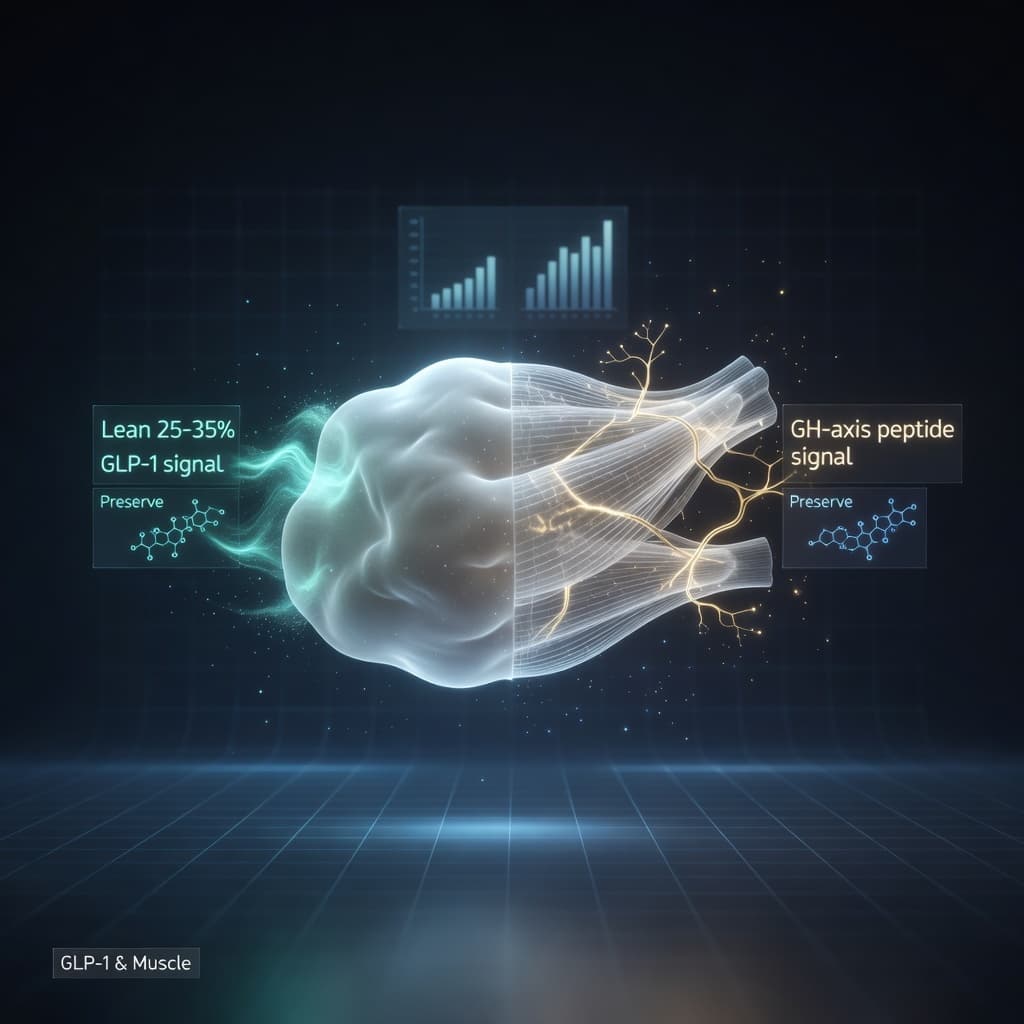
TL;DR
GLP-1 receptor agonists (semaglutide, tirzepatide, retatrutide) produce real, large weight loss, but the body-composition substudies show that roughly a quarter to a third of that weight is lean mass, not fat. This is a trial-documented finding, not a "keto flu" myth. The GH/IGF-1/myostatin axis is the body's genuine anabolic lever, and GH secretagogues like CJC-1295 and ipamorelin reliably raise GH and IGF-1 in humans. But no published human trial has combined a GH secretagogue with a GLP-1 drug to test whether it protects muscle. The one trial that pairs an anabolic drug with a GLP-1 agonist used bimagrumab, a myostatin-pathway antibody, not a GHRH analog or ghrelin mimetic. This article lays out the evidence honestly, then gives a constructive, evidence-based playbook for protecting muscle on a GLP-1, with the GH-axis peptides framed as the logical (not proven) next layer.
Semaglutide, tirzepatide and retatrutide have changed what is achievable with pharmacological weight loss. They have also surfaced a problem that gets far less marketing attention than the headline percentages: a meaningful share of the weight coming off is muscle, not just fat. That is not internet folklore. It is sitting in the DEXA substudies of the same trials that produced the topline numbers. This article walks through what those trials actually show, why losing lean mass matters beyond the number on the scale, what the body's own anabolic signaling system looks like, what our GH-axis research peptides actually do at the mechanism level, and then states plainly what is and is not proven about combining the two drug classes. It closes with a constructive playbook, because the honest answer to "is muscle loss on a GLP-1 a real problem" is yes, and the honest answer to "is there something sensible to do about it" is also yes.
The Lean-Mass-Loss Problem: What GLP-1 Trials Actually Show
The topline trial for semaglutide, STEP 1, established the scale of the effect: once-weekly semaglutide 2.4 mg produced a -14.9% change in body weight at 68 weeks versus -2.4% with placebo (PMID 33567185). That is the number that made headlines. It says nothing on its own about what kind of weight came off.
The body-composition substudies fill that gap. A DEXA substudy of SURMOUNT-1 (n=160) found that tirzepatide produced -21.3% total body weight, -33.9% fat mass and -10.9% lean mass at week 72 (PMID 39996356). Put differently, roughly a quarter of the weight lost was lean mass, and the fat-to-lean ratio of what was lost improved only modestly (from 0.93 to 0.70), meaning fat loss was proportionally larger but lean-mass loss was still substantial in absolute terms. Notably, the much smaller weight loss in the placebo arm carried a similar lean-mass share, around 25%, so some baseline proportion of lean loss during any weight loss appears to be structural rather than drug-specific.
A phase 2 substudy of retatrutide in people with type 2 diabetes tells a comparable story at the higher end of the dose range: retatrutide 8 mg cut total fat mass by 26.1% at 36 weeks (12 mg: 23.2%), while lean mass fell by several kilograms over the same period (PMID 40609566). The authors themselves note that the proportion of lean-to-total weight loss on retatrutide is similar to other obesity pharmacotherapies, in the range of roughly a fifth to a third of total weight lost.
A 2025 systematic review pulling together 20 preclinical and clinical studies on GLP-1 receptor agonists and muscle sums up the state of play bluntly: animal studies sometimes show GLP-1 agonism improving grip strength or muscle cross-sectional area, but in humans, the clinical trials consistently show concurrent weight loss and lean-mass loss together (PMID 41400575). Muscle-protective efficacy in humans has not been established for any GLP-1 drug on its own. Across semaglutide, tirzepatide and retatrutide, the pattern is consistent enough to call it a real, trial-documented finding: roughly 25-35% of total weight lost on these drugs is lean mass, not a myth, not exaggerated marketing, just what DEXA scans show.
Why Muscle Loss Matters Beyond the Scale
None of this would be worth writing about if lean mass were a cosmetic detail. It is not. Skeletal muscle is the body's largest reservoir of insulin-sensitive tissue and a major driver of resting metabolic rate, so losing a meaningful fraction of it during weight loss works against two of the things a GLP-1 user is usually trying to achieve: durable metabolic improvement and a body composition that holds after the weight is off. Losing muscle alongside fat also raises the practical risk of what researchers call sarcopenic obesity, a body that is lighter on the scale but has proportionally less functional tissue and more relative frailty, particularly relevant for older or previously sedentary GLP-1 users who were not doing resistance training before starting the drug. The scale number improves. The underlying tissue composition, if unmanaged, can move in a less favorable direction than the headline percentage suggests.
The Body's Anabolic Signaling: GH, IGF-1 and Myostatin Explained
The muscle-growth axis that GH-secretagogue research targets sits behind two hormones working in the same direction and one brake working against them. Growth hormone (GH) and insulin-like growth factor 1 (IGF-1) both drive muscle hypertrophy: IGF-1 signals through the PI3K/Akt pathway to increase protein synthesis and simultaneously suppress the enzymes responsible for breaking muscle protein down (PMID 18500379). That is the anabolic side of the ledger. On the other side sits myostatin, a well-established negative regulator of muscle growth that acts as the natural brake on the same pathway, limiting how much muscle mass the body allows itself to build regardless of how strong the anabolic signal is. Raising GH and IGF-1 pushes on the accelerator; myostatin is the physiological foot still on the brake. This is the mechanistic backdrop for why anyone interested in preserving lean mass during a caloric deficit looks at the GH axis in the first place, and why, as the section below on bimagrumab shows, drugs that release the myostatin brake are a separate and mechanistically distinct strategy from drugs that push harder on the GH/IGF-1 accelerator.
What the Research Peptides We Carry Actually Do
Four products sit at the intersection of this discussion, one on the GLP-1 side and three on the GH-axis side.
Retatrutide is a triple agonist acting on GLP-1, GIP and glucagon receptors, the same drug class whose body-composition substudy (PMID 40609566) is discussed above. It is the strongest fat-loss agent in this article's data set, and it carries the same lean-mass-loss profile as the other GLP-1 drugs in that class.
CJC-1295 with DAC is a long-acting GHRH analog, and it is a form we do not carry. A single injection in healthy adults produced dose-dependent GH increases of 2 to 10-fold, sustained for 6 or more days, alongside IGF-1 increases of 1.5 to 3-fold sustained for 9 to 11 days (PMID 16352683). That is a real, human-confirmed, sustained elevation of the GH/IGF-1 axis discussed in the previous section, but it describes the DAC-conjugated molecule, not the product below. What we sell as CJC-1295 is the No-DAC form, also called Mod GRF 1-29 (see our dedicated explainer): the same GHRH-receptor mechanism, but without the albumin-binding DAC group, so it clears in roughly 30 minutes instead of days, amplifying the body's own pulsatile GH release rather than flooding the axis for nearly a week.
Ipamorelin works through a different receptor, the ghrelin receptor (GHSR-1a), and was originally characterized as the first selective GH secretagogue: in animal studies it released GH without the meaningful ACTH, cortisol or prolactin elevation seen with earlier, less selective GH-releasing peptides (PMID 9849822). That selectivity profile was established in animal models (rats and swine), not in a human trial, and should be read as animal pharmacology rather than a confirmed human safety finding.
The CJC-1295/ipamorelin blend pairs the two mechanisms, a GHRH analog and a ghrelin-receptor agonist acting on separate receptors that both converge on pituitary GH release, which is the standard rationale in GH-secretagogue research for combining the two rather than using either alone.
First-ever triple-action weight management peptide targeting three receptors at once: GLP-1, GIP, and glucagon. Shown exceptional results in Phase 2 trials - up to 24% weight reduction. The most advanced metabolic peptide available.
A first-in-class dual GIP and GLP-1 receptor agonist, and one of the most extensively studied compounds in modern metabolic and weight-regulation research. Supplied as a lyophilised research peptide with a per-batch certificate of analysis, for laboratory and in-vitro use only.
CJC-1295 without DAC (Mod GRF 1-29) is a short-acting GHRH(1-29) analog for GH/IGF-1 research. Research-grade lyophilized powder, specified purity >=99% (HPLC). Laboratory use only.
Highly selective growth hormone releaser that triggers natural GH pulses without raising cortisol or prolactin. Clean GH stimulation with minimal side effects - the most targeted growth hormone peptide available.
2-in-1 growth hormone blend: CJC-1295 no-DAC (Modified GRF 1-29, 5 mg) + Ipamorelin (5 mg) combined in one vial. The CJC-1295 component is the short-acting no-DAC variant (about 30 minute half-life), not the long-acting DAC form. Stimulates natural GH release through two different pathways for amplified, more physiological growth hormone pulses.
GIP/GLP-1/Glucagon agonists and metabolic pathways
Growth hormone secretagogues and gonadotropins
Lean-mass research
First-ever triple-action weight management peptide targeting three receptors at once: GLP-1, GIP, and glucagon. Shown exceptional results in Phase 2 trials - up to 24% weight reduction. The most advanced metabolic peptide available.
CJC-1295 without DAC (Mod GRF 1-29) is a short-acting GHRH(1-29) analog for GH/IGF-1 research. Research-grade lyophilized powder, specified purity >=99% (HPLC). Laboratory use only.
Highly selective growth hormone releaser that triggers natural GH pulses without raising cortisol or prolactin. Clean GH stimulation with minimal side effects - the most targeted growth hormone peptide available.
2-in-1 growth hormone blend: CJC-1295 no-DAC (Modified GRF 1-29, 5 mg) + Ipamorelin (5 mg) combined in one vial. The CJC-1295 component is the short-acting no-DAC variant (about 30 minute half-life), not the long-acting DAC form. Stimulates natural GH release through two different pathways for amplified, more physiological growth hormone pulses.
Is Adding a GH Secretagogue to a GLP-1 Proven to Preserve Muscle? The Honest Evidence Gap
This is the question the whole article is really building toward, and the honest answer is no, not yet, not directly.
The specific combination has never been tested in humans
No published human trial has combined CJC-1295, ipamorelin, or any GH secretagogue with semaglutide, tirzepatide or retatrutide to measure whether it preserves lean mass. The idea is mechanistically coherent: GH secretagogues raise GH/IGF-1 in humans, most directly demonstrated for CJC-1295 with DAC (PMID 16352683), the long-acting form we do not carry, and GH/IGF-1 drive the anabolic side of the muscle pathway (PMID 18500379). Our own CJC-1295 (No DAC) works through the same GHRH-receptor mechanism but has not been tested in an equivalent human trial. Coherence is not the same as a demonstrated clinical result. This is a hypothesis with a plausible mechanism, not an established fact.
The closest thing to direct evidence for a GH secretagogue's effect on human body composition on its own is a 2-year randomized controlled trial of the oral ghrelin mimetic MK-677 (25 mg/day) in 65 healthy older adults. Fat-free mass rose by a net of roughly 1.6 kg compared to placebo, a real, measured effect. But strength and physical function did not improve, and fasting glucose rose while insulin sensitivity worsened (PMID 18981485). That trial was never run alongside a GLP-1 drug, so it tells us a GH secretagogue can raise lean mass in isolation, at a metabolic cost, and nothing about what happens when it is layered on top of the deficit and hormonal environment a GLP-1 drug creates.
The one real trial: bimagrumab, not a GH secretagogue
The only published human trial that adds an anabolic-pathway drug to a GLP-1 agonist specifically to test muscle preservation used bimagrumab, a myostatin/activin-receptor blocking antibody, paired with semaglutide. Semaglutide alone produced a 7.4% lean-mass loss; adding bimagrumab limited that loss to 2.9% while increasing fat loss (PMID 41772149). This is a genuinely important result: it proves the underlying strategy, add an anabolic-pathway drug to a GLP-1 to protect muscle, can work. But bimagrumab blocks the myostatin brake described earlier in this article. It is not a GHRH analog and not a ghrelin-receptor agonist. It works on a completely different receptor system than CJC-1295 or ipamorelin. No equivalent trial exists for GH secretagogues, so the bimagrumab result validates the concept, not the specific combination this article's readers are usually asking about.
Put simply: the muscle-loss problem is real and trial-documented. The GH/IGF-1 mechanism for protecting muscle is real and well-characterized. The strategy of pairing an anabolic drug with a GLP-1 has been validated once, for a myostatin antibody. The specific pairing of a GH secretagogue with a GLP-1 drug remains a mechanistic and community hypothesis, not a clinical fact, and any source telling you otherwise is overstating the evidence.
The Muscle-Preservation Playbook: What Actually Makes Sense
Here is what actually makes sense to protect muscle while losing weight on a GLP-1, split into what is proven and what is a reasonable next layer.
The evidence-based fundamentals, which do preserve lean mass in a caloric deficit:
- Resistance or strength training. This is the single strongest lever available for preserving lean mass during any weight-loss intervention, GLP-1 or otherwise. A muscle under a mechanical loading stimulus is a muscle the body is far less willing to break down for fuel, deficit or no deficit.
- Adequate, higher protein intake. Protein intake above a minimal maintenance level spares lean mass during a calorie deficit by supplying the amino acids protein synthesis needs and blunting the catabolic pressure of the deficit itself.
- Sleep. Growth hormone release itself is tied to deep sleep, and poor sleep independently worsens body composition outcomes during any weight-loss program.
- Overall nutritional quality. Adequate micronutrients and total energy that supports training, rather than an unnecessarily aggressive deficit on top of an already appetite-suppressing drug, gives the body the raw material it needs to hold onto muscle while shedding fat.
These four fundamentals are not speculative. They are the standard, well-supported levers for preserving lean mass in any caloric deficit, GLP-1-assisted or not, and they should be the first thing anyone using retatrutide or a comparable drug puts in place.
The anabolic adjunct: GH-axis peptides, mechanistically sound, not RCT-proven for this combination. On top of that foundation, this is the logical next lever many in the research community, and practitioners and creators covering this space, add: GH-axis peptides such as CJC-1295 (No DAC) and ipamorelin (or the combined blend) to support endogenous GH and IGF-1 signaling, alongside retatrutide for the GLP-1 side. The mechanistic case rests on the GHRH-receptor pathway that reliably raises GH and IGF-1 in humans, documented most directly for CJC-1295 with DAC, the long-acting form we do not carry (PMID 16352683), and GH/IGF-1 signaling reliably drives the anabolic pathway that opposes lean-mass loss (PMID 18500379). Our own CJC-1295 (No DAC) shares that mechanism but clears in roughly 30 minutes rather than days, and has not itself been tested in an equivalent human trial. As the section above makes explicit, the specific GLP-1 combination has not been tested in a controlled human trial either way. This is the idea, presented honestly as a plausible, community-practiced layer on top of proven fundamentals, not a substitute for them and not a guaranteed outcome.
What the Research Community Is Doing (and Why Caution Is Warranted)
What the community reports (anecdotal, not clinical evidence)
Reddit threads on this topic were not directly accessible for this article, so nothing below is a Reddit quote. What follows is drawn from directly fetched posts on MESO-Rx (thinksteroids.com) and AnabolicMinds.com, the closest PED-adjacent, GLP-1-experienced forums to the online conversation this article is describing, plus secondary reporting on GLP-1/fitness-creator content trends.
A recurring MESO-Rx position (Bimagrumab thread, user LostButFound) is that most GLP-1-driven muscle loss is explained by the severe calorie and protein deficit the drugs induce, not a direct drug effect on muscle tissue itself, "the desired reduction in calories (and protein) is the main culprit." Other posters push back on how the loss is even measured: one (user Ghoul) argues DEXA-based lean-mass numbers are inflated by intramuscular fat and adipose-tissue structural components rather than true contractile muscle, and another (user SubparMarioBro) cites MRI-based studies putting actual muscle loss closer to 10-18%, well below the 25-40% lean-mass-loss figures that circulate in clinic marketing and press coverage.
On the other side, a self-reported MESO-Rx success story (user hellerhiwater) describes losing roughly 140 lbs on tirzepatide while continuing to lift consistently, later adding TRT, framed as personal evidence that resistance training protects muscle even during aggressive GLP-1 weight loss. It is one self-report, not a controlled outcome, but it lines up with the fundamentals above.
On AnabolicMinds.com, a thread titled "Stacking Tirzepatide with CJC-1295/Ipamorelin" shows the real-world version of the combination this article discusses: a poster on tirzepatide wanting to add CJC-1295/ipamorelin specifically to keep building muscle while losing fat, with a reply noting they cleared the stack with their own doctor and were told it was "no problem." This is the actual pattern people are trying, not a hypothetical.
Myostatin and activin-receptor antibodies like bimagrumab are being discussed in these same circles, via secondary press coverage (Outside magazine), as a pharmaceutical route to blunt muscle loss on semaglutide, citing trial data of up to 17.8 kg weight loss with preserved lean mass. Worth flagging as aspirational for a research-peptide audience: it is a prescription monoclonal antibody, not something sourced or handled like the peptides in this article, and it is not itself an established community protocol yet.
A safety caveat that gets underplayed by clinic marketing but surfaces in journalism and creator coverage: a cited study reported 94% of CJC-1295 users experiencing some adverse reaction, and a separate trial in the GH-secretagogue space was halted after a participant death, with causality to the study drug unconfirmed. This is a real caution against treating "just add CJC/ipa to your GLP-1" as a low-risk default.
Finally, the one thing that shows up consistently, whether on MESO-Rx threads, in creator content like Thomas DeLauer's coverage of CJC-1295/ipamorelin, or in commentary from RP Strength's Mike Israetel, is agreement on the base layer: roughly 1.6-2.2 g/kg protein (or the informal "1g per pound of bodyweight" heuristic) plus resistance training two to three times a week. GH peptides and myostatin-pathway drugs are consistently framed by these same sources as optional, experimental layers on top of that base, never a substitute for it. Meanwhile, on more general PED-adjacent forums like AnabolicSteroidForums.com, threads about GLP-1 drugs often spend more time comparing gas, burping and nausea between semaglutide and tirzepatide than discussing muscle at all, a reminder that muscle strategy is not always the dominant conversation even in body-composition-focused communities.
If you are researching retatrutide alongside our GH-axis peptides, it is worth reading our dedicated guides on tirzepatide and semaglutide for the GLP-1 side of this picture, and our HGH and MK-677 articles for a deeper look at the GH-axis mechanisms referenced above.
Questions about these research peptides
If you have questions about retatrutide, CJC-1295, ipamorelin or the combined blend, contact support@peptidesdirect.io.
FAQ
This article is for informational and educational purposes only. All mentioned peptides are intended exclusively for laboratory research and not for human consumption. It is not medical, dietary or training advice. For Research Purposes Only.
Research context for English-speaking buyers
Most of our English-speaking customers ship to the UK, Ireland, Malta or other English-as-second-language EU territories. The regulatory picture differs per country.
- Relevant authorities
- MHRA (UK, post-Brexit), HPRA (Ireland, EU-aligned), FDA Section 503A bulks list (US, restricted Cat 2 status of several peptides as of 2026)
- Customs and VAT
- EU shipments include 19% VAT; UK shipments after Brexit are now extra-EU and may attract UK VAT plus a handling fee at import
- Typical shipping window
- EU 2-4 working days, UK 4-7 working days, other international 7-14 working days, depending on customs
Research-grade peptides shipped from our EU warehouse are sold for laboratory use only and are not authorised for human or veterinary therapeutic application in any of the destination jurisdictions. US customers should be aware that the FDA Section 503A bulks list classification (and the April 2026 reclassification of twelve compounds) only governs compounding pharmacies, not direct-to-researcher imports for non-clinical work. UK buyers should declare the consignment on import and may be asked for a research justification by HMRC. We provide a CoA per batch identified by colour code rather than serial number; customs sometimes asks for this document when clearing the parcel.