How to Spot a Fake Peptide Certificate of Analysis
A Certificate of Analysis is only as good as your ability to verify it. What a real CoA must contain (HPLC plus mass spec, methods, reference standards), the red flags of a forged one, and why independent verification matters.
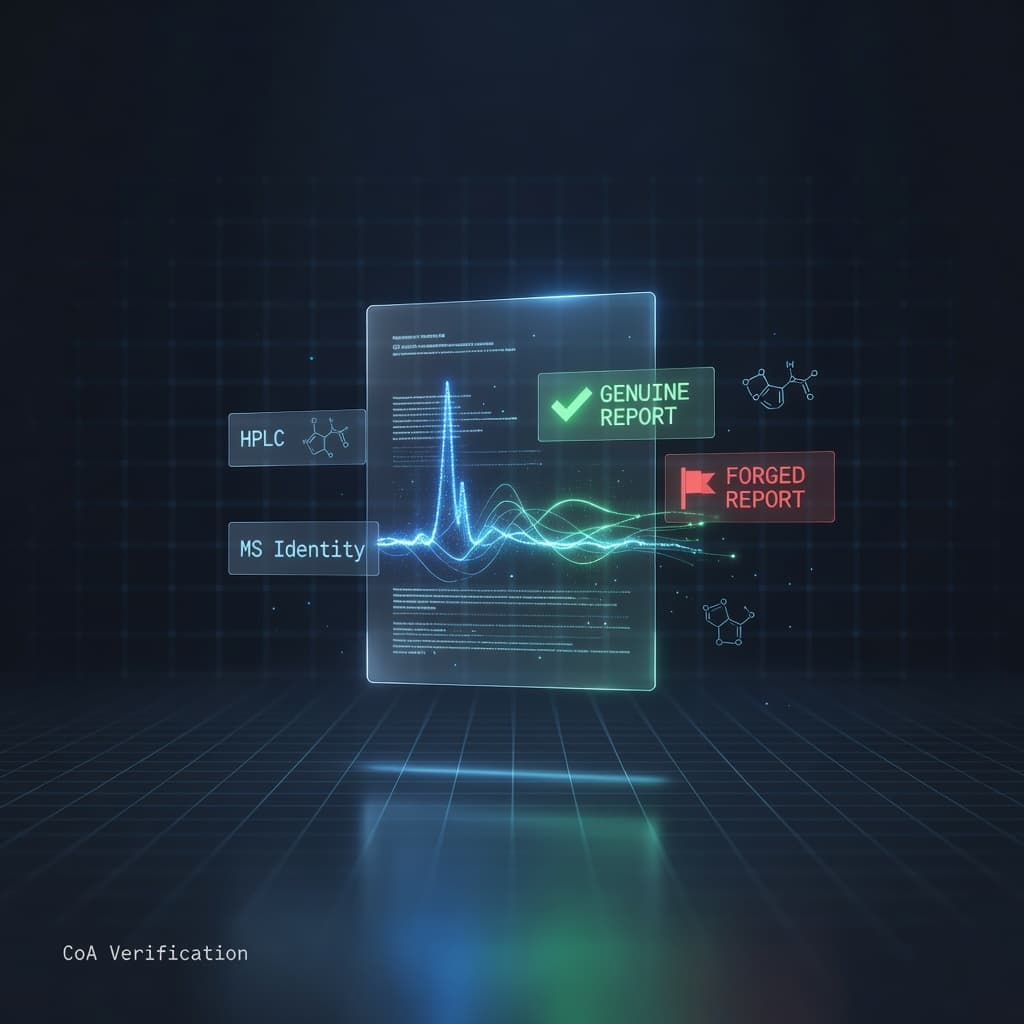
TL;DR: A number on paper is not a measurement until it is verified
Supplier purity claims are routinely false. In one study of obestatin peptides from five manufacturers, two-thirds fell below 95 percent purity and/or had individual impurities above 1 percent, and one product was an entirely different peptide than labelled (PMID 18342612). A real CoA needs both HPLC and mass spec. HPLC tells you how much target peptide is present; mass spectrometry tells you what the molecule actually is (PMID 34110145). A certificate with a purity number but no MS identity trace is incomplete. A single clean number hides low-level contamination. Even a roughly 1 percent contaminant can cause false results (PMID 18077621), and chiral d-isomer impurities are invisible to ordinary purity testing (PMID 36857849). Verify, do not trust. In one market-surveillance study, online semaglutide samples labelled 99 percent pure measured 7.7 to 14.37 percent, with endotoxin in every sample (PMID 39509151). The printed value collapsed under independent testing. Verification confirms the document, not the vial, and never makes a research compound safe or legal for human use.
A Certificate of Analysis (CoA) is supposed to be the trust anchor of a peptide purchase. But a CoA is a document, and documents can be fabricated, copied, or simply hollow. This guide explains what a genuine analytical report must contain, how to read it, and how to verify it, so a forged or empty certificate does not fool you. It is a document-verification and due-diligence reference for laboratory research buyers only, with no medical or usage guidance. The compounds named are used as analytical examples; nothing here implies any of them is safe or lawful for human consumption.
Bacteriostatic water and research supplies
Why a CoA Must Be Verifiable, Not Just Present
The reason to care is blunt: supplier purity claims are frequently wrong. When obestatin peptides from five independent manufacturers were profiled, two-thirds had purity below 95 percent or individual impurities above 1 percent, and one product was an entirely different peptide than the label claimed (PMID 18342612). And the level that matters is low: an HIV peptide set contaminated with a cytomegalovirus peptide at roughly 1 percent by weight was enough to generate false-positive results, which is why formal biochemical QC before use is recommended (PMID 18077621). The clearest market warning comes from one market-surveillance study of online semaglutide: samples labelled 99 percent pure measured 7.7 to 14.37 percent, with endotoxin detected in every sample and most packaging failing compliance checks (PMID 39509151). A number on a certificate is not a measurement until it is independently verified.
What a Genuine CoA Contains
A credible certificate has two analytical halves plus the scaffolding that makes it reproducible.
HPLC purity and MS identity are both required (PMID 34110145)
HPLC (purity, the "how much"): reversed-phase separation on a C18 column with an acetonitrile/water gradient containing TFA, detected near 210 to 220 nm (a common reference range for the peptide-bond absorbance; the exact wavelength depends on the validated method), with percent purity calculated as the target-peak area divided by total peak area. This separates the target from truncation and deletion byproducts. A real report shows the actual chromatogram, and names the column, gradient, wavelength and run time. Mass spectrometry (identity, the "what"): in ESI-MS a peptide appears as a series of multiply-charged ions, and identity is confirmed when the measured (deconvoluted) mass matches the theoretical monoisotopic mass from the sequence, typically within about plus or minus 1 Da. A real identity section shows this spectrum, not just a stated molecular weight. LC-MS is specifically used to identify and control synthetic-peptide impurities, including isomers, against thresholds (PMID 34110145).
Beyond the two traces, a genuine report is anchored so it can be reproduced: it ties results to a well-characterized reference standard and a documented method (PMID 36949371), and legitimate labs record system-suitability controls such as detection-limit and sensitivity metrics that show the instrument was actually performing (PMID 26218711). A certificate that names no method, no column, no reference standard and no instrument controls has nothing to reproduce and cannot be independently confirmed.
The Analytical Red Flags
From the above, the analytical warning signs of a hollow or fake CoA are concrete:
- A bare purity number with no chromatogram. You cannot see the peaks, so you cannot see the impurities.
- HPLC purity but no mass-spec identity trace. The report never proves the molecule is the claimed peptide (PMID 34110145). A same-retention-time impostor could pass.
- No impurity table. A single "99 percent" hides exactly the roughly 1 percent contamination that matters (PMID 18077621).
- No method details. No column, gradient, wavelength, run time or reference standard means nothing is reproducible (PMID 36949371).
- A high purity figure treated as proof of identity. Ordinary reversed-phase purity does not detect chiral d-isomer (epimer) impurities, which need chiral HPLC-MS/MS in the 0.1 to 1.0 percent range (PMID 36857849). High achiral purity does not prove stereochemical identity.
The Document Red Flags
Separate from the chemistry, a forged certificate often fails on the document itself. These are practical verification heuristics rather than cited science, but they catch copy-paste forgery independent of the analytical content:
- Copy-pasted or low-resolution lab logos, or a logo that does not match the lab's real branding.
- Mismatched fonts, inconsistent kerning, or misaligned table columns that suggest a template was edited.
- Date logic that does not add up (a test date before the batch date, or an impossible timeline).
- A batch or lot number that resolves to nothing when checked against the lab.
- PDF metadata (author, producing software, modification date) that names a different author or a document editor rather than the lab's reporting system.
How to Actually Verify One
The single most powerful step is to resolve the batch on the testing lab's own system, not the vendor's. A genuine CoA ties one specific batch number to a specific test date and named third-party lab, and independent verification means looking that batch up on the lab's public portal (for example a Janoshik verify lookup) so the document, not just the seller, confirms the result. That is why third-party testing matters: a self-issued, in-house certificate is a claim, while a report from a named external lab that you can re-confirm on that lab's portal is verifiable evidence.
The core checklist is broadly applicable to any peptide: the red flags do not change much with the molecule, though the expected mass and sequence, and the appropriate analytical methods, impurity profiles, reference standards and acceptance criteria, must be evaluated per compound. Whether you are looking at a certificate for retatrutide, tirzepatide or BPC-157, you check for the chromatogram, the mass-spec identity, the method details, the batch traceability, and then you verify the batch on the named lab.
First-ever triple-action weight management peptide targeting three receptors at once: GLP-1, GIP, and glucagon. Shown exceptional results in Phase 2 trials - up to 24% weight reduction. The most advanced metabolic peptide available.
A first-in-class dual GIP and GLP-1 receptor agonist, and one of the most extensively studied compounds in modern metabolic and weight-regulation research. Supplied as a lyophilised research peptide with a per-batch certificate of analysis, for laboratory and in-vitro use only.
Gastric pentadecapeptide (15 amino acids) known for exceptional tissue repair properties. Promotes wound healing, angiogenesis, and cytoprotection across tendons, muscles, gut, and nerves. Over 30 years of preclinical research.
The Honest Limits of Verification
What a verified CoA does and does not prove
A matching batch on a lab portal confirms that a tested batch existed and met its spec at the time of testing. It does not, by itself, prove that the specific vial in your hand is that batch, so verification reduces risk rather than eliminating it. And a verifiable CoA speaks only to the analytical quality of a tested sample; it never makes a research compound safe or lawful for human use. Retatrutide is investigational and BPC-157 is not an approved medicine; tirzepatide is the active substance in the EU-authorised medicine Mounjaro, but the tirzepatide research material supplied here is not an authorised medicinal product and is not for human use. The pharmacopeial benchmarks used here (0.1 percent impurity reporting, the sub-95 percent purity concern, roughly plus or minus 1 Da mass tolerance) come from the therapeutic context and are reference points to reason with, not legal requirements for research chemicals.
Batch-traceable CoA research materials
First-ever triple-action weight management peptide targeting three receptors at once: GLP-1, GIP, and glucagon. Shown exceptional results in Phase 2 trials - up to 24% weight reduction. The most advanced metabolic peptide available.
A first-in-class dual GIP and GLP-1 receptor agonist, and one of the most extensively studied compounds in modern metabolic and weight-regulation research. Supplied as a lyophilised research peptide with a per-batch certificate of analysis, for laboratory and in-vitro use only.
Gastric pentadecapeptide (15 amino acids) known for exceptional tissue repair properties. Promotes wound healing, angiogenesis, and cytoprotection across tendons, muscles, gut, and nerves. Over 30 years of preclinical research.
Research Context and Handling
Retatrutide, tirzepatide and BPC-157 are supplied for laboratory research only and are not medicines, supplements or authorised medicinal products, and are not for human or veterinary use. The compounds discussed as analytical examples (semaglutide, obestatin, and the peptide sets from the cited studies) are teaching illustrations and are not offered for sale in this context. A CoA is a supplier-provided, third-party-lab document, and verification confirms that document and batch rather than any in-house testing. For related quality references, see how to vet a supplier and their CoA and peptide purity by HPLC and mass spec.
Frequently Asked Questions
This article is for research and educational purposes only. It explains how to authenticate an analytical certificate; cited studies establish the general need for verification and do not validate any specific product, and document-forensic tips are best-practice heuristics. A verified CoA speaks only to a tested sample and never makes a compound safe or lawful for human use. Nothing here is medical advice, a health claim, dosing guidance or a recommendation for use. Any products offered by the shop are supplied exclusively for laboratory research; the other compounds are published analytical examples and are not offered for sale.
Research context for English-speaking buyers
Most of our English-speaking customers ship to the UK, Ireland, Malta or other English-as-second-language EU territories. The regulatory picture differs per country.
- Relevant authorities
- MHRA (UK, post-Brexit), HPRA (Ireland, EU-aligned), FDA Section 503A bulks list (US, restricted Cat 2 status of several peptides as of 2026)
- Customs and VAT
- EU shipments include 19% VAT; UK shipments after Brexit are now extra-EU and may attract UK VAT plus a handling fee at import
- Typical shipping window
- EU 2-4 working days, UK 4-7 working days, other international 7-14 working days, depending on customs
Research-grade peptides shipped from our EU warehouse are sold for laboratory use only and are not authorised for human or veterinary therapeutic application in any of the destination jurisdictions. US customers should be aware that the FDA Section 503A bulks list classification (and the April 2026 reclassification of twelve compounds) only governs compounding pharmacies, not direct-to-researcher imports for non-clinical work. UK buyers should declare the consignment on import and may be asked for a research justification by HMRC. We provide a CoA per batch identified by colour code rather than serial number; customs sometimes asks for this document when clearing the parcel.