Peptide Quality Explained: HPLC vs Mass Spec, Research-Grade vs Pharma-Grade, Lyophilized vs Pre-Mixed
Peptide quality explained: HPLC vs mass spec, research-grade vs pharma-grade, lyophilized vs pre-mixed, and what a CoA actually tells you.
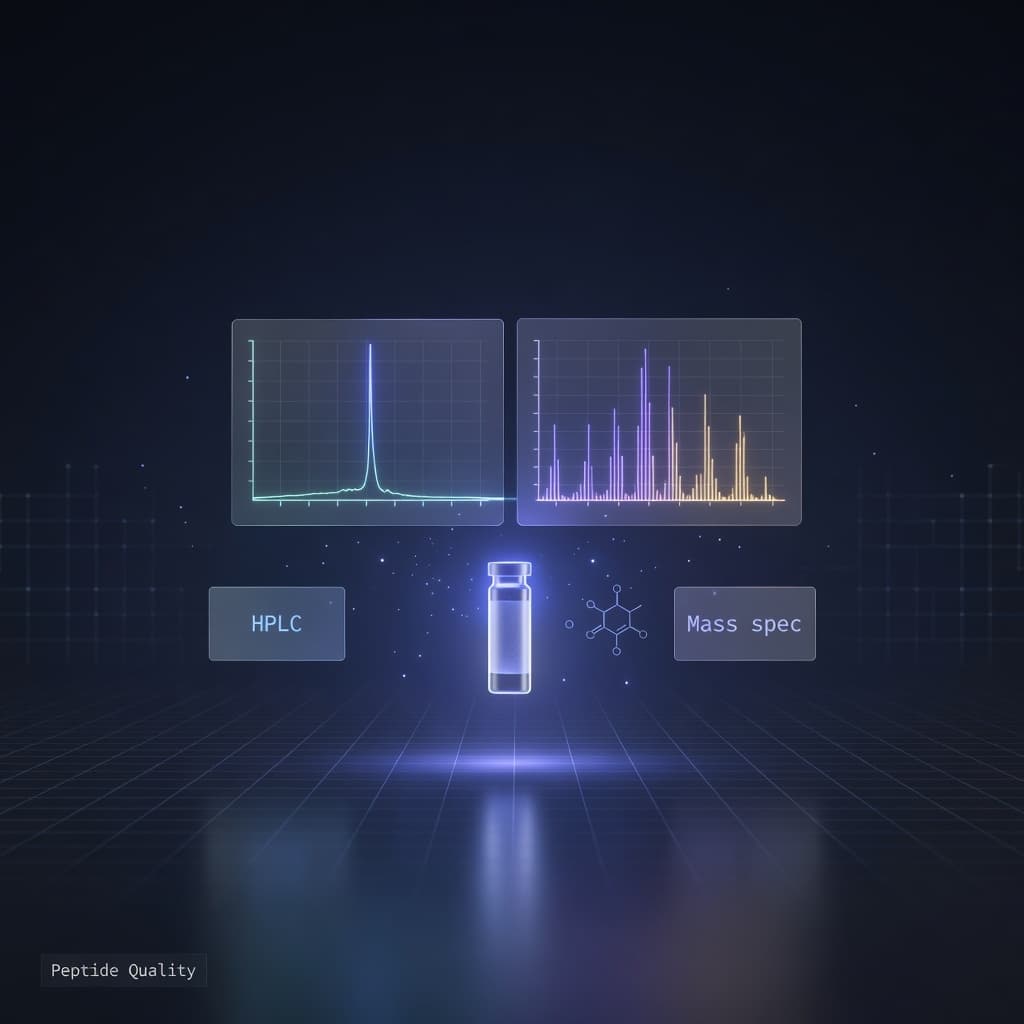
TL;DR: purity, identity and quality are three different questions
HPLC measures purity, not identity. A 99% HPLC peak area tells you how much of the detectable material is one dominant species, not whether that species is the correct sequence.
Mass spectrometry measures identity. It compares the measured mass, and ideally the fragmented sequence, against the intended peptide. A rigorous Certificate of Analysis (CoA) needs both tests, not one or the other.
Research-grade is not automatically lower purity than pharma-grade. The real gap is a manufacturing quality system (GMP, batch records, stability programs), not a purity number on a label.
Lyophilized powder outlasts reconstituted solution by months, not days, because water itself drives the main degradation pathways (hydrolysis, deamidation, oxidation).
Neither HPLC nor mass spec detects bacterial endotoxin. That requires a separate assay entirely, and research-grade material carries no mandatory release specification for it the way parenteral pharmaceuticals do.
"99% pure, third-party tested" is printed on almost every research peptide listing you will find. On its own it is a nearly meaningless sentence: pure by which method, tested for what, measured on the day of manufacture or the day you opened the vial? This article works through what HPLC and mass spectrometry actually measure, what separates research-grade material from pharmaceutical-grade GMP product, why lyophilized powder and pre-mixed (reconstituted) solution are not interchangeable in stability, and what a Certificate of Analysis can and cannot promise. None of this is a claim about biological effect or human use: it is a technical explanation of analytical chemistry and manufacturing practice, for researchers who want to read a spec sheet correctly.
HPLC and Mass Spectrometry Measure Different Things
Reversed-phase HPLC (RP-HPLC) separates the components of a sample by how they interact with a chromatography column, then reports each as a peak. "Purity" on a CoA is a relative number: the target peptide's peak area as a percentage of total UV-absorbing peak area in the chromatogram. It tells you how much of what the detector sees is one dominant species relative to synthesis by-products such as truncated or deleted sequences, deamidation products, and diastereomers (stereoisomers formed during synthesis).
What it does not tell you is whether that species is the correct molecule. A single-residue deletion, insertion, or diastereomer can co-elute with the main peak, coming off the column at the same retention time and getting counted as part of the "pure" peak instead of flagged as an impurity. This is a documented limitation in peptide impurity profiling, and it is exactly why orthogonal methods (HILIC alongside RP-HPLC, or two-dimensional LC-MS) exist: to catch impurities hiding inside an apparently clean RP-HPLC peak.
Mass spectrometry answers a different question: is this the right molecule at all. Electrospray ionization mass spectrometry (ESI-MS) measures the peptide's mass, usually as multiply charged ions, and compares it against the theoretical mass of the intended sequence. Tandem mass spectrometry (MS/MS) goes further, fragmenting the peptide into a ladder of b- and y-ions that confirms the actual sequence rather than just the total mass, and is considered the gold standard for identity, since two different sequences can in principle share the same total mass while being different molecules (Chrone, Lorentzen and Hojrup, PMID 38997482).
Put together: a sample can be 99% pure by HPLC peak area and still be the wrong molecule, a close structural analog, or the right composition arranged in the wrong order. That is exactly why ICH Q6B, the international guideline for specifications of biotechnological and biological products, treats identity and purity as separate specifications rather than one combined number. A CoA reporting only an HPLC chromatogram, with no MS trace, has told you about purity and nothing about identity.
FDA's own Center for Drug Evaluation and Research demonstrated why a single HPLC-UV number is not sufficient for full peptide quality control. Using LC-HRMS on peptide drugs including calcitonin, bivalirudin, and exenatide, the lab combined amino acid composition, sequence confirmation, and impurity quantification, including impurities co-eluting with the main peak, down to below 0.1%, in one experiment (Zeng et al., AAPS J. 2015, PMID 25716148), resolution well beyond a standalone HPLC-UV trace. A serious CoA reports HPLC purity and MS identity as two separate lines, not one combined claim.
Why this matters for a buyer, not just a chemist
If a vendor's CoA shows only a chromatogram with a purity percentage and no mass spectrum, you have evidence of relative purity and no evidence of identity. The two tests are not redundant checks on the same thing, they check different failure modes, and a rigorous CoA needs both. This is the standard we apply to every batch listed at /coa: HPLC purity and MS identity, reported separately.
Research-Grade vs Pharma-Grade vs GMP: What Actually Differs
The most common misconception is that "research-grade" simply means a lower purity number than "pharmaceutical-grade." In practice the percentages can overlap: research-grade synthetic peptides are frequently sold at 98% or higher HPLC purity, numerically comparable to pharmaceutical batch documentation. Purity percentage is not the dividing line.
The real distinction is a manufacturing quality system, defined in regulation, not a marketing claim. In the United States, Good Manufacturing Practice (GMP) for finished pharmaceuticals is codified at 21 CFR Part 211: validated manufacturing processes, environmental monitoring of the production facility, formal deviation and corrective-action investigations, complete batch records with in-process testing data, and ongoing stability programs. None of that is a number you print on a label, it is infrastructure surrounding the synthesis, how the batch was made, monitored, and followed up on, not just what it measured on the day it was tested.
Research-grade peptide manufacturing typically supplies a CoA, identity and purity at the point of release, without that surrounding infrastructure. That is not automatically a defect for a research context: an in-vitro laboratory reagent does not need a validated aseptic fill line the way an injectable pharmaceutical intended for repeated human dosing does. But "research-grade" and "GMP pharmaceutical-grade" answer different questions, one about analytical results on a specific batch, the other about the manufacturing system behind it, and a high purity number does not upgrade a research-grade CoA into the second category.
This distinction has an active legal dimension in 2026. A "research use only" or "not for human consumption" label does not, by itself, place a product outside pharmaceutical regulation if surrounding marketing implies human therapeutic use. FDA has been enforcing exactly this line: on March 31, 2026 (published April 7, 2026), its Center for Drug Evaluation and Research issued seven warning letters to online peptide sellers whose "research use only" labeling was, in FDA's assessment, contradicted by marketing implying human use. A disclaimer is not a substitute for GMP manufacturing when a product is positioned for human administration, and that is a separate legal question from the peptide's analytical quality. Every product at peptidesdirect.io is labeled and sold strictly for laboratory research use, not human consumption, and nothing here is dosing or usage guidance.
A high purity number is not a GMP claim
Do not read "98% pure, research grade" as equivalent to "pharmaceutical grade." The purity figure and the manufacturing-system classification are two separate facts. We sell research-use material with third-party analytical documentation, not GMP-manufactured pharmaceutical product, and we do not represent it as the latter.
Lyophilized vs Pre-Mixed: Why Dry Powder Outlasts Solution
Lyophilization (freeze-drying) removes the great majority of a peptide solution's water by sublimation under vacuum, leaving a dry powder. This matters mechanistically because water is a required reactant, or mobile carrier, for the dominant chemical degradation pathways that affect peptides: hydrolysis, deamidation, and several oxidation routes. Remove most of the water and you sharply slow all three, which is the core reason a lyophilized peptide stays stable far longer than the same peptide once dissolved.
Deamidation of asparagine residues, and to a lesser degree glutamine, is one of the dominant degradation routes for peptides in aqueous solution, proceeding through a cyclic-imide intermediate at neutral-to-basic pH and by direct hydrolysis at acidic pH, with a rate depending strongly on pH, temperature, and solvent (Patel and Borchardt, Pharm Res. 1990, PMID 2395797). A follow-up study quantified how much solvent state matters: deamidation rate constants dropped markedly as solvent viscosity rose from 0.7 to 13 centipoise, with no further change above that, and rates rose with solvent polarity (Li et al., J Pept Res. 2000, PMID 11095186). The more mobile and water-like the environment, the faster this degradation runs, and a lyophilized solid is about as far from that state as you can get.
Oxidation is the other major pathway. Methionine and cysteine side chains are the most easily oxidized residues in peptides, followed by histidine, tryptophan, and tyrosine, and oxidative modification can alter structure, promote aggregation, and reduce biological activity (Torosantucci, Schoneich and Jiskoot, Pharm Res. 2014, PMID 24065593). Trace metal-ion contamination, from water or storage containers, can independently drive oxidative degradation, shown for a histidine-containing fragment of human relaxin (Pharm Res., PMID 10990205), and does not require atmospheric oxygen exposure the way simple air oxidation does.
None of this makes lyophilized powder chemically inert, only much slower to degrade. Residual moisture, oxygen, temperature, and light still drive slow degradation in the dry state, and there is a genuine floor below which drying further backfires: lyophilized-protein studies found an optimum residual moisture level, not simply "the drier the better," since excessively low moisture can itself cause physical instability (Hsu et al., Dev Biol Stand. 1992, PMID 1592175). A study on a lyophilized monoclonal antibody found higher residual moisture measurably decreased chemical stability regardless of glassy or rubbery state (Breen et al., Pharm Res. 2001, PMID 11683251). Dry is much more stable than wet, but "optimal moisture," not "zero moisture," is the actual target.
USP-grade sterile water with 0.9% benzyl alcohol (near-neutral, pH 6.2 to 6.4) - the standard solvent for reconstituting lyophilized peptides. Essential accessory for any peptide research. Each vial is sealed and ready to use.
For reconstitution, bacteriostatic water, 0.9% benzyl alcohol, USP, is the standard diluent for multi-dose research use. By USP convention, a multi-dose vial preserved with benzyl alcohol is discarded 28 days after first puncture when refrigerated. That figure is a microbial safety window tied to the preservative's antimicrobial activity, not a chemical-stability claim: the peptide can degrade through the pathways above well inside that same 28-day window, depending on sequence and storage. Order-of-magnitude figures repeated across peptide-handling technical guides put lyophilized powder frozen around minus 20 degrees Celsius at 12 to 24-plus months of stability (5-plus years at minus 80 degrees Celsius), at room temperature at roughly 1 to 6 months, and reconstituted solution refrigerated at 2 to 8 degrees Celsius at roughly 7 to 30 days. These counts are peptide-specific, drawn from vendor and lab technical guidance rather than one universal peer-reviewed source, so treat them as consensus ranges. Our reconstitution calculator and unit converter run on the same logic: dry powder is the stable, long-shelf-life form, and reconstitution starts a countdown.
What a Certificate of Analysis Actually Guarantees, and What It Doesn't
A Certificate of Analysis for a research peptide documents batch-specific identity, usually via mass spectrometry, and purity, usually via HPLC peak area, at the point the batch was tested, alongside a batch or lot number and the test methods used. That is a genuinely useful claim: this exact manufactured batch, tested on this date, showed this molecular mass and this chromatographic purity.
What it is not is a stability study. A CoA is a point-in-time snapshot, almost always taken on the dry powder shortly after manufacture, and makes no claim about how that material behaves after shipping, reconstitution, or weeks in a refrigerator. Shelf-life is established through a separate type of testing, real-time or accelerated stability programs tracking specifications over time under defined storage, generally part of the GMP infrastructure discussed above rather than something research-grade CoAs perform. If you read a CoA as an implicit promise that the vial will still test the same six weeks after reconstitution, that promise is not in the document.
What a CoA does not cover
A CoA confirms identity and purity of that specific tested batch at the time of testing. It is not a sterility certificate, not a stability guarantee, and not an endotoxin test (see below). Treat it as a snapshot of manufacturing quality control, not a claim about the product's condition weeks or months later, or any statement about biological effect.
On purity thresholds: there is no regulation defining "research-grade" or "pharmaceutical quality" purity cutoffs, only industry convention. Around 95% HPLC purity is commonly described as the practical floor for research-grade material, with 98 to 99%-plus described as pharmaceutical-quality or high-purity research grade. Going from 95% to 99% purity is not a small step, it is a fivefold reduction in impurity fraction, from 5% down to 1% of the detected material: a batch at 99.2% is meaningfully cleaner than one at 96.5%, even though both clear a "research grade" bar. This is why we publish batch-specific CoAs at /coa and explain how to read them at /purity, rather than printing one blanket purity claim across a product line: purity is a per-batch result, not a fixed product attribute.
The Test HPLC and MS Don't Run: Endotoxin
Neither HPLC nor mass spectrometry detects bacterial endotoxin, also called lipopolysaccharide (LPS), a component of the outer membrane of gram-negative bacteria that can trigger a strong biological response even in trace amounts. A peptide sample can be 99% pure by HPLC and correctly identified by MS while still carrying significant endotoxin contamination picked up during synthesis, purification, or handling. Endotoxin requires an entirely separate assay, classically the Limulus Amebocyte Lysate (LAL) test, or the recombinant Factor C alternative, standardized under USP General Chapter 85, Bacterial Endotoxins Test.
For parenteral pharmaceutical products the acceptable endotoxin limit is dose-calibrated: Limit equals K divided by M, where K is a threshold pyrogenic dose (commonly 5 endotoxin units per kilogram body weight per hour for most parenteral drugs) and M is the maximum bolus dose per kilogram. Batch-release specifications commonly target endotoxin levels below roughly 0.5 EU per milliliter, a rigorously enforced, dose-linked GMP specification that illustrates the gap from a different angle: research-grade material, sold explicitly for in-vitro laboratory use, has no equivalent mandatory endotoxin release specification. A purity and identity CoA, however clean, says nothing about endotoxin status unless endotoxin testing is separately listed as a result.
Full-length 43-amino-acid Thymosin Beta-4, a naturally occurring repair protein, independently confirmed by a third-party CoA from Janoshik. Promotes cell migration and new blood vessel formation for systemic tissue healing. Especially researched for muscle, tendon, and cardiac repair.
Gastric pentadecapeptide (15 amino acids) known for exceptional tissue repair properties. Promotes wound healing, angiogenesis, and cytoprotection across tendons, muscles, gut, and nerves. Over 30 years of preclinical research.
This gap is worth keeping in mind for peptides frequently discussed in wound-healing and tissue-research contexts, such as BPC-157 or TB-500: a clean HPLC and MS result on the peptide itself tells you about the molecule, not whether the batch carries elevated endotoxin from upstream processing. If endotoxin matters for your application, look for it as its own line item on the CoA, not something implied by a high purity percentage.
Counterions and the "mg" on the Label
One more nuance rarely discussed on vendor pages: every synthetic peptide is isolated as a salt, not a free base. Acidic counterions, most commonly trifluoroacetate (TFA) left over from the Fmoc solid-phase synthesis cleavage step, or acetate after a subsequent ion-exchange step, bind electrostatically to basic sites on the peptide, the N-terminus and any lysine, arginine, or histidine side chains, and remain part of the lyophilized powder unless a manufacturer deliberately exchanges them out (Roux et al., J Pept Sci. 2008, PMID 18035848).
That has a practical consequence for what "X mg" on a vial actually means. TFA is heavier than acetate, so for a peptide sequence carrying several basic residues, the counterion mass can represent a meaningfully larger fraction of total vial weight than the same peptide as an acetate salt. Two vials both labeled "5 mg" and both showing greater than 98% purity by HPLC area can still differ in actual peptide mass if their salt form differs, unless the CoA states salt-corrected content alongside the chromatographic purity figure. This is a separate parameter from HPLC purity, not a purity difference: a TFA-salt vial is not "less pure," it carries a different, heavier counterion contributing to the total label weight. Retatrutide, a larger, multi-domain peptide with several basic residues, is a useful example: the counterion contribution to vial weight scales with how many basic sites the sequence carries, so larger, more complex peptides are exactly where salt-form disclosure on a CoA matters most.
First-ever triple-action weight management peptide targeting three receptors at once: GLP-1, GIP, and glucagon. Shown exceptional results in Phase 2 trials - up to 24% weight reduction. The most advanced metabolic peptide available.
Bacteriostatic water and research supplies
What to actually check on a CoA
Look for four things on any CoA before treating "purity" as a settled question: an HPLC purity percentage with a chromatogram, a mass spectrometry identity confirmation with the measured mass, a batch or lot number that matches the vial in front of you, and, where relevant to your application, a separate endotoxin result. A CoA missing any of the first two has told you half the story at most.
Frequently Asked Questions
Multi-dose reconstitution for research peptides
Multi-domain peptide where counterion/salt form matters most
Paired wound-healing research peptides
This article is for informational and research purposes only. All products discussed are sold exclusively for in-vitro laboratory research use, not for human consumption or ingestion, and nothing in this article constitutes dosing, medical, or usage guidance.
Research context for English-speaking buyers
Most of our English-speaking customers ship to the UK, Ireland, Malta or other English-as-second-language EU territories. The regulatory picture differs per country.
- Relevant authorities
- MHRA (UK, post-Brexit), HPRA (Ireland, EU-aligned), FDA Section 503A bulks list (US, restricted Cat 2 status of several peptides as of 2026)
- Customs and VAT
- EU shipments include 19% VAT; UK shipments after Brexit are now extra-EU and may attract UK VAT plus a handling fee at import
- Typical shipping window
- EU 2-4 working days, UK 4-7 working days, other international 7-14 working days, depending on customs
Research-grade peptides shipped from our EU warehouse are sold for laboratory use only and are not authorised for human or veterinary therapeutic application in any of the destination jurisdictions. US customers should be aware that the FDA Section 503A bulks list classification (and the April 2026 reclassification of twelve compounds) only governs compounding pharmacies, not direct-to-researcher imports for non-clinical work. UK buyers should declare the consignment on import and may be asked for a research justification by HMRC. We provide a CoA per batch identified by colour code rather than serial number; customs sometimes asks for this document when clearing the parcel.