NAD+ Delivery Routes: IV, Subcutaneous, Oral and Bioavailability in Research
NAD+ delivery routes compared: IV, subcutaneous and oral, and what the research shows about NAD+ bioavailability, in a research context.
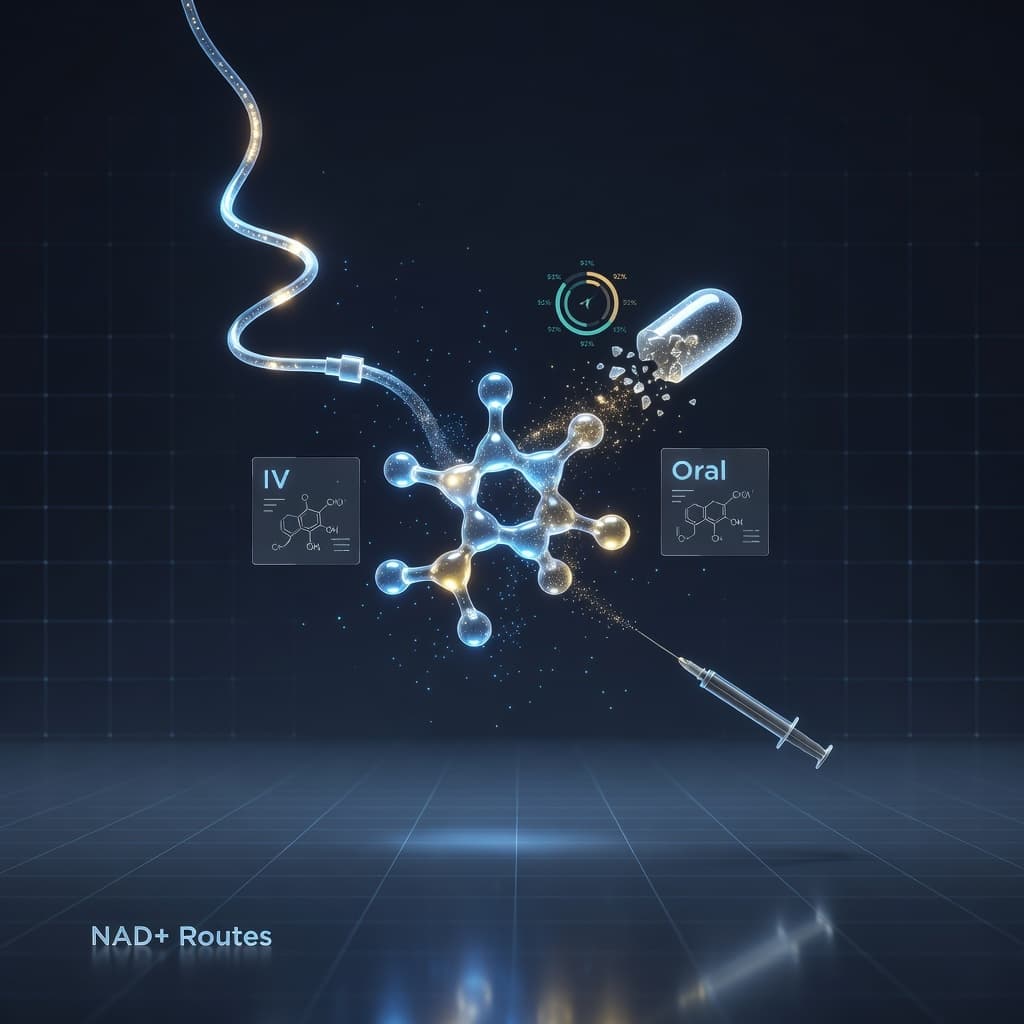
TL;DR: NAD+ delivery routes
NAD+ is a large, doubly charged dinucleotide (about 663 to 664 g/mol) that sits far outside the property range associated with oral absorption, and no confirmed general transporter carries intact NAD+ across a mammalian cell membrane. The only published human pharmacokinetic study of intravenous NAD+ found blood NAD+ did not rise in the first two hours of a six-hour infusion, and a real-world tolerability review found IV NAD+ caused moderate to severe symptoms in every recipient studied. No published human study has tested subcutaneous NAD+ at all, and no published human pharmacokinetic study has tested intact oral NAD+ either. The route with the strongest human evidence for raising NAD+ is, somewhat counterintuitively, not NAD+ itself: oral dosing of the smaller precursors NMN and NR has repeated, peer-reviewed human trial data behind it. Everything below distinguishes preclinical mechanism from the thin human trial record, and none of it is a human dosing protocol.
Why the Delivery Route Matters for a Molecule Like NAD+
NAD+ (nicotinamide adenine dinucleotide) gets marketed across IV drips, subcutaneous injections, oral capsules, sublingual troches and patches, often with the implicit claim that route barely matters as long as the molecule gets in. The chemistry says otherwise. PubChem lists the neutral canonical form of NAD+ (CID 5892) at 663.4 g/mol with the formula C21H27N7O14P2, and the specific cationic species that the name "NAD+" actually refers to (CID 5893, the oxidized, positively charged nicotinamide-ring form) at 664.4 g/mol, C21H28N7O14P2, carrying a formal +1 charge. Both figures sit well above the roughly 500 g/mol ceiling in Lipinski's Rule of Five, the standard rough guide to which molecules can passively cross a gut wall or a cell membrane in useful amounts.
Molecular weight alone would be a weak argument. NAD+ fails on every other axis in the same rulebook. Its topological polar surface area is 321 A^2 (neutral form), more than double the roughly 140 A^2 threshold above which passive intestinal absorption becomes very poor. It carries 7 hydrogen-bond donors and 18 hydrogen-bond acceptors, against Lipinski ceilings of 5 and 10 respectively, and 11 rotatable bonds, above Veber's ceiling of 10. Structurally, NAD+ also carries two ionizable phosphate groups that stay anionic at physiological pH, plus that permanently charged nicotinamide nitrogen, a combination of size, polarity and fixed charge that textbook NAD+ biology has long treated as the reason the molecule cannot cross a lipid bilayer by simple diffusion (Belenky, Bogan and Brenner, Trends Biochem Sci 2007, PMID 17161604).
That is not a single-study claim, it is the consensus starting point for why cells are understood to maintain their NAD+ pool mainly through de novo synthesis or salvage from smaller precursors such as nicotinamide, NR and NMN, rather than by importing whole NAD+ across the membrane (Belenky et al., PMID 17161604). Route selection for a research protocol involving NAD+ therefore is not a matter of taste. It is a question of which barrier, gut wall, extracellular enzymes, or the plasma membrane itself, the molecule has to cross intact, and whether any documented mechanism exists to get it there.
Essential cellular coenzyme that declines with age. Powers energy metabolism in every cell, activates sirtuins (longevity genes), and supports DNA repair. A cornerstone molecule in aging and longevity research.
Oral NAD+: A Molecule Built to Fail Passive Absorption
Given the numbers above, it should not be surprising that no published human pharmacokinetic study was located that dosed intact oral NAD+, as opposed to its precursors, and measured resulting blood NAD+. That is a genuine data gap, not a settled negative result, but it also means the specific bioavailability percentages that circulate on commercial NAD+ vendor blogs, figures like "2 to 5 percent oral bioavailability," are not traceable to any indexed primary study and should not be repeated as verified fact.
What is documented is why oral NAD+ would struggle even if a study existed. Extracellular and gut-lumen NAD+ is actively degraded before intact absorption could plausibly occur. CD38, an NAD+ glycohydrolase with its catalytic domain facing the extracellular space, accounts for over 90 percent of NAD-consuming ecto-enzyme activity in many tissues, breaking NAD+ down into nicotinamide and ADP-ribose (Zeidler et al., Am J Physiol Cell Physiol 2022, PMID 35138178). A separate downstream enzyme, CD73, acts on NMN, the first breakdown product, converting it to NR before any cellular entry. This is not purely a cell-culture abstraction: ex vivo human aortic valve and aorta tissue from cardiac-surgery patients actively hydrolyzed both NAD+ and NMN via CD38 and CD73 activity, confirming the enzymology operates on real human tissue rather than only in isolated assays, even though that particular study was set in a disease context (calcific aortic valve disease) rather than gut absorption specifically (Jablonska et al., J Cell Mol Med 2021, PMID 34142751).
One narrow exception worth knowing
It would overstate the science to say NAD+ literally never crosses an intact membrane under any circumstance. Connexin-43 hemichannels, studied in isolated fibroblasts and in reconstituted proteoliposomes, were shown to mediate bidirectional, calcium-regulated NAD+ flux across an intact membrane, the first demonstrated route for a nucleotide this large to cross one (Bruzzone et al., FASEB J 2001, PMID 11099492). This is a specific gap-junction-protein mechanism in particular cell types, not a general absorption pathway, and it has never been shown to explain oral or IV uptake of NAD+ in humans. It belongs in the picture for accuracy, not as a reason to expect meaningful gut or systemic absorption.
Why the Field Uses NMN and NR Instead of NAD+ Itself
The practical response to NAD+'s poor absorption profile has not been to push harder on NAD+ delivery, it has been to shift research toward its smaller precursors. Oral nicotinamide riboside (NR) is, in the words of the pivotal human trial itself, "uniquely and orally bioavailable," producing a dose-dependent rise in the blood NAD+ metabolome at single oral doses of 100, 300 and 1000 mg, without the flushing reaction that nicotinic acid causes (Trammell et al., Nat Commun 2016, PMID 27721479). NMN has a comparable, independently repeated human trial record. Our companion article, NAD+ vs NMN vs NR: Which Precursor Does the Research Actually Support?, walks through that full trial record precursor by precursor rather than repeating it here.
The kinetics of that oral precursor route are slow and compartment dependent, which matters for anyone comparing it to the acute, single-session kinetics of an IV infusion. A pharmacokinetic study giving 1200 mg per day of an oral NAD+ precursor, NR or NMN, to healthy volunteers and to Parkinson's disease patients (n=12 across stages) found blood NAD+ metabolites plateaued only after about two weeks of daily dosing, while a measurable cerebral (brain) NAD+ increase, tracked by imaging and spectroscopy, appeared only after about four weeks (Berven et al., iScience 2026, PMID 41858901). That timeline, weeks rather than hours, is the opposite shape from what an IV infusion protocol implicitly promises, and it is a fact worth holding next to the acute IV data in the next section.
Intravenous NAD+: What the Human Pharmacokinetic Data Actually Show
IV NAD+ is marketed as the most direct route available, on the logic that it bypasses gut absorption entirely. The one published human pharmacokinetic study of the route complicates that logic rather than confirming it. Eight healthy men received 750 mg of NAD+ by IV infusion (3 umol per minute) over six hours, with three additional subjects receiving saline as controls. Blood and plasma NAD+ did not rise during the first two hours; the paper states NAD+ was "rapidly and completely removed from the plasma for at least the first 2 h." The urine and plasma metabolite profile was consistent with NAD+ glycohydrolase and NAD+ pyrophosphatase activity, meaning much of the infused material appears to have been broken down extracellularly rather than taken up intact by tissue (Grant et al., Front Aging Neurosci 2019, PMID 31572171). This was a small pilot study: no clinical efficacy endpoints were tested, no half-life was reported, and it describes a single research infusion protocol, not a recommendation.
Tolerability data point the same direction. A retrospective electronic-medical-record review from a commercial IV wellness clinic compared 500 mg NAD+ to 500 mg nicotinamide riboside (NR), both given in 500 mL saline over four consecutive days with 30-day follow-up. Every NAD+ recipient reported moderate to severe symptoms, abdominal cramping, nausea, vomiting, an elevated heart rate and chest pressure, while the IV NR group reported only minor, transient tingling or mild cramping. Because of these symptoms, NAD+ infusions had to run far more slowly, averaging about 97 minutes versus about 37 minutes for NR, a roughly 60 percent shorter run time for NR. All symptoms resolved once the infusion stopped (Reyna et al., Front Aging 2026, PMID 41704678).
An unreviewed preprint points the same direction, with a caveat
A newer randomized pilot adds a possible inflammatory signal to the same pattern, but it is not yet peer-reviewed and is funded by an NR manufacturer, so it should be read cautiously and flagged as preliminary. Single acute IV doses of 500 mg NAD+, 500 mg NR, 500 mg oral NR or saline placebo were compared in healthy adults across a two-phase design (n=37, then n=16). NR infused roughly 75 percent faster than NAD+. IV NAD+ raised white-blood-cell and neutrophil counts, a possible acute inflammatory response, while IV NR did not, and IV NR produced the largest acute rise in blood NAD+ at three hours, plus 20.7 percent versus baseline, numerically outperforming IV NAD+ itself (medRxiv preprint 2024.06.06.24308565, industry funded, no PMID, not peer reviewed).
It is also worth being transparent about where the IV NAD+ protocol itself comes from. The commonly cited "BR+NAD" infusion protocol was developed in 2001 at a private addiction-recovery clinic in Louisiana, a trademarked commercial protocol rather than an output of an academic pharmacology program, and IV NAD+ clinics today remain an unregulated wellness offering rather than an FDA- or EMA-approved therapy for any condition. One coauthor of the sole published IV NAD+ pharmacokinetic pilot is affiliated with that same clinic, a transparency point about the field's origins rather than a reason to dismiss the data itself.
Subcutaneous NAD+: The Route With No Published Human Data
Subcutaneous NAD+ is widely sold and discussed, but a direct search of the literature for it comes up essentially empty. A targeted PubMed search for subcutaneous NAD+ randomized trials returned zero relevant results as of this review. No published human pharmacokinetic study or randomized controlled trial of the subcutaneous route currently exists in the indexed literature. Specific claims seen on commercial sites describing, for example, a "randomized trial of subcutaneous NAD+ in adults over 45" could not be traced to any indexed publication in this research pass, and should not be treated as evidence.
That absence cuts both ways. It does not mean subcutaneous delivery has been shown not to work, only that no controlled human data currently exists either way, a genuinely open question rather than a settled negative or positive. For a research protocol involving subcutaneous administration in an animal or in vitro model, that gap itself is a legitimate design starting point, and any claim that subcutaneous NAD+ has already been "clinically studied" in humans should be treated skeptically until a specific, checkable trial can be cited.
Reconstitution, Stability and Handling NAD+ as a Research Material
Route aside, NAD+ supplied as lyophilized powder for laboratory reconstitution has its own handling chemistry worth getting right. Oxidized NAD+, the form sold as a research material, is comparatively stable in neutral-to-mildly-acidic aqueous solution, but its labile nicotinamide-ribose glycosidic bond hydrolyzes under alkaline conditions, releasing free nicotinamide and ADP-ribose and destroying the cofactor's identity. That is the opposite pH-sensitivity pattern from the reduced form, NADH, which is instead acid-labile and comparatively alkaline-stable. Marketing copy that treats both forms as equally sensitive to acid and alkali in the same direction is oversimplifying real cofactor chemistry.
Buffer identity, not only pH, materially changes the degradation rate. A 2024 peer-reviewed stability study found that at pH 8.5 and 19 degrees C, NAD+ held in Tris buffer lost only about 4 percent of signal over 43 days, while the same pH and temperature in phosphate buffer left it "degraded nearly entirely" over the same period, phosphate appears to catalyze the breakdown (activation energy around 46 kJ/mol in phosphate versus roughly 125 to 128 kJ/mol in Tris or HEPES). The same study's NADH data show that a 6 degree C rise, from 19 to 25 degrees C, roughly doubled to tripled the degradation rate (Wolfe et al., Molecules 2024, PMID 39598842).
The general lyophilization principle that applies to labile biomolecules broadly, not a measurement specific to NAD+, is that freeze-dried powder is markedly more storage-stable than reconstituted solution, because the dominant degradation pathway is hydrolysis, which requires water. Once reconstituted for a laboratory protocol, solution should be kept cold, protected from light, used promptly, and not subjected to repeated freeze-thaw cycles. Very specific numeric claims about reconstituted NAD+ potency loss that circulate on commercial peptide-shop blogs, figures like a stated percentage lost after a stated number of hours at room temperature, attributed to an unnamed study, could not be traced to any indexed publication in this research pass and should be treated as unverified marketing content, even where their general direction, cold storage plus fast use equals better, matches real cofactor chemistry.
Every NAD+ batch sold through this shop carries an independent third-party Certificate of Analysis from Janoshik, listed by batch at /coa with the raw chromatogram viewable at verify.janoshik.com, and general purity methodology is explained at /purity. For calculating dilution volumes for a laboratory reconstitution protocol, the reconstitution calculator covers common buffer volumes; it does not replace a molecule-specific stability protocol.
USP-grade sterile water with 0.9% benzyl alcohol (near-neutral, pH 6.2 to 6.4) - the standard solvent for reconstituting lyophilized peptides. Essential accessory for any peptide research. Each vial is sealed and ready to use.
Common Claims Worth Re-Checking
A few specific claims recur often enough in NAD+ marketing to name directly. "IV NAD+ is the most direct, most effective way to raise NAD+" does not match the one available human pharmacokinetic pilot, where blood NAD+ did not rise in the first two hours of a six-hour infusion (PMID 31572171), nor the tolerability data showing worse side effects and a far slower required infusion rate than IV NR (PMID 41704678). "Subcutaneous NAD+ has been clinically studied in humans" does not match a literature search that returned zero relevant results for that specific claim. "Oral NAD+ supplements deliver intact NAD+ into the bloodstream" is not supported by any located human pharmacokinetic study, and it runs directly against NAD+'s own molecular properties plus the CD38 and CD73 ecto-enzyme activity described above, which is precisely why the field pivoted to the smaller precursors NMN and NR instead.
The counterintuitive summary
The route with the strongest verified human evidence for raising NAD+ is not oral NAD+, not IV NAD+, and not, as far as the current evidence shows, subcutaneous NAD+. It is oral dosing of the smaller precursor molecules NMN and NR, which are not NAD+ at all, but feed into the same salvage pathway one or two enzymatic steps upstream. That is the central, slightly ironic finding running through the delivery-route literature reviewed here.
NAD+ in the Wider Longevity Research Toolkit
NAD+ delivery rarely sits in isolation in a longevity-adjacent research program. MOTS-C is a mitochondrial-derived peptide studied mainly as an AMPK activator in animal models of metabolic and exercise physiology, adjacent to the same mitochondrial energy axis NAD+ feeds into, with human outcome data still thin. Epitalon sits in the geroprotector literature, mostly animal and cell-culture work on telomerase activity, a similarly preclinical-dominant evidence base. Neither should be read as more clinically validated than the NAD+ delivery-route data summarized above; both are mechanistically interesting and thin on human trial data, and both deserve the same route-and-evidence scrutiny applied to NAD+ itself.
For the wider precursor comparison, see NAD+ vs NMN vs NR: Which Precursor Does the Research Actually Support?. For brain aging specifically, see NAD+ 2026: Aging, Brain Health and What the NMN Human Studies Really Show.
Mitochondrial-derived signaling peptide (16 amino acids) that mimics the effects of exercise at the cellular level. Activates AMPK, improves glucose uptake, and enhances fat metabolism - a key tool in metabolic and longevity research.
Tetrapeptide (Ala-Glu-Asp-Gly) that activates telomerase, the enzyme responsible for maintaining telomere length. One of the most studied peptides in longevity research, developed by Prof. Khavinson at the St. Petersburg Institute of Bioregulation.
Mitochondrial function, NAD+ metabolism, telomere maintenance
NAD+ salvage-pathway and cofactor delivery research
Reconstituting lyophilized cofactor and peptide vials
FAQ
This article describes research findings for research and educational purposes only. Nothing here is medical advice, a treatment protocol, or a human dosing recommendation. All research peptide and cofactor materials sold through this shop are intended for laboratory and research use only, not for human consumption.
Research context for English-speaking buyers
Most of our English-speaking customers ship to the UK, Ireland, Malta or other English-as-second-language EU territories. The regulatory picture differs per country.
- Relevant authorities
- MHRA (UK, post-Brexit), HPRA (Ireland, EU-aligned), FDA Section 503A bulks list (US, restricted Cat 2 status of several peptides as of 2026)
- Customs and VAT
- EU shipments include 19% VAT; UK shipments after Brexit are now extra-EU and may attract UK VAT plus a handling fee at import
- Typical shipping window
- EU 2-4 working days, UK 4-7 working days, other international 7-14 working days, depending on customs
Research-grade peptides shipped from our EU warehouse are sold for laboratory use only and are not authorised for human or veterinary therapeutic application in any of the destination jurisdictions. US customers should be aware that the FDA Section 503A bulks list classification (and the April 2026 reclassification of twelve compounds) only governs compounding pharmacies, not direct-to-researcher imports for non-clinical work. UK buyers should declare the consignment on import and may be asked for a research justification by HMRC. We provide a CoA per batch identified by colour code rather than serial number; customs sometimes asks for this document when clearing the parcel.