Growth Hormone, GH Secretagogues and Related Hormonal Compounds: An Overview
Overview of GHRH analogues, GHRPs, IGF-LR3 and Melanotan 2 with focus on mechanisms, signalling pathways and typical research applications.
The compounds covered here span a broad spectrum. They include short peptides, protein-based agents and glycoprotein hormones. Growth hormone secretagogues, reproductive hormones and melanocortin agonists engage different endocrine systems and each carry a distinct pharmacological profile. Below is an overview of the relevant hormonal compounds at PeptidesDirect, with focus on mechanisms, signalling pathways and typical research applications.
How the GH Axis Works
The Growth Hormone Signalling Cascade
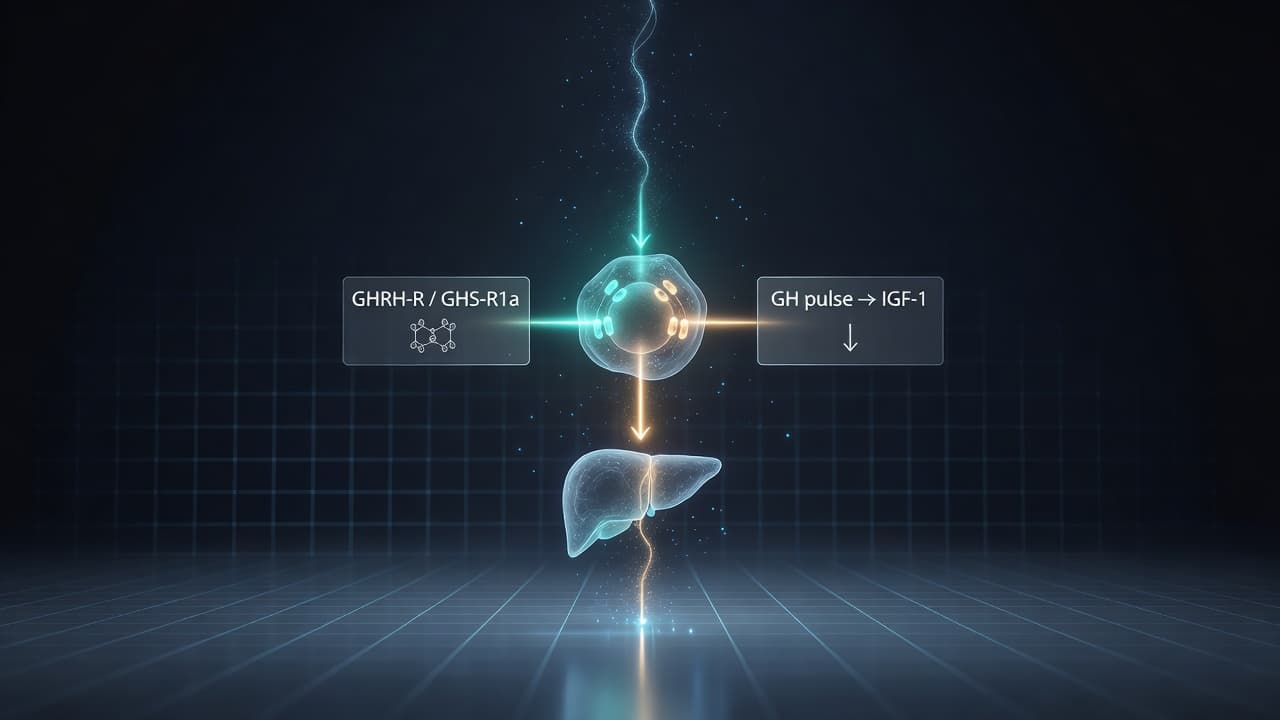
The hypothalamus releases GHRH, which stimulates GH secretion from the anterior pituitary. Somatostatin, also from the hypothalamus, acts as a counter-regulatory signal. Once GH enters the bloodstream, it stimulates IGF-1 production primarily in the liver, which mediates many downstream effects on target tissues.
Sermorelin, Tesamorelin and CJC-1295 act at the beginning of this cascade by mimicking GHRH. Ipamorelin, in contrast, stimulates the ghrelin receptor GHS-R1a at somatotrophs in the pituitary. IGF-LR3 acts even further downstream, providing the downstream growth factor without involving GH.
Where a peptide intervenes in this chain determines its effects, its limitations and the type of research it is suited for.
CJC-1295/Ipamorelin Mix - Dual GH Secretion via Two Pathways
The CJC-1295/Ipamorelin combination pairs two peptides targeting different receptors to stimulate GH release.
CJC-1295 in technical literature typically refers to the DAC variant - a modified GHRH analogue with a Drug Affinity Complex. This extends its half-life to several days. A no-DAC variant is also frequently discussed, technically described separately as Mod-GRF(1-29), which acts considerably shorter. CJC-1295 with DAC binds the GHRH receptor on pituitary somatotrophs and amplifies GH signals via the GHRH side of the axis. Due to extended exposure, the pattern does not necessarily match a strictly physiological pulse profile.
What we stock below as CJC-1295 (No DAC) is this short-acting no-DAC form, i.e. Mod-GRF(1-29), not the DAC variant described above. Its half-life is roughly 30 minutes, not several days. When reading a study labelled simply "CJC-1295," always check which molecule was actually used, it is usually the DAC form, not the one shipped here. The third-party Janoshik report for this batch confirms the identity, labelling it "Cjc_no_dac" (verify the certificate). For the full mechanism and evidence behind this specific molecule, see our guide Mod GRF 1-29 Explained.
Ipamorelin works via a different receptor. It is a growth hormone-releasing peptide (GHRP) that acts as an agonist at the ghrelin receptor GHS-R1a. Compared to GHRP-6 or GHRP-2, ipamorelin is considered more selective, with generally lower effects on cortisol and prolactin. Its appetite-stimulating effect is also frequently described as lower, though this should not be categorically excluded.
Synergistic dual receptor activation
When a GHRH analogue is combined with a GHRP, the GH response is often stronger than with either compound alone. The two receptor systems can potentiate each other, generating a substantially larger GH release. How closely this pattern approximates physiological pulsatility, however, depends on the specific protocol and in particular whether a long-acting DAC variant or a short-acting GHRH analogue is used.
2-in-1 growth hormone stack: CJC-1295 no-DAC (Modified GRF 1-29) + Ipamorelin, available as a 10 mg blend vial (5 mg + 5 mg co-lyophilized) or as the 20 mg option with two separately sealed single vials (10 mg + 10 mg). The CJC-1295 component is the short-acting no-DAC variant (about 30 minute half-life), not the long-acting DAC form. Stimulates natural GH release through two different pathways for amplified, more physiological growth hormone pulses.
CJC-1295 without DAC (Mod GRF 1-29) is a short-acting GHRH(1-29) analog for GH/IGF-1 research. Research-grade lyophilized powder, specified purity >=99% (HPLC). Laboratory use only.
Highly selective growth hormone releaser that triggers natural GH pulses without raising cortisol or prolactin. Clean GH stimulation with minimal side effects - the most targeted growth hormone peptide available.
Sermorelin - A Physiologically Close GHRH Fragment
Sermorelin consists of the first 29 amino acids of the 44-amino-acid GHRH molecule - the biologically active fragment. It stimulates GH release via the endogenous GHRH receptor and generates short GH pulses that more closely approximate the physiological secretion pattern than direct GH administration.
For certain research designs, the key point is that Sermorelin engages the endogenous axis. As GH rises, somatostatin and other feedback mechanisms modulate further release. This typically limits the response, though it does not make excessive stimulation categorically impossible. Sermorelin was also used clinically as a diagnostic agent under the brand name Geref.
Sermorelin vs. CJC-1295: The half-life trade-off
The principal difference from CJC-1295 with DAC is the half-life. Sermorelin is cleared within minutes, generating a relatively brief GH pulse. CJC-1295 with DAC persists considerably longer in the system, leading more to sustained exposure than clearly separated pulses. The frequently separately discussed no-DAC variant, usually labelled Mod-GRF(1-29), is pharmacokinetically closer to short-acting GHRH analogues, and it is this no-DAC form, not the DAC variant, that we stock as CJC-1295 (No DAC). For studies of GH dynamics, Sermorelin's short duration of action can therefore be an advantage, whereas CJC-1295 with DAC (a molecule we do not carry) is better suited to prolonged stimulation models.
Sermorelin is suited for physiological GH secretion studies, GHRH receptor pharmacology, models of age-related GH decline and diagnostic testing protocols.
GHRH(1-29) analog for physiological growth hormone stimulation research
Tesamorelin - Focus on Visceral Fat
Tesamorelin is a further GHRH analogue, modified with a trans-3-hexenoic acid group at tyrosine in position 1. This modification improves stability. In the United States, the formulation Egrifta WR was approved on 25 March 2025 for reduction of excess visceral abdominal fat in adults with HIV and lipodystrophy. Previously, Tesamorelin was marketed under the brand names Egrifta and later Egrifta SV.
Clinical trial data for Tesamorelin focus primarily on reduction of visceral adipose tissue. Accordingly, it is particularly relevant for research on visceral fat metabolism, lipodystrophy models and GH-mediated effects on fat distribution. It targets the same GHRH receptor as Sermorelin but carries a different pharmacokinetic profile due to its structural modification.
Modified GHRH analog for lipodystrophy and metabolic liver research
IGF-LR3 - Downstream of the GH Axis
IGF-LR3 (Insulin-like Growth Factor 1, Long-R3 variant) takes a different approach. Rather than stimulating GH release and waiting for hepatic IGF-1 production, it delivers a modified IGF-1 directly.
The R3 modification
The R3 modification reduces binding to IGF-binding proteins (IGFBPs), which can increase bioavailability and extend effective half-life. IGF-LR3 activates the IGF-1 receptor and triggers PI3K/Akt and MAPK signalling cascades. It is therefore relevant for models involving proliferative and anabolic IGF-1 effects.
This peptide is suited for research questions about downstream GH effects rather than GH itself - for example, cell proliferation models, IGF-1 receptor signalling, muscle hypertrophy mechanisms or metabolic studies where IGF-1 activity needs to be separated from GH activity.
Long R3 variant of Insulin-like Growth Factor 1, modified for reduced IGFBP binding and ~20-30 hour half-life. Researched for cell proliferation, hypertrophy, and metabolic signaling. ≥99% purity.
Melanotan 2 - Beyond Pigmentation
Melanotan 2 (MT-2) is a synthetic cyclic analogue of alpha-melanocyte-stimulating hormone. It is classified among hormonal peptides for its endocrine effects, even though technically it is a melanocortin peptide.
MT-2 acts non-selectively at the various melanocortin receptor subtypes. Its activity at MC1R drives melanogenesis and thus the pigmentation pathway. It also activates MC4R, which is involved in appetite regulation and sexual function, among other processes. The cyclic structure confers greater stability than linear alpha-MSH.
Research applications include melanocortin receptor pharmacology, pigmentation biology, appetite and energy homeostasis via MC4R, sexual function and UV-protective mechanisms of the skin.
Tanning peptide that activates melanin production in the skin. Stimulates melanocyte receptors for natural UV-free pigmentation. Also researched for appetite regulation and libido effects.
Selecting the Right Compound for Your Research
The choice depends primarily on where in the signalling cascade intervention is desired and which research question takes priority.
Enhanced GH secretion via two endogenous receptor systems
Relatively selective GH release via the ghrelin receptor
GHRH-mediated GH pulses with short duration of action
Visceral fat research and HIV-associated lipodystrophy
Downstream IGF-1 signalling without direct GH administration
Melanocortin receptor research and pigmentation biology
Thinking in tiers for GH axis research
For GH axis research, a tiered perspective is useful:
- Want to stimulate GH release? Then the GHRH pathway (Sermorelin, CJC-1295, Tesamorelin), the ghrelin pathway (Ipamorelin) or the combination are the options. The secretagogues are compared against the natural growth-hormone response.
- Want to study downstream IGF-1 signals without direct GH administration? Then IGF-LR3 is the more appropriate tool.
Quality and Ordering
PeptidesDirect provides analytical documents for hormonal peptides, including Janoshik COAs for purity testing. For practical planning, information on shipping, availability and reconstitution may also be relevant. Bacteriostatic water is also available separately.
Related Products
2-in-1 growth hormone stack: CJC-1295 no-DAC (Modified GRF 1-29) + Ipamorelin, available as a 10 mg blend vial (5 mg + 5 mg co-lyophilized) or as the 20 mg option with two separately sealed single vials (10 mg + 10 mg). The CJC-1295 component is the short-acting no-DAC variant (about 30 minute half-life), not the long-acting DAC form. Stimulates natural GH release through two different pathways for amplified, more physiological growth hormone pulses.
GHRH(1-29) analog for physiological growth hormone stimulation research
Modified GHRH analog for lipodystrophy and metabolic liver research
Long R3 variant of Insulin-like Growth Factor 1, modified for reduced IGFBP binding and ~20-30 hour half-life. Researched for cell proliferation, hypertrophy, and metabolic signaling. ≥99% purity.
Frequently Asked Questions
Research context for English-speaking buyers
Most of our English-speaking customers ship to the UK, Ireland, Malta or other English-as-second-language EU territories. The regulatory picture differs per country.
- Relevant authorities
- MHRA (UK, post-Brexit), HPRA (Ireland, EU-aligned), FDA Section 503A bulks list (US, restricted Cat 2 status of several peptides as of 2026)
- Customs and VAT
- EU shipments include 19% VAT; UK shipments after Brexit are now extra-EU and may attract UK VAT plus a handling fee at import
- Typical shipping window
- EU 2-4 working days, UK 4-7 working days, other international 7-14 working days, depending on customs
Research-grade peptides shipped from our EU warehouse are sold for laboratory use only and are not authorised for human or veterinary therapeutic application in any of the destination jurisdictions. US customers should be aware that the FDA Section 503A bulks list classification (and the April 2026 reclassification of twelve compounds) only governs compounding pharmacies, not direct-to-researcher imports for non-clinical work. UK buyers should declare the consignment on import and may be asked for a research justification by HMRC. We provide a CoA per batch identified by colour code rather than serial number; customs sometimes asks for this document when clearing the parcel.