Which Peptides Increase BDNF? Semax, Selank and BPC-157 in the Research
What the preclinical literature actually shows about Semax, Selank and BPC-157 and BDNF: the neurotrophin, TrkB, the hippocampus, and where the evidence is strong versus thin.
TL;DR: What the neurotrophin literature actually shows
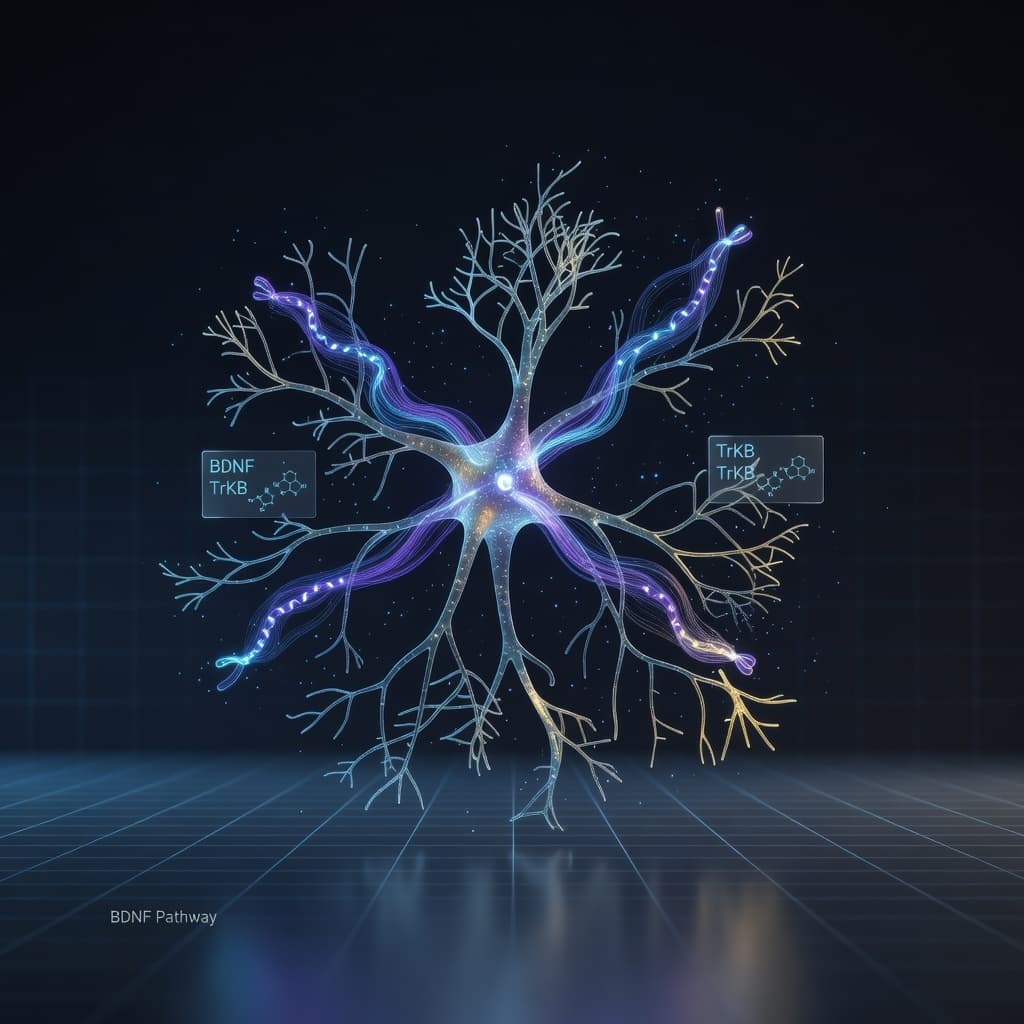
BDNF (brain-derived neurotrophic factor) acts through the TrkB receptor and is understood to support synaptic plasticity, hippocampal neurogenesis and memory consolidation. It is the most-studied neurotrophin in the peptide-nootropic conversation. Semax has the strongest and most specific data: a single intranasal dose in rats raised hippocampal BDNF protein, TrkB activation and BDNF mRNA (PMID 16996037). Selank also shifts hippocampal neurotrophins, raising Bdnf mRNA at about 3 hours and BDNF protein at about 24 hours in rats (PMID 18841804). BPC-157 is the weakest case: a 2024 review frames its brain effects as broad cytoprotection and growth-factor modulation, and notes there are no human trials (PMID 38675421). A specific, well-replicated "BPC-157 raises BDNF" finding is not established. All of this is preclinical. No human trial establishes a BDNF-raising or cognitive benefit for any of the three.
Few molecules come up in the peptide-nootropic literature as often as BDNF. It is the growth factor most tightly linked to learning, memory and the brain's capacity to rewire itself, so any compound that plausibly raises it attracts attention. This article looks at what the actual preclinical research says about three research peptides frequently discussed in that context, Semax, Selank and BPC-157, and, just as importantly, where the evidence is strong and where it is thin. All findings below come from animal or cell studies. None of these compounds has a human trial showing a BDNF-raising or cognitive effect, and everything here is written for laboratory research context only.
Neuroprotective and nootropic peptides
What BDNF Actually Does: Neurotrophins, TrkB and the Hippocampus
BDNF is a secreted protein of the neurotrophin family. It signals mainly through its high-affinity receptor TrkB, and that signalling is understood to support long-term potentiation (the cellular basis of learning), dendritic spine growth, adult hippocampal neurogenesis and the consolidation of memory. Its relative, nerve growth factor (NGF), signals through a different receptor (TrkA) and is more associated with cholinergic-neuron survival and peripheral nerve maintenance.
The central research question for the peptides below is narrow and specific: do they raise BDNF (and NGF) signalling, and if so, where in the brain and for how long? As the data show, the answer is not a simple "yes everywhere". Neurotrophin responses are region-specific and temporally staged, and they were measured in rodents, not people.
Semax and BDNF: The ACTH(4-10) Analogue With the Strongest Data
Semax is a synthetic analogue of the ACTH(4-10) melanocortin fragment: the heptapeptide Met-Glu-His-Phe-Pro-Gly-Pro, an ACTH(4-7) core plus a C-terminal Pro-Gly-Pro extension that resists enzymatic breakdown. Of the three compounds here, it has the most direct neurotrophin data.
The core hippocampal finding (PMID 16996037)
In rats, a single intranasal application of Semax produced a maximal roughly 1.4-fold increase in hippocampal BDNF protein, an approximately 1.6-fold increase in TrkB tyrosine phosphorylation (receptor activation), and around a 3-fold rise in exon-III BDNF mRNA with a 2-fold rise in TrkB mRNA. In other words, it raised both the neurotrophin and the activation of its receptor, tying Semax's reported cognitive effects to the hippocampal BDNF/TrkB system.
That single-study finding is reinforced by a broader body of work from the same research groups. Semax stimulates BDNF expression across multiple regions of the living rat brain, establishing the effect as a reproducible in-vivo signal rather than a cell-culture artefact (PMID 14556513). It also produces rapid, region-specific changes: intranasal Semax increased both NGF and BDNF genes in the hippocampus, raised BDNF in the brainstem and cerebellum, but lowered NGF in the frontal cortex (PMID 17353092). A time-course study went further, showing multidirectional, tissue-specific dynamics, including transient early decreases in one region alongside increases in another (PMID 19662538). The honest reading is that Semax modulates the neurotrophin system in a staged, region-dependent way, not that "BDNF goes up everywhere".
Semax's neuroprotective profile also extends beyond neurotrophins. A genome-wide transcriptional analysis in a rat focal-ischemia model found Semax predominantly up-regulated genes tied to the immune and vascular systems, with the immune effect strengthening by 24 hours (Medvedeva et al., BMC Genomics 2014, PMC3987924). That places its mechanism in a wider neuroinflammatory and angiogenic context rather than a single pathway.
Brain-boosting nootropic peptide derived from ACTH. Increases BDNF (brain-derived neurotrophic factor), enhances focus, memory, and mental clarity. Widely used in Russian clinical practice for cognitive enhancement.
Selank and BDNF: A Tuftsin Analogue That Also Shifts Hippocampal Neurotrophins
Selank is a synthetic heptapeptide, Thr-Lys-Pro-Arg-Pro-Gly-Pro, derived from the immunomodulatory peptide Tuftsin with the same Pro-Gly-Pro stabilising tail as Semax. It is usually studied for anxiolytic and immunomodulatory effects, but it also has a direct neurotrophin signal.
Selank and hippocampal BDNF (PMID 18841804)
Intranasal Selank regulated BDNF expression in the rat hippocampus in vivo: it raised Bdnf mRNA about 3 hours after administration and BDNF protein about 24 hours after administration (at study doses of 250 and 500 micrograms per kilogram). That temporal pattern, mRNA first and protein later, indicates Selank stimulated local hippocampal neurotrophin synthesis rather than simply moving existing protein around.
Alongside this, Selank is also studied for possible GABAergic and monoaminergic activity as part of its anxiolytic-leaning research profile, though those mechanisms are less directly evidenced here than its hippocampal BDNF signal. Its direct BDNF dataset is real but thinner than Semax's, so the fair summary is that Selank shifts hippocampal neurotrophins as one part of a broader stress-modulating profile.
Synthetic tuftsin analog with anxiolytic, nootropic, and immunomodulatory properties. Developed at the Russian Academy of Sciences.
BPC-157 and Neurotrophins: Where the Evidence Is Thinnest
BPC-157 is a stable gastric pentadecapeptide (GEPPPGKPADDAGLV) studied mostly for tissue repair. It frequently appears in "peptides that raise BDNF" lists, but the primary literature does not support that claim as cleanly as it does for Semax and Selank.
Be precise: BPC-157's BDNF link is not well established
A comprehensive 2024 review synthesises decades of preclinical work indicating BPC-157 modulates dopaminergic, serotonergic, glutamatergic, GABAergic and nitric-oxide systems and shows neuroprotective and antidepressant-like effects in animal models, while explicitly noting no confirmed direct receptor and no human trials (PMID 38675421). Its documented central actions are best described as cytoprotection plus modulation of neurotransmitter and growth-factor pathways (including the nitric-oxide system), not a specific, replicated up-regulation of hippocampal BDNF. Claims that "BPC-157 raises BDNF" mostly trace to secondary sources rather than primary studies, so this article does not assert it as a proven BDNF inducer.
That does not make BPC-157 uninteresting for CNS research; it makes the neurotrophin framing the wrong one. Its animal-model story is about broad cytoprotection and neurotransmitter- and growth-factor-pathway modulation, measured after systemic administration in injury models rather than intranasal delivery.
Gastric pentadecapeptide (15 amino acids) known for exceptional tissue repair properties. Promotes wound healing, angiogenesis, and cytoprotection across tendons, muscles, gut, and nerves. Over 30 years of preclinical research.
Head to Head: How the Three Differ in the Neurotrophin Literature
Directness of the BDNF evidence, ranked
- Semax: strongest and most specific, hippocampal BDNF protein, TrkB activation and mRNA (PMID 16996037), replicated across regions (PMID 14556513).
- Selank: clear but thinner, hippocampal Bdnf mRNA at 3 hours and protein at 24 hours (PMID 18841804).
- BPC-157: weakest direct evidence, broad neuroprotection and growth-factor modulation in animal models, no established specific BDNF finding and no human trials (PMID 38675421).
The three also arrive at the brain from different starting points. Semax derives from ACTH (a stress-axis fragment), Selank from Tuftsin (an immune peptide), and BPC-157 from a gastric protective protein. Their functional leans differ too: Semax is studied as pro-cognitive and neuroprotective, Selank as anxiolytic and stress-modulating, and BPC-157 as a broad cytoprotective and regenerative agent whose CNS effects come through neurotransmitter-system modulation rather than one neurotrophin. Finally, the route matters for honesty: the Semax and Selank neurotrophin data come from intranasal dosing in rats with rapid onset, while BPC-157 CNS studies use systemic dosing in injury models.
Most direct hippocampal BDNF/TrkB data
Neurotrophin plus anxiolytic/stress research
The Semax and Selank Combination
Because Semax leans pro-cognitive and Selank leans anxiolytic, and because both share the same Pro-Gly-Pro stabilisation, they are studied as complementary tools rather than interchangeable ones. The combined Semax and Selank blend is offered for research designs that examine cognitive and affective endpoints in parallel. This is a theoretical rationale drawn from the two separate literatures, not a claim of a combined human benefit, and no combined study is cited here.
Pre-mixed combination of the two leading nootropic peptides in one vial. Semax boosts focus and BDNF, Selank reduces anxiety and enhances calm. Together they provide balanced cognitive enhancement for research.
Limitations: Preclinical Models and No Human Trials
Every efficacy statement above is from rodent or cell studies. There is no human clinical trial establishing that Semax, Selank or BPC-157 raises BDNF or improves cognition in people. The rat study doses (for example Semax around 50 micrograms per kilogram, Selank 250 to 500 micrograms per kilogram intranasally) are study parameters, not usage guidance. Disease models such as focal ischemia are used to probe mechanism in animals; they are not evidence that these products treat any condition. And the neurotrophin responses themselves are region-specific and time-dependent, which is a reason to be cautious about simple "raises BDNF" shorthand.
Research Compounds and Handling
Semax, Selank and BPC-157 are supplied strictly for laboratory research and are not intended for human consumption. None is approved by the EMA or FDA for the effects discussed here (Semax and Selank are approved pharmaceuticals in Russia but not in the EU or US). Certificates of analysis for identity and purity are batch-specific and third-party where available. For the broader picture on these compounds, see the Semax and Selank nootropic overview and the BPC-157 research guide.
The Wolverine Stack: BPC-157 + TB-500 in equal parts in one vial (50/50: 10mg = 5mg each, 20mg = 10mg each). The most researched healing peptide duo for tissue repair, tendon recovery, and systemic regeneration. Batch-specific Janoshik COA.
Frequently Asked Questions
This article is for research and educational purposes only. All findings discussed are from preclinical (animal and cell) studies and do not constitute evidence of efficacy in humans. Nothing here is medical advice, a health claim, or a recommendation for use. All compounds mentioned are sold exclusively for laboratory research.
Research context for English-speaking buyers
Most of our English-speaking customers ship to the UK, Ireland, Malta or other English-as-second-language EU territories. The regulatory picture differs per country.
- Relevant authorities
- MHRA (UK, post-Brexit), HPRA (Ireland, EU-aligned), FDA Section 503A bulks list (US, restricted Cat 2 status of several peptides as of 2026)
- Customs and VAT
- EU shipments include 19% VAT; UK shipments after Brexit are now extra-EU and may attract UK VAT plus a handling fee at import
- Typical shipping window
- EU 2-4 working days, UK 4-7 working days, other international 7-14 working days, depending on customs
Research-grade peptides shipped from our EU warehouse are sold for laboratory use only and are not authorised for human or veterinary therapeutic application in any of the destination jurisdictions. US customers should be aware that the FDA Section 503A bulks list classification (and the April 2026 reclassification of twelve compounds) only governs compounding pharmacies, not direct-to-researcher imports for non-clinical work. UK buyers should declare the consignment on import and may be asked for a research justification by HMRC. We provide a CoA per batch identified by colour code rather than serial number; customs sometimes asks for this document when clearing the parcel.