Why Peptides Degrade: Oxidation, Deamidation, Aggregation and Shelf Life
The molecular chemistry behind peptide shelf life: methionine and cysteine oxidation, asparagine deamidation, backbone hydrolysis, disulfide scrambling and aggregation, and how temperature, pH, moisture, light and freeze-thaw drive each.
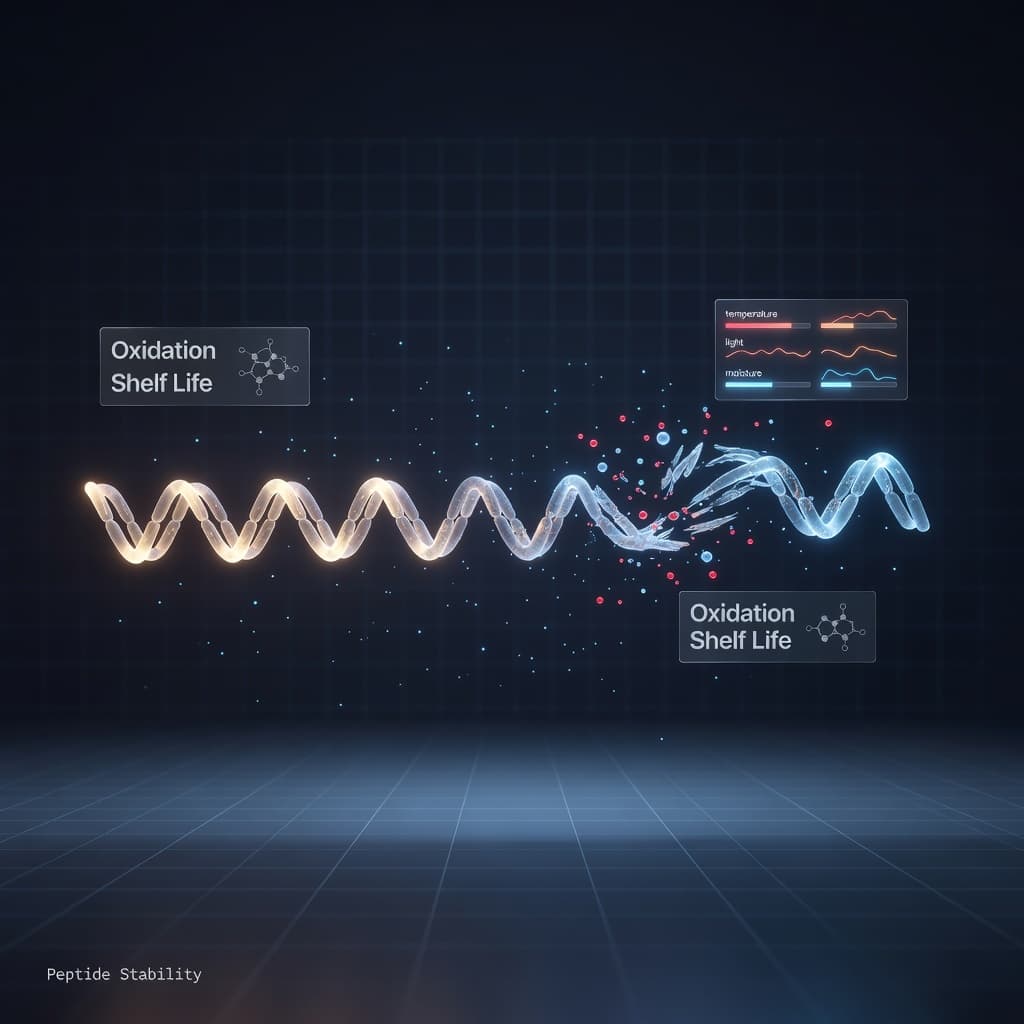
TL;DR: A peptide is a reactive molecule, not an inert powder
Instability comes in two families: chemical (covalent changes to the molecule) and physical (the molecule staying intact but misfolding or clumping) (PMID 20143256). The common chemical routes are methionine oxidation (PMID 8290469) and cysteine thiol oxidation, asparagine deamidation via a succinimide intermediate (PMID 16960822), backbone hydrolysis at hotspots like the acid-labile Asp-Pro bond (PMID 12212803), and disulfide scrambling (PMID 21142). The physical route is aggregation and fibrillation after partial unfolding, driven by concentration, interfaces and freeze-thaw (PMID 38811078, 39299357). Water is the master lever. Backbone hydrolysis needs water, which is why the dry (lyophilized) powder is inherently more stable than reconstituted solution, and why residual moisture and the glass transition temperature govern the dry cake (PMID 11683251). Cold, dark and dry slow the chemical degradation reactions; the rate of chemical reactions rises roughly two- to threefold per 10 degrees C (a rule of thumb, not an exact constant). Freezing itself can still promote physical aggregation, so it is not universally protective.
A peptide looks like an inert white powder, but chemically it is a reactive chain of amide bonds and vulnerable side chains. Understanding why it degrades, rather than just following a storage checklist, tells you which conditions actually matter and why. This is an analytical peptide-chemistry reference for laboratory research handling only. It contains no dosing, no reconstitution-for-use instructions and no shelf-life guarantees; reconstitution vehicles are discussed purely as solvent chemistry that affects stability. Most quantitative degradation data below come from therapeutic proteins and model peptides, so the mechanisms transfer but the exact kinetics are not measured facts about any specific research peptide.
Bacteriostatic water and research supplies
Two Families of Instability
Stability reviews classify peptide and protein breakdown into two categories (PMID 20143256):
- Chemical instability: the covalent structure changes (deamidation, oxidation, hydrolysis, disulfide exchange). The molecule becomes a different molecule.
- Physical instability: the covalent structure is intact but the molecule misfolds, adsorbs to surfaces, or aggregates. The chemistry is the same but the assembly is wrong.
Deamidation is the single most common chemical route. Both families are accelerated by the same broad levers (heat, water, interfaces), which is why the handling advice converges even though the mechanisms differ.
Oxidation: Methionine and Cysteine
Methionine is the classic oxidation target: its thioether sulfur oxidizes to methionine sulfoxide (and further to sulfone), driven by dissolved oxygen, trace transition metals, peroxide impurities and light, with the rate and yield depending on oxidant concentration and pH (maximal around pH 6 to 7), and a nearby histidine can intramolecularly accelerate it (PMID 8290469). Methionine sulfoxide and sulfone formation is chemically near-irreversible in the abstract chemical sense; routine laboratory handling does not restore the unoxidized methionine.
Cysteine is the other oxidation-prone residue. Free thiols oxidize readily and undergo thiol-disulfide exchange, so cysteine-containing peptides are especially sensitive to oxygen, trace metals and alkaline pH (standard chemistry).
Deamidation: The Succinimide Route
Asparagine deamidation is the most common chemical degradation pathway to design around. The asparagine side-chain amide converts to a carboxylate through a cyclic succinimide (Asu) intermediate, whose formation is the rate-limiting step at physiological pH; the succinimide then hydrolyzes to a roughly 3:1 mixture of iso-aspartate and aspartate, changing both the charge and the backbone connectivity (PMID 16960822, 19152321). Glutamine deamidates more slowly by an analogous route. Rate depends on formulation pH, temperature and local sequence, with flexible neighbours like glycine speeding it up. Because deamidation both alters charge and can introduce an iso-aspartate kink, it is a favourite target of analytical stability testing.
Backbone Hydrolysis and the Asp-Pro Hotspot
Hydrolysis of the amide (peptide) bond is the fundamental covalent breakdown of any peptide backbone, and it requires water as a reactant. It is acid- or base-catalyzed, and it has specific hotspots: the Asp-Pro bond is unusually labile and readily cleaved under acidic conditions, while neighbouring X-Pro bonds are much more stable (PMID 12212803). In model peptides, cleavage at aspartic-acid residues is strongly pH-dependent, accelerating sharply below pH 5, with the Asp-Pro peptide degrading faster than other Asp-Xaa variants (PMID 19395214). Because hydrolysis needs water, it is largely a reconstituted-solution problem rather than a dry-powder one.
Disulfide Scrambling and Alkaline Beta-Elimination
Peptides that rely on a specific disulfide pairing (cystine bridge) have an extra failure mode. Free thiols can form wrong intramolecular or intermolecular disulfides (scrambling), and at alkaline pH disulfide bonds are cleaved not by simple hydrolysis but by a beta-elimination reaction that forms persulfide and dehydroalanine species (PMID 21142). Alkaline pH drives that beta-elimination specifically, while disulfide scrambling more broadly is promoted by oxygen, trace metals, heat and agitation, which is why cystine-containing peptides dislike basic conditions.
Light: Photo-Oxidation
UV and even ambient light drive photo-oxidation. Light generates reactive oxygen species, often via trace photosensitizer impurities, that damage residues such as methionine, tryptophan, tyrosine and cysteine and can disrupt disulfides (PMID 35056968). That is the chemical basis for the standard handling control of protecting peptides from light (amber vials, dark storage).
The Physical Route: Aggregation and Freeze-Thaw
Physical instability is a different mechanism entirely. Partial unfolding exposes hydrophobic patches, and molecules then self-associate through a nucleation-dependent process (a lag phase, elongation and secondary nucleation) into amorphous aggregates or ordered amyloid fibrils (PMID 38811078). Despite very different sequences, aggregation appears to follow only a few general nucleation-growth scenarios, and the propensity to fibrillate tracks with conditions that permit partial unfolding (PMID 12727507). Concentration, temperature extremes, interfaces (air-water, ice-water) and agitation all promote it.
Freezing is not automatically protective
Freeze-thaw is its own physical stressor. It drives aggregation through ice-water and air-water interfacial stress plus cryoconcentration and buffer pH shifts, and repeated cycles compound the damage; deaeration and cryoprotectants such as trehalose reduce it (PMID 39299357). This is why minimising freeze-thaw cycles is a recognised handling control. It is also why the aggregation and fibrillation literature, which is strongest for large proteins and antibodies, should not be over-read: many short synthetic peptides are comparatively robust, and a single freeze-thaw does not ruin every peptide.
How the Environment Sets the Rate
Four environmental levers govern all of the above:
- Temperature. Reaction rates rise steeply with heat: as a rule of thumb, chemical reaction rates increase roughly two- to threefold per 10 degrees C (the Q10 rule, an approximation, not a peptide-specific constant). Cold storage generally slows chemical degradation reactions.
- pH. Directionally, low pH favours backbone hydrolysis at aspartate sites (PMID 19395214), while neutral-to-alkaline pH favours deamidation and disulfide scrambling. The exact optimum is sequence-dependent, so this is a direction, not a prescription.
- Moisture and the dry state. In a lyophilized cake, degradation is governed by residual moisture and the glass transition temperature (Tg): for one lyophilized antibody, Tg fell from about 80 degrees C at 1 percent moisture to about 25 degrees C at 8 percent moisture, with higher moisture consistently reducing stability (PMID 11683251). Above Tg, molecular mobility rises and deamidation and aggregation accelerate; storing below Tg is necessary but not sufficient, because formulation composition and structural preservation during freezing and drying also matter (PMID 8660705, 37647008).
- Light. Photo-oxidation, as above.
Lyophilized vs Reconstituted: Why the Powder Wins
The single largest lever on chemical shelf life is water. Because hydrolysis needs water and molecular mobility is far lower in a dry glass, removing water by lyophilization stabilizes the peptide, and reconstituted aqueous peptide is inherently less stable than the dry powder (standard chemistry). That is the chemical reason the dry vial is the stable form and the reconstituted solution is the working, shorter-lived form. The choice of reconstitution vehicle then sets the solution pH: bacteriostatic water (with benzyl alcohol), plain sterile water and dilute acetic-acid water differ in pH and antimicrobial properties, which is solvent chemistry that affects stability, discussed here for that reason only, not as preparation-for-use.
Reconstitution-vehicle chemistry (solvent, pH)
USP-grade sterile water with 0.9% benzyl alcohol (near-neutral, pH 6.2 to 6.4) - the standard solvent for reconstituting lyophilized peptides. Essential accessory for any peptide research. Each vial is sealed and ready to use.
Dilute 0.6% acetic-acid diluent at around pH 3.8, for reconstituting research peptides that stay cloudy in plain bacteriostatic water, such as IGF-1 LR3 and Cagrilintide. Two-step protocol. Each vial is sealed and ready to use.
Honest Limits
There are no published, peer-reviewed shelf-life or percent-potency-loss-per-month figures for the specific research peptides sold here, including BPC-157, so this article gives no expiry dates, half-lives or exact degradation percentages. The mechanisms above are well-established peptide chemistry, mostly measured on therapeutic proteins, antibodies and model peptides; they explain why handling matters, but they are not quantitative predictions for any one vial.
Gastric pentadecapeptide (15 amino acids) known for exceptional tissue repair properties. Promotes wound healing, angiogenesis, and cytoprotection across tendons, muscles, gut, and nerves. Over 30 years of preclinical research.
Research Context and Handling
The reconstitution vehicles, storage box and BPC-157 referenced here are supplied for laboratory research only and are not medicines, supplements or authorised medicinal products, and are not for human or veterinary use. This article gives no dosing or preparation-for-use guidance; storage guidance is general chemistry, not a certified expiry claim for any product. For related handling references, see the peptide storage guide and why BPC-157 results vary.
Frequently Asked Questions
This article is for research and educational purposes only. It describes peptide degradation chemistry for laboratory handling; storage guidance is general chemistry, not a certified expiry claim, and reconstitution vehicles are discussed only as solvent chemistry. Nothing here is medical advice, a health claim, dosing guidance or a recommendation for use. All products linked in this article are supplied exclusively for laboratory research and are not for human or veterinary use.
Research context for English-speaking buyers
Most of our English-speaking customers ship to the UK, Ireland, Malta or other English-as-second-language EU territories. The regulatory picture differs per country.
- Relevant authorities
- MHRA (UK, post-Brexit), HPRA (Ireland, EU-aligned), FDA Section 503A bulks list (US, restricted Cat 2 status of several peptides as of 2026)
- Customs and VAT
- EU shipments include 19% VAT; UK shipments after Brexit are now extra-EU and may attract UK VAT plus a handling fee at import
- Typical shipping window
- EU 2-4 working days, UK 4-7 working days, other international 7-14 working days, depending on customs
Research-grade peptides shipped from our EU warehouse are sold for laboratory use only and are not authorised for human or veterinary therapeutic application in any of the destination jurisdictions. US customers should be aware that the FDA Section 503A bulks list classification (and the April 2026 reclassification of twelve compounds) only governs compounding pharmacies, not direct-to-researcher imports for non-clinical work. UK buyers should declare the consignment on import and may be asked for a research justification by HMRC. We provide a CoA per batch identified by colour code rather than serial number; customs sometimes asks for this document when clearing the parcel.