How a Peptide Is Actually Made: Solid-Phase vs Liquid-Phase Synthesis
How research peptides are built: solid-phase synthesis, why 38 couplings create impurities, and a 2026 liquid-phase route for retatrutide.
Almost every article about research peptides starts after the peptide exists. It arrives in a vial, with a purity number attached, and the conversation begins there. That skips the part that determines the purity number in the first place.
A peptide is assembled one amino acid at a time, in a chemical reactor, and every single one of those steps can fail. Understanding how that assembly works is the shortest route to understanding why a certificate of analysis looks the way it does, why a 39-residue peptide is a fundamentally harder product than a 15-residue one, and why "99% pure" is a claim about a process, not a promise about a molecule.
In June 2026, a group at Sichuan University published a new synthesis route for retatrutide. It is a good excuse to explain the part of the story most vendor content skips.
TL;DR: How peptides get built
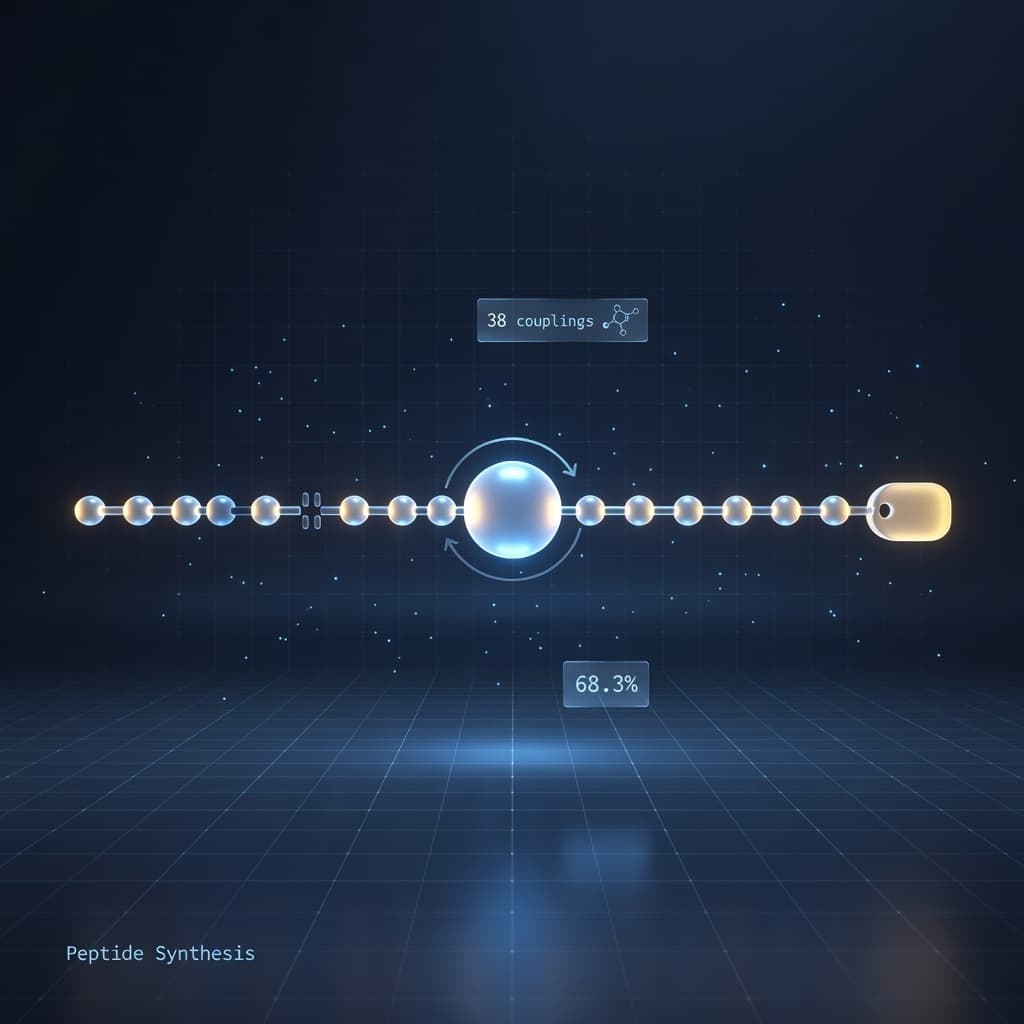
The dominant method is solid-phase peptide synthesis (SPPS): the chain is anchored to a resin bead and extended one residue at a time, with wash steps in between. The core problem is multiplicative. Retatrutide has 39 amino acids, so it takes 38 couplings. At 99% efficiency per coupling, only 68.3% of the chains come out full-length. The rest are failure sequences. Those failures are a large part of what your CoA is measuring. They are not contamination from outside; they are by-products of the build itself (alongside storage-related degradation and the counterion salt). The 2026 paper (Org Lett, PMID 42224238) presents a hydrophobic tag-assisted liquid-phase route (LPPS) for retatrutide, and states that SPPS "suffers from inherent limitations in terms of efficiency, scalability, and structural flexibility". What it does not mean: we do not know which route any given vendor's material took, ours included. Synthesis route is not something a purity percentage tells you.
The 38-Coupling Problem
Start with the arithmetic, because it explains almost everything else.
To build a chain of 39 amino acids, you perform 38 coupling reactions (the first residue is already anchored). Each coupling joins the next amino acid to the growing chain. Chemists talk about coupling efficiency: the fraction of chains that successfully get the next residue attached.
Coupling efficiency is very high. It is also not 100%, and that is the whole story, because the failures compound:
- Full-length chains after 38 couplings
- 96.3%
- Full-length chains after 38 couplings
- 82.7%
- Full-length chains after 38 couplings
- 68.3%
- Full-length chains after 38 couplings
- 46.4%
Read the 99% row again. A coupling that works ninety-nine times out of a hundred, repeated 38 times, leaves roughly a third of the material as something other than the target peptide. Not because anyone was careless. Because 0.99 raised to the 38th power is 0.683.
Now compare peptides of different lengths at that same 99% per step:
- Length
- 15 aa
- Couplings
- 14
- Full-length crude
- 86.9%
- Length
- 39 aa
- Couplings
- 38
- Full-length crude
- 68.3%
- Length
- 43 aa
- Couplings
- 42
- Full-length crude
- 65.6%
This is why length is not a trivia fact about a peptide. It is a cost driver, a purity driver, and a purification-burden driver. Every additional residue is another chance to fail, and the failures accumulate multiplicatively rather than additively.
What the percentages describe
These figures are the theoretical crude composition before any purification, and they assume a uniform efficiency across every step, which real syntheses do not have (some couplings are much harder than others). Purification then removes most of the failure material, which is exactly why the number on a finished CoA is far higher than the crude yield.
The point of the table is not to predict a specific vendor's crude. It is to show why the impurity problem exists at all and why it scales with chain length.
How Solid-Phase Synthesis Works
The method that dominates peptide manufacture was invented by Bruce Merrifield in the early 1960s and won him the Nobel Prize in Chemistry in 1984. Its central idea is deceptively simple: anchor the growing chain to an insoluble support, so that purification between steps becomes a wash rather than a separation.
The cycle repeats, once per residue:
Anchor
The first amino acid is attached to a solid resin bead. Everything that follows happens while the chain stays tethered to that bead.
Deprotect
The incoming end of the chain carries a temporary protecting group (in modern practice usually Fmoc) so it cannot react at the wrong moment. That group is stripped off to expose the reactive end.
Couple
The next amino acid, itself protected everywhere except the end that should react, is activated and joined to the chain. This is the step whose efficiency drives the table above.
Wash
Excess reagents and by-products are rinsed away. The chain stays behind because it is bolted to the bead. This is the trick that makes the whole method practical.
Repeat, then cleave
Deprotect, couple, wash, 38 times over for retatrutide. At the end the finished chain is cleaved off the resin and the side-chain protecting groups are removed, and only then does purification of the actual peptide begin.
The elegance is in step four. Because the product is stuck to a bead, you can flood every coupling with a large excess of reagent to push it toward completion, and then simply wash the excess away. That is what makes 99%-plus coupling efficiency achievable at all.
The cost of that elegance is not that you are blind. On-resin checks are routine: a ninhydrin (Kaiser) spot test on a few beads reveals unreacted chain ends after a coupling, and many automated synthesizers monitor each Fmoc deprotection by UV, which on those instruments gives a per-cycle efficiency reading in real time. A chemist can see a coupling underperform at the step it happens and respond, typically by coupling again or by capping the failed chains.
The cost is that seeing it does not undo it. You cannot purify a chain while it is bolted to a bead, so every failure sequence stays attached to its own bead and rides along to the finish line. Detection is available throughout; separation is only available at the end.
Where the Impurities Actually Come From
This is the part that connects directly to the certificate in your hand. The peaks on an HPLC trace are not random dirt. They are structured, predictable consequences of the build.
Deletion sequences. A coupling fails, and the chain simply lacks that one residue. If the failure goes uncapped the build continues, and you end up with a peptide missing an amino acid somewhere in the middle. It is nearly the right molecule, nearly the right mass, and it behaves nearly the same on a column. That "nearly" is why these are the hardest impurities to separate, and it is exactly why chemists cap detected failures: capping deliberately converts a would-be deletion into a truncation, which is easier to remove later.
Truncated sequences. A chain stops growing entirely and never reaches full length. Usually easier to separate, because a substantially shorter chain differs enough in hydrophobicity to move away from the main peak on a reversed-phase column.
Racemisation. Amino acids are chiral. Coupling conditions can flip a residue from the L form to the D form. The result has the same mass as the target, so mass spectrometry alone will not catch it. This is why the EMA guideline lists enantiomeric purity as its own test with its own method (chiral GC), separate from mass and sequence.
Deamidation and oxidation. Certain residues degrade in predictable ways, both during the synthesis and afterwards during storage. Asparagine and glutamine deamidate; methionine and tryptophan oxidise.
Residual reagents and counterions. Peptides typically come out of purification as a salt, most often a trifluoroacetate (TFA) salt. That salt is part of the mass in the vial and is not the peptide.
Now look at what the EU's synthetic-peptide guideline asks for, and it stops reading like bureaucracy. It expects methods sensitive enough to meet the Ph. Eur. 0.1% reporting threshold; the Ph. Eur. monograph allows an identification threshold of 0.5%, so impurities above that should be identified rather than merely counted; and where impurities are observed co-eluting as one peak, a 1.0% qualification threshold applies unless otherwise justified. That last clause exists precisely because deletion sequences are so similar to the target that they hide underneath the main peak. We go through that document in detail in our guide to the EMA synthetic-peptide guideline.
What this means for a purity number
A purity figure is a peak-area ratio from one method under one set of conditions. It cannot tell you whether a co-eluting deletion sequence is sitting inside the main peak, and it cannot see a racemised residue at all, because that impurity has the same mass and can have very similar retention.
None of that makes purity numbers useless. It makes them one answer among several. The reason mass spectrometry, sequence confirmation and chiral methods exist as separate tests is that each catches something the others structurally cannot. Our peptide quality guide covers how those methods differ.
Why Retatrutide Is a Hard Build
Retatrutide is a useful case study because almost everything that makes a peptide difficult is present at once.
It is long. 39 amino acids, 38 couplings, with the compounding problem described above.
It contains non-standard building blocks. The design uses 2-aminoisobutyric acid (Aib) and alpha-methyl-leucine, which are not among the twenty amino acids your body codes for. They were put there deliberately, primarily to resist enzymatic degradation and tune receptor activity. Chemically, sterically hindered residues like these are notoriously harder to couple than ordinary ones, so the "99% per step" assumption is optimistic exactly where the molecule is most unusual.
It is lipidated. A C20 fatty diacid is attached to a lysine side chain through an AEEA and gamma-glutamate linker. That is not one extra step but a small sub-synthesis, and it requires orthogonal protecting-group chemistry so that the fatty acid attaches to that one specific lysine and nothing else. That side chain is what makes the molecule long-acting; the discovery paper reports that its pharmacokinetic profile supported once-weekly dosing (PMID 35985340). For a synthesis article the relevant point is simply that the lipidation is worth its cost in build complexity.
It ends in an amide. The C-terminus is a serinamide rather than a free acid, which constrains the resin and cleavage chemistry available.
Put together: a long chain, hindered non-coded residues, a lipid side chain requiring selective attachment, and an amide C-terminus. Every one of those is a place where a route can lose material or generate an impurity that a purity percentage may or may not resolve.
The 2026 Paper: A Liquid-Phase Alternative
Which brings us to the study that prompted this article.
In Organic Letters (2026;28(23):7486-7490, epub 1 June 2026, PMID 42224238), Mao, Pang, Qiao and Dong at the West China School of Pharmacy, Sichuan University, describe a route to retatrutide that abandons the resin.
Their framing of the problem is direct. They note that retatrutide's synthesis "relies predominantly on solid-phase peptide synthesis (SPPS), an approach that suffers from inherent limitations in terms of efficiency, scalability, and structural flexibility". Their alternative is hydrophobic tag-assisted liquid-phase peptide synthesis (LPPS), which they present as "a practical and flexible alternative to conventional SPPS for the synthesis of Retatrutide".
The idea behind a hydrophobic tag is a neat inversion of Merrifield's. Instead of anchoring the chain to an insoluble bead, you attach a large, greasy tag that keeps the chain soluble in the reaction but lets you crash it out of solution on demand, by changing the solvent. You get the thing SPPS gives you (an easy way to separate your growing chain from the reagents) without the thing SPPS costs you (a chain bolted to a bead that cannot be purified until the end, and constraints on scale).
The practical consequence, in principle, is that intermediates can be purified along the way rather than only at the end. That is a different benefit from simply noticing a bad coupling, which SPPS already allows. If a coupling underperforms at residue 20, an on-resin test tells you so either way; what a soluble intermediate additionally offers is the chance to physically remove the failure sequences at that point, instead of carrying them through the remaining 19 couplings and asking a final purification to sort it all out at once.
Read this at the right altitude
This is one methods paper, not an industry shift. Organic Letters is a short-format journal; the paper demonstrates a route, it does not establish that LPPS is now the better way to make retatrutide at commercial scale, and it makes no claim about product quality in the market.
Above all: we do not know which route the material in any vendor's vial took, and that includes ours. A synthesis route is not disclosed on a certificate of analysis, and no purity figure reveals it. Anyone telling you their peptide is better because of how it was synthesised is telling you something they almost certainly cannot evidence.
Why Any of This Should Change What You Ask
The practical payoff of understanding the build is that it reframes the questions worth asking about a vial.
A purity percentage is downstream of a manufacturing process you cannot see. What you can do is ask the questions that the process makes relevant: was identity confirmed by mass, and for a long peptide, was the sequence confirmed rather than just the mass? Is there a measured content in mg, or only a ratio? Is the batch checkable against the testing lab's own record? Our supplier vetting guide works through that in practice, and the certificates we hold are published on our lab reports page, with the testing lab named and most of them commissioned by the manufacturer rather than by us.
The honest summary is that chemistry sets a floor on how clean a long peptide can be, purification decides how close to that floor you get, and a certificate reports one narrow view of the result. Knowing that is worth more than any number on a label.
Products and Categories Referenced
Peptides from our catalogue that this article is relevant to. The first three are the worked examples above, chosen for chain length and build difficulty rather than as recommendations. All are research-use-only materials. Nothing here describes how any specific batch was synthesised.
GIP/GLP-1/Glucagon agonists and metabolic pathways
First-ever triple-action weight management peptide targeting three receptors at once: GLP-1, GIP, and glucagon. Shown exceptional results in Phase 2 trials - up to 24% weight reduction. The most advanced metabolic peptide available.
Gastric pentadecapeptide (15 amino acids) known for exceptional tissue repair properties. Promotes wound healing, angiogenesis, and cytoprotection across tendons, muscles, gut, and nerves. Over 30 years of preclinical research.
Full-length 43-amino-acid Thymosin Beta-4, a naturally occurring repair protein, independently confirmed by a third-party CoA from Janoshik. Promotes cell migration and new blood vessel formation for systemic tissue healing. Especially researched for muscle, tendon, and cardiac repair.
Naturally occurring copper tripeptide complex for skin regeneration and anti-aging research. Stimulates collagen synthesis, accelerates wound healing, and modulates 4000+ genes. Plasma levels decline with age, making it a key target in longevity research.
Mitochondrial-derived signaling peptide (16 amino acids) that mimics the effects of exercise at the cellular level. Activates AMPK, improves glucose uptake, and enhances fat metabolism - a key tool in metabolic and longevity research.
Long chains, hard builds
First-ever triple-action weight management peptide targeting three receptors at once: GLP-1, GIP, and glucagon. Shown exceptional results in Phase 2 trials - up to 24% weight reduction. The most advanced metabolic peptide available.
Full-length 43-amino-acid Thymosin Beta-4, a naturally occurring repair protein, independently confirmed by a third-party CoA from Janoshik. Promotes cell migration and new blood vessel formation for systemic tissue healing. Especially researched for muscle, tendon, and cardiac repair.
Short chains, simpler builds
Gastric pentadecapeptide (15 amino acids) known for exceptional tissue repair properties. Promotes wound healing, angiogenesis, and cytoprotection across tendons, muscles, gut, and nerves. Over 30 years of preclinical research.
Naturally occurring copper tripeptide complex for skin regeneration and anti-aging research. Stimulates collagen synthesis, accelerates wound healing, and modulates 4000+ genes. Plasma levels decline with age, making it a key target in longevity research.
Frequently Asked Questions
FOR RESEARCH USE ONLY. Not for human consumption. Nothing in this article is medical advice or a therapeutic claim. Descriptions of synthesis chemistry are general background from the published literature and do not describe the manufacturing route of any specific product sold on this site.
Research context for English-speaking buyers
Most of our English-speaking customers ship to the UK, Ireland, Malta or other English-as-second-language EU territories. The regulatory picture differs per country.
- Relevant authorities
- MHRA (UK, post-Brexit), HPRA (Ireland, EU-aligned), FDA Section 503A bulks list (US, restricted Cat 2 status of several peptides as of 2026)
- Customs and VAT
- EU shipments include 19% VAT; UK shipments after Brexit are now extra-EU and may attract UK VAT plus a handling fee at import
- Typical shipping window
- EU 2-4 working days, UK 4-7 working days, other international 7-14 working days, depending on customs
Research-grade peptides shipped from our EU warehouse are sold for laboratory use only and are not authorised for human or veterinary therapeutic application in any of the destination jurisdictions. US customers should be aware that the FDA Section 503A bulks list classification (and the April 2026 reclassification of twelve compounds) only governs compounding pharmacies, not direct-to-researcher imports for non-clinical work. UK buyers should declare the consignment on import and may be asked for a research justification by HMRC. We provide a CoA per batch identified by colour code rather than serial number; customs sometimes asks for this document when clearing the parcel.