MK-677 vs Ipamorelin and CJC-1295: Oral vs Injectable GH Secretagogues in Research
How MK-677 (oral ghrelin agonist), Ipamorelin (selective GHRP) and CJC-1295 (GHRH analogue) differ by receptor, route, kinetics and evidence, with the pulsatile-versus-sustained distinction explained.
TL;DR: Three secretagogues, two receptors, one axis
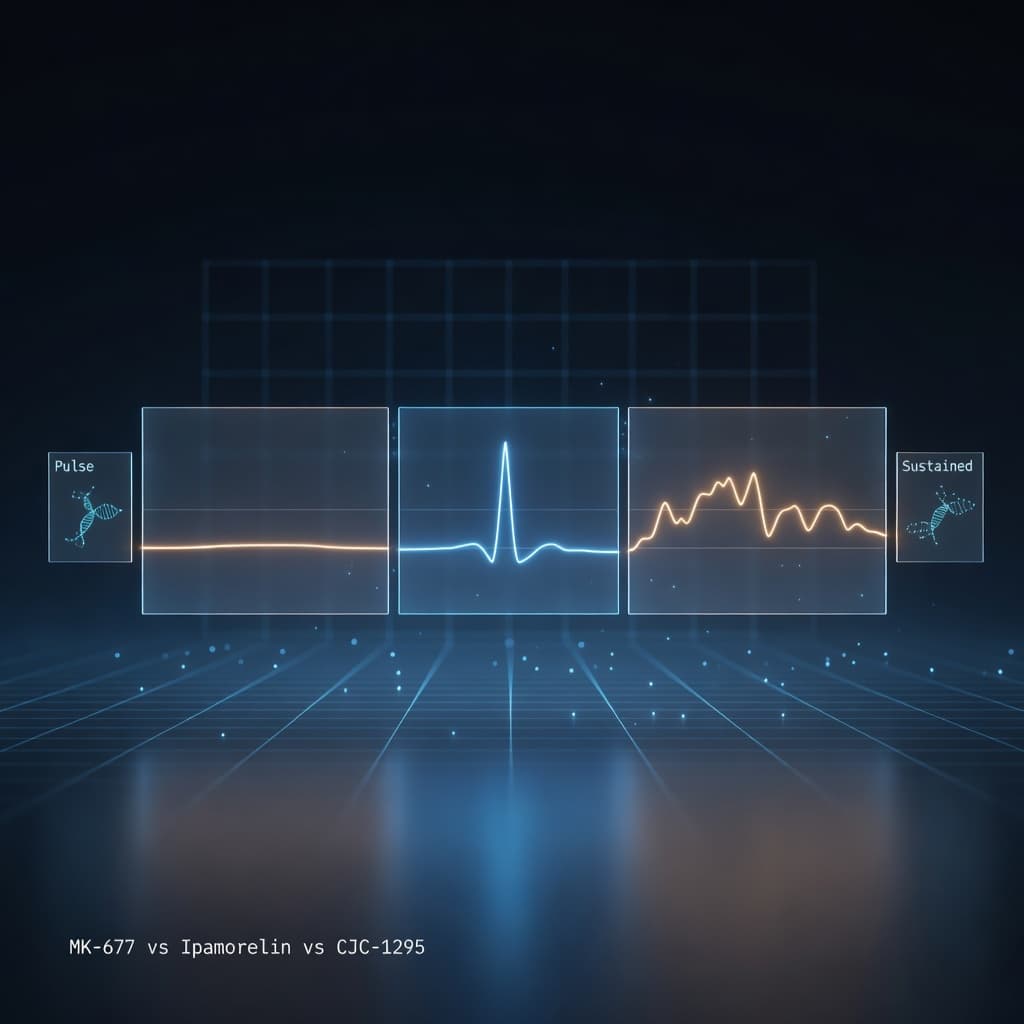
MK-677 (ibutamoren) is an oral, non-peptide ghrelin-receptor agonist with a long (about 24-hour) half-life that produces sustained, near-continuous GH and IGF-1 elevation (PMID 8954023). It is discussed here for scientific comparison only and is not a product we stock. Ipamorelin is an injectable, selective GHRP that hits the same ghrelin receptor as MK-677; in its largely preclinical characterisation study it produced GH release without materially raising cortisol or prolactin (PMID 9849822). CJC-1295 works through a different receptor entirely, the GHRH receptor. The DAC version has a multi-day half-life (about 5.8 to 8.1 days) with IGF-1 elevated for weeks, while keeping GH pulses intact (PMID 16352683, 17018654). The spine of the comparison is oral versus injectable, one receptor versus another, and a flat sustained curve versus a short pulse.
MK-677 dominates the search conversation about growth-hormone secretagogues, largely because it is oral. But "oral GH pill" versus "injectable peptide" is only one of the differences, and it is not even the most important one. This article compares MK-677, Ipamorelin and CJC-1295 on the axes that actually matter in the research literature: receptor pathway, route, kinetics, selectivity and depth of human evidence. MK-677 itself is used here purely as a comparison and search-bridge term; it is not stocked or orderable, and every practical pointer funnels to the two stocked research peptides and their blend. Everything is written for laboratory research context only, with no dosing or usage guidance.
Growth hormone secretagogues and gonadotropins
Two Receptors, One Goal
The single most useful way to organise these three compounds is by the receptor they act on. Two distinct pituitary pathways both raise GH:
- The ghrelin receptor (GHS-R1a), activated by MK-677 (an oral non-peptide agonist) and by Ipamorelin (an injectable selective peptide GHRP).
- The GHRH receptor, activated by CJC-1295 (a GHRH analogue).
Because the two pathways are separate and complementary, agents that hit them provide a theoretical complementary-pathway rationale for pairing a GHRP with a GHRH analogue in research designs. So "MK-677 versus Ipamorelin" is a same-receptor, different-route, different-duration comparison, while "versus CJC-1295" is a different-pathway comparison.
MK-677 (Ibutamoren): The Oral Ghrelin Agonist
Sustained oral stimulation (PMID 8954023, 18981485)
MK-677 is an orally active, non-peptide ghrelin-receptor agonist. Given once daily to healthy elderly subjects for up to four weeks, it enhanced pulsatile GH release and raised serum IGF-1 back toward young-adult levels at the 25 mg study dose, without changing cortisol (prolactin rose about 23 percent but stayed within the normal range) (PMID 8954023). In a 2-year randomised, double-blind, placebo-controlled trial in healthy older adults, oral MK-677 25 mg per day increased fat-free mass (about +1.1 kg versus -0.5 kg on placebo) and restored GH and IGF-1 to young-adult ranges, but it also raised fasting blood glucose and reduced insulin sensitivity, the key metabolic caveat of sustained GH-axis elevation (PMID 18981485).
MK-677's defining property is the sustained duration of its effect: once-daily oral dosing produces near-continuous IGF-1 elevation across roughly 24 hours, while the underlying GH release itself stays pulsatile (the study reported enhanced pulsatile GH secretion, PMID 8954023). That sustained pattern is also the setting in which its GH-associated and ghrelin-mediated effects were reported: appetite stimulation, fluid retention and the reduced insulin sensitivity noted above. A short-term study showed it can be nitrogen-sparing during energy restriction (nitrogen balance +0.31 g/day on MK-677 versus -1.48 g/day on placebo, PMID 9467534), a mechanistic anabolic signal downstream of GH and IGF-1, not a treatment claim. And a clean cautionary example: in Alzheimer's disease, MK-677 confirmed target engagement (IGF-1 rose about 73 percent at 12 months) but produced no clinical benefit (PMID 19015485), a reminder that raising IGF-1 is not the same as a disease effect.
Ipamorelin: The Selective GHRP
Ipamorelin is a pentapeptide that hits the same ghrelin receptor (GHS-R1a) as MK-677, but it behaves very differently. It triggers a short, discrete GH pulse, and its defining feature is selectivity. In its characterisation study, which is largely preclinical, it released GH potently while, unlike the earlier GHRPs GHRP-6 and GHRP-2, not raising ACTH or cortisol above the level seen with GHRH alone, and it was described as the first selective growth hormone secretagogue (PMID 9849822). Being a peptide, it is not orally bioavailable, so it is used by injection in research. Where MK-677 gives a flat, prolonged curve, Ipamorelin gives a clean spike.
Highly selective growth hormone releaser that triggers natural GH pulses without raising cortisol or prolactin. Clean GH stimulation with minimal side effects - the most targeted growth hormone peptide available.
CJC-1295: The DAC Study Data and the No-DAC Stocked Form
CJC-1295 acts on a different receptor, the GHRH receptor. Its DAC (drug-affinity-complex) version binds albumin to extend its half-life dramatically. In healthy adults, a single dose of CJC-1295 DAC produced dose-dependent 2- to 10-fold increases in mean GH for six or more days and 1.5- to 3-fold increases in IGF-1 for 9 to 11 days, with an estimated half-life of 5.8 to 8.1 days and IGF-1 staying above baseline up to about 28 days after repeated dosing (PMID 16352683). Crucially, despite continuous GHRH-receptor stimulation, GH kept its pulsatile pattern: pulse frequency and magnitude were unchanged while basal GH rose sharply (about 7.5-fold), mean GH rose about 46 percent and IGF-1 about 45 percent (PMID 17018654).
DAC versus no-DAC: do not blur the two
The multi-day pharmacokinetics and the up-to-28-day IGF-1 data above are documented for the DAC form specifically. The stocked CJC-1295 (and the blend) is the short-acting no-DAC "modified GRF(1-29)" form, which is much shorter-acting and has no dedicated controlled human trial. The DAC multi-day duration data do not describe the stocked product.
CJC-1295 without DAC (Mod GRF 1-29) is a short-acting GHRH(1-29) analog for GH/IGF-1 research. Research-grade lyophilized powder, specified purity >=99% (HPLC). Laboratory use only.
Oral vs Injectable, and Pulsatile vs Sustained
Two contrasts capture most of the practical difference between these compounds.
Route. MK-677 is orally active because it is a small non-peptide molecule; Ipamorelin and CJC-1295 are peptides and are used by injection in research. That is the headline convenience difference, and the reason MK-677 gets so much search attention.
Curve shape. This is the more meaningful difference. Ipamorelin produces a short sharp pulse that mimics a ghrelin surge. CJC-1295 DAC raises the baseline while keeping pulses intact over days. MK-677 gives a flat, prolonged 24-hour elevation. That continuum, from a discrete pulse to elevated-with-pulses to flat-sustained, is the clearest way to see how the three differ. It was under MK-677's flat, sustained ghrelin-receptor activation that appetite stimulation, fluid retention and reduced insulin sensitivity were reported in its trials (PMID 18981485); Ipamorelin's brief pulse and the injectable GHRH analogues were studied under different exposure patterns, and these studies do not establish a single exposure-response rule linking the three.
Selective ghrelin-receptor (GHRP) research, short pulse
GHRH-receptor pathway research (stocked form is short-acting no-DAC)
What the Human Data Do and Do Not Show
Evidence is uneven
MK-677 has the largest and longest human dataset, including a 2-year RCT (PMID 18981485) and disease-context trials (PMID 19015485). CJC-1295's human data come mainly from two 2006 pharmacology studies of the DAC form (PMID 16352683, 17018654). Ipamorelin's foundational data are largely preclinical, from its characterisation paper (PMID 9849822), with limited controlled human trials. None of the three is an approved medicine for the uses implied by fitness culture, and MK-677 is an investigational compound prohibited in sport under anti-doping rules (WADA S2). The Alzheimer's, catabolism and body-composition studies are reported as what the trials measured, not as outcomes a reader can obtain.
Why Researchers Pair a GHRP With a GHRH Analogue
Because Ipamorelin (ghrelin pathway) and CJC-1295 (GHRH pathway) engage two complementary pituitary pathways, combining them is a theoretical complementary-pathway rationale, and the CJC-1295 and Ipamorelin blend exists for that research pairing. This is a mechanistic rationale, not an efficacy, synergy or dosing claim, and the supplied studies do not test the combination.
2-in-1 growth hormone stack: CJC-1295 no-DAC (Modified GRF 1-29) + Ipamorelin, available as a 10 mg blend vial (5 mg + 5 mg co-lyophilized) or as the 20 mg option with two separately sealed single vials (10 mg + 10 mg). The CJC-1295 component is the short-acting no-DAC variant (about 30 minute half-life), not the long-acting DAC form. Stimulates natural GH release through two different pathways for amplified, more physiological growth hormone pulses.
Stocked Research Peptides and Handling
Of the three compounds compared here, Ipamorelin and CJC-1295 (and the combined blend) are the ones stocked as research peptides; MK-677 is discussed for comparison only and is not offered. The stocked CJC-1295 and blend are the short-acting no-DAC (modified GRF 1-29) form, not the long-acting DAC form whose multi-day data appear above. The stocked compounds are supplied for laboratory research and are not intended for human consumption. This article contains no dosing, reconstitution-for-injection or cycling guidance. Check the supplier-provided, batch-specific third-party Certificate of Analysis for the tested batch, and see the growth hormone peptides overview and the IGF-1 biomarker explainer for the wider picture.
Frequently Asked Questions
This article is for research and educational purposes only. MK-677 is discussed for scientific comparison and is not offered for sale. Nothing here is medical advice, a health claim, dosing guidance or a recommendation for use, and study findings are not outcomes a reader can obtain. All stocked compounds mentioned are sold exclusively for laboratory research.
Research context for English-speaking buyers
Most of our English-speaking customers ship to the UK, Ireland, Malta or other English-as-second-language EU territories. The regulatory picture differs per country.
- Relevant authorities
- MHRA (UK, post-Brexit), HPRA (Ireland, EU-aligned), FDA Section 503A bulks list (US, restricted Cat 2 status of several peptides as of 2026)
- Customs and VAT
- EU shipments include 19% VAT; UK shipments after Brexit are now extra-EU and may attract UK VAT plus a handling fee at import
- Typical shipping window
- EU 2-4 working days, UK 4-7 working days, other international 7-14 working days, depending on customs
Research-grade peptides shipped from our EU warehouse are sold for laboratory use only and are not authorised for human or veterinary therapeutic application in any of the destination jurisdictions. US customers should be aware that the FDA Section 503A bulks list classification (and the April 2026 reclassification of twelve compounds) only governs compounding pharmacies, not direct-to-researcher imports for non-clinical work. UK buyers should declare the consignment on import and may be asked for a research justification by HMRC. We provide a CoA per batch identified by colour code rather than serial number; customs sometimes asks for this document when clearing the parcel.